
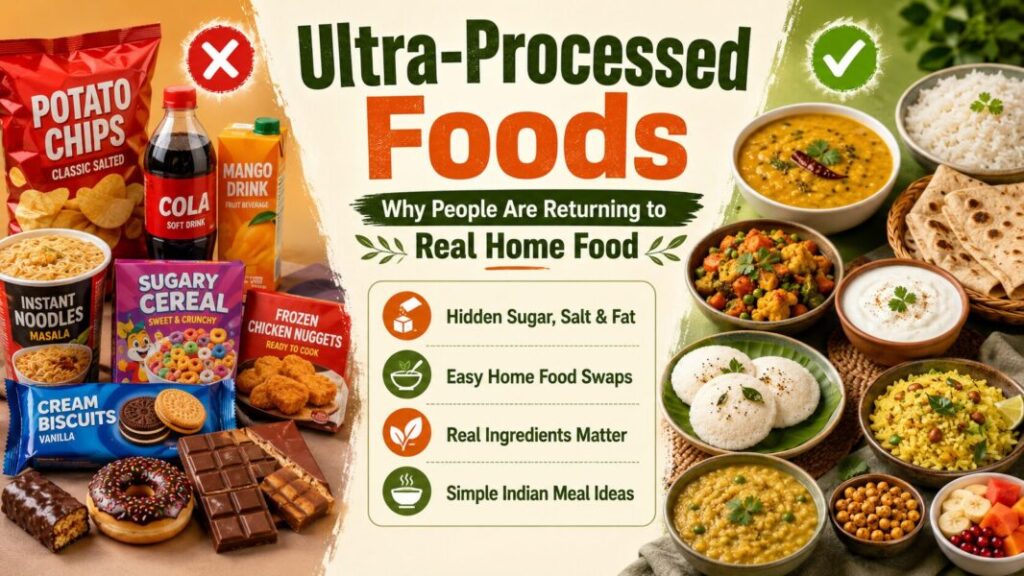
Ultra-Processed Foods: Why People Are Returning to Real Home Food
Learn what UPFs are, their health concerns, label clues and practical Indian meal swaps.
A packet of biscuits with tea. Instant noodles after work. Breakfast cereal on a busy morning. Packaged juice for children. Chips during a movie.
None of these choices looks serious on its own.
The problem starts when packaged convenience foods quietly take over breakfast, snacks, school boxes and late-night meals. A food that was once occasional becomes part of the daily routine.
That shift is now visible across India.
A 2024 study mapping ultra-processed foods in India reported that their sales rose from about US$0.9 billion in 2006 to US$37.9 billion in 2019. The researchers noted that Indian consumers are now exposed to a wide range of biscuits, sugary drinks, packaged snacks, breads and ready-to-cook meals. (PMC)
At the same time, many families are looking back at simpler food:
Dal rice.
Idli and sambar.
Roti with sabzi.
Curd rice.
Poha with peanuts.
Egg and chapati.
Homemade khichdi.
This return to real home food is not about rejecting every packet in the kitchen. It is about recognising that food made from familiar ingredients usually gives better control over sugar, salt, oil and portion size.
What Are Ultra-Processed Foods?
Not every processed food is unhealthy.
Processing includes many normal kitchen and food-production methods such as:
- Cooking
- Freezing
- Grinding
- Fermenting
- Pasteurizing
- Drying
- Canning
Milk is pasteurized. Dal is cleaned and split. Atta is milled. Curd is fermented. Frozen peas are processed.
These foods should not automatically be called unhealthy.
Ultra-processed food is different
Ultra-processed foods are usually industrial formulations made with several refined ingredients, additives and flavouring substances. They may contain ingredients that are rarely used in a normal home kitchen.
Common examples include:
- Sugary soft drinks
- Packaged sweetened juices
- Instant noodles
- Flavoured chips
- Cream biscuits
- Candy and chocolate bars
- Sweet breakfast cereals
- Frozen nuggets
- Packaged cakes
- Ready-to-eat meals
- Some protein bars
- Highly flavoured snack mixtures
They may contain combinations of:
- Refined flour
- Added sugar
- Glucose or corn syrup
- Refined oils
- Modified starch
- Protein isolates
- Flavour enhancers
- Artificial colours
- Emulsifiers
- Stabilising agents
- Sweeteners
- Preservatives
The concern is not simply that the food comes inside a packet. The concern is the overall formulation and how often it replaces regular food.
Why Ultra-Processed Foods Became So Popular
Ultra-processed foods did not become popular by accident.
They solve real problems.
They save time
Working families may not have time to cook every meal from scratch. Instant and ready-to-eat foods offer speed.
They are easy to store
Packets stay usable for weeks or months. Fresh vegetables, curd and cooked dal have a much shorter life.
They are strongly flavoured
Sweet, salty and crunchy foods are easy to enjoy. A packet is designed to taste the same every time.
They are heavily marketed
Children see colourful cartoons. Adults see words like:
- High protein
- Baked
- Multigrain
- Natural
- Low fat
- Energy
- Immunity
- No added sugar
These claims can create a healthy image even when the overall product is high in sugar, salt or refined ingredients.
They are available everywhere
Packaged snacks are sold in supermarkets, school canteens, petrol stations, vending machines and small neighbourhood shops.
That convenience is difficult for home food to match.
Latest Indian Consumption Signals
Ultra-processed food consumption is not equal across India.
A 2025 study covering several South Asian regions found that around 75% of participants in North India reported consuming an ultra-processed food during the previous day, compared with roughly 41% in South India and Pakistan. Among people who consumed these foods, they contributed about 13% to 17% of total energy intake. Biscuits were one of the common sources across the regions studied. (ScienceDirect)
This does not mean every Indian is eating the same way.
Food habits differ by:
- State
- Income
- Urban or rural location
- Age
- Work schedule
- Food prices
- Family habits
- Availability of fresh food
Still, the direction is clear. Packaged convenience food is entering more daily eating occasions.
Why Health Experts Are Concerned
ICMR-NIN’s 2024 Dietary Guidelines for Indians advise people to restrict foods high in fat, salt and sugar, including ultra-processed foods. The guidelines encourage more whole grains, millets, pulses, vegetables, fruits, nuts and other fibre-rich foods. (ICMR-National Institute of Nutrition)
The concern is not based on one ingredient alone.
Many ultra-processed foods combine several features:
- High calorie density
- Added sugar
- Excess sodium
- Refined carbohydrates
- Unhealthy fat balance
- Low fibre
- Easy-to-eat texture
- Large serving sizes
- Heavy marketing
A major 2024 evidence review published in The BMJ found that greater exposure to ultra-processed food was associated with higher risks across several health outcomes, with especially consistent links involving cardiometabolic conditions, common mental disorders and mortality. The authors also noted that much of the evidence is observational, so association should not automatically be presented as proof that every ultra-processed product directly causes disease. (BMJ)
That distinction matters.
A sugary drink, packaged whole-grain bread and a fortified cereal may all fall under broad processing classifications, but they are not nutritionally identical.
The sensible message is not panic.
It is to reduce dependence on foods that are high in sugar, salt and unhealthy fats, especially when they crowd out vegetables, fruits, pulses and normal meals.
What Happens When Packaged Food Replaces Home Food?
The biggest problem may be displacement.
A packet does not only add something to the diet. It often replaces something better.
| Ultra-processed choice | What it may replace | Simple home alternative |
|---|---|---|
| Sweet cereal | Idli, poha or eggs | Poha with peanuts |
| Biscuits and tea | Proper breakfast | Besan chilla with curd |
| Packaged juice | Whole fruit | Fruit and water |
| Instant noodles | Dal, rice or roti | Vegetable khichdi |
| Chips | Chana or peanuts | Roasted chana |
| Frozen fried snack | Fresh meal | Egg bhurji and roti |
When this happens occasionally, it may not matter much.
When it happens daily, the diet may become lower in:
- Fibre
- Vegetables
- Fresh fruit
- Pulses
- Natural protein
- Food variety
It may also become higher in salt, sugar and calories without providing lasting fullness.
Why People Are Returning to Real Home Food
1. People Want to Know What They Are Eating
With home cooking, the ingredients are visible.
You know whether the dal contains one teaspoon or four teaspoons of oil. You know whether sugar was added to the curd. You can decide how much salt goes into the sabzi.
Packaged food is more difficult to judge.
Even when the nutrition label is present, serving sizes and marketing claims can confuse buyers.
2. Home Food Can Be Adjusted
One recipe can be changed for different family members.
You can:
- Reduce salt for someone with high blood pressure
- Use less chilli for children
- Add extra dal for protein
- Add vegetables for fibre
- Reduce oil for weight management
- Make soft khichdi for an elderly person
Packaged products offer less flexibility.
3. Traditional Meals Often Combine Nutrients Naturally
Indian meals were not designed around isolated nutrients.
Dal rice combines a pulse and cereal.
Idli with sambar adds fermented grains, dal and vegetables.
Roti with chana gives carbohydrates, protein and fibre.
Curd rice adds dairy protein and fermented food.
These meals may not come with “high protein” printed on the plate, but they can still be balanced.
4. Packaged Food Costs Add Up
A ₹10 snack looks inexpensive.
But several daily packets, drinks and bars can cost more than basic ingredients such as:
- Dal
- Rice
- Eggs
- Seasonal vegetables
- Bananas
- Peanuts
- Curd
- Chana
Home food requires planning and cooking time, but it can still offer better value per meal.
5. People Are Tired of Misleading Health Claims
Consumers are becoming more alert to words such as:
- Natural
- Healthy
- Fitness
- Whole grain
- Baked
- Zero sugar
- High protein
- Fruit-based
One positive claim does not decide the quality of the entire product.
A biscuit can contain some millet and still be high in sugar.
A snack can be baked and still be high in sodium.
A drink can have no added sugar but still contain concentrated natural sugars.
This is why label reading is becoming part of smart grocery shopping.
How to Identify an Ultra-Processed Food
There is no single perfect test, but these clues can help.
Check the ingredient list
Look at the first three ingredients. They usually make up most of the product.
Be cautious when the list begins with:
- Refined wheat flour
- Sugar
- Glucose syrup
- Refined oil
- Maltodextrin
- Modified starch
Look for several additives
One additive does not make a product dangerous.
But a long list of colours, flavours, emulsifiers, stabilisers and sweeteners often indicates a heavily formulated product.
Ask whether you could make it at home
You may not make every product at home, but the question is useful.
Can you recognise the ingredients?
Plain curd is processed, but simple. A dessert cup with syrups, colours, stabilisers and flavouring is different.
Check sugar, sodium and saturated fat
Compare similar products using values per 100 grams or 100 ml.
Do not rely only on the serving chosen by the company.
Watch for health claims on the front
The more health promises you see, the more carefully you should read the back.
Processed Does Not Always Mean Bad
This point is important because unnecessary fear can make healthy eating confusing.
These foods are processed but can still be useful:
- Pasteurised milk
- Plain curd
- Frozen vegetables
- Unsalted nuts
- Roasted chana
- Plain oats
- Whole-wheat atta
- Canned beans with limited additives
- Traditional pickles in small portions
- Idli or dosa batter
Convenience is not automatically the enemy.
The aim is to choose products that remain close to their original food form and contain a simple ingredient list.
Practical Home-Food Swaps
You do not need to change everything in one day.
Start with the food you eat most often.
Replace biscuit breakfast
Try:
- Two eggs and roti
- Idli and sambar
- Besan chilla
- Poha with peanuts
- Curd with fruit
Replace packaged evening snacks
Try:
- Roasted chana
- Peanuts
- Fruit
- Homemade sundal
- Boiled corn
- Makhana with light seasoning
Replace instant dinner
Try:
- Moong dal khichdi
- Egg bhurji with roti
- Curd rice with vegetables
- Vegetable dalia
- Leftover dal with fresh chapati
Replace packaged sweet drinks
Try:
- Water
- Lemon water without excess sugar
- Buttermilk
- Coconut water
- Unsweetened lassi
- Whole fruit
A Realistic 7-Day Reduction Plan
Extreme rules usually fail.
A gradual plan is easier.
Day 1: Count the packets
Notice how many packaged snacks and drinks you eat in one day.
Do not judge yourself. Just count.
Day 2: Fix breakfast
Replace biscuits, sugary cereal or bakery food with one proper breakfast.
Day 3: Carry one snack
Keep fruit, roasted chana or nuts ready.
Day 4: Read one label
Check ingredients, sugar and sodium on your most-used packaged food.
Day 5: Cook one simple dinner
Choose khichdi, dal rice, egg roti or curd rice.
Day 6: Remove sugary drinks
Use water, buttermilk or a whole fruit instead.
Day 7: Prepare for next week
Boil chana, make dosa batter, stock curd or chop basic vegetables.
Small preparation reduces last-minute dependence on instant food.
Can Home Food Also Become Unhealthy?
Yes.
Home cooking is not automatically perfect.
These home foods can still be high in calories, sugar, salt or oil:
- Deep-fried pakoda
- Poori
- Heavy biryani
- Sweet halwa
- Excess pickle
- Large amounts of ghee
- Sugary tea several times a day
The benefit of home food is control, not a health guarantee.
You still need to think about:
- Portion size
- Oil
- Salt
- Sugar
- Vegetable intake
- Protein
- Meal timing
The 80–20 Approach
For many families, a practical approach works better than total restriction.
Try to make most daily food from:
- Vegetables
- Fruits
- Pulses
- Whole grains
- Milk or curd
- Eggs or other preferred protein
- Nuts and seeds
- Home-cooked meals
Keep highly processed snacks and desserts for occasional use.
You do not have to feel guilty about eating a packet of chips at a movie or having instant noodles once in a while.
The problem is frequency, not one isolated meal.
Quick Shopping Checklist
Before placing a packaged food in your basket, ask:
- What are the first three ingredients?
- Is sugar listed under several names?
- Is sodium high?
- Does the serving size match what I will actually eat?
- Is the product replacing a proper meal?
- Is the front label making a bigger promise than the back label supports?
- Can I find a simpler version?
Final Takeaway
Ultra-processed foods became popular because they are fast, tasty, portable and easy to store.
Those benefits are real.
But convenience should not quietly replace daily nourishment.
The return to real home food is not a trend against modern life. It is a practical response to confusing labels, rising food costs and growing concern about diets high in sugar, salt and refined ingredients.
Start with one meal.
Cook something simple. Use ingredients you recognize. Add dal, vegetables, curd, eggs, fruit or chana based on your preference.
Home food does not need to be perfect or elaborate.
It only needs to become the normal choice again.
5 FAQs
Q1. Is every packaged food ultra-processed?
No. Plain milk, curd, oats, atta and frozen vegetables are processed but may still be simple and nutritious.
Q2. Are ultra-processed foods completely unsafe?
Not necessarily. Occasional intake is different from daily dependence. Frequency and overall diet quality matter.
Q3. How can I identify an ultra-processed food?
Check for a long ingredient list, refined ingredients, added sugars and several colors, flavors, emulsifiers or sweeteners.
Q4. Is homemade fried food better than packaged snacks?
Homemade food gives more control, but deep-fried food can still be high in calories and fat. Cooking method matters.
Q5. What is the easiest packaged food to replace first?
Start with sugary drinks, biscuits or evening snacks because these are often consumed daily without providing a complete meal.
Further Reading
Energy Drinks in India: Are They Really Safe
Are Healthy Packaged Foods Really Healthy? FSSAI Claim Check
High-Protein Indian Foods: Best Budget Options for Daily Health
Brain-Healthy Foods: Why the MIND Diet Is Getting More Attention in 2026
Healthy School Food: Why Kids’ Nutrition Is Back in the Spotlight in 2026
Low-Sodium Eating in 2026: Hidden Salt in Everyday Foods and Smarter Ways to Cut It
Front-of-Pack Nutrition Labels: What New Food Labels May Mean for Shoppers in 2026
Best High-Protein Dals in India: Which Dal Gives More Protein?
Disclaimer
This article is for general education and food-awareness purposes only. It is not medical advice or a personalized diet plan. People with diabetes, kidney disease, heart conditions, food allergies, digestive disorders or other medical concerns should consult a qualified doctor or registered dietitian before making major dietary changes.
Article Information
Author: Kartalks Research Desk
Reviewed by: Kartalks Editorial Team
Content Type: Weekly Indian stock market outlook, Nifty 50 levels, Bank Nifty levels, Sensex view, support and resistance levels, FII/DII activity, sector performance, IPO updates, commodity trends, currency movement, and investor education
Sources: NSE, BSE, SEBI, weekly market data, FII/DII activity, sector performance data, IPO filings, commodity market data, currency market updates, company filings, and official public sources
Last Updated: July 19, 2026