
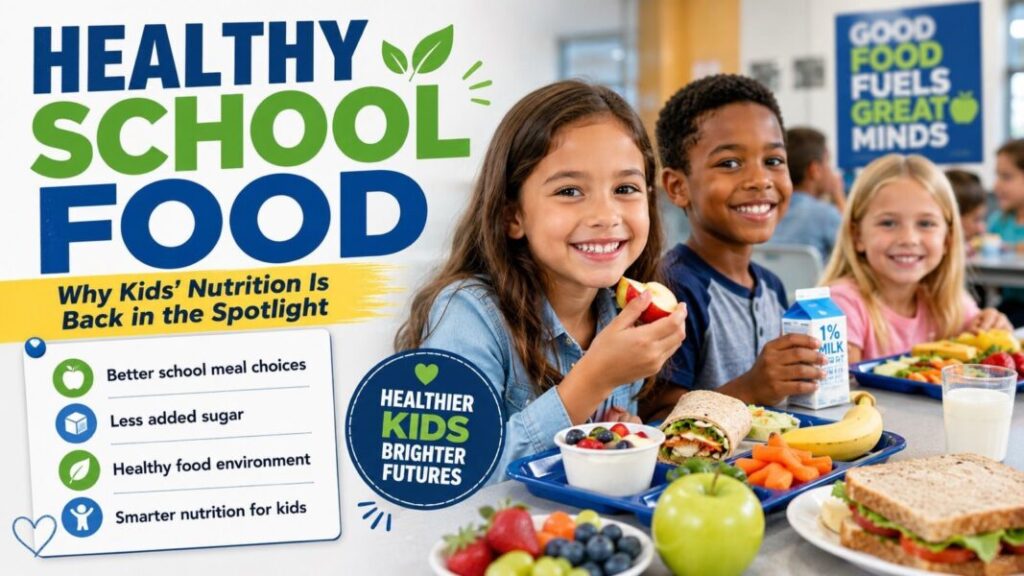
Healthy School Food: Why Kids’ Nutrition Is Back in the Spotlight in 2026
Healthy school food is getting renewed attention in 2026 for a simple reason: school is one of the places where children eat most consistently, and food choices there can shape habits for years. WHO released a new guideline in January 2026 urging countries to improve school food environments, while USDA’s updated school-meal standards are phasing in added-sugars limits and other nutrition changes in the United States. CDC also notes that most U.S. children consume as much as half of their daily calories at school, which makes school food much more than a cafeteria issue.
🍎 Why healthy school food matters so much
Children do not build food habits only at home. WHO says schools are a critical setting for shaping lifelong dietary habits and for reducing health and nutrition inequities. The same WHO update says an estimated 466 million children receive school meals globally, which shows how powerful school food systems can be when they are done well.
CDC makes the case even clearer from a daily-life angle. A healthy school nutrition environment gives students nutritious and appealing foods and beverages, consistent messages about good nutrition, and real chances to learn and practice healthy eating throughout the school day, including before and after school. When children spend so much of their day on school grounds, the food environment around them starts to matter as much as the lesson plan.
That is why this topic is back in the spotlight now. It is not only about obesity, sugar, or lunch menus. It is about concentration, long-term health, fairness, and whether schools make the healthy choice easier or harder for children. That broader framing is exactly what both WHO and CDC are pushing.
🏫 What WHO’s 2026 guideline is asking schools to do
WHO’s 2026 guideline is not limited to one narrow fix. It covers three big areas: direct food provision in schools, nutrition standards or rules for foods and beverages served or sold at school, and nudging interventions that make healthier choices more likely. WHO explains that nudging can include changes to the placement, presentation, or pricing of food options available to children.
That matters because many school food conversations focus only on the official lunch tray. WHO is saying the whole environment counts:
- what food is served
- what snacks or drinks are sold
- what children see first
- what feels normal and attractive
- what is easy to pick quickly
This is a more realistic view of how children actually make food choices during a busy school day. The guideline also stresses that monitoring and enforcement matter, because policies on paper do not help much if schools do not apply them consistently.
WHO’s January 2026 release also said that, as of October 2025, 104 Member States had policies on healthy school food, and almost three quarters of those included mandatory criteria to guide the composition of school food. That tells us this is no longer a fringe idea. It is becoming a mainstream policy direction.
🍭 Why added sugar has become a big part of the discussion
In the United States, one of the biggest shifts is USDA’s move to gradually limit added sugars in school meals. USDA’s 2024 final rule says the changes are being phased in over time and are based on the goals of the Dietary Guidelines for Americans. The rule also includes a sodium reduction step and keeps working on long-term meal-pattern standards.
USDA’s added-sugars page gives the most useful practical details. Starting in school year 2025–26, breakfast cereals in school meals may have no more than 6 grams of added sugars per dry ounce, yogurt may have no more than 12 grams of added sugars per 6 ounces, and flavored milk may have no more than 10 grams of added sugars per 8 fluid ounces in school meals. Then, beginning in school year 2027–28, a broader weekly limit phases in so that added sugars stay below 10% of calories across the week in school breakfast and lunch programs.
USDA also explains why it acted. Its page says school breakfasts currently provide about 17% of calories from added sugars and school lunches about 11%, while roughly 70% to 80% of school-aged children exceed the recommended limit for added sugars. That is a strong reminder that this is not a small technical change. It is a response to a real nutrition gap.
🥛 Healthy school food is not just about lunch
One of the most useful things in CDC’s school-nutrition guidance is that it treats school food as an environment, not a single meal. CDC says this includes the foods and beverages available to students, nutrition messages around campus, celebrations and rewards, and the example set by teachers and staff. It even notes that schools and parents can work together so classroom celebrations and rewards support health rather than rely on junk food.
That is important because children notice patterns fast. If the lunch line talks about health but rewards, vending choices, events, and adults around them send a different message, the healthy message becomes weaker. On the other hand, when meals, drinks, celebrations, and staff behavior all move in the same direction, children get a more believable and more consistent signal. That is a practical inference from CDC’s school-nutrition framework.
🥗 What healthier school food looks like in real life
A healthy school food environment does not need to be joyless or rigid. USDA says school meals will continue to emphasize fruits and vegetables, whole grains, and the right balance of nutrients, while the newer rule pushes schools to focus more on products with less added sugar. USDA also says school meals remain the most nutritious food source for American schoolchildren, even while acknowledging there is room for improvement.
In practical terms, healthier school food usually means more of this:
- fruit and vegetable options children will actually eat
- whole grains that are familiar and workable
- lower-sugar breakfast items
- reasonable beverage choices
- less dependence on highly sweetened or heavily processed foods
And less of this:
- sugary defaults
- nutrition standards that look good on paper but fail in practice
- mixed messages between meals and other school events
That is the direction both WHO and USDA are moving toward, even if countries and school systems will implement it differently.
👨👩👧 What parents can do alongside schools
Parents cannot control every school menu, but they can still influence the bigger picture. The American Academy of Pediatrics advises serving water and milk more often and avoiding soda, sports drinks, sweet tea, sweetened coffee, and fruit drinks as routine choices. It also says children age 2 and older should aim for less than 25 grams of added sugar per day, while children under 2 should avoid added sugar altogether.
That makes parent-school partnership more practical than it sounds. Parents can:
- check school menus with a more informed eye
- ask about beverage options and breakfast items
- support healthier celebration ideas
- send simpler, lower-sugar snacks when needed
- talk with children about everyday food choices without turning food into fear
The goal is not to make kids anxious about eating. The goal is to make healthy choices more normal, more available, and less confusing. That fits the spirit of the current WHO, USDA, CDC, and AAP guidance.
📚 Why this story matters in 2026
Healthy school food is back in the spotlight because nutrition policy is moving from vague good intentions to more specific rules and environments. WHO is asking countries to improve school food systems more deliberately. USDA is phasing in measurable added-sugars limits. CDC is still emphasizing that school nutrition can shape lifelong habits. Put together, that means school food is being treated less like a side topic and more like a public-health foundation.
For readers, the takeaway is simple: when school food improves, it is not just about one lunch tray. It can affect energy, habits, taste preferences, sugar intake, and how children learn to think about food for years ahead. That is exactly why the conversation has become bigger again in 2026.
❓ 5 FAQs
1. Why is healthy school food getting more attention in 2026?
Because WHO released a new 2026 guideline on healthier school food environments, and USDA is phasing in added-sugars limits and other nutrition updates for school meals.
2. Why does school food matter so much?
CDC says most U.S. children consume as much as half of their daily calories at school, so school food strongly affects daily nutrition.
3. What is changing in U.S. school meals?
USDA is gradually limiting added sugars, including specific caps for breakfast cereals, yogurt, and flavored milk, followed by a broader weekly added-sugars limit.
4. What does WHO want schools to improve?
WHO’s guideline covers direct food provision, nutrition standards for foods and beverages served or sold at school, and nudging strategies that encourage healthier choices.
5. What can parents do to support healthier school food habits?
Parents can encourage water and milk more often, cut back on sugary drinks, watch added sugar intake, and work with schools on healthier celebrations and snack choices.
Further reading
Brain-Healthy Foods: Why the MIND Diet Is Getting More Attention in 2026
Front-of-Pack Nutrition Labels: What New Food Labels May Mean for Shoppers in 2026
Low-Sodium Eating in 2026: Hidden Salt in Everyday Foods and Smarter Ways to Cut It
Top 10 Foods & Nutrition for a Healthy Life
7 No-Cook Breakfasts Recipes for Healthy and Budget Indian Mornings.
Clean Label And Natural Food Movement
Sustainable and Local Food Movement: Why Climate and Health Are Finally Sharing the Same Plate
Disclaimer
This article is for general educational purposes only and is not medical, school-policy, or legal advice. Nutrition standards, school meal rules, and local implementation can vary by country, state, and school system. For child-specific dietary advice, please speak with a qualified healthcare professional or registered dietitian.
Article Information
Author: Kartalks Editorial Team
Reviewed by: Kartalks Content Review Team
Content Type: Food, recipe, nutrition awareness, lifestyle, and general information
Sources: food safety references, nutrition awareness resources, and official public sources
Last Updated: May 17, 2026