
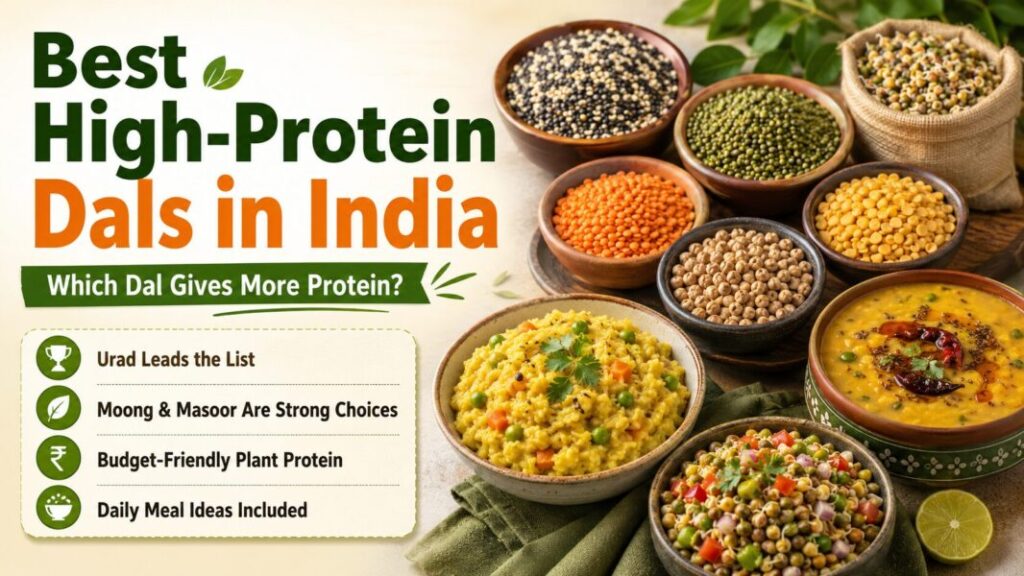
Best High-Protein Dals in India: Which Dal Gives More Protein?
Best high – protein dals in India: Dal has always been part of the Indian plate.
Long before protein bars, shakes and high-protein snacks became popular, Indian homes were already using moong, masoor, toor, chana and urad dal as affordable sources of plant protein.
But all dals do not contain exactly the same amount of protein.
Urad dal generally comes near the top. Moong and masoor are also strong choices. Matki, kulthi and toor dal offer good protein too, while chana dal gives a useful mix of protein, fibre and fullness.
The difference between most dals, however, is not huge enough to make one dal “good” and another dal “bad”.
The smarter approach is to rotate them.
A bowl of moong dal may suit one person better because it feels lighter. Another person may prefer chana dal because it keeps them full for longer. Urad dal may offer more protein, but it can feel heavy if the portion is large or if it is cooked with too much butter and cream.
So, the right question is not only:
Which dal has the most protein?
It is also:
Which dal can I eat regularly, digest comfortably and combine with the rest of my meal?
This guide explains the protein ranking, cooking differences, portion reality and the best ways to use Indian dals in daily food.
🌱 Why Dal Remains One of India’s Best Protein Foods
Pulses typically contain around 19% to 26% protein in their dry form. They also provide complex carbohydrates, fibre, minerals and plant compounds. This makes them especially useful in vegetarian and budget-conscious Indian diets. (Frontiers)
Dal is practical because it is:
- Widely available
- Cheaper than many packaged protein foods
- Easy to store
- Suitable for many regional recipes
- Naturally low in saturated fat
- Useful for children, adults and older people
- Easy to combine with rice, roti, vegetables and curd
Dal also brings something protein powder cannot: it is real food.
It gives protein along with fibre, carbohydrates and micronutrients. That makes it a more complete daily food choice, even though its protein quality is different from eggs, milk, fish or meat.
📊 Which Dal Has the Most Protein?
The figures below are approximate values per 100 grams of uncooked dry dal.
Cooking adds water. So, 100 grams of cooked dal will show much less protein than 100 grams of dry dal.
| Dal or pulse | Approx. protein per 100g dry | Common use |
|---|---|---|
| Urad dal | 24–25g | Dal makhani, idli, dosa, vada |
| Moong dal | 23–24g | Dal, khichdi, chilla, sprouts |
| Masoor dal | 23–24g | Quick dal, soup, khichdi |
| Whole green moong | Around 24g | Curry, sprouts, salad |
| Matki or moth bean | Around 23g | Usal, misal, sprouts |
| Toor or arhar dal | Around 22g | Sambar, dal tadka |
| Kulthi or horse gram | Around 22g | Rasam, soup, curry |
| Chana dal | Around 21g | Dal, chutney, curry |
A recent July 2026 comparison placed urad dal at about 25 grams of protein per 100 grams dry, moong and masoor at about 24 grams, matki at 23 grams, toor and kulthi at 22 grams, and chana dal at about 21 grams. (The Times of India)
These values should be treated as practical estimates, not laboratory guarantees. Protein can vary based on the pulse variety, processing, moisture and source.
🥇 1. Urad Dal: Highest Among Common Indian Dals
Urad dal usually ranks at or near the top for protein.
It is used across India in:
- Dal makhani
- Maa ki dal
- Idli batter
- Dosa batter
- Medu vada
- Papad
- Urad dal tadka
Why urad dal stands out
Urad dal offers roughly 24–25 grams of protein per 100 grams dry. It also gives fibre and minerals.
Its thick, creamy texture makes meals satisfying. This is one reason urad-based dishes can keep hunger away for longer.
But the final dish matters.
Plain urad dal with controlled oil is very different from restaurant-style dal makhani loaded with butter, cream and salt.
Best way to eat it
Try:
- Simple urad dal with jeera and garlic
- Mixed dal with urad in a smaller proportion
- Homemade idli or dosa
- Urad dal khichdi with vegetables
People who experience gas or heaviness may do better with smaller portions, longer soaking and thorough cooking.
🥈 2. Moong Dal: High Protein and Easy to Use
Moong dal is one of the most versatile dals in India.
It comes in several forms:
- Yellow split moong
- Green split moong
- Whole green moong
- Sprouted moong
Moong provides roughly 23–24 grams of protein per 100 grams dry.
Why families prefer moong
Moong is often chosen when someone wants a light meal. It cooks quickly and works well in simple food.
Common dishes include:
- Moong dal tadka
- Moong khichdi
- Pesarattu
- Moong chilla
- Sprouts chaat
- Moong soup
A moong chilla breakfast can be more protein-rich than a breakfast made only with refined cereal foods.
Best combination
Serve moong dal with:
- Rice and vegetables
- Roti and curd
- Millet roti
- Vegetable khichdi
- Paneer or egg on the side when more protein is needed
Moong is not automatically gas-free for everyone, but many people find it easier to tolerate than heavier beans.
🥉 3. Masoor Dal: Quick Cooking With Strong Protein
Masoor dal is one of the easiest dals for busy homes.
It cooks faster than rajma, chana or whole pulses and does not always need long soaking.
Dry masoor dal contains roughly 23–24 grams of protein per 100 grams.
Why masoor deserves more attention
Masoor offers a good mix of:
- Protein
- Fibre
- Folate
- Iron
- Complex carbohydrates
It works well in:
- Simple masoor dal
- Vegetable dal
- Lentil soup
- Masoor khichdi
- Mixed dal recipes
Masoor is a smart weekday option because it needs less preparation.
A thick bowl of masoor dal with one or two rotis and a vegetable side can form a satisfying lunch.
🌿 4. Whole Green Moong: Protein Plus More Fibre
Whole green moong has a similar protein level to split moong, but the outer covering adds more fibre.
This makes it useful for people trying to build meals that are both protein-rich and filling.
You can use whole moong in:
- Green moong curry
- Sprouts
- Sundal
- Salads
- Usal
- One-pot rice dishes
Sprouted or cooked?
Sprouting changes the texture and availability of some nutrients, but sprouts are not automatically much higher in total protein.
Also, sprouts should be washed and handled carefully. Children, pregnant women, older adults and people with weaker immunity may prefer properly cooked sprouts rather than raw ones.
Whole moong is especially useful for breakfast or evening meals when mixed with vegetables and lemon.
🌾 5. Matki: The Protein-Rich Dal Many Families Ignore
Matki, also called moth bean, is popular in Maharashtra and parts of Rajasthan.
It gives about 23 grams of protein per 100 grams dry and also provides useful fibre.
Common dishes include:
- Matki usal
- Misal
- Sprouted matki salad
- Matki curry
- Matki pulao
Is misal always healthy?
Matki itself is nutritious.
But a plate of misal can become heavy when it includes:
- Excess farsan
- Too much oil
- Large pav portions
- Extra salt
- Sugary drinks on the side
A healthier matki meal would use more sprouts or curry, less farsan and a moderate bread portion.
🍲 6. Toor Dal: Everyday Protein for Indian Homes
Toor dal, also called arhar dal, is one of India’s most familiar dals.
It gives around 22 grams of protein per 100 grams dry.
It is used in:
- Sambar
- Gujarati dal
- Dal tadka
- Pappu
- Varan
- Dal rice
Toor dal may not top the protein table, but it remains one of the best everyday choices because people actually eat it regularly.
That point matters.
A slightly lower-protein dal eaten consistently is more useful than a higher-protein dal that stays unused in the kitchen.
Make toor dal more useful
- Keep the dal reasonably thick
- Add vegetables to sambar
- Avoid too much oil in the tadka
- Include salad or cooked greens
- Combine with rice or roti in a controlled portion
A watery bowl with very little dal solids will naturally provide less protein.
🐎 7. Kulthi or Horse Gram: Traditional and Protein-Rich
Kulthi, also known as horse gram, gives around 22 grams of protein per 100 grams dry.
It is used in southern, central and hill-region cuisines.
Popular preparations include:
- Kollu rasam
- Kulthi soup
- Horse gram curry
- Chutney powder
- Sprouted kulthi
Kulthi has a strong earthy flavour and usually needs proper soaking and cooking.
It is often surrounded by exaggerated weight-loss or “fat-burning” claims online. These claims should be viewed carefully.
Kulthi is a useful pulse, not a miracle medicine.
Its real benefits come from its protein, fibre and place in a balanced diet.
🟡 8. Chana Dal: Slightly Lower Protein, Strong Fullness
Chana dal provides around 21 grams of protein per 100 grams dry.
That is slightly below urad or moong, but chana dal still remains an excellent food.
It has a firm texture and can be quite filling.
Use it in:
- Chana dal curry
- Lauki chana dal
- Chana dal chutney
- Dal vada
- Puran poli filling
- Mixed dal
Chana dal works especially well with vegetables such as bottle gourd, spinach and ridge gourd.
For weight management, boiled or lightly tempered chana dal is more useful than deep-fried dal snacks.
🍛 Dry Dal vs Cooked Dal: Why Protein Numbers Look Confusing
This is where many online comparisons become misleading.
A website may say:
- Moong dal has 24g protein per 100g
- Another source may say cooked moong has only 7g or 8g
Both can be correct.
The first figure is usually for dry dal.
The second is for cooked dal, which has absorbed water.
Simple example
Suppose you cook 50 grams of dry dal.
It may become 140–170 grams after cooking, depending on water and recipe.
The protein has not disappeared. It is simply spread across a heavier cooked portion.
So when comparing dals, always check whether the number is for:
- Dry weight
- Cooked weight
- One cup
- One bowl
- One serving
Comparisons are meaningful only when the measurement method is the same.
🥣 How Much Protein Is There in One Bowl of Dal?
One medium bowl of cooked dal may provide roughly 7–10 grams of protein, depending on:
- How much dry dal was used
- Bowl size
- Water added
- Whether vegetables were added
- Whether the dal is thin or thick
A restaurant bowl and a home bowl may be very different.
A thin rasam-style dal may have less protein per bowl than a thick dal made with more lentils.
Practical home rule
For one adult meal, using roughly 30–40 grams of dry dal can make a reasonable portion, depending on the rest of the meal.
Protein needs vary, so dal should not be the only source in every case.
🧬 Is Dal a Complete Protein?
Dal contains valuable protein, but most pulses are relatively low in sulphur-containing amino acids such as methionine.
Cereals such as rice and wheat have a different amino acid pattern. This is why traditional meals such as dal-rice, khichdi, idli-sambar and dal-roti make nutritional sense.
Research on pulse-cereal blends shows that combining the two can improve the overall amino-acid balance, though the exact quality depends on the foods and proportions used. (FAO AGRIS)
You do not need to calculate amino acids at every meal.
Eating varied foods across the day is enough for most healthy people.
Good combinations include:
- Dal and rice
- Dal and roti
- Khichdi and curd
- Idli and sambar
- Pesarattu and curd
- Chana dal and millet roti
📏 How Much Protein Does an Adult Need?
ICMR-NIN guidance places the general protein requirement for healthy adults at about 0.83 grams per kilogram of body weight per day.
For a 60 kg adult, that comes to roughly 50 grams daily.
Needs can be higher during growth, pregnancy, breastfeeding, illness recovery, older age and regular strength training. (nin.res.in)
Dal can make a useful contribution, but one bowl may not meet the full day’s requirement.
A balanced day may include:
- Dal or chana
- Milk or curd
- Paneer, soy, egg, fish or chicken
- Nuts or seeds
- Whole grains
- Vegetables
ICMR-NIN also advises obtaining protein from natural food combinations rather than routinely depending on protein supplements. (nin.res.in)
🥗 Best Dal for Different Needs
| Your priority | Good dal choices | Practical reason |
|---|---|---|
| Highest protein | Urad, moong, masoor | Around 23–25g per 100g dry |
| Lighter everyday meal | Moong, masoor | Quick cooking and softer texture |
| More fibre and fullness | Whole moong, matki, chana dal | Skin and firmer texture |
| Regular family cooking | Toor, moong, masoor | Easy to use in daily meals |
| Traditional variety | Kulthi, matki | Good protein with regional recipes |
No dal should be chosen only because it is number one on a protein chart.
Digestibility, taste, cost and your family’s eating pattern matter just as much.
🥄 How to Improve Protein From Dal Meals
1. Make dal thicker
If the dal is extremely watery, one bowl may contain very little actual pulse.
2. Use mixed dal
Mixing moong, masoor, toor and small amounts of urad can improve flavour and variety.
3. Add another protein source
Pair dal with:
- Curd
- Paneer
- Egg
- Soy
- Fish
- Chicken
- Roasted chana
4. Add vegetables
Spinach, bottle gourd, tomato, carrot, pumpkin and greens add fibre and micronutrients.
5. Control oil
A large tadka does not increase protein. It only raises calories.
6. Watch restaurant versions
Dal makhani and dal fry may contain more fat and salt than homemade dal.
7. Rotate your pulses
Use moong one day, toor another day, masoor later in the week, and whole pulses on weekends.
Variety is better than chasing one “best” dal.
💨 Does Dal Cause Gas?
Dal can cause gas in some people because pulses contain fermentable carbohydrates and fibre.
You do not need to stop eating dal immediately.
Try these steps:
- Start with a smaller serving
- Soak whole pulses well
- Throw away the soaking water when appropriate
- Cook until completely soft
- Use ginger, jeera, hing or ajwain
- Eat slowly
- Increase fibre gradually
- Drink enough water
Moong and masoor may feel lighter for some people, while rajma, kala chana and whole urad may feel heavier.
Tolerance differs from person to person.
People with IBS, inflammatory bowel disease or persistent digestive symptoms should seek personalised advice.
❌ Common Protein Mistakes With Dal
Mistake 1: Counting dry protein as cooked protein
Twenty-four grams per 100 grams usually refers to dry dal, not one cooked bowl.
Mistake 2: Eating only rice with dal water
A little dal water over a large rice portion is mostly a carbohydrate-heavy meal.
Mistake 3: Believing sprouts double the protein
Sprouting can change nutrient availability, but it does not magically double the total protein.
Mistake 4: Thinking more tadka means more nutrition
Oil, butter and cream add taste and calories, not protein.
Mistake 5: Depending on one dal every day
Different pulses offer different textures, fibres and micronutrients.
Mistake 6: Treating dal as the only required protein
Many adults benefit from adding curd, milk, paneer, soy, eggs or other protein foods.
📅 Simple 7-Day Dal Rotation Plan
Monday
Toor dal with rice, beans sabzi and curd
Tuesday
Moong dal chilla with chutney and curd
Wednesday
Masoor dal with roti and spinach
Thursday
Chana dal with bottle gourd and salad
Friday
Idli with vegetable sambar
Saturday
Matki usal with roti or controlled pav
Sunday
Urad dal or mixed dal with rice and vegetables
This keeps meals interesting without making food planning complicated.
✅ Final Verdict: Which Dal Gives More Protein?
Among commonly eaten Indian dals, urad dal usually provides the highest protein per 100 grams dry, at roughly 24–25 grams.
Moong dal, whole green moong and masoor dal follow closely at around 23–24 grams. Matki is also protein-rich. Toor, kulthi and chana dal provide slightly less, but they are still valuable protein foods.
The difference between these dals is smaller than social media comparisons often suggest.
The best choice is not necessarily the dal with the highest number.
It is the dal that:
- Fits your budget
- Suits your digestion
- Is cooked regularly
- Is eaten in a proper portion
- Is combined with vegetables and other protein foods
- Replaces less nutritious packaged food
For most Indian families, rotating three or four dals through the week is more useful than eating only urad dal because it ranks first.
🙋 5 Short FAQs
1. Which dal has the highest protein?
Urad dal is usually among the highest, with roughly 24–25 grams of protein per 100 grams dry.
2. Is moong dal better than toor dal?
Moong contains slightly more protein and may feel lighter for some people. Toor remains an excellent everyday dal.
3. How much protein is in one bowl of cooked dal?
A medium bowl may provide roughly 7–10 grams, depending on the quantity of dry dal and water used.
4. Is dal enough for daily protein?
Dal helps, but many adults should also include curd, milk, paneer, soy, eggs, fish, chicken, nuts or seeds.
5. Does dal rice make a complete protein?
Dal and rice have complementary amino-acid patterns, making the combination better balanced than either food alone.
Further Reading
Are Healthy Packaged Foods Really Healthy? FSSAI Claim Check
Energy Drinks in India: Are They Really Safe
Protein vs Fiber: Which Is More Important for Weight Loss and Gut Health?
Healthy Indian Food Combinations Explained: Dal Rice, Curd Jeera and Turmeric Pepper
🧘♀️ Mindful Eating and Mental Wellness: How a Calm Plate Heals the Mind
⚠️ Disclaimer
This article is for general nutrition and educational purposes only. It is not medical advice or a personal diet plan. Protein needs vary according to age, body weight, pregnancy, activity, kidney health, liver health, digestion and medical conditions. People with kidney disease, IBS, food allergies or other health concerns should consult a qualified doctor or registered dietitian before making major dietary changes.
Article Information
Author: Kartalks Editorial Team
Reviewed by: Kartalks Health Content Desk
Content Type: Food, health, wellness, nutrition awareness, lifestyle tips, and general public health information
Sources: official public health references, nutrition awareness resources, food safety guidelines, wellness references, and official public sources
Last Updated: July 12, 2026