
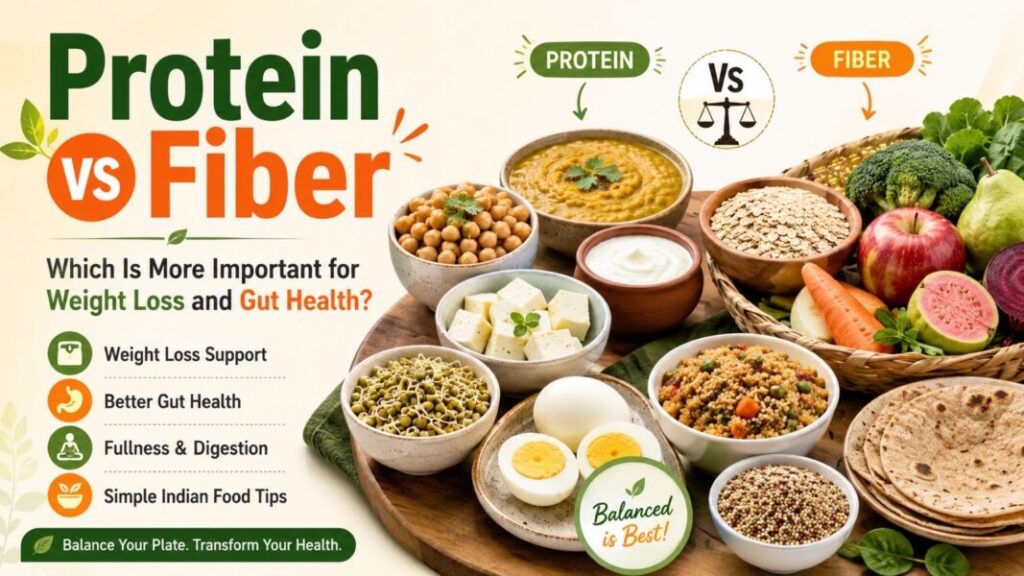
Protein vs Fiber: Which Is More Important for Weight Loss and Gut Health?
🥗 Introduction: The Real Answer Is Not Protein or Fiber, It Is Protein Plus Fiber
When people talk about weight loss, protein gets a lot of attention. We hear about high-protein diets, protein powders, eggs, paneer, chicken, dal, soy and gym meals.
When people talk about gut health, fiber becomes the hero. We hear about fruits, vegetables, oats, millets, chana, sprouts, whole grains and salad.
So the common question is simple:
Protein vs fiber — which is more important for weight loss and gut health?
The practical answer is this:
For weight loss, protein is very important because it supports fullness and muscle maintenance.
For gut health, fiber is more important because it feeds gut-friendly bacteria and supports bowel movement.
For overall daily health, you need both.
A plate with only protein and no fiber can become heavy for digestion. A plate with only fiber and very little protein may not keep you strong or full for long. The best Indian plate is balanced: dal, chana, curd, eggs or paneer with vegetables, fruits, millets, rice, roti or sprouts.
WHO explains healthy diet through four core ideas: adequacy, balance, moderation and diversity. It also says many people today eat more highly processed foods and do not eat enough fruits, vegetables or dietary fiber.
💪 What Is Protein and Why Does It Matter?
Protein is a body-building nutrient. It helps in muscle repair, growth, hormones, enzymes, immunity and daily body maintenance.
For adults, ICMR-NIN’s 2024 Dietary Guidelines for Indians mention a protein RDA of around 0.83 gram per kg body weight per day for healthy men and women.
That means a person weighing 60 kg may need roughly around 50 grams of protein per day, depending on health condition, activity level, age and other factors.
✅ Good Indian Protein Foods
You do not need expensive diet products to get protein. Many Indian foods are useful:
- Dal
- Chana
- Rajma
- Lobia
- Sprouts
- Soy chunks
- Paneer
- Curd
- Milk
- Eggs
- Fish
- Chicken
- Peanuts
- Nuts and seeds
Harvard explains that animal-based foods like eggs, milk, fish and meat are good sources of complete protein, while plant-based protein foods can be combined in variety to cover amino acid needs.
🌾 What Is Fiber and Why Does It Matter?
Fiber is the part of plant foods that our body does not fully digest. It comes from foods like vegetables, fruits, whole grains, pulses, nuts and seeds.
Fiber is not just for constipation. It supports gut health, fullness, blood sugar balance and better meal quality.
WHO says people above 10 years should aim for at least 25 grams of naturally occurring dietary fiber per day, mainly from foods like whole grains, vegetables, fruits and pulses. WHO also recommends at least 400 grams of fruits and vegetables daily for everyone above 10 years of age.
✅ Good Indian Fiber Foods
- Vegetables
- Fruits
- Chana
- Rajma
- Lobia
- Moong sprouts
- Oats
- Millets
- Brown rice
- Whole wheat roti
- Flax seeds
- Chia seeds
- Peanuts
- Guava
- Apple
- Banana
- Cucumber
- Greens
Harvard’s Nutrition Source explains that soluble fiber attracts water in the gut and forms a gel, which can slow digestion and may reduce hunger.
⚖️ Protein vs Fiber for Weight Loss
For weight loss, protein and fiber work in different ways.
Protein helps because:
- It keeps you full for longer
- It supports muscle maintenance
- It reduces the chance of eating only carb-heavy meals
- It improves breakfast and lunch quality
- It can reduce unnecessary snacking when meals are balanced
Fiber helps because:
- It adds volume to the meal
- It slows digestion
- It supports bowel regularity
- It improves gut bacteria activity
- It helps you feel satisfied with fewer calories
So, which is better for weight loss?
✅ Best answer: protein gives strength and fullness, fiber gives volume and gut support.
For example, eating only boiled eggs may give protein, but it lacks fiber. Eating only fruit salad gives fiber and vitamins, but may not provide enough protein. But eating egg with vegetable salad, or dal with vegetables, or curd with fruit and nuts, gives a better balance.
🦠 Protein vs Fiber for Gut Health
For gut health, fiber clearly has a stronger role.
Your gut contains many microbes. Diet strongly affects which microbes grow in the colon. Harvard explains that a high-fiber diet affects the type and amount of gut microbiota, and when fiber is fermented in the colon, short-chain fatty acids are produced.
In simple words, your gut bacteria love plant fiber.
That does not mean protein is bad. Protein is also necessary. But too much protein without enough vegetables, fruits and whole grains may make the diet unbalanced.
Gut-friendly Indian combinations:
- Dal + rice + vegetable
- Curd + roasted jeera + cucumber
- Chana salad + curd
- Rajma + rice + salad
- Sprouts + lemon + onion + tomato
- Millet roti + dal + greens
- Oats or dalia + nuts + fruit
These combinations are more useful than only focusing on one nutrient.
🍛 Best Indian Foods That Give Both Protein and Fiber
Some foods are special because they give both protein and fiber.
| Food | Why It Helps | Best Use |
|---|---|---|
| Chana | Protein + fiber | Chana curry, sundal, salad |
| Rajma | Filling and gut-friendly | Rajma rice, rajma bowl |
| Lobia | Budget-friendly protein and fiber | Curry, salad |
| Moong dal | Light protein option | Dal, khichdi, dosa |
| Sprouts | Protein + crunch + fiber | Chaat, salad |
| Soy chunks | High protein | Curry, pulao, stir-fry |
| Peanuts | Protein + fat + fiber | Chutney, poha, snack |
| Oats | Fiber + some protein | Upma, porridge |
| Millets | Fiber-rich grains | Roti, dosa, upma |
| Curd with seeds | Protein + gut support | Breakfast bowl |
🧠 Simple Rule: Build a Protein-Fiber Plate
A good Indian plate should not look like only rice or only roti.
Try this simple formula:
Half plate: vegetables or salad
One quarter: protein food
One quarter: rice, roti, millet, dosa or idli
Small side: curd, nuts, seeds or healthy fat
Example:
Rice + dal + beans poriyal + curd + cucumber salad
Another example:
Roti + chana curry + salad + buttermilk
This is more realistic than following extreme diet trends.
🥣 Breakfast Ideas With Protein and Fiber
1. Besan Chilla With Curd
Besan gives protein. Onion, tomato and coriander add fiber and taste.
2. Idli With Sambar
Idli gives energy. Sambar adds dal, vegetables and fiber.
3. Poha With Peanuts and Vegetables
Poha gives quick energy. Peanuts add protein and fat. Vegetables add fiber.
4. Sprouts Chaat
Moong sprouts with onion, tomato, cucumber and lemon is light but filling.
5. Curd Bowl With Fruit and Nuts
Curd adds protein. Fruit and nuts add fiber and fullness.
🍽️ Lunch and Dinner Ideas
Option 1
Rice + dal + cabbage sabzi + curd
Option 2
Roti + rajma + cucumber salad
Option 3
Millet roti + paneer bhurji + greens
Option 4
Brown rice or regular rice + chana curry + carrot salad
Option 5
Egg curry + roti + vegetable side dish
Option 6
Fish curry + rice + cooked vegetables
The goal is not to remove Indian food. The goal is to improve the plate.
❌ Common Mistakes People Make
Mistake 1: Eating Protein Without Fiber
Only eggs, chicken or paneer without vegetables can miss gut-friendly fiber.
Mistake 2: Eating Fiber Without Protein
Only salad or fruit may not keep you full for long.
Mistake 3: Depending on Protein Powder
Most healthy people should first improve food quality. Protein powder is not compulsory for everyone.
Mistake 4: Eating Too Much Rice With Very Little Dal
Dal rice is good, but the dal portion should be meaningful.
Mistake 5: Increasing Fiber Suddenly
If you suddenly eat too much fiber, you may feel gas or bloating. Increase slowly and drink enough water. Mayo Clinic also advises increasing fiber gradually so the digestive system and gut microbes get time to adjust.
🧾 Which Is More Important: Final Comparison
| Goal | More Important | Best Practical Choice |
|---|---|---|
| Weight loss | Protein + fiber together | Dal + vegetables, eggs + salad, chana bowl |
| Gut health | Fiber | Vegetables, fruits, pulses, whole grains |
| Muscle strength | Protein | Eggs, dal, paneer, curd, fish, chicken |
| Constipation support | Fiber + water | Fruits, greens, oats, chana, sprouts |
| Fullness | Both | Protein food with fiber-rich sides |
| Daily health | Balanced diet | Variety, portion control, less processed food |
🛒 Budget Shopping List for Protein and Fiber
Budget Protein Foods
- Dal
- Eggs
- Curd
- Peanuts
- Soy chunks
- Chana
- Milk
Budget Fiber Foods
- Cabbage
- Carrot
- Cucumber
- Greens
- Banana
- Guava
- Oats
- Millets
- Sprouts
Foods That Give Both
- Chana
- Rajma
- Lobia
- Moong sprouts
- Peanuts
- Millets
- Oats
✅ Final Takeaway
Protein and fiber are not enemies. They are partners.
For weight loss, protein helps you stay full and supports muscle. Fiber adds volume, supports digestion and improves gut health. For gut health, fiber has a stronger role because gut bacteria depend on fiber-rich plant foods.
But the smartest answer is this:
Do not choose protein or fiber. Build every meal with both.
A simple Indian plate with dal, vegetables, curd, roti or rice can be more useful than a costly diet plan. The best health changes are usually the ones you can follow every day.
🙋♀️ 5 FAQs
1. Which is better for weight loss, protein or fiber?
Both are important. Protein helps with fullness and muscle support, while fiber adds volume and supports digestion.
2. Which is better for gut health?
Fiber is more important for gut health because it feeds helpful gut bacteria and supports bowel movement.
3. Can I eat protein and fiber together?
Yes. This is the best option. Dal with vegetables, chana salad, curd with fruit, and egg with salad are good examples.
4. Is high protein bad for digestion?
Normal protein from food is fine for most healthy people. But very high protein with low fiber may feel heavy for some people.
5. What is the best Indian food for both protein and fiber?
Chana, rajma, lobia, sprouts, peanuts, oats, millets and dal-based meals are good choices.
👉Further Reading
Healthy Indian Food Combinations Explained: Dal Rice, Curd Jeera and Turmeric Pepper
⚠️ Disclaimer
This article is for general health and educational purposes only. It is not medical advice or a personal diet plan. Protein and fiber needs can change based on age, pregnancy, kidney disease, liver disease, diabetes, gut disorders, medications, activity level and other health conditions. Please consult a qualified doctor or registered dietitian before making major diet changes, especially if you have any medical condition.
Article Information
Author: Kartalks Editorial Team
Reviewed by: Kartalks Health Content Desk
Content Type: Food, health, wellness, nutrition awareness, lifestyle tips, and general public health information
Sources: official public health references, nutrition awareness resources, food safety guidelines, wellness references, and official public sources
Last Updated: June 21, 2026