
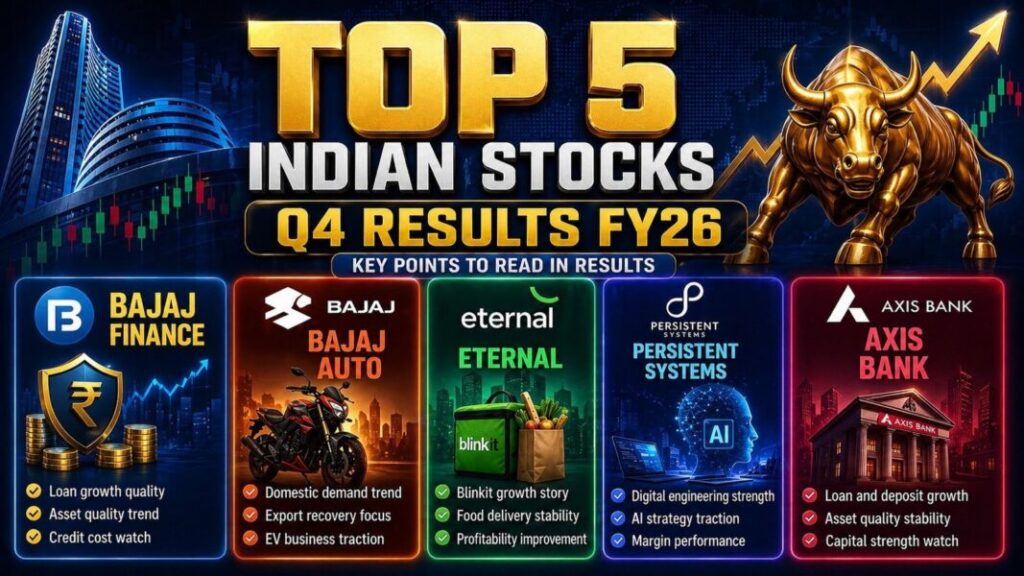
Top 5 Indian Stocks Q4 Results FY26: Bajaj Finance, Bajaj Auto, Eternal, Persistent Systems and Axis Bank
Quarterly results matter because they tell investors what is really improving: growth, margins, balance-sheet strength, guidance, or capital return. This report is written in a clean, list-wise WordPress format and uses the latest available public data as of May 1, 2026. One important note: Bajaj Finance, Eternal, Persistent Systems, and Axis Bank have already reported Q4 FY26, while Bajaj Auto’s Q4 FY26 results are still pending and are scheduled for the May 6 board meeting. So the Bajaj Auto section uses the latest reported quarter, March sales trend, and current setup rather than unreported numbers.
Article Information
Author: Kartalks Research Desk
Reviewed by: Kartalks Editorial Team
Content Type: Stock results analysis, company fundamentals, technical overview, and investment education
Sources: NSE, BSE, company exchange filings, quarterly results, investor presentations, annual reports, SEBI updates, and official public sources
Last Updated: May 1, 2026
1) Bajaj Finance | CMP: ₹937
Q4 FY26 key numbers
- Net profit: ₹5,553 crore, up about 22% YoY.
- Net interest income: around ₹11,781 crore, up about 20% YoY.
- Assets under management: ₹5.09 lakh crore, up about 22% YoY, which is a major milestone for the company.
- GNPA / NNPA: 1.01% / 0.41%, showing asset quality remained fairly controlled.
- Final dividend: ₹6 per share, including a special component of ₹0.60 linked to the Bajaj Housing Finance stake sale gain. No bonus was announced.
What investors should analyse
- Loan growth quality, not just headline AUM growth.
- Whether lower credit cost can stay sustainable in FY27.
- Gold loan growth, customer franchise expansion, and deposit traction.
- Management confidence on long-term profit growth and return ratios.
Management review
Management commentary and analyst summaries suggest Bajaj Finance remains confident about maintaining strong long-term growth, with FY27 credit cost guidance in the 1.45% to 1.6% range and long-term profit growth guidance still around 23% to 24%. The business is also pushing more AI-led operating improvements, which matters because scale alone is no longer enough for a premium lender.
Fundamentals and balance-sheet view
- P/E: about 30.4
- ROE: about 18.2%
- Dividend yield: about 0.47%
- 52-week range: roughly ₹788 to ₹1,102
For lenders like Bajaj Finance, debt-equity is less useful than AUM growth, asset quality, provisions, credit cost, and customer franchise expansion. On that score, this quarter still looks solid.
Technical view
At around ₹937, the stock is trading below its 52-week high but comfortably above the lower end of the range, which tells investors the chart is not overheated and still has room if earnings delivery stays consistent.
Investment opportunity and stock forecast
Bajaj Finance still looks like one of the cleaner high-quality financial plays in the market. The quarter was not just about profit growth; it also showed franchise depth, improving scale, and manageable asset-quality stress. My read: better suited for long-term investors than short-term traders, and still one of the strongest compounding stories in the NBFC space.
Peers to compare
For practical comparison, investors can line up Bajaj Finance against Cholamandalam Investment, Shriram Finance, Muthoot Finance, and other leading retail-focused NBFCs.
2) Bajaj Auto | CMP: ₹9,994
Q4 FY26 status
- Q4 FY26 results are not out yet.
- The company has scheduled its board meeting for May 6, 2026 to consider audited Q4/FY26 results.
- The same meeting will also consider dividend and a possible buyback.
Latest available operating snapshot
- In the latest reported quarter, revenue from operations was ₹15,220.33 crore.
- PAT was ₹2,502.81 crore.
- Management described it as a record quarter with double-digit growth across businesses.
March 2026 business trend
- Total March sales: 4,45,377 units, up about 20% YoY
- Domestic sales: 2,66,290 units
- Exports: 1,79,087 units
- Both domestic and export momentum stayed strong going into the Q4 result window.
What investors should analyse
- Domestic motorcycle demand in the 125cc-plus segment.
- Export recovery, especially in international markets.
- EV progress and margin sustainability.
- What the board says on dividend and buyback, because that can materially affect sentiment.
Management review
Management commentary in the latest quarter pointed to leadership focus in premium motorcycles, export recovery, EV traction, and commercial vehicle resilience. That keeps Bajaj Auto in the strong-operating-business category even before Q4 is officially announced.
Fundamentals and ratios
- P/E: about 31.2
- ROCE: about 28.1%
- ROE: about 22.8%
- Dividend yield: about 2.10%
- Public ratio trackers show debt-equity around 0.27 on the latest available annual basis.
Technical view
At around ₹9,994, Bajaj Auto is trading very close to its 52-week high zone, with the public range around ₹7,556 to ₹10,187. That means the market is already pricing in a fairly strong result or at least a strong operating setup.
Investment opportunity and stock forecast
Bajaj Auto looks like one of the stronger names in this basket from a price-structure perspective. The only caution is that the actual Q4 print is still pending, so sentiment can swing on margins, dividend, or buyback language. My read: strong stock, but investors should respect event risk until the May 6 update is out.
Peers to compare
For comparison, investors usually track Bajaj Auto alongside Hero MotoCorp, TVS Motor, Eicher Motors, and other large two-wheeler names.
3) Eternal | CMP: around ₹245–₹247
Q4 FY26 key numbers
- Revenue from operations: ₹17,292 crore
- Profit for the quarter: ₹174 crore
- Revenue was up sharply YoY and profit also improved strongly from the year-ago base.
- FY26 revenue: ₹54,364 crore
- FY26 profit: ₹366 crore.
What investors should analyse
- Whether Blinkit growth is scaling profitably, not just rapidly.
- Whether food delivery remains stable while quick commerce expands.
- Whether adjusted EBITDA keeps improving at the group level.
- Whether the market is paying too much for future growth.
What stood out in this quarter
The biggest takeaway from Eternal’s Q4 was not just revenue growth. It was the scale of the platform story. The company said more than 109 million Indians completed transactions worth over $10 billion through Blinkit, District, and Zomato during FY26, while consolidated adjusted revenue and adjusted EBITDA also expanded sharply. Blinkit added 216 net new stores in Q4, taking the total to 2,243, and its adjusted EBITDA improved as scale kicked in.
Management review
Management has set ambitious long-term targets, including $20 billion B2C NOV by FY28 and $1 billion adjusted EBITDA by FY29. That tells investors one thing clearly: the market is valuing Eternal more as a multi-business consumer internet platform than a simple food-delivery stock.
Fundamentals and balance-sheet view
- Current price: around ₹245 to ₹247
- P/E: about 651
- ROE: about 1.19%
- ROCE: about 2.97%
- Debt-equity: effectively 0
- Dividend: none announced with Q4 results.
Technical view
The stock is trading well below its 52-week high near ₹368 but above the ₹213 area, which means the chart is still in recovery mode rather than full momentum mode.
Investment opportunity and stock forecast
Eternal is one of the most interesting growth stories in India, but it is also one of the easiest stocks to overpay for. If Blinkit continues to scale profitably, the market may stay constructive. But because valuation is already rich, even strong quarters can see volatility. My read: high-growth stock, high-expectation stock, and better suited to investors who can handle sharp sentiment swings.
Peers to compare
For comparison, investors usually track Eternal against other listed or adjacent consumer-tech, delivery, and platform businesses, while also watching quick-commerce competition closely.
4) Persistent Systems | CMP: ₹4,800
Q4 FY26 key numbers
- Q4 revenue: about ₹4,055.9 crore
- Q4 PAT: about ₹529.3 crore
- Revenue growth: about 16.2% YoY
- PAT growth: about 33.7% YoY
- EBIT margin: 16.3%
- Full-year dividend: ₹40 per share.
What investors should analyse
- Whether the AI-first strategy is translating into better margins and deal quality.
- Whether the company can sustain its long streak of sequential growth.
- Whether TCV and ACV momentum remain strong.
- Whether the correction in the stock price has already priced in slower sentiment.
What stood out in this quarter
Persistent said Q4 FY26 marked its 24th sequential quarter of growth, which is a very strong operational signal. The company also reported TCV of $600.8 million and ACV of $445.1 million, showing that the pipeline remains meaningful and not just dependent on one or two large deals.
Management review
Chairman Anand Deshpande highlighted stronger AI adoption on top of the company’s engineering and data foundations, while CEO Sandeep Kalra said the AI-first strategy is improving delivery quality and scale. That is exactly the kind of management tone investors like in a mid-to-large digital engineering name.
Fundamentals and debt
- P/E: about 39.2
- ROCE: about 34.4%
- ROE: about 27.3%
- Dividend yield: about 0.73%
- The company is widely screened as almost debt free.
Technical view
At around ₹4,800, Persistent is well below its 52-week high near ₹6,599 and only modestly above the ₹4,449 low. That means the business numbers look much stronger than the recent chart, which is often where interesting medium-term setups begin.
Investment opportunity and stock forecast
Persistent remains one of the better long-term digital engineering stories in Indian IT. The quarter was strong, margins were healthy, and management language stayed confident. My read: good quality growth stock, but the chart still needs time to fully repair after the earlier correction.
Peers to compare
For practical comparison, investors may track Persistent against Coforge, LTIMindtree, Mphasis, KPIT Technologies, and Tata Elxsi depending on whether they focus more on digital IT or engineering-led technology work.
5) Axis Bank | CMP: ₹1,268
Q4 FY26 key numbers
- PAT: ₹7,071 crore
- Profit was up sequentially but roughly flat to slightly lower YoY.
- NII growth: about 5% YoY
- Deposits growth: about 14% YoY
- Advances growth: about 19% YoY
- GNPA / NNPA: 1.23% / 0.37%
- Capital adequacy ratio: 16.42%
- Dividend: ₹1 per share.
What investors should analyse
- Whether deposit growth is healthy enough to support loan growth.
- Whether provisions remain elevated.
- Whether treasury income weakness was one-off or recurring.
- What the proposed large fundraise means for future growth and dilution.
What stood out in this quarter
Axis Bank’s quarter looked okay on core operating metrics, but the market did not celebrate because profit missed expectations and the company also approved a large fundraise plan of up to ₹55,000 crore. The bank additionally made a ₹2,001 crore prudent standard-asset provision, which strengthens the balance sheet but also pressures near-term reported profitability.
Management review
The tone from the numbers suggests Axis is prioritizing balance-sheet resilience over near-term optics. That is not always exciting for traders, but it can be constructive for medium-term investors if credit growth and asset quality remain stable.
Fundamentals and balance-sheet view
- P/E: about 14.9
- ROE: about 13.2%
- Current price: about ₹1,268
- 52-week range: about ₹1,041 to ₹1,418.
For banks, debt-equity is not the right headline ratio. Investors should focus much more on GNPA, NNPA, capital adequacy, deposit growth, advances growth, and provision buffers. On those metrics, Axis remains stable even if the quarter was not exciting.
Technical view
At around ₹1,267.70, Axis Bank is roughly mid-range and about 10.6% below its 52-week high, so the chart is weaker than the strongest bank charts but not broken.
Investment opportunity and stock forecast
Axis Bank is not the most thrilling name in this list, but it still offers a reasonable mix of scale, private-bank quality, and valuation comfort. My read: more of a steady banking name than a breakout story right now, but a watchable candidate if provision pressure cools and growth stays healthy.
Peers to compare
For comparison, investors usually place Axis Bank alongside HDFC Bank, ICICI Bank, Kotak Mahindra Bank, and IndusInd Bank within the private-banking pack.
Final investor takeaway
If I rank these five on current setup:
- Best clean Q4 execution: Persistent Systems
- Best financial compounder profile: Bajaj Finance
- Best near-term event stock: Bajaj Auto because Q4, dividend, and buyback commentary are still pending
- Best high-growth but high-risk story: Eternal
- Best value comfort among large banks here: Axis Bank
5 FAQs
1) Which stock delivered the strongest reported Q4 FY26 among these names?
Persistent Systems and Bajaj Finance look strongest on reported Q4 quality. Persistent had strong revenue, profit, and margin performance, while Bajaj Finance delivered robust profit growth and strong AUM expansion.
2) Why is Bajaj Auto different in this report?
Because Bajaj Auto had not yet announced Q4 FY26 results as of May 1, 2026. Its board meeting is scheduled for May 6, 2026, and that meeting may also include a dividend and buyback decision.
3) Which stock looks most expensive on valuation?
Eternal looks the richest on current valuation metrics, with a very high P/E and low current return ratios, which means the market is paying more for future growth than present profitability.
4) Which stock looks best for dividend-focused investors?
Persistent Systems and Bajaj Auto are attractive to dividend-oriented investors, while Bajaj Finance also declared a final dividend this quarter. Axis Bank’s dividend is comparatively modest.
5) Which stock looks best for long-term investors?
For long-term investors, Bajaj Finance stands out for franchise quality, while Persistent Systems stands out for growth quality. Axis Bank fits investors who prefer more valuation comfort, and Eternal fits investors willing to take more growth-related risk.
Further reading
Q4 Results FY26: 5 Important Indian Stocks
Market Fall Value Buying Stocks in India
Market Fall Value Buying Stocks – Part 2
US-Iran War Latest Updates and Stock Market Impact – Part 6
Disclaimer
This article is for educational and informational purposes only and should not be treated as investment advice. Stock prices, quarterly numbers, management commentary, and market sentiment can change quickly. Please do your own research or consult a SEBI-registered financial advisor before making any investment decision.