
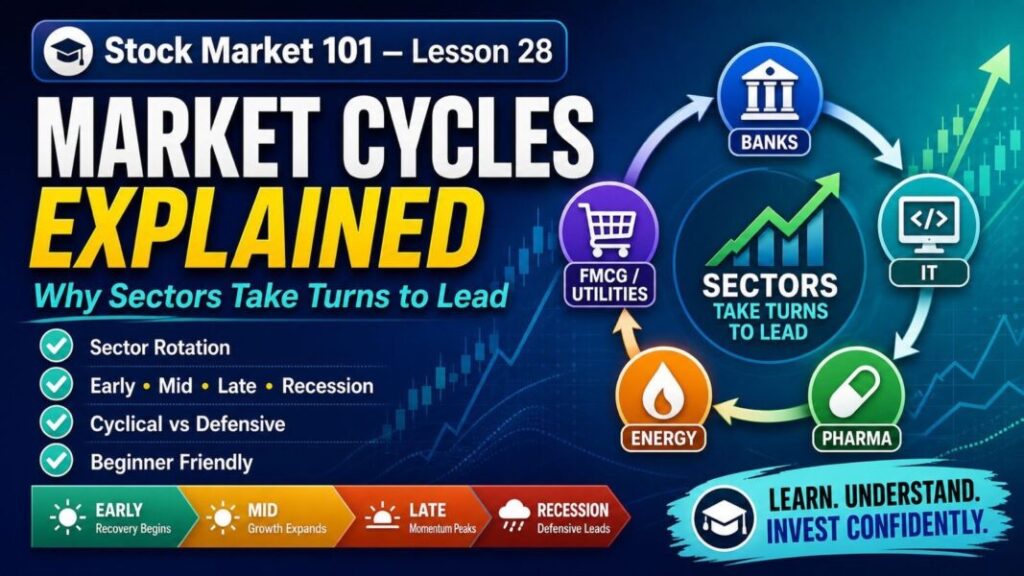
Stock Market 101 – Lesson 28: Market Cycles Explained: Why Sectors Take Turns to Lead
Article Information
Author: Kartalks Education Desk
Reviewed by: Kartalks Editorial Team
Content Type: Stock market education and beginner-friendly finance learning
Sources: SEBI investor education material, NSE/BSE educational resources, official public sources, and general finance learning references
Last Updated: May 2, 2026
Hook
Have you ever seen one group of stocks shine for months, then suddenly slow down while another group takes control?
That is one of the most normal things in the stock market.
Banks do not lead forever. IT does not lead forever. Pharma does not lead forever. Energy does not lead forever. Leadership changes because the economy changes, interest rates change, inflation changes, and investor expectations change. Fidelity and Schwab both explain that different sectors have historically tended to perform differently across phases of the business cycle.
That is why this lesson matters.
When beginners understand Market Cycles Explained, they stop treating sector moves like random noise. They start seeing a pattern: different sectors often lead at different times, and that is exactly why diversification across sectors matters. The SEC also stresses diversification because different parts of the market do not always behave the same way.
What Does Market Cycles Explained Mean?
In simple words, a market cycle is the idea that the economy and markets move through phases.
They do not stay hot forever.
They do not stay weak forever.
Fidelity’s business-cycle framework describes four broad phases:
- early cycle
- mid cycle
- late cycle
- recession
Each phase comes with different conditions, such as:
- stronger or weaker growth
- easier or tighter credit
- rising or falling confidence
- different inflation pressure
- changing profit trends
That is the base idea behind Sector Rotation.
Why Sectors Take Turns to Lead
Not every business earns money in the same environment.
A consumer staples company can hold up even when growth slows.
A bank often reacts strongly to economic growth, credit demand, and rate conditions.
An industrial company may benefit when business activity and capex improve.
Utilities and healthcare are usually viewed as more defensive because demand for their services tends to be steadier. Fidelity and Schwab both frame sector rotation around these economic differences across sectors.
So sector leadership changes because the backdrop changes.
That is the simple answer.
The Business Cycle in Easy Words
1. Early Cycle
This phase usually comes after a weak period or recession.
Growth starts improving.
Credit conditions may become easier.
Consumer demand begins to recover.
Business confidence starts coming back.
Fidelity says the early cycle is often marked by a sharp recovery from negative to positive growth, improving sales, and margin recovery, and that consumer discretionary and industrials have historically tended to do well in this phase.
Why some sectors can lead here
- consumers start spending again
- businesses restart expansion plans
- economically sensitive stocks begin reacting early
This is often where Cyclical Sectors start attracting attention.
2. Mid Cycle
This is usually the longer and more stable part of the cycle.
Growth is still positive, but not exploding.
Profits are healthier.
Credit growth can improve.
The economy often looks more balanced.
Fidelity says the mid-cycle phase has historically shown smaller performance gaps between sectors because leadership rotates more often in this stage.
What that means for beginners
Mid cycle is often less about one clear winner and more about broader participation.
You may see leadership move around more.
That is why many investors get confused here. They expect one sector to dominate for too long, but the market often starts spreading leadership across multiple areas. Fidelity also notes that no single sector behaves the same way in every cycle, so these are tendencies, not fixed rules.
3. Late Cycle
Late cycle often comes when growth is still positive but begins slowing.
Inflation pressure may rise.
Capacity can become tighter.
Rate pressure can matter more.
The market starts looking ahead to the next slowdown before the slowdown is fully visible.
Fidelity describes late cycle as a phase associated with slowing growth after a strong run, higher inflationary pressure, and more constrained conditions.
Why sector leadership changes here
Because the market begins asking different questions:
- Which sectors can handle inflation better?
- Which businesses still have pricing power?
- Which stocks are too expensive after a long run?
- Which sectors may struggle if growth slows further?
This is why leadership can rotate even while the economy still looks decent on the surface.
4. Recession Phase
This is the weaker part of the cycle.
Demand slows.
Profit pressure rises.
Risk appetite weakens.
Investors become more selective.
Fidelity says economically sensitive assets have generally performed worse than defensive assets during recession phases, while more defensive assets have tended to hold up relatively better.
This is where Defensive Sectors matter
Common defensive areas often include:
- healthcare
- utilities
- consumer staples
These sectors are not risk-free.
But they are often considered more stable because people still need medicine, electricity, and essential goods even when the economy weakens.
Cyclical Sectors vs Defensive Sectors
This is one of the most important beginner concepts in Market Cycles Explained.
Cyclical Sectors
These are sectors that usually respond more strongly to economic growth.
Examples often include:
- consumer discretionary
- industrials
- financials
- materials
- parts of technology and energy, depending on the backdrop
These can do well when:
- growth improves
- confidence rises
- spending increases
- business activity expands
Defensive Sectors
These are sectors often considered steadier during weak or uncertain periods.
Examples often include:
- consumer staples
- healthcare
- utilities
These can attract interest when:
- growth slows
- recession fears rise
- investors want stability
- earnings visibility matters more
That does not mean cyclical is always better or defensive is always safer.
It means they often respond differently.
What Is Sector Rotation?
Sector Rotation means shifting market leadership from one sector to another as the economic backdrop changes.
Fidelity defines a sector rotation strategy as rotating in and out of sectors as the economy moves through different phases of the business cycle. Schwab also explains that different sectors tend to outperform at different points of the cycle.
For beginners, the easiest way to understand it is this:
Yesterday’s winner may not be tomorrow’s winner.
That is normal.
Why Beginners Should Care
Because this lesson helps you avoid a common mistake:
chasing the last winning sector too late
A sector may look strong because it matched the previous phase well. But if the cycle is shifting, the next leaders may be different. Fidelity also notes that sector strategies can be more volatile than broader market exposure and may underperform the broader market.
So the value of this lesson is not only to help you find opportunities.
It is also to help you avoid blind concentration.
A Smart Beginner Way to Use This Idea
You do not need to predict every twist.
You just need a better framework.
Ask simple questions like:
- Is the economy recovering or slowing?
- Are investors preferring growth-sensitive sectors or safer sectors?
- Is leadership broadening or narrowing?
- Am I too heavily concentrated in one theme?
- Does my portfolio have sector balance?
This is where the SEC’s diversification guidance becomes practical. The SEC says investors should spread exposure because different asset groups and market segments do not always perform the same way, and rebalancing can help prevent a portfolio from becoming too overemphasized in one area.
Common Mistakes Beginners Make
Thinking one sector will lead forever
It will not.
Historical sector leadership has tended to rotate as the cycle changes.
Treating sector rotation like a guaranteed formula
It is not.
Fidelity clearly says every cycle is different, and structural shifts, innovation, regulation, and market conditions can change historical patterns.
Ignoring diversification
This is a big one.
Schwab warns that becoming too concentrated in one sector can leave a portfolio vulnerable if that area weakens, and the SEC also emphasizes diversification and rebalancing.
Confusing short-term hype with long-term cycle change
A one-week move is not always a true rotation.
Sometimes the market is just reacting to news, results, or sentiment.
That is why this lesson works best as a broad framework, not a daily trading signal. Fidelity presents sector rotation as part of an intermediate-term business-cycle approach, not as a guaranteed short-term timing system.
Simple Takeaway for Readers
Here is the easiest way to remember Lesson 28:
- the economy changes
- sector leadership changes
- investors should not chase blindly
- diversification matters
- understanding cycles improves patience
That is the heart of Market Cycles Explained.
Final Lesson Summary
The biggest lesson is simple:
Sectors take turns to lead because economic conditions do not stay the same.
Fidelity’s business-cycle research says sector performance has historically tended to rotate as the economy shifts from one phase to another, and Schwab says different sectors often outperform at different points in the cycle.
So when you see leadership move from one sector to another, do not assume the market has gone mad.
It may just be following the cycle.
And for beginners, that understanding brings two big benefits:
- less panic
- better portfolio thinking
The SEC’s diversification guidance fits perfectly here: do not overfocus on one area of the market, because different sectors can behave very differently in changing environments.
5 FAQs – Market Cycles Explained
Q1. What are market cycles?
Market cycles are phases where the economy and markets move through recovery, growth, slowdown, and recession.
Q2. Why do sectors take turns to lead?
Because different sectors perform better in different economic conditions.
Q3. What is sector rotation?
Sector rotation means leadership shifts from one sector to another as the cycle changes.
Q4. Are defensive sectors always safe?
No. They may be more stable in weak periods, but they still carry market risk.
Q5. Should beginners rotate sectors actively?
Not always. Beginners are usually better off understanding the concept and staying diversified.
Further reading
Stock Market 101 – Lesson 27: Auditor Report & Qualifications
Stock Market 101 – Lesson 26: Management Discussion (MD&A): How to Read Promoter Confidence
Stock Market 101 – Lesson 25: Notes to Accounts: Hidden Clues Most People Ignore
Stock Market 101 – Lesson 24: Cash Flow Statement in Real Life: Profit vs Cash (Red Flags)
Stock Market 101 – Lesson 20 Your 12-Month Wealth Plan & Rebalancing
Stock Market 101 – Lesson 17: Trading Psychology (Biases, FOMO, and Discipline)
Disclaimer
This lesson is for educational purposes only and should not be treated as investment advice. Please do your own research before making any investment decision.