
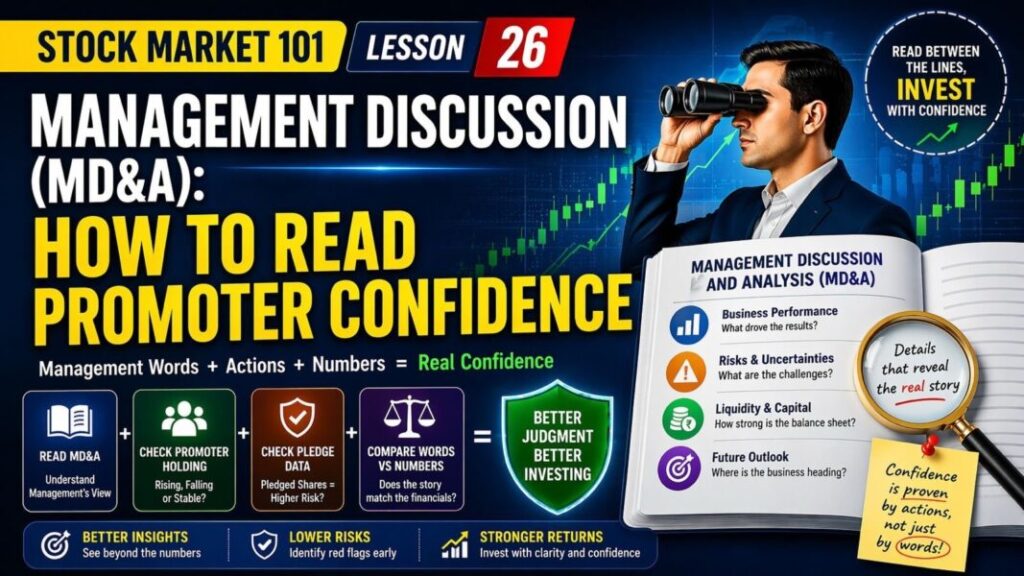
Stock Market 101 – Lesson 26: Management Discussion (MD&A): How to Read Promoter Confidence
Hook
A company can post decent numbers and still leave investors uncomfortable.
Why?
Because numbers tell you what happened, but management commentary often tells you how management wants you to see what happened. That is exactly why the Management Discussion and Analysis (MD&A) section matters. Investor.gov says the MD&A section gives management’s view on business results and lets management explain the story in its own words, while SEC guidance says MD&A is meant to help investors understand financial condition, results, liquidity, capital resources, and the effect of known trends and uncertainties.
For Indian market readers, this becomes even more useful when you connect MD&A with promoter confidence. That confidence is not one official number printed in the report. It is something investors infer by reading management tone, promoter holding patterns, promoter pledging or encumbrance, and whether management actions match its words. NSE publishes shareholding-pattern and pledged-data disclosures, and SEBI requires disclosure of promoter/promoter-group shareholding details and, in specified cases, detailed reasons for encumbrance.
What Is MD&A in Simple Words?
The Management Discussion and Analysis section is where management explains the business year in plain narrative form instead of only showing line items from the financial statements. Investor.gov describes it as the company’s own discussion of results, while the SEC says the purpose is to give readers a narrative explanation of the financial statements so investors can see the company through the eyes of management.
That means MD&A is not just filler text in an annual report. A good MD&A should help you understand:
- what drove revenue and margins,
- what management sees as key risks,
- how cash, debt, and liquidity are changing,
- what trends may affect future performance,
- and whether management sounds realistic or overly polished.
What Does “Promoter Confidence” Really Mean?
In practical investing language, promoter confidence usually means how strongly the controlling or founding shareholder group seems to believe in the business and support it. But beginners should remember one important point: promoter confidence is not the same thing as a confident tone in the annual report. It is an investor judgment built from multiple clues, not a single official metric. The strongest clues usually come from management commentary, promoter shareholding disclosures, and promoter pledge or encumbrance disclosures.
So the right question is not:
“Did management sound confident?”
The better question is:
“Did management sound confident, explain risks honestly, and back that message with promoter behavior and clean disclosures?” That is the real beginner way to read promoter confidence.
Why MD&A Is a Good Place to Judge Promoter Confidence
SEC guidance says MD&A should discuss known trends, demands, commitments, events, uncertainties, liquidity, capital resources, and critical estimates. In other words, this is the section where management is expected to explain the business beyond headline profit. That makes it one of the best places to judge whether management is open, balanced, and forward-aware.
A confident and trustworthy management discussion usually does not read like marketing material. It usually explains both the positives and the pressure points. If management celebrates growth but avoids discussing debt, cash flow strain, margin pressure, customer concentration, or weak segments, that is not real confidence. It may be selective storytelling. That reading is an inference, but it is exactly the kind of inference MD&A is meant to help investors make.
How to Read Promoter Confidence Inside MD&A
1. Check Whether Management Explains the Business Clearly
When management is truly comfortable with the business, the MD&A usually explains performance drivers clearly. It should help you understand what improved, what weakened, and why. Investor.gov and SEC guidance both point to MD&A as the place where results and business conditions are explained in context.
If the language is full of vague phrases like “challenging environment,” “temporary issue,” or “strategic transition,” but gives little real detail, be careful. Strong management commentary usually becomes more useful, not less useful, when times are difficult. A vague MD&A can be a soft warning sign. This is an inference from the purpose of MD&A, not a rule written as a scorecard.
2. Look for Honesty About Risks and Uncertainties
SEC guidance places special emphasis on known trends, events, demands, commitments, and uncertainties. That means management is expected to discuss material pressure points, not just wins.
So if a company faces cost pressure, high debt, regulation risk, weak collections, or dependence on a few customers, a healthy MD&A should acknowledge that. When management openly discusses real risks and still shows a sensible plan, that often signals stronger management quality than a glossy, one-sided narrative. Honest explanation can be a better confidence signal than flashy optimism.
3. Study Liquidity and Capital Resources Carefully
One of the most important parts of MD&A is liquidity and capital resources. The SEC explicitly highlights this as a core MD&A area because investors need to understand how a company funds operations, capex, and obligations.
For beginners, this is where promoter confidence becomes more real. If management says business prospects are strong, but liquidity is stretched, debt is rising, and refinancing pressure is high, then the confidence story becomes weaker. Real confidence usually sits better with stable liquidity, sensible capital allocation, and a manageable balance sheet.
4. See Whether Management Talks About Growth With Discipline
A good MD&A may discuss expansion plans, new products, capacity additions, or investments. But the key is balance. Confident management usually links growth plans with cash flow, funding visibility, execution ability, and market demand.
Be cautious when growth talk sounds big but the explanation is thin. If management promises a lot without explaining capital needs, timing, competition, or risks, the tone may sound confident while the substance remains weak. This mismatch is one of the easiest beginner red flags to miss.
5. Compare MD&A Tone With the Financial Statements
Investor.gov notes that annual and quarterly reports include the financial statements along with management discussion. That means these parts are meant to be read together, not separately.
So always cross-check:
- positive management tone vs actual cash flow,
- expansion plans vs debt burden,
- margin confidence vs falling profitability,
- business optimism vs weak working capital,
- and “temporary issue” language vs repeated weakness over multiple periods.
When the MD&A and the numbers move together, confidence feels more believable. When the story and the statements disagree, step back and read more carefully.
Cross-Check MD&A With Promoter Holding
This is where many beginners can improve immediately.
NSE provides shareholding pattern disclosures, and SEBI requires disclosure of promoter and promoter-group shareholding details. That means investors can track promoter ownership rather than rely only on commentary.
A stable or rising promoter holding does not automatically prove confidence, but it can support a positive reading when the MD&A and financials also look healthy. On the other hand, falling promoter holding deserves attention, especially if management language remains unusually bullish. That reading is an investor inference from public shareholding disclosures, not a regulatory conclusion by itself.
Cross-Check MD&A With Pledged or Encumbered Shares
NSE also publishes pledged-data disclosures, including promoter holding and promoter shares encumbered, and SEBI has required additional disclosure of reasons for encumbrance in specified cases to improve transparency.
This matters a lot for promoter confidence. If promoters have heavily pledged or encumbered shares, the market usually treats that as a risk signal because promoter ownership is supporting an outside obligation. It does not always mean the business is weak, but it definitely means the confidence signal should be read more carefully. A confident MD&A plus rising encumbrance is not as reassuring as a confident MD&A with clean promoter holdings.
A Simple Beginner Checklist for Reading Promoter Confidence
Use this five-step approach:
Step 1: Read the MD&A first
See how management explains revenue, margins, risks, liquidity, and future plans.
Step 2: Mark the risk words
Look for debt, uncertainty, slowdown, demand weakness, competition, cash flow, regulation, and working capital. A useful MD&A should not hide material pressure points.
Step 3: Compare the tone with the numbers
Do profit, cash flow, and leverage support management’s confidence?
Step 4: Check promoter shareholding pattern
Use exchange filings to see whether promoter ownership is steady, rising, or falling.
Step 5: Check pledge or encumbrance data
If promoter shares are pledged or encumbered, read that together with the MD&A, not separately.
Red Flags Beginners Should Watch
Some common warning signs are:
- MD&A sounds promotional but avoids hard facts,
- known risks are barely discussed,
- liquidity and debt discussion feels weak,
- promoter holding is falling,
- promoter shares are increasingly pledged or encumbered,
- and management confidence is not supported by cash flow or balance-sheet strength.
No single sign proves trouble. But when several signs appear together, the quality of promoter confidence becomes weaker. That is why the best investors do not read tone alone. They verify the tone against disclosures.
Final Lesson Summary
The biggest lesson from Management Discussion (MD&A): How to Read Promoter Confidence is this:
Confidence is strongest when words, numbers, and promoter disclosures all point in the same direction.
MD&A helps you hear management’s side of the story. Shareholding-pattern disclosures help you see whether promoter ownership supports that story. Pledge and encumbrance disclosures help you judge whether that ownership is under pressure. Put together, these sources help beginners move from gut feeling to evidence-based reading.
So do not read MD&A like a speech.
Read it like an investor.
5 FAQs – Management Discussion and Promoter Confidence
1. What is MD&A in an annual report?
MD&A is the section where management explains the company’s financial condition, results, liquidity, and key business developments in narrative form. Investor.gov says it gives management’s view on business results, and SEC guidance says it should help investors understand the company through management’s eyes.
2. Is promoter confidence an official financial ratio?
No. Promoter confidence is not a standard official ratio. It is an investor judgment built from management commentary, promoter shareholding trends, and promoter pledge or encumbrance disclosures.
3. Why should I not rely only on management tone?
Because MD&A is management’s own explanation. It is useful, but it should be checked against financial statements, liquidity discussion, and promoter disclosures before drawing conclusions.
4. Where can I check promoter holding data?
NSE publishes shareholding-pattern filings, and SEBI requires disclosure of promoter and promoter-group shareholding in the prescribed format.
5. Why do pledged or encumbered shares matter?
Because encumbrance can signal financial pressure around promoter-owned shares. NSE publishes pledged-data information, and SEBI requires additional disclosure of reasons for encumbrance in specified cases.
Further reading
Stock Market 101 – Lesson 25: Notes to Accounts: Hidden Clues Most People Ignore
Stock Market 101 – Lesson 24: Cash Flow Statement in Real Life: Profit vs Cash (Red Flags)
Stock Market 101 – Lesson 23: Balance Sheet Deep Dive: Debt, Assets, Equity (Beginner View)
Stock Market 101-Lesson 22: Profit and Loss in Annual Report
Stock Market 101 – Lesson 20 Your 12-Month Wealth Plan & Rebalancing
Stock Market 101 – Lesson 17: Trading Psychology (Biases, FOMO, and Discipline)
Investor.gov – How to Read a 10-K
Disclaimer:
This lesson is for educational purposes only and should not be treated as investment advice. Please do your own research before making any investment decision.