
Article Information
Author: Kartalks Research Desk
Reviewed by: Kartalks Editorial Team
Sources: NSE, BSE, SEBI, market closing data, sector performance, FII/DII data, commodity updates, currency updates, company filings, and official public sources
Last Updated: May 1, 2026
US-Iran War Latest Updates and Stock Market Impact – Part 6: Will Indian Markets Stay Volatile?
- The US-Iran war impact on Indian stock market is still a major live theme because the conflict is now influencing crude oil, the rupee, foreign flows and overall market sentiment.
- This Part 6 article is rewritten in a complete list-type, WordPress-friendly format so you can paste it directly into your post editor.
- The latest backdrop remains fragile: the ceasefire has not fully restored confidence, the Strait of Hormuz is still a risk point, and Indian equities remain highly headline-driven.
Why This Topic Matters for Indian Investors
- The war is no longer just a geopolitical issue.
- It has become a market issue because it is now affecting:
- Crude oil prices
- Indian rupee movement
- Foreign investor sentiment
- Inflation expectations
- Short-term market direction
- For India, this matters more because a spike in oil prices quickly creates pressure on:
- import costs
- inflation
- current account worries
- currency stability
- corporate margins.
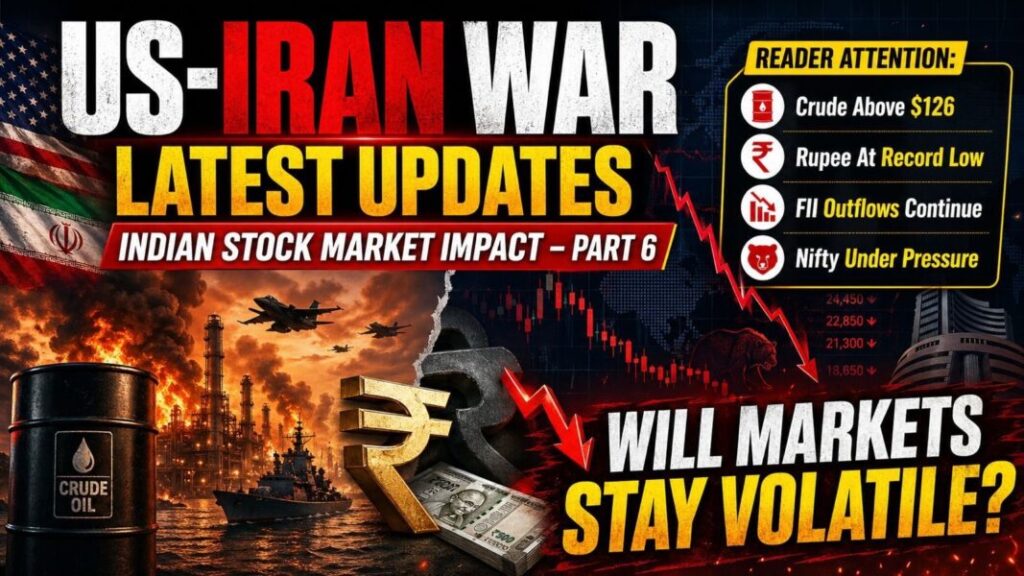
5 Important Points for Reader Attention
- Iran has warned of a painful response if the U.S. renews attacks, showing that the conflict risk is still active despite the ceasefire.
- The Strait of Hormuz remains the biggest global trigger, and Reuters says about 20% of global oil and gas supplies pass through it.
- Brent crude surged above $126 a barrel on April 30, which is a four-year high and a clear inflation risk for oil-importing economies like India.
- The rupee hit a record low of 95.33 per dollar intraday before recovering slightly, showing how sensitive Indian assets remain to oil and risk-off sentiment.
- Indian shares had a strong April overall, but the last session of the month still showed weakness, proving that the rebound remains vulnerable to fresh war headlines.
US-Iran War Latest Updates
- The current situation is best described as:
- not a full peace
- not a full restart of war
- but a tense pause with real escalation risk still alive.
- Reuters reported that:
- Iran threatened “long and painful strikes” if Washington renews attacks
- the U.S. is still seeking international support to reopen the Strait of Hormuz
- the broader conflict remains unresolved.
- That means markets are not pricing full relief.
- They are pricing:
- uncertainty
- possible oil disruption
- elevated geopolitical premium
- fragile global risk appetite.
Why the Strait of Hormuz Is the Real Market Trigger
- The Strait of Hormuz matters because it is one of the most important energy routes in the world.
- Reuters says around one-fifth of global oil and gas supply moves through it.
- So when that route is disrupted, global markets immediately worry about:
- oil shortages
- shipping delays
- higher insurance costs
- inflation
- weaker global growth.
- For Indian investors, this is the key transmission line from war to Dalal Street.
- The chain is simple:
- Hormuz stress
- oil spike
- rupee pressure
- inflation fear
- equity volatility.
Crude Oil Impact on Indian Stock Market
- Brent crude briefly rose above $126 a barrel on April 30.
- That matters because higher oil usually creates pressure on India through:
- fuel costs
- transport costs
- imported inflation
- margin compression
- weaker macro sentiment.
- Even if oil cools later, the damage is not fully gone because markets start discounting:
- inflation risk
- policy pressure
- slower growth
- more volatility in earnings forecasts.
- That is why oil remains the single biggest short-term indicator for this story.
Rupee Pressure and Currency Warning
- The rupee touched a record low of 95.33 per U.S. dollar and later closed around 94.91 on April 30.
- Reuters also reported the rupee is down more than 5% in 2026 so far.
- A weak rupee hurts sentiment because it signals:
- rising external stress
- higher imported inflation
- pressure on overseas investors
- possible RBI intervention
- more caution in risk assets.
- Reuters further reported that the RBI’s short-dollar forward book reached a record $104 billion in March, showing how aggressively the central bank has been defending the currency backdrop.
Indian Stock Market Impact – What Happened Recently
- On April 30, Reuters reported:
- Nifty 50 closed at 23,997.55
- Sensex closed at 76,913.50
- both indices fell around 0.75% on the day.
- At the same time, April was still a very strong month overall:
- Nifty rose 7.5%
- Sensex rose 6.9%
- this was the best month for Indian benchmarks since December 2023.
- That creates an important mixed picture:
- the market has already bounced hard
- but the rally is not fully trusted
- one fresh oil spike can quickly change sentiment again.
FII Activity and Investor Sentiment
- Reuters reported that foreign investors pulled more than $20 billion from Indian equities in the first four months of 2026.
- That is a major negative signal because heavy outflows usually mean:
- less support for broad rallies
- greater sensitivity to global cues
- weaker confidence in emerging market risk
- added pressure on the rupee.
- In simple terms:
- domestic investors may support the market
- but sustained FII selling makes rallies more fragile.
This last line is an inference based on the reported outflows and market behavior.
Sector-Wise Impact on Indian Stocks
- Reuters reported that all 16 major sectors gained in April despite the late-month wobble.
- Some of the strongest April performers were:
- Energy
- Metals
- Financials
- FMCG
- broader mid-cap and small-cap pockets.
- Reuters specifically noted:
- metal index rose 15.2%
- energy index gained strongly
- financials climbed 9.1%
- small- and mid-caps outperformed large caps in April.
- Still, going forward, the more vulnerable sectors are likely to be:
- airlines
- logistics
- chemical names with imported inputs
- fuel-sensitive consumption plays
- transport-heavy businesses.
This is an inference based on the oil and currency pressure described in Reuters reporting.
Management of Risk: What Investors Should Watch
- The most important triggers now are:
- Brent crude
- rupee stability
- Hormuz developments
- fresh U.S.-Iran military headlines
- FII flow direction.
- If these factors improve together:
- Indian markets can remain supported.
- If they worsen together:
- volatility can return very quickly.
This is an inference from how markets reacted through April.
- volatility can return very quickly.
Indian Stock Market Forecast – Part 6
Bullish Case
- Indian markets can extend the rebound if:
- crude cools below current stress zones
- the rupee stabilizes
- no fresh attacks happen
- Hormuz tensions ease
- foreign selling slows.
- In that case:
- quality large caps
- stronger financials
- defensives
- select domestic leaders
may continue to attract buying.
This is an inference from April sector performance and broader sentiment.
Neutral Case
- The most likely short-term case looks like:
- market remains volatile
- sentiment improves one day, weakens the next
- crude drives mood
- stock-specific action becomes more important than index conviction.
- This means:
- not a clean crash
- not a clean bull run
- more of a headline-driven market.
Bearish Case
- The bearish setup returns if:
- ceasefire conditions weaken
- Hormuz stays blocked longer
- Brent spikes again
- rupee falls further
- FII selling intensifies.
- In that situation:
- inflation fear rises
- RBI pressure increases
- market valuation comfort reduces
- traders become defensive again.
Final Reader Takeaway
- The US-Iran war impact on Indian stock market remains strong because the market is still trading on:
- crude oil shock
- rupee stress
- foreign outflows
- geopolitical risk premium.
- April’s rebound was meaningful.
- But the latest data still does not support blind bullishness.
- The smarter approach right now looks like:
- cautious optimism
- selective stock picking
- strict risk control
- close tracking of oil and rupee.
The final sentence is an inference based on the Reuters-reported market backdrop.
5 FAQs
Q1. Is the US-Iran war still affecting Indian markets?
- Yes.
- Oil prices, the rupee and foreign investor sentiment are still reacting to the conflict and the Hormuz situation.
Q2. Why is crude oil the biggest trigger for India?
- Because higher crude quickly affects inflation, import costs, currency stability and market sentiment.
Q3. What were the latest closing levels mentioned in this article?
- Nifty 50: 23,997.55
- Sensex: 76,913.50
Q4. Why is the rupee falling?
- Mainly because of oil surge, external risk aversion and heavy foreign outflows. Reuters reported the rupee hit a record low of 95.33 intraday on April 30.
Q5. What should investors monitor next?
- Watch:
- Brent crude
- Hormuz updates
- rupee movement
- FII flows
- any fresh war escalation.
This is an inference based on the latest market drivers.
Further reading
US-Iran War Latest Updates and Stock Market Impact – Part 5
US-Iran War Latest Escalations and Stock Market Impact – Part 4
US-Iran War Risk and the Indian Stock Market
Indian Markets Post Market Report Today (Apr 30, 2026)
Stock Market 101 – Lesson 27: Auditor Report & Qualifications
Q4 Results FY26: 5 Important Indian Stocks
Disclaimer
- This article is for educational and informational purposes only.
- It is not investment advice or a recommendation to buy or sell any security.
- Geopolitical events can move markets sharply and unpredictably.
- Please consult a registered financial advisor before making investment decisions.