
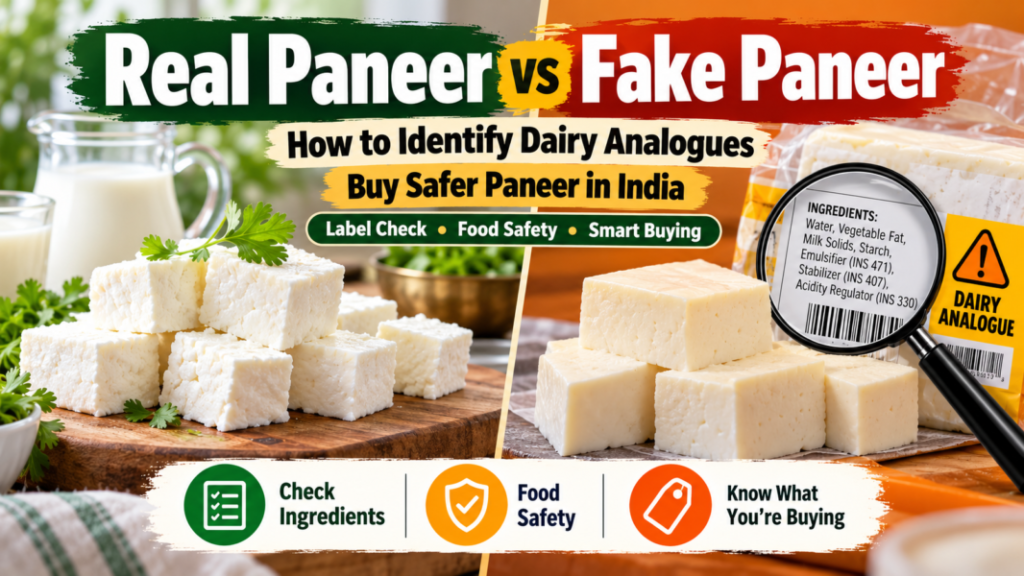
Real Paneer vs Fake Paneer: How to Identify Dairy Analogues and Buy Safer Paneer in India
Paneer is one of the most familiar protein foods in Indian homes. It goes into curries, rolls, sandwiches, salads and restaurant dishes.
But in 2026, one question is getting more attention: is the paneer you are buying actually paneer?
That concern became more relevant after FSSAI proposed a draft amendment on 24 September 2026 aimed at stopping non-milk-derived products from being marketed using the word “paneer”. Under the proposal, products licensed or registered under the “Analogue in Dairy Context” category would have to stop using “Paneer” in their name, label or marketing.
This does not mean every cheap paneer is fake or unsafe. It also does not mean every dairy analogue is poisonous.
The real issue is transparency.
If a product is made with vegetable fat, vegetable protein or other substitutes instead of the milk ingredients consumers expect, the buyer should be able to tell that clearly.
So how can you identify real paneer vs fake paneer, what should you check on a packet, and can popular home tests actually prove anything?
Let us separate useful information from viral tricks.
What Is Real Paneer According to FSSAI?
Under FSSAI standards, paneer is a product made from milk, with or without added milk solids, by heating and precipitating it using permitted acidulants such as citric acid, lactic acid or vinegar.
In simple terms, traditional paneer starts with milk.
The milk proteins separate into curds after acidification and heating. The curds are drained and pressed to form paneer.
FSSAI’s standard also sets compositional requirements. Regular paneer is required to meet limits for moisture and milk fat on a dry-matter basis.
That is different from a product in which some or all of the dairy fat or dairy protein has been replaced with vegetable-derived ingredients.
What Is a Dairy Analogue?
The word “analogue” sounds technical, but the idea is simple.
A dairy analogue is a product designed to resemble a dairy food while replacing part or all of certain milk components with ingredients that do not come from milk.
For example, a paneer-like product may use:
- Vegetable oil or vegetable fat
- Soy protein or another vegetable protein
- Starch or other texturising ingredients
- A combination of dairy and non-dairy ingredients
Existing FSSAI guidance for dairy analogues requires declarations when milk fat or milk protein is partly or fully replaced. Labels may need statements such as “Contains Soy Protein”, “Contains Mixed Vegetable Fat” or “Contains no Milk Fat”, depending on the formulation.
That is why the ingredient list matters more than whether the product looks white and soft.
FSSAI Paneer Standards and Dairy Analogue Rules
Why Did FSSAI Propose New Paneer Rules in September 2026?
FSSAI’s September 2026 draft proposal specifically targets products made from constituents not derived from milk but marketed as paneer.
The regulator said the aim is to prevent misleading presentation and make sure the product name reflects what the food is actually made from.
Under the proposal, products already registered or licensed under the “Analogue in Dairy Context” category would be required to stop using “Paneer” in their nomenclature, labelling or marketing.
One detail matters here:
This is still a draft proposal as of October 2026.
FSSAI invited objections and suggestions, with the proposal to be considered after the prescribed consultation period.
So consumers should not treat the proposal as if the final rule has already been implemented nationwide.
PIB – FSSAI Draft Proposal on Non-Milk Products Sold as Paneer
Real Paneer vs Fake Paneer: The Terms Can Be Misleading
“Fake paneer” is a popular phrase, but it can refer to different things.
These are not all the same problem.
| Product | What it means | Main concern |
|---|---|---|
| Standard paneer | Made according to paneer standards using milk | Hygiene and freshness |
| Dairy analogue | Some/all milk components replaced | Correct labelling and consumer awareness |
| Adulterated paneer | Undeclared substances added or composition manipulated | Food fraud and possible safety issue |
A properly labelled non-dairy or partly dairy analogue is different from an illegally adulterated product pretending to be standard paneer.
That distinction is important.
A vegetable-fat-based analogue is not automatically unsafe simply because it is not traditional paneer. But selling it as paneer without clear disclosure can mislead someone who expects the nutrition and ingredients of a milk-based product.
Why Does the Difference Matter Nutritionally?
People often buy paneer partly because they see it as a dairy protein source.
Milk-based paneer naturally provides protein along with calcium and fat.
If a product substitutes milk protein with starch or another ingredient, the nutritional profile can be very different.
Even an analogue containing vegetable protein may not have the same protein, fat or calcium profile as standard paneer.
That is why front-of-pack appearance is not enough.
Check the nutrition panel and ingredient list.
If two blocks look identical but one contains mainly milk and another contains vegetable fat, starch and soy protein, they are not nutritionally identical products.
How to Read the Ingredient Label
For packaged paneer, start here before trying any home experiment.
A short ingredient list is usually easier to understand
A typical plain paneer ingredient list may include:
Milk, permitted acidulant
Some products may use milk solids as permitted under standards.
A longer ingredient list does not automatically mean the food is unsafe, but it should tell you what you are actually buying.
Be more alert if you see ingredients such as:
- Vegetable oil
- Palm oil
- Vegetable fat
- Soy protein
- Added starch
- Non-dairy protein
If these are being used to replace expected milk components, the product may fall into the analogue category rather than being standard paneer.
FSSAI already has specific labelling provisions for analogues, including declarations about non-milk constituents replacing milk components.
Look for the FSSAI Licence or Registration Number
Packaged foods sold by regulated food businesses normally carry FSSAI identification details.
The 14-digit FSSAI licence or registration number helps identify the food business responsible for the product.
You can use FSSAI’s consumer services to verify a business or lodge a complaint if you suspect misleading labelling or adulteration. FSSAI also states that consumers can have products tested through notified laboratories or report them to food-safety authorities.
A licence number does not guarantee that every batch is perfect, but a properly labelled product from a traceable manufacturer gives you more accountability than an anonymous loose block.
FSSAI Food Safety Connect – Verify Licence or File a Complaint
What About Loose Paneer From a Local Shop?
Loose paneer is common in India and can be perfectly genuine.
But it gives you fewer pieces of information.
There may be:
- No ingredient list
- No nutrition panel
- No manufacturing date on the block
- No direct consumer-facing licence information
- No clear storage history
That does not automatically make it unsafe.
Instead, judge the seller.
Buy from a shop with good turnover, refrigeration and visible hygiene. Ask whether the paneer is made in-house or supplied by a dairy. If possible, ask for the supplier or manufacturer details.
Very cheap pricing compared with local milk prices can justify extra caution, although price alone cannot prove adulteration.
Can You Identify Real Paneer by Touch or Taste?
Not reliably.
Consumers often hear advice such as:
- Real paneer should crumble easily
- Fake paneer feels rubbery
- Real paneer tastes creamy
- Fake paneer squeaks when chewed
- Real paneer should break when pressed
These observations may sometimes give clues about texture, moisture or processing.
They cannot confirm composition.
Paneer texture changes depending on:
- Type of milk
- Fat content
- Acidity
- Heating temperature
- Pressing
- Moisture level
- Refrigeration
- Age of the product
A perfectly genuine low-fat or heavily pressed paneer can feel firm or rubbery.
A cleverly formulated analogue can feel soft.
Texture is not a laboratory test.
What About the Iodine Test for Starch?
This is one of the few home checks with a clear chemical basis.
FSSAI’s DART consumer material describes a test for starch in milk products including paneer. The sample is boiled with water, cooled, and tincture of iodine is added. A blue colour indicates the presence of starch.
But this test has an important limitation.
It detects starch. It does not prove whether a product is dairy paneer or a dairy analogue.
A paneer sample can contain no starch and still contain substituted vegetable fat.
And a home test performed incorrectly may produce confusing results.
So the iodine test can be a screening check for one specific adulterant. It is not a universal “real paneer test”.
Why Viral Home Tests Are Often Unreliable
You may have seen videos claiming you can identify fake paneer by:
- Burning it
- Rubbing it between your fingers
- Dropping it in hot water
- Checking whether it floats
- Looking for a colour change with random household ingredients
- Judging whether it melts or crumbles
These methods are usually too crude to establish composition.
A food laboratory can measure milk fat, protein, moisture and other chemical markers under controlled conditions.
Your kitchen cannot reliably tell whether fat came from milk or vegetable oil just by looking at how the paneer behaves in a pan.
FSSAI does publish selected home adulteration tests for certain substances, but those tests are targeted screening methods, not a replacement for formal laboratory analysis.
That difference gets lost on social media.
FSSAI Food Products Standards Compendium
Is Fake Paneer Dangerous?
The answer depends on what “fake” means.
Properly made dairy analogue
If it uses permitted food ingredients, is manufactured hygienically and is accurately labelled, it is not automatically unsafe.
The concern is that consumers should know what they are purchasing.
Adulterated or illegally manufactured paneer
This is a different issue.
Undeclared ingredients, unsafe colours, poor-quality fats, contaminated water or unhygienic processing can create food-safety problems.
Spoiled genuine paneer
Real milk paneer can also make you sick if it has been stored badly.
Authenticity and safety are related, but they are not the same thing.
How to Buy Safer Paneer in India
A few habits are more useful than viral home tests.
- Buy packaged paneer from recognised or traceable manufacturers when practical.
- Check the ingredient list rather than relying only on the front label.
- Look for milk as the main dairy ingredient.
- Check for declarations such as vegetable fat, vegetable protein or analogue terminology.
- Check the FSSAI licence or registration information.
- Review the manufacturing and use-by dates.
- Make sure chilled paneer is being stored under refrigeration.
- Avoid packets that are swollen, leaking or damaged.
- For loose paneer, choose shops with good refrigeration, hygiene and rapid stock turnover.
- Refrigerate paneer promptly after purchase.
The main idea is simple: traceability, labelling and proper storage tell you more than squeezing the paneer between your fingers.
Does Homemade Paneer Solve the Problem?
Homemade paneer gives you control over the ingredients.
If you start with good-quality milk, you know vegetable fat has not secretly replaced the milk fat.
But homemade does not automatically mean safer.
Milk quality, hand hygiene, clean utensils, safe water, refrigeration and storage still matter.
Food can become contaminated in a home kitchen just as it can in commercial settings if hygiene is poor.
So homemade paneer may improve ingredient transparency, but basic food safety still applies.
Common Myths About Real and Fake Paneer
“If paneer is very white, it must be fake”
Not necessarily.
Colour varies with milk type, fat composition and processing.
“Rubbery paneer always contains chemicals”
No.
Overcooking, low moisture or heavy pressing can also produce a rubbery texture.
“Cheap paneer is definitely fake”
Price can raise questions, especially if it seems unusually low, but it is not proof.
“The iodine test tells me if paneer is real”
No.
It checks specifically for starch when performed correctly.
“All analogue paneer is poisonous”
No.
An analogue and an adulterated unsafe product are not automatically the same thing. The regulatory concern is partly about honest naming and ingredient disclosure.
FoSCoS – Dairy Products and Analogue Categories
When Should You Report a Paneer Product?
Consider reporting it if:
- A product labelled paneer clearly lists replacement vegetable fats or proteins without appropriate disclosure
- The food smells spoiled despite being within date
- Packaging appears tampered with
- The seller refuses to provide basic manufacturer information
- You suspect adulteration
- Several people develop symptoms after eating the same product
FSSAI’s Food Safety Connect system allows consumers to raise food-safety complaints, and consumers may also seek testing through notified laboratories.
For severe vomiting, persistent diarrhoea, dehydration, blood in stools, high fever or other significant symptoms after eating food, seek medical attention rather than relying on home remedies.
Frequently Asked Questions
Q1. What is the easiest way to tell if packaged paneer is real?
Read the ingredient list. Standard paneer should be milk-based. If vegetable fat, vegetable protein or other milk replacements are present, check how the product is described and labelled.
Q2. Is analogue paneer the same as adulterated paneer?
Not necessarily. A dairy analogue can be intentionally manufactured with non-milk ingredients and labelled accordingly. Adulteration involves undeclared substitution, contamination or failure to meet applicable standards.
Q3. Does FSSAI plan to ban fake paneer?
FSSAI issued a draft amendment on 24 September 2026 proposing that products made from non-milk-derived constituents should not be represented or marketed using the term “Paneer”. The proposal was still in the consultation process as of October 2026.
Q4. Can iodine identify fake paneer?
Iodine can be used as a screening test for starch. A blue colour can indicate starch, according to FSSAI’s DART guidance. It cannot establish whether every other ingredient in the product is genuine milk-derived paneer.
Q5. Is packaged paneer safer than loose paneer?
Not automatically. Packaged paneer generally provides better traceability through labelling, manufacturing details and licence information. Loose paneer can also be safe if it comes from a hygienic, reliable source and is stored correctly.
Final Takeaway
The debate around real paneer vs fake paneer is not simply about whether a block is soft, white or cheap.
The better question is: what is it made from, how is it labelled, and can the seller be traced?
FSSAI’s September 2026 proposal reflects exactly that concern. Products made using non-milk-derived substitutes should not be able to look like paneer, be called paneer and leave consumers guessing about what they are buying.
For shoppers, ingredient labels, FSSAI identification, refrigeration and trusted sellers are far more useful than viral “burn tests” or texture tricks.
And if you genuinely suspect adulteration, laboratory testing or an official food-safety complaint is the proper route.
Further Reading
Vitamin D Deficiency in India: Symptoms, Food Sources, Sunlight and When to Get Tested
Fibermaxxing Diet: Is the Viral High-Fibre Food Trend Actually Healthy?
Monsoon Diet 2026: Foods to Eat and Avoid During the Rainy Season
How Much Protein Do You Really Need Every Day?
Healthy Indian Food Combinations Explained: Dal Rice, Curd Jeera and Turmeric Pepper

Health Disclaimer
This article is for general informational and educational purposes only. It is not a substitute for professional medical advice, diagnosis or treatment. Food regulations may change after draft consultations, so consumers and food businesses should refer to the latest FSSAI notifications for current legal requirements.
Article Information
Author: Kartalks Editorial Team
Reviewed by: Kartalks Health Content Desk
Content Type: Food safety awareness, paneer buying guide, dairy analogue explanation, packaged food label reading, consumer awareness, nutrition awareness, and general public health information
Sources: FSSAI, food safety guidelines, packaged food labelling rules, consumer awareness resources, nutrition references, dairy product information, and official public sources
Last Updated: October 11, 2026