
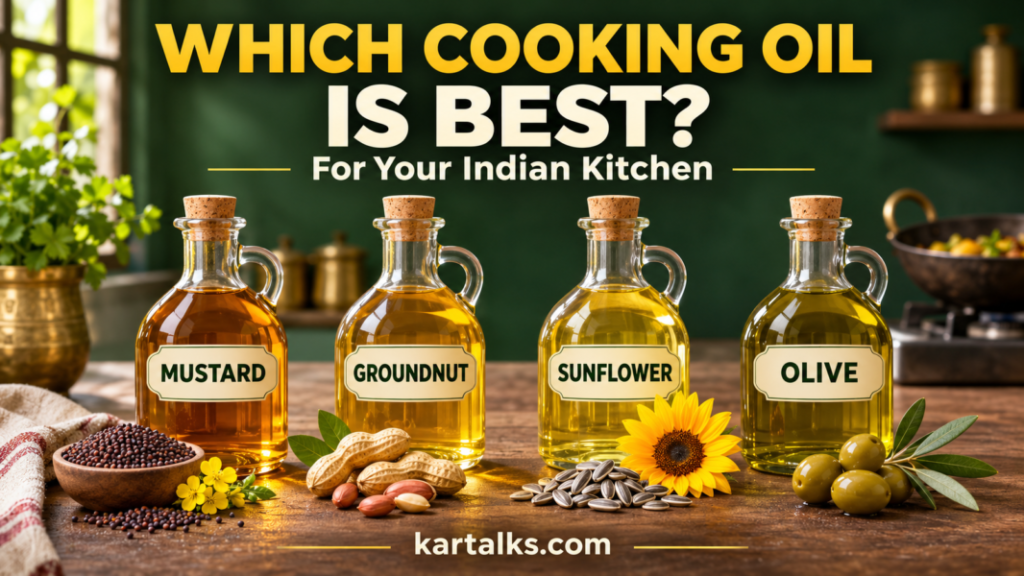
Which Cooking Oil Is Best for Indian Cooking? Mustard, Groundnut, Sunflower and Olive Oil Compared
Stand in the cooking-oil aisle for five minutes and the choice can become confusing. One bottle says “heart-friendly”, another says “cold-pressed”, and a third costs twice as much.
Meanwhile, you need something for tomorrow’s dal and sabzi.
The best oil for Indian cooking depends on what you cook, the flavour you enjoy and your budget. Mustard, groundnut, sunflower and olive oil can all have a place. None makes unlimited pouring or frequent deep-frying healthy.
For many households, a familiar edible oil used sensibly is a better starting point than an expensive bottle bought on a health promise.
How to choose the best oil for Indian cooking
Look beyond the brand name. Ask three questions:
- Does its flavour suit our usual meals?
- Is this particular oil suitable for the cooking method?
- How much oil does our household actually use?
Nutrition matters too. WHO recommends replacing saturated and trans fats with unsaturated fats. This supports choosing suitable liquid vegetable oils more often instead of relying heavily on butter, ghee or vanaspati. It does not mean adding extra oil to an already oily meal.
You may see two terms on labels: MUFA, meaning monounsaturated fat, and PUFA, meaning polyunsaturated fat. Both are types of unsaturated fat.
Here is a practical comparison.
| Oil | Fat profile and flavour | Useful kitchen role |
|---|---|---|
| Mustard | Rich in MUFA; also supplies PUFA, including plant omega-3; pungent flavour | Regional sabzis, fish preparations and dishes where mustard flavour belongs |
| Groundnut | Supplies MUFA and PUFA; refined versions are milder | Everyday cooking, sautéing and occasional frying with a suitable grade |
| Sunflower | Regular varieties are rich in omega-6 PUFA; usually neutral | Everyday dishes where you want the spices to lead |
| Olive | Rich in MUFA; flavour varies by grade | Sautéing, roasting, dressings and everyday cooking when taste and budget suit |
These are broad descriptions. Seed variety, processing and the specific product affect composition and cooking performance.
Mustard oil: useful when you want its flavour
For many Bengali and North Indian dishes, mustard oil is part of the recipe’s identity. Replacing it changes the taste, even if the rest of the ingredients stay the same.
Its unsaturated-fat profile makes it a reasonable option within a varied diet. ICMR guidance includes mustard and groundnut among MUFA-rich cooking oils.
Buy edible mustard oil labelled for food use from a reliable seller. An oil intended for massage or external use is not a cooking substitute.
There is also no need to keep oil smoking heavily to prove that it is ready. Control the heat and follow the recipe without prolonged overheating.
A practical choice if: your family enjoys its pungency and regularly cooks dishes that suit it.
It need not become your only oil.
Groundnut oil: a practical everyday option
Groundnut oil works well for households cooking a mix of dal, poriyal, curries and pan-cooked dishes.
Refined groundnut oil has a milder taste and is suited to higher-temperature cooking. Filtered or cold-pressed versions can have a stronger peanut flavour; follow their cooking instructions rather than assuming every bottle performs identically.
Its useful cooking properties do not make a plate of deep-fried snacks a daily health food.
A caution for peanut allergy
Unrefined groundnut oil can retain peanut proteins and cause allergic reactions. Highly refined oil has much less allergenic protein, but someone with peanut allergy should seek individual advice rather than test it at home. If the product’s refinement is unclear, choose an alternative.
A practical choice if: you want a versatile oil and there is no relevant allergy restriction.
Sunflower oil: check which type you are buying
Sunflower oil’s neutral taste is helpful when you do not want the oil competing with the dish.
Regular sunflower oil is rich in linoleic acid, an omega-6 fat. Omega-6 is an essential dietary fatty acid; its presence alone is not a reason to label an oil unhealthy. WHO includes sunflower oil among sources of preferable unsaturated fats.
However, high-oleic sunflower oil is different. It contains more monounsaturated oleic acid and generally has better resistance to oxidation during heating than conventional sunflower oil. The label needs to specify this; do not assume it from the brand name. Oklahoma State University
Neither version should be repeatedly overheated.
A practical choice if: you prefer a neutral oil. Include different fat sources across meals rather than expecting one bottle to provide everything.
Olive oil: cooking is allowed
Extra-virgin olive oil is not restricted to salads.
UC Davis guidance explains that it can be used for cooking. Its heat performance depends on quality, freshness and grade, so a blanket claim that olive oil becomes unsafe whenever heated is misleading.
Extra-virgin or regular olive oil?
Extra-virgin olive oil has more distinctive flavour and retains more naturally occurring phenolic compounds. Try it in sautéed vegetables, cooked beans, dressings or a simple dal if you enjoy the taste.
Regular or light-tasting olive oil is milder. “Light” describes its character, not fewer calories.
All four oils supply roughly nine calories per gram. A more expensive bottle does not offer permission to pour freely. UC Food Quality
A practical choice if: you like it and can comfortably afford it. You do not need olive oil to cook balanced Indian meals.
Cold-pressed or refined: which should you buy?
Cold-pressed oils can offer distinctive flavour and retain some compounds reduced during refining. Refined oils generally have a milder taste and may suit higher-temperature cooking better.
Neither label settles the whole health question.
Consider the original oil, its quality, storage and intended use. A fresh, appropriately used refined oil is not automatically a poor choice, and “wood-pressed” does not make repeated frying safe.
A bottle’s smoke point is useful information, but it is not a complete health ranking. Heating time and the oil’s composition matter too.
How much oil is reasonable?
ICMR–NIN gives about 27–30 grams of visible fat daily for a 2,000-calorie diet as an example. Requirements vary with activity, age and other needs. This is guidance for added fats together, including cooking oil, ghee and butter—not a separate allowance for each. nin.res.in
It is also not the same as total dietary fat: nuts, seeds, dairy and other foods contribute fat too.
For a useful first step, measure the oil going into your usual meals. If a four-serving curry contains four teaspoons, that is approximately one teaspoon per serving before counting other dishes.
A measuring spoon often helps more than changing brands.
The habits that matter after buying
Even a suitable oil needs sensible handling.
- Avoid repeated deep-frying in the same oil. FSSAI warns that deterioration occurs during repeated heating.
- Do not freshen old frying oil by topping it up.
- Discard degraded oil. Persistent foaming, an unpleasant smell or marked changes in appearance are warning signs.
- Store bottles tightly closed, away from the stove and sunlight.
- Buy quantities you can use while fresh. A large bargain container is less useful if it sits open for months. fssai.gov.in
For a straightforward shopping decision, choose mustard when its flavour belongs in your meals, groundnut for versatility, sunflower for neutrality, or olive oil when you enjoy it. Using different oils across dishes is reasonable; there is no need for a rigid weekly rotation timetable.
Five questions readers often ask
Q1. Do I need to change my cooking oil every month?
No fixed monthly schedule is necessary. ICMR–NIN encourages variety in oils. You can achieve that through different dishes or purchases without creating a complicated calendar.
Q2. Which oil should I use if my cholesterol is high?
Replacing saturated fats with unsaturated fats is the better-supported principle. The amount used and your wider diet matter. Seek personalised advice if you have high cholesterol or heart disease; changing oil does not replace prescribed treatment. American Heart Association
Q3. Does “cholesterol-free” mean an oil is healthier?
Ordinary plant oils naturally contain no cholesterol. The claim does not tell you which has the better fat profile or suits your cooking method.
Q4. Can I mix two oils at home?
Mixing does not guarantee a nutritional advantage or make an oil tolerate more heat. Using suitable oils separately in different dishes is simpler. Follow the instructions on any packaged blend.
Q5. Which of these oils helps with weight loss?
None causes weight loss by itself. Their calorie content is similar, so measuring portions matters more than choosing a bottle marketed as “light”.
Choose an oil that fits your kitchen, use it with care, and give the rest of the plate equal attention.
Further Reading
Jaggery vs Sugar: Is Your Daily Chai Really Healthier With Gud?
High-Protein Biscuits, Bars and Drinks: Are These Packaged Foods Really Healthy?
Healthy Indian Food Combinations Explained: Dal Rice, Curd Jeera and Turmeric Pepper
Article Information
Author: Kartalks Editorial Team
Content Type: Food and health awareness, Indian cooking oil comparison, mustard oil, groundnut oil, sunflower oil, olive oil, healthy fats, saturated and unsaturated fats, smoke point awareness, heart health, cooking methods, nutrition education, and consumer buying guidance
Sources: ICMR-NIN Dietary Guidelines for Indians, FSSAI food safety and edible oil standards, WHO healthy diet guidance, nutrition research references, and official public health resources
Last Updated: November 22, 2026
Health disclaimer:
This article is for general informational and educational purposes only. It is not a substitute for professional medical advice, diagnosis or treatment. Consult a qualified healthcare professional for advice about allergies, medical conditions or individual dietary needs.