
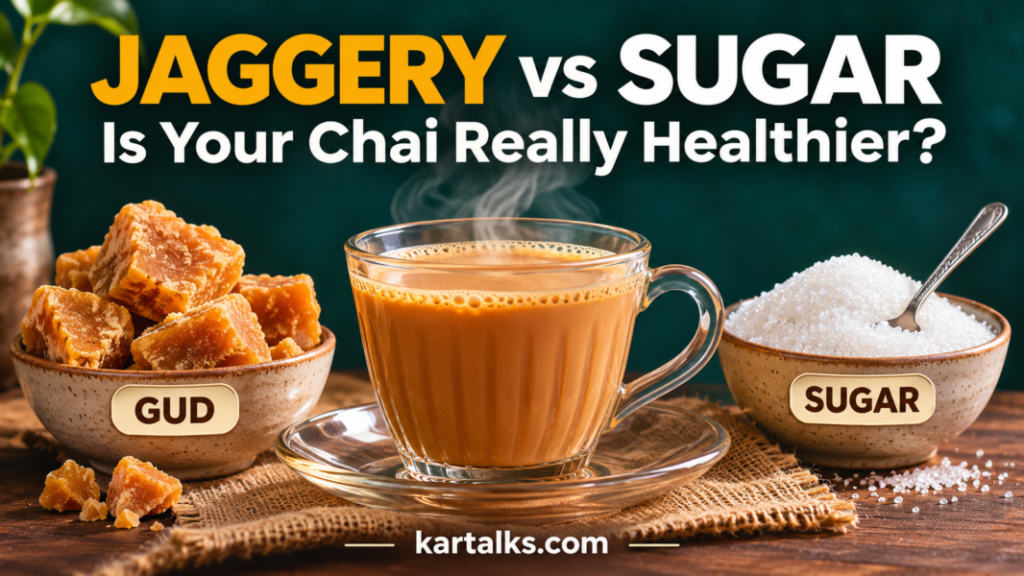
Jaggery vs Sugar: Is Your Daily Chai Really Healthier With Gud?
“No sugar, just a little jaggery.”
You hear versions of this in homes across India. The sugar jar gets pushed aside, gud takes its place, and the morning chai suddenly feels like a healthier choice.
But does that small kitchen swap make much difference?
The jaggery vs sugar comparison has a fairly simple answer: jaggery retains some minerals that white sugar largely lacks, but both are concentrated sweeteners. Replacing sugar with gud does not automatically make chai suitable for diabetes or weight loss.
There is room to enjoy its flavour. The amount you use still matters.
Jaggery vs sugar: what actually changes?
White sugar is mainly sucrose. During production, sugar is separated and refined into the familiar crystals we spoon into tea.
Cane jaggery is made by concentrating sugarcane juice and allowing it to set, or processing it into granules. It retains more of the juice’s non-sugar components, giving it a deeper flavour and some minerals. Palm jaggery comes from palm sap and has a different composition.
This article mainly compares ordinary cane jaggery with white table sugar.
“Less refined” describes how a food is made. It does not mean the finished product is low in sugar. PMC
A small-portion nutrition comparison
Most people do not put 100 grams of either sweetener into one cup. A smaller comparison is more useful.
| What you are comparing | White sugar | Cane jaggery |
|---|---|---|
| Calories in 10 grams | About 40 kcal | Roughly 35–38 kcal |
| Main nutritional contribution | Sugar and energy | Sugar and energy |
| Minerals | Negligible amounts | Some iron, calcium and other minerals; amounts vary |
| When added to chai | Counts towards free sugars | Counts towards free sugars |
These are approximate figures. Jaggery varies with moisture, raw material and processing, so check the product label where available. The calorie estimates come from food composition and dietary exchange data. Dietary Advice
The difference at this portion is only a few calories. Adding a larger piece of gud can easily cancel it out.
Does gud offer any real nutritional benefit?
It does retain some minerals. That is a genuine difference, although it needs context.
A nutrient figure quoted for 100 grams can sound impressive. Your cup of chai contains only a small fraction of that amount, so the mineral contribution is much smaller too. Jaggery remains predominantly a source of sugar despite its mineral content. patient.info
Eating more jaggery to obtain more iron also means eating more sugar. That makes it a poor strategy for improving an otherwise low-iron diet.
For someone who enjoys its caramel-like taste, jaggery can be a flavour choice. If that stronger flavour helps you use less sweetener, the reduction could be useful. It is the smaller amount doing the work.
What about anaemia and “better digestion”?
Jaggery is often recommended at home for low haemoglobin, digestion or a feeling of weakness. These traditional uses should be separated from established treatment.
Research discussing its minerals, plant compounds or traditional uses does not, by itself, prove that a spoonful in chai treats anaemia or improves digestion.
Persistent tiredness or diagnosed iron deficiency deserves medical assessment. Do not replace prescribed iron treatment with gud.
Similarly, enjoying a little jaggery after lunch is a food preference. Claims that it “cleans the lungs”, removes toxins or guarantees better digestion should not be presented as proven benefits.
Can people with diabetes replace sugar with jaggery?
Jaggery is not a diabetes-safe substitute for sugar.
It contains sugars that can raise blood glucose. Its minerals do not cancel out that effect. Indian government diabetes guidance specifically cautions against treating honey or jaggery as a better option for blood glucose control. ncdc.mohfw.gov.in
So, “I stopped sugar but now use two spoons of gud” may change the taste without solving the original concern.
For people with diabetes, prediabetes or gestational diabetes, the portion and total carbohydrate intake need attention. A doctor or registered dietitian can help decide how sweetened drinks fit into an individual eating plan.
Being on diabetes medication does not make freely adding jaggery harmless. Equally, switching sweeteners is not a reason to change medication yourself.
How much sweetness is already in your daily chai?
Consider a common routine: morning tea, another cup at work and an evening cup at home.
If each contains two level teaspoons of white sugar, that is roughly 24 grams across the day, assuming about four grams per teaspoon. Biscuits, sweets and other drinks would add more.
This is an illustration, not an estimate of everyone’s intake. Household spoons differ.
WHO recommends keeping free sugars below 10% of daily energy intake and suggests reducing them further to below 5% for additional benefits. For a 2,000-calorie diet, those figures are about 50 grams and 25 grams respectively. The lower figure is a useful reference, not a universal personal prescription.
Free sugars include those added at home and during manufacturing, as well as sugars in honey, syrups and fruit juices. Naturally occurring sugar in plain milk and intact fruit is treated differently. who.int
That means the gud you add to tea still counts. So does the sugar in the biscuits beside it.
Is there a recommended daily serving of jaggery?
There is no need to eat jaggery every day for health.
If you choose to use it, keep it within your total free-sugar intake rather than treating it as an extra allowance. A weighed five-gram portion can help you understand what a small amount looks like; it is not a medically recommended daily dose.
A “small piece” is surprisingly difficult to judge. Weighing your usual piece once may tell you more than repeatedly guessing.
A better chai habit without losing the pleasure
You do not have to give up the ritual of sitting down with a warm cup.
Start with the sweetness level you are used to and reduce it gradually. NHS advice also recommends cutting down sugar in hot drinks this way. NHS
A few practical changes can help:
- Use a measuring spoon. A heaped household spoon makes portions harder to track.
- Reduce a little at a time. Try moving from two spoons to one-and-a-half, then reassess.
- Let flavour carry more of the cup. Ginger, cardamom or cinnamon can make less-sweet chai more enjoyable; they do not cancel sugar.
- Request less sweetener outside. Ask whether tea can be prepared without premixed sugar.
- Notice the snack pairing. Automatically having biscuits with every cup can add sweetness you barely register.
If you prefer gud, measure it too. Replacing a teaspoon of sugar with a large jaggery lump is an easy way to lose track.
Who should take extra care?
People managing blood glucose or trying to reduce excess calorie intake should pay particular attention to portions.
Dental health matters as well. Frequent exposure to sugary foods and drinks increases the risk of tooth decay. Slowly sipping sweetened chai throughout the afternoon keeps exposing teeth to sugar. Having fewer sweetened drinks is a useful change.
During pregnancy, especially with gestational diabetes, follow your care team’s advice rather than assuming a traditional sweetener is automatically suitable.
For children, jaggery should not be used as a routine health supplement. ICMR–NIN guidance advises no added sugar for children under two.
Five questions readers often ask
Q1. Is organic jaggery better for blood sugar?
An organic label concerns production standards. It does not make jaggery sugar-free or establish a special blood glucose benefit. Count it as a sweetener.
Q2. Does boiling gud in tea remove its calories?
No. Dissolving or boiling it does not remove its sugar or energy. Adding it before or after brewing does not turn the drink into a low-sugar option.
Q3. Is honey a healthier replacement in chai?
Honey also contributes free sugars. Choose it for flavour if you enjoy it, while watching the amount. Replacing one sweetener with another does not automatically reduce sugar intake.
Q4. Can I have a little jaggery while trying to lose weight?
A small amount may fit into an individual eating plan. It does not cause weight loss, and replacing equal amounts of sugar with jaggery makes only a modest calorie difference. Your wider eating pattern matters.
Q5. Does jaggery after meals help digestion?
This is a familiar traditional practice, but strong clinical evidence for a digestive benefit from a small serving is limited. Persistent bloating, pain or constipation needs appropriate advice rather than relying on jaggery.
Your daily chai can stay a pleasure. Choose gud if you like its taste, keep the portion modest, and gradually explore how little sweetness you actually need.
Further Reading
High-Protein Biscuits, Bars and Drinks: Are These Packaged Foods Really Healthy?
Festive Season Health Guide: Enjoy Indian Sweets Without Overeating Sugar and Fat
Vitamin D Deficiency in India: Symptoms, Food Sources, Sunlight and When to Get Tested
Fibermaxxing Diet: Is the Viral High-Fibre Food Trend Actually Healthy?
Healthy Indian Food Combinations Explained: Dal Rice, Curd Jeera and Turmeric Pepper
Article Information
Author: Kartalks Editorial Team
Reviewed by: Kartalks Health Content Desk
Content Type: Food and health awareness, jaggery vs sugar comparison, daily chai habits, added sugar intake, calorie awareness, blood sugar impact, nutrition facts, traditional Indian sweeteners, healthier dietary choices, and consumer education
Sources: ICMR-NIN Dietary Guidelines for Indians, FSSAI food safety and nutrition resources, WHO guidelines on sugar intake, Indian Food Composition Tables, and official public health references
Last Updated: November 15, 2026
Health disclaimer:
This article is for general informational and educational purposes only. It is not a substitute for professional medical advice, diagnosis or treatment. Consult a qualified healthcare professional for advice about your health, diet or medication.
Very useful info
Thank you, Srinivas! Glad you found the information useful. We appreciate your continued support!