
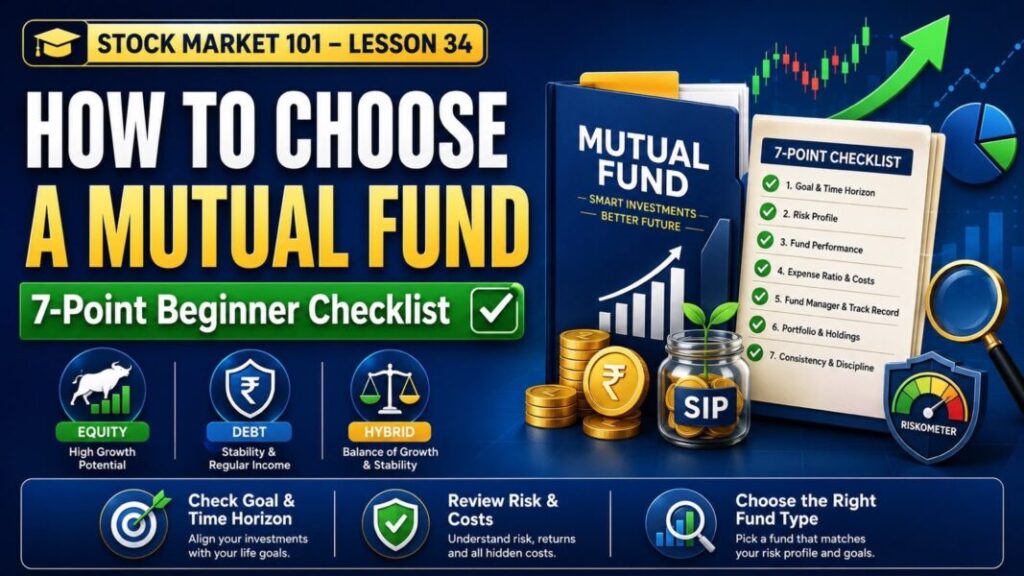
Stock Market 101 – Lesson 34: How to Choose a Mutual Fund: 7-Point Beginner Checklist
Hook
Choosing a mutual fund looks easy until you actually open a mutual fund app.
Suddenly, you see hundreds of fund names.
Large cap, mid cap, small cap, flexi cap, liquid fund, short duration fund, aggressive hybrid fund, balanced advantage fund, index fund, ELSS, sector fund — and every fund looks attractive in some way.
That is where many beginners get confused.
The real question is not “Which fund gave the highest return last year?”
The better question is:
“Which mutual fund suits my goal, time period, and risk comfort?”
That is why this lesson is important. In this guide, we will understand How to Choose a Mutual Fund using a simple 7-point beginner checklist. No complicated language. No guaranteed-return claims. Just practical learning for new investors.
AMFI explains that mutual fund schemes are classified into categories such as equity schemes, debt schemes, hybrid schemes, solution-oriented schemes, index funds, ETFs, and fund of funds. This means mutual funds are not one single product; different categories are created for different needs and risk levels.
How to Choose a Mutual Fund: Simple Beginner Approach
Before choosing a mutual fund, remember one thing clearly:
The fund should match your purpose.
A good fund for one person may not be suitable for another person.
For example:
- A 25-year-old investing for retirement may choose differently.
- A parent saving for school fees after 2 years may choose differently.
- A retired person looking for stability may choose differently.
- A beginner with low risk comfort may choose differently.
So, choosing a mutual fund starts with your own situation, not with someone else’s portfolio.
1. First Decide Your Investment Goal
This is the first and most important step.
Do not start by asking:
“Which fund is best?”
Start by asking:
“Why am I investing?”
Your goal can be:
- emergency planning
- child education
- house down payment
- retirement
- wealth creation
- short-term parking of money
- tax saving
- regular income planning
Once the goal is clear, the fund category becomes easier to choose.
For example:
If the goal is long-term wealth creation, equity mutual funds may be considered by investors who can handle volatility.
If the goal is short-term stability, high-risk equity funds may not be suitable.
If the investor wants a middle path, hybrid mutual funds may be studied.
SEBI investor education material explains that equity funds invest in equity securities, debt funds aim to provide regular income, and hybrid funds invest in a combination of equity and debt securities.
2. Match the Fund With Your Time Horizon
Time horizon means how long you can keep the money invested.
This is very important because every mutual fund category behaves differently.
Simple time-horizon thinking
- Few months: avoid high-risk equity funds
- 1 to 3 years: focus more on stability and lower volatility
- 3 to 5 years: balanced or hybrid options may be studied
- 5 years and above: equity-oriented funds may be considered, depending on risk appetite
This is not a fixed rule for everyone, but it is a practical beginner framework.
Why does time matter?
Because equity markets can be volatile in the short term. If you need money soon and the market falls, you may be forced to exit at the wrong time.
So, before choosing any fund, ask:
“Can I stay invested long enough for this category?”
3. Choose the Right Mutual Fund Category
This is where beginners usually make mistakes.
They pick a fund name before understanding the category.
That is risky.
First understand the category.
Common mutual fund categories
- equity funds
- debt funds
- hybrid funds
- index funds
- ETFs
- ELSS funds
- liquid funds
- sectoral funds
- thematic funds
AMFI’s categorization page clearly lists broad mutual fund categories such as equity, debt, hybrid, solution-oriented, and other schemes like index funds, ETFs, and fund of funds.
Simple category understanding
Equity funds
These invest mainly in stocks. They may offer higher growth potential but come with higher volatility.
Debt funds
These invest mainly in fixed-income instruments. They may be relatively more stable than equity funds but are not risk-free.
Hybrid funds
These invest in a mix of equity and debt. Risk depends on the fund’s actual allocation.
Index funds and ETFs
These try to follow a market index. AMFI explains that index funds and ETFs mirror and closely track a benchmark index.
So, do not buy only because a fund name sounds popular.
First ask:
“Which category does this fund belong to?”
4. Check the Riskometer Before Investing
This is one of the easiest tools for beginners.
The Riskometer shows the risk level of a mutual fund scheme.
SEBI’s investor education page explains that the Riskometer is a risk-measuring tool used in the mutual fund industry to show the risk level of a mutual fund scheme, ranging from low to very high. It is mandatory for asset management companies to display it.
Beginners should check the Riskometer before investing.
Not after investing.
What to ask while checking Riskometer
- Is the fund low risk, moderate risk, high risk, or very high risk?
- Am I comfortable with this level of risk?
- Does this risk level match my goal?
- Can I stay calm if the fund value falls?
This is very important because some fund names sound safe, but their actual risk may be higher than expected.
A beginner should not ignore this.
5. Do Not Choose Only by Past Returns
This is probably the most common mistake.
Many beginners sort funds by 1-year return and choose the top fund.
That is not the right way.
Past return can tell you what happened earlier, but it cannot guarantee future performance.
A fund may have performed well because:
- that sector was in trend
- market conditions favoured that category
- one or two stocks performed very strongly
- risk taken by the fund was higher
- timing helped the fund
So, returns should be checked, but not blindly followed.
Better things to check along with return
- fund category
- risk level
- consistency
- downside behaviour
- expense ratio
- portfolio quality
- fund manager track record
- investment objective
A fund that gives high return with very high volatility may not suit every beginner.
6. Check Costs: Expense Ratio and Exit Load
Costs may look small, but they matter.
Two important costs beginners should know are:
- expense ratio
- exit load
Expense ratio
Expense ratio is the annual cost charged by the fund for managing the scheme.
A lower expense ratio can be useful, especially for long-term investors, but cost should not be the only factor.
A cheap fund is not automatically the best fund.
Exit load
Exit load is charged when investors redeem units before a specified period.
SEBI’s investor education page explains that some funds reduce exit load over time and that certain funds may charge an exit load if units are redeemed within a particular period.
Before investing, always check:
- Is there an exit load?
- How long does it apply?
- What happens if I withdraw early?
- Does my goal require liquidity?
This matters because beginners sometimes invest money they may need soon, and then exit load becomes a surprise.
7. Check Portfolio, Overlap, and Fund Style
After checking goal, time horizon, category, risk, return, and cost, also check what the fund actually holds.
A mutual fund is not just a name.
It is a portfolio.
Check these points
- Which stocks or securities does the fund hold?
- Is the fund too concentrated?
- Does it overlap with your other funds?
- Is it investing according to its stated objective?
- Is it taking too much risk for higher returns?
Portfolio overlap is especially important.
For example, if you already hold three large-cap funds, they may hold many of the same top companies. Buying too many funds does not always mean better diversification.
Sometimes it only creates duplication.
So, beginners should avoid collecting too many funds without understanding what is inside them.
Simple 7-Point Mutual Fund Checklist
Here is the full checklist in one place.
Before choosing a mutual fund, ask these 7 questions:
1. What is my goal?
Is it retirement, education, emergency money, tax saving, or wealth creation?
2. What is my time horizon?
Do I need this money in months, years, or after a long period?
3. Which fund category suits this goal?
Equity, debt, hybrid, index, ETF, ELSS, liquid, or another category?
4. What does the Riskometer show?
Is the risk level suitable for me?
5. Am I choosing only by past return?
If yes, stop and check consistency, risk, and portfolio quality too.
6. What are the costs?
Check expense ratio, exit load, and other scheme details.
7. What is inside the fund?
Check portfolio, overlap, concentration, and investment style.
This checklist is simple, but it can prevent many beginner mistakes.
How SIP Helps Beginners Choose Better
Many beginners invest through SIP.
SIP means Systematic Investment Plan.
Instead of investing one big amount at once, SIP helps you invest regularly.
AMFI explains rupee cost averaging in SIPs, where investors buy more units when NAV is low and fewer units when NAV is high.
This can help beginners build discipline.
But remember:
SIP does not remove risk.
If the fund is risky, SIP also carries that risk.
So, first choose the right fund category. Then use SIP as an investing method if it suits your goal.
Common Mistakes Beginners Make While Choosing Mutual Funds
1. Choosing the fund with highest recent return
This is risky because short-term winners can change quickly.
2. Ignoring the Riskometer
A fund may look attractive, but the risk level may not match your comfort.
3. Investing short-term money in equity funds
Equity funds can fall in the short term, so money needed soon should be handled carefully.
4. Buying too many funds
Too many funds can create overlap and confusion.
5. Not checking exit load
Early withdrawal may cost money if exit load applies.
6. Following social media tips blindly
A fund suitable for someone else may not suit your goal.
7. Not reviewing the fund
After investing, review the fund periodically. Do not check daily, but do not ignore it for years either.
How Beginners Can Review a Mutual Fund
Reviewing does not mean panic-selling.
It means checking whether the fund still matches your original reason for investing.
A simple review can be done every 6 or 12 months.
Check during review
- Is the fund still following its objective?
- Has the risk level changed?
- Is performance too weak compared with similar funds?
- Is there too much overlap?
- Has your goal or time horizon changed?
- Are you still comfortable with volatility?
Do not exit only because of one bad month.
But also do not stay forever if the fund no longer suits your plan.
How to Choose a Mutual Fund: Final Learning
The biggest lesson is simple:
Do not choose a mutual fund only by return. Choose it by goal, time horizon, category, risk, cost, and suitability.
A beginner should first understand the purpose of the fund.
Then check the category.
Then check the Riskometer.
Then check costs, portfolio, and overlap.
That is the real meaning of How to Choose a Mutual Fund.
A mutual fund is useful only when it fits your financial life. The same fund can be suitable for one person and unsuitable for another.
So invest with clarity.
Not confusion.
5 FAQs – How to Choose a Mutual Fund
1. How should beginners choose a mutual fund?
Beginners should start with their goal, time horizon, risk appetite, fund category, Riskometer, cost, and portfolio quality.
2. Is past return enough to select a mutual fund?
No. Past return is only one factor. Investors should also check risk, consistency, category, costs, and suitability.
3. What is Riskometer in mutual funds?
Riskometer is a SEBI-mandated tool that shows the risk level of a mutual fund scheme from low to very high.
4. Should beginners invest through SIP?
SIP can help beginners invest regularly and follow discipline, but it does not remove market risk.
5. How many mutual funds should beginners hold?
There is no fixed number. Beginners should avoid too many overlapping funds and focus on a simple, clear portfolio.
Further Reading
Stock Market 101 – Lesson 34: How to Choose a Mutual Fund
Stock Market 101 – Lesson 33: Mutual Fund Basics: Equity, Debt, Hybrid
Stock Market 101 – Lesson 26: Management Discussion (MD&A): How to Read Promoter Confidence
Stock Market 101 – Lesson 26: Management Discussion (MD&A): How to Read Promoter Confidence
Disclaimer
This article is only for educational and informational purposes. It is not investment advice or a mutual fund recommendation. Mutual fund investments are subject to market risks. Please read all scheme-related documents carefully and consult a certified financial advisor before making investment decisions.
Article Information
Author: Kartalks Education Desk
Reviewed by: Kartalks Editorial Team
Content Type: Stock market education, beginner-friendly investing concepts, finance learning, and investor awareness
Sources: SEBI investor education material, NSE/BSE educational resources, official public sources, and general finance learning references
Last Updated: June 12, 2026