
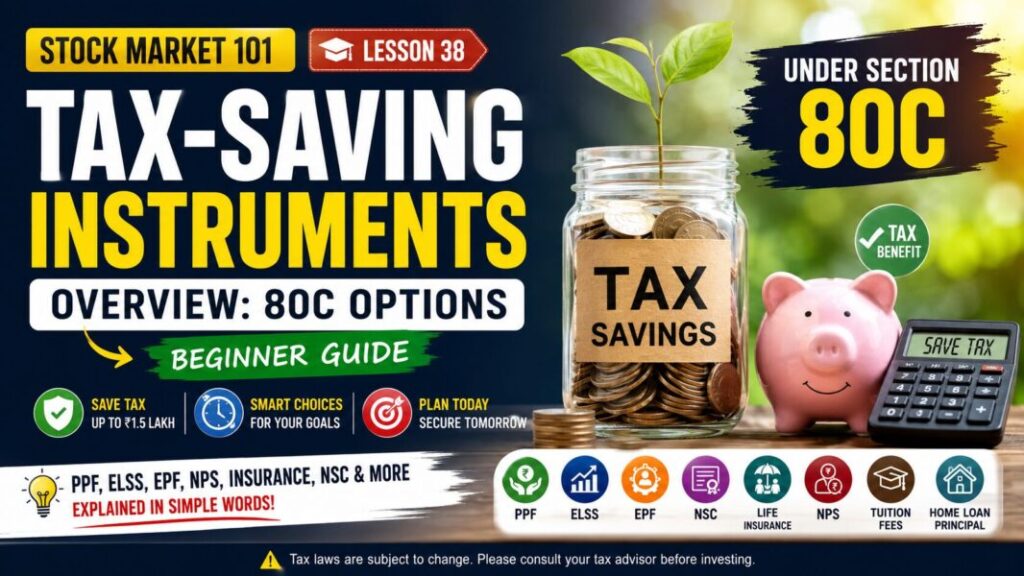
Stock Market 101 – Lesson 38: Tax-Saving Instruments Overview: 80C Options for Beginners
Tax planning often begins in the last few weeks of March.
An employer asks for investment proof. The tax portal shows a higher liability. Then people rush to buy an insurance policy, open a fixed deposit, or invest in a fund without checking whether it suits their needs.
That is the wrong order.
A tax-saving product should not be chosen only because it reduces tax. It should also fit your financial goal, risk comfort, lock-in period, and need for liquidity.
A five-year product may not suit money needed next year. A market-linked investment may not suit someone who cannot handle fluctuations. An insurance policy should not be purchased only because an agent says it qualifies under Section 80C.
This beginner guide explains the main Tax-Saving Instruments available under Section 80C, who may find them useful, and what to check before investing.
Tax laws can change. This article reflects official information available in July 2026 and is meant for education, not personal tax advice.
First Check: Are You Using the Old or New Tax Regime?
Before comparing any Section 80C option, answer one basic question:
Are you filing under the old tax regime or the new tax regime?
This matters because the new tax regime is now the default regime. Most common Chapter VI-A deductions, including Section 80C, are generally not available under the new regime. The Income Tax Department’s guidance confirms that Section 80C deductions remain relevant mainly when a taxpayer chooses the old tax regime, subject to eligibility and applicable conditions.
Under the old tax regime, an eligible individual or Hindu Undivided Family can claim a combined deduction of up to ₹1.5 lakh under Sections 80C, 80CCC and 80CCD(1). The limit is shared across qualifying investments and payments; it is not a separate ₹1.5 lakh allowance for each product.
For example, suppose during a financial year you have:
- ₹60,000 employee provident fund contribution
- ₹40,000 eligible children’s tuition fees
- ₹30,000 life insurance premium
- ₹50,000 ELSS investment
The qualifying total is ₹1.8 lakh. However, the combined deduction under the ₹1.5 lakh ceiling cannot exceed ₹1.5 lakh.
That is why the first step is not buying another product. It is checking how much of the limit is already being used automatically.
Open Old vs New Tax Regime FAQs
What Is Section 80C?
Section 80C allows eligible taxpayers under the old regime to reduce taxable income through specified investments, deposits and payments.
The Income Tax Department lists common qualifying items such as:
- life insurance premium
- provident fund contribution
- tuition fees
- National Savings Certificate
- housing-loan principal repayment
- certain small-savings products
- eligible fixed deposits and pension contributions
The deduction is based on the eligible amount actually paid or invested during the relevant financial year, subject to legal conditions and the combined ceiling.
Section 80C is not a cashback.
Suppose your eligible taxable income is ₹10 lakh and you claim ₹1.5 lakh under Section 80C. The deduction reduces the income on which tax is calculated; it does not directly return ₹1.5 lakh to you.
Your actual tax saving depends on your applicable slab rate, cess, other deductions, and total income.
Tax-Saving Instruments: Quick Comparison
| Option | Broad risk and lock-in | Usually considered for |
|---|---|---|
| EPF or eligible provident fund | Relatively stable; retirement-focused | Salaried employees |
| PPF | Government small-savings product; long tenure | Long-term conservative saving |
| ELSS | Equity-market risk; 3-year lock-in | Long-term growth with tax saving |
| NSC | Fixed-income small-savings product; 5-year term | Conservative savers |
| Five-year tax-saving deposit | Fixed return; 5-year lock-in | Investors wanting predictability |
| Sukanya Samriddhi | Long-term girl-child savings scheme | Eligible parents or guardians |
| Life insurance premium | Depends on policy; often long commitment | Genuine protection needs |
| Home-loan principal | Linked to home purchase and repayment | Eligible homeowners |
| Tuition fees | Qualifying payment, not an investment | Parents paying eligible fees |
| SCSS | Senior-citizen savings product | Eligible senior citizens |
This table is only a starting point. The correct choice depends on your tax regime, goal, time horizon and risk profile.
1. Employee Provident Fund and Voluntary Contributions
For many salaried employees, provident fund contribution already uses part of the Section 80C limit.
The employee’s eligible contribution to provident fund can qualify under Section 80C. The Income Tax Department includes provident-fund payments among the recognised deduction items.
This is important because an employee may already be using a meaningful part of the ₹1.5 lakh ceiling through monthly payroll deductions.
Open Income Tax Deduction Guide
Before investing elsewhere, check:
- your annual EPF contribution
- whether you made any additional eligible provident-fund contribution
- how much Section 80C capacity remains
- whether your retirement portfolio is already too heavily tilted toward fixed income
Provident fund is designed mainly for retirement. It should not be treated like a normal savings account for frequent withdrawals.
2. Public Provident Fund
PPF is a government-backed long-term small-savings product.
It is commonly used by conservative investors who want to build a retirement or long-term corpus without direct equity-market exposure. Eligible contributions fall within the Section 80C ceiling.
PPF has a long original tenure. Official India Post material provides for withdrawal of the full balance after the expiry of 15 years from the end of the year in which the initial subscription was made, with extensions possible in blocks of five years.
PPF may suit people who:
- want long-term disciplined saving
- prefer a government small-savings product
- do not need the money soon
- want a stable component in their portfolio
- are comfortable with limited liquidity
PPF may not suit people who:
- need money within a few years
- want high liquidity
- seek equity-like growth
- are already overallocated to fixed-income assets
Do not choose PPF merely because it is familiar. Its long horizon should match a genuine long-term goal.
3. Equity Linked Savings Scheme
ELSS is a tax-saving mutual fund category that invests mainly in equities.
It carries market risk. Its value can rise or fall with stock-market conditions, so returns are not fixed or guaranteed.
SEBI’s investor guide states that ELSS investments have a three-year lock-in from the date of investment. It also explains that ELSS returns depend on equity-market performance.
Among common Section 80C investment products, ELSS has a relatively short statutory lock-in. But a three-year lock-in does not mean a three-year investment horizon is always enough.
Equity investing generally needs patience.
ELSS may suit people who:
- are using the old tax regime
- have a long-term wealth goal
- can accept market fluctuations
- understand mutual-fund risk
- prefer equity exposure as part of tax planning
Be careful about:
- selecting only by one-year returns
- investing the full amount on the last day without understanding the fund
- owning several similar ELSS funds
- assuming the three-year lock-in guarantees profit
- redeeming automatically as soon as the lock-in ends
If investing through an SIP, each instalment normally has its own three-year lock-in from its allotment date.
4. National Savings Certificate
NSC is a government small-savings certificate available through post offices.
India Post describes NSC as a tax-saving savings scheme and confirms that eligible deposits qualify for Section 80C deduction. Official material also notes that the current NSC issue has a five-year term.
NSC may suit investors who:
- prefer a fixed-income product
- are comfortable locking money for five years
- want predictable terms rather than market-linked returns
- are building a conservative portfolio
The interest treatment should be understood carefully. Accrued interest may have tax and reinvestment implications, so investors should review the current tax rules rather than assuming the entire maturity amount is automatically tax-free.
5. Five-Year Tax-Saving Fixed Deposit or Time Deposit
A five-year tax-saving bank fixed deposit is another widely used Section 80C option.
Post Office five-year Time Deposits can also qualify under Section 80C. India Post officially confirms that the five-year Time Deposit is eligible for the deduction.
These products are simple to understand:
- money is deposited for a fixed term
- the applicable rate is known when booked
- premature access is restricted
- interest is generally taxable according to applicable rules
This option may suit:
- people who dislike market volatility
- investors who want predictable interest
- taxpayers who can leave the amount untouched for five years
- those seeking simplicity
Check before investing:
- whether the deposit is specifically eligible for Section 80C
- lock-in and premature-closure rules
- interest taxation
- bank or institution terms
- whether inflation may reduce the real return
A normal one-year or three-year bank FD does not become eligible merely because it is called a fixed deposit. It must meet the prescribed tax-saving conditions.
6. Sukanya Samriddhi Account
Sukanya Samriddhi Account is a government small-savings scheme intended for the long-term financial needs of a girl child.
India Post includes Sukanya Samriddhi among its small-savings products and notes that the account is opened for an eligible girl child through a parent or legal guardian.
This is a goal-specific product, not a general tax-saving shortcut.
It may be useful for:
- eligible parents or guardians
- long-term education planning
- future marriage-related goals
- families comfortable with the scheme’s long tenure and withdrawal conditions
The product should be selected because it matches the child’s long-term goal, not only to fill unused Section 80C space.
7. Life Insurance Premium
Eligible life-insurance premiums can qualify under Section 80C.
But insurance should first solve a protection need.
A common mistake is buying an unsuitable traditional policy or high-cost bundled plan in March only because it provides a tax deduction.
The Income Tax Department confirms that life-insurance premiums are included under Section 80C, subject to conditions. It also notes that eligibility can depend on the policyholder relationship, sum assured and premium limits prescribed by law.
Before buying a policy, ask:
- How much life cover does my family need?
- Is this primarily protection or investment?
- What is the premium-paying commitment?
- What happens if I stop paying?
- What are the exclusions and surrender terms?
- Is the premium fully eligible under current Section 80C rules?
Tax saving should be a secondary benefit. Adequate protection should come first.
8. Children’s Tuition Fees
Section 80C is not limited to investment products.
Eligible tuition fees paid for full-time education in India can also qualify. The Income Tax Department states that the benefit applies to tuition fees for the full-time education of up to two children, while items such as development fees and donations are excluded.
This matters because many parents may already be using part of their Section 80C limit through school or college payments.
Keep proper records:
- fee receipts
- institution details
- child’s name
- payment date
- separation of tuition fees from transport, development or donation charges
Do not claim the full school bill automatically. Only qualifying tuition components should be considered.
9. Home-Loan Principal Repayment
Eligible repayment of housing-loan principal can fall under Section 80C.
The Income Tax Department includes housing-loan principal among recognised Section 80C items, subject to applicable conditions.
Remember the difference:
- Principal repayment may qualify under Section 80C.
- Interest payment is dealt with under separate tax provisions and conditions.
Homeowners should use the annual loan certificate to separate principal and interest correctly.
Do not claim the total EMI as an 80C deduction.
10. Senior Citizens Savings Scheme
SCSS is a government-backed small-savings product meant for eligible senior citizens and certain eligible retirees.
India Post confirms that eligible investment in SCSS qualifies under Section 80C. It also states that interest is taxable and may be subject to TDS under applicable rules.
SCSS may suit eligible investors seeking:
- a government small-savings option
- periodic income
- a retirement-oriented product
- lower market exposure
Eligibility, deposit limits, tenure, interest rates and premature-closure rules should be checked on the official portal before opening an account.
Where Does NPS Fit?
NPS is often discussed alongside Section 80C, but its tax treatment comes mainly under Section 80CCD.
An individual’s eligible NPS contribution under Section 80CCD(1) falls within the combined ₹1.5 lakh ceiling shared with Sections 80C and 80CCC. Under the old regime, Section 80CCD(1B) can offer an additional deduction of up to ₹50,000 for eligible NPS contributions, over and above the combined ₹1.5 lakh ceiling. PFRDA’s official guide explains this additional NPS deduction.
Employer contribution under Section 80CCD(2) is treated separately and can remain relevant under the new regime, subject to applicable limits and conditions.
NPS is retirement-focused and market-linked. It has specific withdrawal and annuity rules. Do not choose it only for the extra deduction without understanding the retirement structure.
How to Choose Among Tax-Saving Instruments
There is no single best Section 80C option.
The right choice depends on what you need.
Choose based on goal
For retirement:
- EPF
- PPF
- NPS
- long-term equity exposure such as ELSS, if suitable
For a girl child’s long-term goal:
- Sukanya Samriddhi may be studied
For predictable fixed-income saving:
- NSC
- five-year tax-saving deposit
- PPF
- SCSS for eligible senior citizens
For long-term market-linked growth:
- ELSS may be considered by investors who accept equity risk
For protection:
- suitable life insurance cover, chosen for insurance need first
Choose based on time horizon
Do not invest emergency money in products with long lock-ins.
Make sure you have enough accessible cash for:
- medical needs
- job loss
- urgent family expenses
- near-term school or household payments
Tax saving should never leave you cash-starved.
Choose based on risk
A guaranteed or fixed-income product and an equity-linked product cannot be compared only by expected return.
Ask:
- Can I tolerate a temporary 20% or 30% market fall?
- Do I need a known return?
- How soon will I need the money?
- Is my existing portfolio already equity-heavy?
- Is my retirement money too concentrated in fixed income?
A Simple Year-Round Tax-Planning Method
Tax planning becomes easier when it is spread across the year.
April to June
- Choose old or new regime after comparing estimated tax.
- List automatic deductions such as EPF.
- Identify tuition fees, insurance premiums and home-loan principal.
- Calculate the remaining Section 80C gap.
July to December
- Continue planned monthly contributions.
- Review goal progress.
- Avoid buying products only because markets are rising.
- Keep receipts and statements organised.
January to March
- Recalculate eligible contributions.
- Fill only the genuine shortfall.
- Submit investment proof on time.
- Avoid rushed insurance or investment decisions.
This approach is better than trying to invest ₹1.5 lakh in the final week of March.
Common Section 80C Mistakes
Investing without checking the tax regime
Someone using the new regime may buy an 80C product expecting a deduction that is generally unavailable.
Forgetting EPF and other existing payments
Many salaried taxpayers already use part of the limit through EPF, tuition fees, insurance or housing principal.
Buying unsuitable insurance
A long premium commitment can become a burden if the product was chosen only for tax saving.
Ignoring lock-in
A deduction today is not worth creating a liquidity problem tomorrow.
Selecting ELSS only by recent returns
A strong one-year return does not guarantee future performance.
Assuming every payment qualifies fully
Life-insurance premiums, tuition fees and housing payments are subject to conditions.
Waiting until March
Last-minute decisions often result in unsuitable products and poor comparisons.
Tax-Saving Instruments: Final Learning
Section 80C is useful, but it should not control your entire financial plan.
First compare the old and new tax regimes.
Then check how much of the ₹1.5 lakh old-regime limit is already used through EPF, tuition fees, insurance premiums or housing-loan principal.
Only after that should you consider adding another product.
The best Tax-Saving Instruments are not simply the ones with the biggest deduction or highest advertised return. They are the ones that fit your goal, risk level, time horizon and cash-flow needs.
Save tax, but do it with purpose.
FAQs on Tax-Saving Instruments
Q1. What is the maximum deduction available under Section 80C?
Eligible taxpayers using the old regime can claim a combined deduction of up to ₹1.5 lakh under Sections 80C, 80CCC and 80CCD(1), subject to conditions.
Q2. Can I claim Section 80C under the new tax regime?
Most common Section 80C deductions are generally unavailable under the new regime. They are mainly relevant when an eligible taxpayer chooses the old regime.
Q3. Which Section 80C option has the shortest lock-in?
ELSS has a statutory three-year lock-in from each investment date, but it carries equity-market risk and does not guarantee returns.
Q4. Are school fees eligible under Section 80C?
Eligible tuition fees for full-time education in India for up to two children can qualify. Development fees, donations and similar charges are excluded.
Q5. Is NPS included in the ₹1.5 lakh Section 80C limit?
Eligible NPS contribution under Section 80CCD (1) shares the combined ₹1.5 lakh ceiling. Under the old regime, eligible contribution under Section 80CCD(1B) can provide an additional deduction of up to ₹50,000.
Further Reading
Stock Market 101 – Lesson 37: Mutual Fund Mistakes
Stock Market 101 – Lesson 34: How to Choose a Mutual Fund
Stock Market 101 – Lesson 32: Using Sector Indices & ETFs for Beginners
Stock Market 101 – Lesson 30: Defensive vs Cyclical Sectors
Stock Market 101 – Lesson 25: Notes to Accounts: Hidden Clues Most People Ignore
Disclaimer
This article is only for educational and informational purposes. It is not tax, legal, investment or financial advice. Tax rules, eligibility conditions and product features may change. Readers should verify the latest information on official government portals and consult a qualified tax professional or SEBI-registered investment adviser before making tax or investment decisions.
Article Information
Author: Kartalks Education Desk
Reviewed by: Kartalks Editorial Team
Content Type: Stock market education, beginner-friendly investing concepts, finance learning, trading basics, risk awareness, and investor education
Sources: SEBI investor education material, NSE/BSE educational resources, stock exchange learning resources, official public sources, and general finance education references
Last Updated: July 11, 2026