
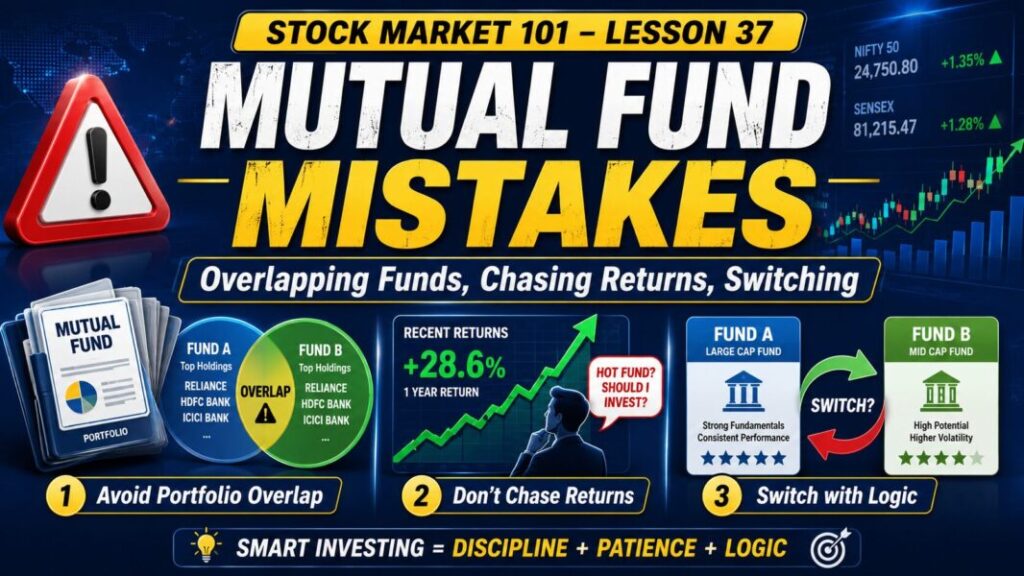
Stock Market 101 – Lesson 37: Mutual Fund Mistakes: Overlapping Funds, Chasing Returns, Switching
Many beginners start mutual fund investing with good intention.
They start one SIP. Then they see another fund giving higher returns. They add that also. After a few months, they see a small-cap fund trending. They add that too. Then someone says one sector fund is the next big opportunity. Slowly, the portfolio grows from 2 funds to 8 funds, then 10 funds, then even more.
At first, this feels like diversification.
But many times, it is not diversification. It is confusion.
Some funds may hold the same stocks. Some funds may be bought only because last year’s returns looked attractive. Some funds may be switched too quickly because the investor becomes impatient.
These are common Mutual Fund Mistakes. They are not dramatic mistakes on day one, but over time they can disturb your portfolio, reduce clarity, and make investing stressful.
In this lesson, we will understand three big mistakes in simple words: overlapping funds, chasing returns, and unnecessary switching.
Mutual Fund Mistakes: Why Beginners Should Be Careful
Mutual funds have become a very important part of Indian investing. AMFI data shows the Indian mutual fund industry average assets under management stood at ₹83,46,579 crore for May 2026, and total folios were 27.66 crore as of May 31, 2026. This shows how strongly Indian investors are participating in mutual funds, but it also makes investor education more important.
A mutual fund pools money from many investors and invests it in assets such as equities, bonds, government securities, and money market instruments. That structure can help beginners access professionally managed portfolios, but it does not remove the need for common sense, review, and risk understanding.
The real danger is not mutual funds.
The real danger is using mutual funds without a plan.
A beginner should not invest only because:
- a fund is trending
- one-year return looks high
- a friend recommended it
- an app shows it on top
- social media says it is “best”
A mutual fund should fit your goal, time horizon, risk comfort, and overall portfolio.
Mistake 1: Buying Too Many Overlapping Mutual Funds
This is one of the most common mistakes.
A beginner may buy:
- one large-cap fund
- one flexi-cap fund
- one large and mid-cap fund
- one focused fund
- one index fund
- one aggressive hybrid fund
On paper, this looks like many funds.
But when you check the actual holdings, many funds may hold the same top companies. This is called mutual fund portfolio overlap.
What is mutual fund portfolio overlap?
Portfolio overlap means two or more funds in your portfolio hold many of the same stocks or securities.
For example, Fund A and Fund B may both hold the same large private bank, same IT stock, same FMCG stock, or same index-heavy company.
Some overlap is normal.
But too much overlap creates a problem.
You may think:
“I have 6 funds, so I am diversified.”
But actually, your money may still be concentrated in the same top stocks.
Why Overlapping Funds Can Hurt Beginners
Overlapping funds can create three problems.
1. False diversification
You may feel safe because you own many funds. But if the same stocks appear again and again, your portfolio may not be as diversified as you think.
2. Difficult review
If five funds behave almost the same way, it becomes hard to understand which fund is actually helping your portfolio.
3. More confusion
Too many funds mean more statements, more performance numbers, more NAVs, more decisions, and more stress.
AMFI provides portfolio disclosure access for mutual fund schemes, and AMFI’s investor section says investors can get transparent data on portfolio holdings for mutual fund schemes. This kind of disclosure can help investors check what their funds actually hold.
Open AMFI Introduction to Mutual Funds
Simple Way to Check Fund Overlap
You do not need to be an expert.
Start with a simple check.
Open the latest factsheet or portfolio disclosure of each fund and check:
- top 10 holdings
- sector exposure
- market-cap exposure
- fund category
- benchmark
- investment style
Then ask:
- Are the same companies appearing repeatedly?
- Are all my equity funds behaving like large-cap funds?
- Do I really need all these funds?
- Does each fund have a clear role?
A simple portfolio is often better than a crowded portfolio.
A beginner does not need 15 mutual funds to invest properly.
Mistake 2: Chasing Recent Returns
This is the mistake that attracts most beginners.
A person opens a mutual fund app and sorts by:
- 1-year return
- top performing fund
- best fund this year
- highest SIP return
- trending category
Then they invest in the fund at the top of the list.
This is called chasing returns.
It feels logical because everyone wants good returns. But choosing a mutual fund only by recent return can be risky.
Mutual Funds Sahi Hai clearly says that past performance of mutual funds is not necessarily indicative of future performance, and mutual fund investments are subject to market risks.
Why Chasing Returns Is Dangerous
A fund may show high recent returns for many reasons.
Maybe:
- its sector performed well
- small-cap stocks had a strong rally
- the fund took higher risk
- one or two holdings performed very strongly
- the market cycle favoured that fund’s style
But after you invest, the same trend may slow down.
This is where beginners get trapped.
They enter after the rally.
Then returns become normal.
Then they become disappointed.
Then they switch to another recent winner.
This creates a cycle:
High return attracts investor → investor enters late → fund underperforms → investor exits → another high-return fund attracts investor.
That is not disciplined investing.
That is emotional investing.
What to Check Instead of Only Past Returns
Returns are important, but they are not the only thing.
Before choosing a fund, check:
- fund category
- Riskometer
- rolling returns
- expense ratio
- benchmark comparison
- downside behaviour
- portfolio quality
- fund manager style
- time horizon
- goal suitability
SEBI explains that the Riskometer is a mandatory tool used by asset management companies to show the risk level of a mutual fund scheme, ranging from low to very high. This helps investors understand risk before investing, not after losses happen.
So, instead of asking only:
“Which fund gave highest return?”
Ask:
“Did this fund give return with risk I can handle?”
That one question can save beginners from many mistakes.
Mistake 3: Switching Funds Too Often
Switching means moving money from one fund to another.
Switching is not always wrong.
Sometimes it is needed.
But unnecessary switching is one of the biggest Mutual Fund Mistakes beginners make.
Many investors switch because:
- one fund underperformed for 3 months
- another fund is trending
- a YouTube video recommended a new fund
- the market corrected
- a friend showed better returns
- the investor lost patience
This is dangerous because mutual funds need time.
A good fund may underperform for some time because its investment style is temporarily out of favour. That does not automatically mean the fund has failed.
When Switching May Be Reasonable
Switching may be considered when there is a real reason.
For example:
- the fund no longer matches your goal
- your risk profile has changed
- the fund has consistently underperformed its benchmark and category
- the fund’s strategy has changed
- your portfolio has too much overlap
- you are close to your goal and need lower risk
- your asset allocation needs rebalancing
But switching only because another fund gave better recent returns is not a strong reason.
Before switching, ask:
“Am I solving a real problem, or am I reacting emotionally?”
Why Too Much Switching Can Hurt
Too much switching creates problems.
1. It breaks discipline
Long-term investing needs patience. If you keep switching, your portfolio never gets enough time to work.
2. It may create costs
Some mutual funds charge exit load when investors redeem units within a specified time frame. SEBI Investor Education explains exit load as a fee charged by the fund house when units are redeemed or sold within a specified period.
3. It may create tax impact
Switching is usually treated like redemption and fresh purchase. Tax impact can depend on fund type, holding period, and current tax rules. Investors should check current tax rules or consult a tax professional before switching.
4. It increases confusion
Every switch creates another decision. More decisions can lead to more mistakes.
Mistake 4: Ignoring Riskometer
Many beginners check return first and risk later.
That order is wrong.
Risk should be checked before investing.
A fund may show strong returns, but the Riskometer may show high or very high risk. That may still be suitable for an aggressive long-term investor, but it may not suit a beginner who panics during market falls.
SEBI says the Riskometer simplifies risk assessment and gives investors a snapshot of the potential risk involved in a scheme.
Beginner questions to ask
Before investing, ask:
- What is the Riskometer level?
- Can I handle this risk?
- Is my time horizon long enough?
- Will I stop SIP if the fund falls?
- Does this fund match my goal?
If the answer is unclear, do not rush.
Mistake 5: Ignoring Expense Ratio and Plan Type
Expense ratio is the cost of owning a mutual fund.
AMFI explains that Total Expense Ratio is calculated as a percentage of a scheme’s average NAV, and the daily NAV is disclosed after deducting expenses.
A high expense ratio is not automatically bad. A low expense ratio is not automatically good.
But cost matters, especially over long periods.
AMFI also explains that direct plans have lower expense ratios than regular plans because distribution expenses and commission are excluded, and the lower expense ratio can translate into higher returns over time compared with the regular plan of the same scheme.
Simple point for beginners
Know what you are paying.
If you need advice, a regular plan through a distributor may have a role.
If you are confident in researching and managing your investments, a direct plan may reduce cost.
But do not invest without understanding the difference.
Mistake 6: Not Linking Funds to Goals
Many investors collect funds without linking them to goals.
One fund for tax saving.
One fund because a friend suggested it.
One fund because the app showed it on top.
One fund because the market was rising.
After a few years, the portfolio has many funds but no clear purpose.
A better method is goal-based investing.
Simple examples
- Emergency money needs stability and liquidity.
- Short-term goals need lower volatility.
- Long-term wealth creation may need equity exposure.
- Retirement planning may need disciplined asset allocation.
- Child education goals may need risk reduction as the goal comes closer.
The fund should serve the goal.
The goal should not be adjusted to justify the fund.
Mistake 7: Reviewing Too Often or Never Reviewing
Both are mistakes.
Some beginners check NAV every day and panic.
Some investors never review for years.
A better approach is calm review.
For many long-term investors, reviewing once every 6 months or once a year may be enough.
During review, check:
- Is the goal still the same?
- Is the fund still suitable?
- Is the risk level comfortable?
- Is there too much overlap?
- Is the SIP amount enough?
- Is the fund performing reasonably against category?
- Is switching really needed?
Review is not for panic.
Review is for clarity.
Simple Checklist to Avoid Mutual Fund Mistakes
Before adding a new mutual fund, ask:
- Do I already own a similar fund?
- What role will this fund play?
- Am I buying only because of recent returns?
- What does the Riskometer show?
- What is the expense ratio?
- Is there any exit load?
- Does this fund match my goal?
- Can I stay invested during market falls?
- Am I investing after research or excitement?
Before switching a fund, ask:
- Has the fund really failed?
- Did I compare it with the correct category?
- Am I switching due to fear?
- Will the new fund reduce overlap?
- Have I checked cost and tax?
- Is this switch improving my plan?
These questions are simple, but they can protect investors from many avoidable mistakes.
Mutual Fund Mistakes: Final Learning
Mutual fund investing is not about owning the highest number of funds.
It is not about chasing last year’s winner.
It is not about switching every time the market changes mood.
Good mutual fund investing is about clarity.
Choose funds based on:
- goal
- time horizon
- risk comfort
- cost
- diversification
- portfolio quality
- review discipline
A beginner does not need a complicated portfolio.
A beginner needs a sensible portfolio.
Avoid overlapping funds.
Avoid chasing returns blindly.
Avoid unnecessary switching.
Respect risk.
Review calmly.
That is how mutual fund investing becomes simpler and more useful for long-term wealth creation.
5 FAQs – Mutual Fund Mistakes
Q1. What are the most common Mutual Fund Mistakes beginners make?
The most common mistakes are buying too many overlapping funds, chasing recent returns, switching funds too often, ignoring risk, and investing without linking funds to goals.
Q2. Is holding many mutual funds good?
Not always. If many funds hold similar stocks, the portfolio may have high overlap. Diversification means having different exposures, not simply owning many fund names.
Q3. Why is chasing returns risky?
Chasing returns is risky because recent performance may not continue. Mutual Funds Sahi Hai says past performance is not necessarily indicative of future performance.
Q4. When should I switch a mutual fund?
Switch only when there is a clear reason, such as goal mismatch, risk mismatch, long-term underperformance, strategy change, portfolio overlap, or asset allocation need.
Q5. How often should beginners review mutual funds?
Beginners can usually review once every 6 months or once a year. Daily checking can create stress and emotional decisions.
Further Reading
Stock Market 101 – Lesson 36: SIP Strategy Upgrade
Stock Market 101 – Lesson 33: Mutual Fund Basics: Equity, Debt, Hybrid
Stock Market 101 – Lesson 30: Defensive vs Cyclical Sectors
Stock Market 101 – Lesson 27: Auditor Report & Qualifications
Stock Market 101 – Lesson 24: Cash Flow Statement in Real Life: Profit vs Cash (Red Flags)
Disclaimer
This article is only for educational and informational purposes. It is not investment advice, mutual fund advice, stock advice, or a recommendation to buy, sell, switch, or hold any scheme. Mutual fund investments are subject to market risks. Please read all scheme-related documents carefully before investing. Past performance is not a guarantee of future returns. Investors should consult a SEBI-registered investment advisor or certified financial planner before making investment decisions.
Article Information
Author: Kartalks Education Desk
Reviewed by: Kartalks Editorial Team
Content Type: Stock market education, beginner-friendly investing concepts, finance learning, trading basics, risk awareness, and investor education
Sources: SEBI investor education material, NSE/BSE educational resources, stock exchange learning resources, official public sources, and general finance education references
Last Updated: July 4, 2026