
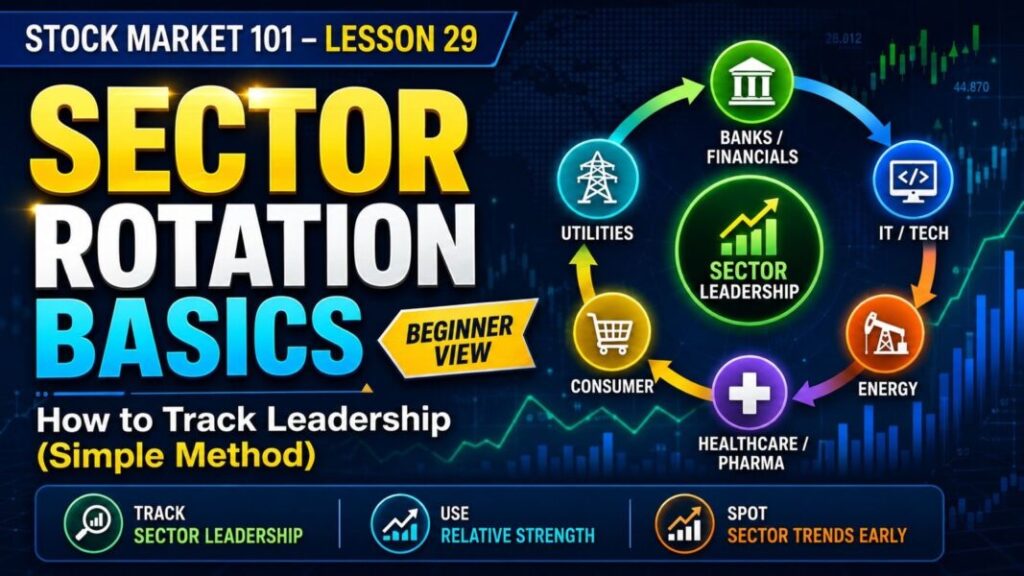
Stock Market 101 – Lesson 29: Sector Rotation Basics: How to Track Leadership (Simple Method)
Hook
One month, banks look unstoppable.
A little later, IT starts moving.
Then suddenly pharma, energy, or FMCG becomes the safer favorite.
Many beginners think this is random. It is not.
A big part of stock market behavior comes from sector rotation—the idea that different sectors often perform better at different points in the business cycle. Fidelity says a sector rotation strategy is based on rotating in and out of sectors as the economy moves through different phases, while Schwab says different sectors often outperform at different points in the economic cycle.
Article Information
Author: Kartalks Education Desk
Reviewed by: Kartalks Editorial Team
Content Type: Stock market education and beginner-friendly finance learning
Sources: SEBI investor education material, NSE/BSE educational resources, official public sources, and general finance learning references
Last Updated: May 9, 2026
What Is Sector Rotation?
In simple words, sector rotation means market leadership shifts from one sector to another over time.
This usually happens because economic growth, inflation, interest rates, profits, and investor expectations do not stay the same forever. Fidelity explains that sector performance has historically tended to rotate as the economy moves through early, mid, late, and recession phases of the business cycle. Schwab makes the same point, noting that sector leadership often changes as the economic backdrop changes.
So when one sector cools down and another takes over, that is not always a mystery.
Very often, it is just the market adjusting to a new backdrop.
Why Sector Leadership Keeps Changing
Different sectors react differently to the economy.
A bank benefits from a different environment than a utility company.
A technology business responds differently than a consumer staples company.
An energy stock does not move for the same reasons as a healthcare stock.
Fidelity says the business cycle can be a critical determinant of equity sector performance over the intermediate term, and companies within the same sector often move in similar patterns because they are affected by similar economic and fundamental factors.
That is the heart of Market Leadership.
The leaders change because the conditions change.
The Big Idea Behind Sector Rotation Basics
You do not need to predict the whole economy perfectly.
You only need to understand one useful idea:
- when growth improves, some sectors usually attract more buying
- when growth slows, leadership can move toward more defensive sectors
- when inflation or rate pressure changes, leadership can rotate again
- when fear rises, investors often prefer stability over excitement
Fidelity’s business-cycle framework and Schwab’s sector education both support this idea: sectors do not lead equally in every phase, and leadership often rotates as conditions evolve.
A Simple Way to Understand Leadership
For a beginner, sector leadership means:
Which sector is attracting stronger price action, better momentum, and more market attention than the rest right now?
That does not automatically mean it will keep leading forever.
In fact, one of the biggest lessons from sector rotation is that leadership is often temporary. Fidelity notes that every business cycle is different, and leadership patterns are historical tendencies, not guarantees.
So the goal is not blind chasing.
The goal is learning how to track leadership early and calmly.
Sector Rotation Basics: The Simple Method to Track Leadership
Here is a beginner-friendly method you can use.
It is simple on purpose.
Step 1: Start With a Sector Watchlist
Pick a small group of major sectors and track them regularly.
For example:
- Banks / Financials
- IT / Technology
- Energy
- Healthcare / Pharma
- Consumer
- Utilities / Defensive areas
This is a practical tracking framework, based on the broader idea from Fidelity and Schwab that investors compare sector behavior because different sectors often lead in different phases.
Do not track too many at the start.
A short watchlist is easier to understand.
Step 2: Compare Sector Performance Over Multiple Timeframes
Do not judge leadership from one day.
A better beginner habit is to compare sector performance over short and medium periods, such as:
- 1 week
- 1 month
- 3 months
This step is a practical method rather than a quoted rule, but it fits the sector-rotation logic from Fidelity and Schwab: leadership changes over time, and looking at more than one window helps you avoid mistaking a brief move for a real rotation.
If one sector is strong across more than one timeframe, it may be showing real leadership.
If it is strong for only one day, that may just be noise.
Step 3: Check Relative Strength, Not Just Absolute Gain
This is very important.
A sector can rise, but still not be a leader if the broader market is rising faster.
So ask:
- Is this sector outperforming the broad market?
- Is it stronger than most other sectors?
- Is money clearly favoring it?
This is the practical meaning of relative strength in a sector-rotation context: not just moving up, but moving up better than the alternatives. The broader idea is supported by Fidelity’s and Schwab’s explanation that sectors outperform at different parts of the cycle.
Leadership is about comparison.
Not just movement.
Step 4: Match Price Action With the Cycle Story
Once you see a sector moving strongly, ask why.
Is the economy improving?
Are rate expectations changing?
Is inflation helping or hurting certain businesses?
Are investors becoming more defensive?
Fidelity says the business cycle affects sector performance through factors like growth, profits, inflation, and credit conditions. Schwab also explains sector rotation through changing economic conditions.
This step matters because leadership with a clear reason is usually more believable than leadership with no clear backdrop.
Step 5: Look for Breadth Inside the Sector
A strong sector usually shows strength in more than one stock.
If only one large stock is moving while the rest of the sector is weak, sector leadership may be narrower than it looks.
This “breadth” check is a practical investor framework rather than a quoted source rule, but it aligns with the SEC’s broader diversification thinking and with the idea that sectors represent groups of companies influenced by related drivers.
So ask:
- Are multiple stocks in the sector participating?
- Or is just one heavyweight creating the illusion of strength?
That question can protect beginners from false signals.
Step 6: Separate Cyclical Leadership from Defensive Leadership
Not all leadership means the same thing.
If banks, industrials, or consumer discretionary areas lead, that may suggest confidence in growth.
If healthcare, staples, or utilities start leading, that may suggest investors are becoming more cautious.
Fidelity and Schwab both describe sector behavior in terms of business-cycle phases, with more economically sensitive areas often doing better in stronger phases and more defensive areas tending to hold up relatively better in weaker phases.
So do not just ask, “Which sector is up?”
Also ask, “What kind of sector is leading?”
That gives the move more meaning.
Step 7: Watch for Leadership Change, Not Just Leadership Confirmation
Beginners often notice leadership too late.
They see a sector only after a big run and assume it will continue forever.
But sector rotation often begins quietly.
A better habit is to watch for:
- improving relative strength
- repeated outperformance
- broader participation
- changing investor preference
Fidelity’s research makes clear that sector leadership rotates through the cycle rather than staying fixed.
The earlier you notice improving leadership, the better your understanding of the market becomes.
Easy Weekly Routine for Beginners
Here is a simple weekly process:
Every weekend, check:
- top-performing sectors for the last 1 month
- top-performing sectors for the last 3 months
- whether the same sectors are still leading
- whether defensive or cyclical sectors are stronger
- whether leadership is broad or narrow
Then write one short note:
- “Current leaders are…”
- “Possible reason is…”
- “Leadership is strengthening / weakening…”
This is a practical routine I recommend based on the sector-rotation framework from Fidelity and Schwab. It is simple, repeatable, and easier for beginners than trying to forecast everything daily.
Common Mistakes Beginners Make
Chasing the strongest sector too late
A sector that already had a huge run may still continue, but the easy move may already be gone.
Fidelity warns that sector leadership changes over time and that every cycle is different.
Confusing one-day strength with real leadership
One news-driven jump does not always mean rotation.
Real leadership usually shows persistence across timeframes.
Ignoring the broader market backdrop
Sector moves make more sense when connected to rates, growth, inflation, and risk appetite. Fidelity’s business-cycle approach is built around exactly that.
Becoming too concentrated
The SEC stresses diversification because different market segments behave differently. A beginner should not assume one hot sector deserves the whole portfolio.
Why This Lesson Matters for Investors
Sector Rotation Basics can help readers:
- understand why leadership changes
- avoid blind chasing
- read the market with more context
- improve diversification thinking
- build patience
The SEC’s asset-allocation guidance supports this mindset because spreading risk across segments can help manage changing market conditions.
This does not mean you must actively trade sectors all the time.
It means you should understand which part of the market is actually in control.
Final Lesson Summary
The biggest takeaway is simple:
Sector leadership changes because the economy, expectations, and investor preferences change.
Fidelity and Schwab both show that sector rotation is a normal part of market behavior, with different sectors often tending to outperform during different phases of the cycle.
A simple beginner method is:
- track a small sector watchlist
- compare performance across timeframes
- check relative strength
- match leadership with the macro story
- watch for participation inside the sector
- stay diversified
That is enough to make a beginner much smarter than someone who only chases whichever stock is trending on a given day.
5 FAQs – Sector Rotation Basics
Q1. What is sector rotation in simple words?
Sector rotation means market leadership shifts from one sector to another as conditions change. Fidelity and Schwab both describe it as a normal part of the business cycle.
Q2. Why do sectors lead one after another?
Because different sectors respond differently to growth, inflation, rates, and investor sentiment.
Q3. What is the easiest way to track leadership?
A simple way is to follow a few key sectors, compare them over multiple timeframes, and see which ones are outperforming the broad market. This is a practical framework built on the sector-rotation approach described by Fidelity and Schwab.
Q4. Should beginners rotate sectors actively?
Not always. Fidelity notes that sector strategies can be more volatile and may underperform the broader market, so many beginners may benefit more from understanding rotation than trading every shift.
Q5. Why does diversification still matter if I track sectors?
Because leadership can change, and the SEC says diversification helps reduce the risk of being too exposed to one market segment.
References
- Fidelity – An introduction to sector rotation strategies
- Charles Schwab – Stock Sectors: What Are They? How Are They Used?
- U.S. SEC – Beginners’ Guide to Asset Allocation, Diversification, and Rebalancing
Further reading
Stock Market 101 – Lesson 28: Market Cycles Explained
Stock Market 101 – Lesson 25: Notes to Accounts: Hidden Clues Most People Ignore
Stock Market 101 – Lesson 20 Your 12-Month Wealth Plan & Rebalancing
Corporate Actions Made Simple for Beginners Stock Market 101-Lesson 15
Stock Market 101 – Lesson 11 MA, RSI & MACD
Stock Market 101 – Chart Patterns Explained
Disclaimer:
This lesson is for educational purposes only and should not be treated as investment advice. Please do your own research before making any investment decision.