
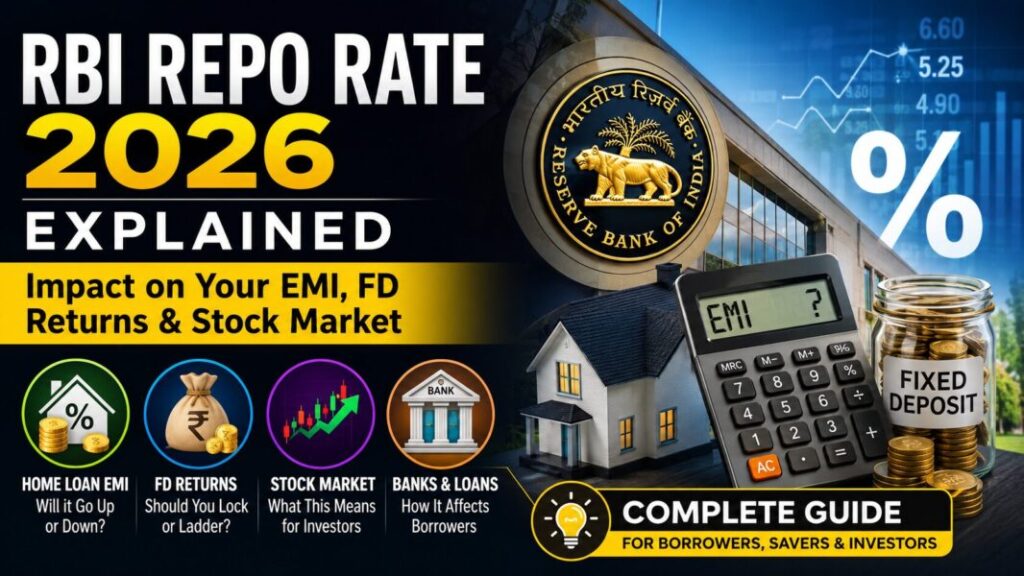
RBI Repo Rate 2026 Explained: Impact on Home Loan EMI, FD Returns and Stock Market
For most families, the RBI repo rate does not look important at first.
It is not like salary credit, grocery bill, school fee, rent, petrol price or home loan EMI. Those things are visible every month. Repo rate feels like a technical number discussed by economists, bankers and TV anchors.
But slowly, this one number reaches our homes.
It can affect how much EMI a home loan borrower pays. It can decide whether fixed deposit investors get better returns. It can influence personal loan rates, car loan rates, bank stocks, real estate demand and overall stock market mood.
That is why the RBI repo rate 2026 is important for every borrower, saver and investor.
In June 2026, the Reserve Bank of India kept the repo rate unchanged at 5.25% and continued with a neutral policy stance. In simple words, RBI did not want to rush into either a rate cut or a rate hike. The central bank wants to watch inflation, crude oil prices, global risks, monsoon, rupee movement and domestic growth before taking the next step.
For common people, the question is simple:
Will my EMI come down? Will FD rates fall? Will the stock market react?
Let us understand this step by step, in simple words.
What Is Repo Rate?
Repo rate is the rate at which the Reserve Bank of India lends short-term money to banks.
Think of it like the basic borrowing cost for banks.
When banks need money, they can borrow from RBI by keeping eligible securities. The interest rate charged on that borrowing is called the repo rate.
Now, why should a home loan borrower care about this?
Because banks also lend money to customers. If the borrowing cost for banks goes up, they may increase loan rates. If the borrowing cost comes down, they may reduce loan rates, depending on their own cost, competition and liquidity.
So even though common people do not directly borrow from RBI, RBI’s repo rate can indirectly affect their loan and deposit rates.
RBI Repo Rate 2026: Quick Snapshot
| Particulars | Latest Position |
|---|---|
| Repo rate | 5.25% |
| Policy stance | Neutral |
| Latest policy context | June 2026 |
| FY27 GDP growth estimate | Around 6.6% |
| FY27 CPI inflation estimate | Around 5.1% |
| RBI’s broad approach | Wait, watch and respond carefully |
The word “neutral” is important here.
It means RBI is not clearly saying, “We are ready to cut rates immediately.”
It is also not saying, “We are preparing to hike rates immediately.”
It is keeping the door open on both sides, depending on future data.
Why Did RBI Keep the Repo Rate Unchanged?
RBI has to manage a difficult balance.
On one side, India needs growth. Businesses need loans. People buy homes, cars and other goods through credit. Lower rates can support borrowing and spending.
On the other side, inflation must stay under control. If prices rise too fast, common people suffer. Food, fuel, rent, education and medical expenses can hurt household budgets.
So RBI cannot look only at growth. It cannot look only at inflation either.
In 2026, there are many moving parts.
Crude oil prices can change quickly. Global tensions can affect markets. The rupee can come under pressure. Food inflation depends partly on monsoon and crop conditions. Foreign investors also watch interest rates closely.
Because of all this, RBI’s decision to keep the repo rate unchanged looks like a cautious decision.
It is like saying: “Let us not move too fast. Let us first see how inflation, oil prices and growth behave.”
How Repo Rate Affects Home Loan EMI
Home loan borrowers usually watch RBI policy very closely.
Most home loans today are floating-rate loans. Many of them are linked to an external benchmark like the repo rate. So when the repo rate changes, home loan rates may change after the bank’s reset period.
But there is one common confusion.
Many borrowers say, “RBI changed rates, but my EMI did not change.”
That can happen because banks do not always change EMI immediately. Sometimes they adjust the loan tenure instead.
For example, if interest rate goes up, your EMI may remain the same, but your loan may continue for more months. If interest rate comes down, EMI may remain the same, but your loan may finish earlier.
So a borrower should not look only at EMI. The remaining tenure is equally important.
A Simple Home Loan Example
Let us say a person has a home loan of ₹50 lakh for 20 years.
If the interest rate is around 8.5%, the EMI is already a major monthly commitment for most families. Now imagine the interest rate rises by even 0.25% or 0.50%.
The monthly increase may not look shocking immediately. But over 15 or 20 years, the total extra interest can become meaningful.
This is why repo rate matters more for long-term loans than short-term loans.
In a home loan, time is long. Even small rate changes can slowly add up.
What Should Home Loan Borrowers Do Now?
Since the repo rate is unchanged, there is no need to panic. But this is a good time to review your home loan.
Many borrowers keep paying EMI for years without checking whether their rate is still competitive. That is not a good habit.
Open your loan statement and check three things:
Your current interest rate
Your remaining tenure
Your next reset date
Also compare your loan rate with what your bank is offering to new customers. Sometimes old borrowers pay higher rates while new borrowers get better offers.
If your rate is much higher, speak to your bank. Ask if they can reduce the spread or convert the loan to a better rate structure. If the difference is large, you may also explore balance transfer, but only after checking processing fees, legal cost and actual savings.
Part-prepayment is also useful if you have surplus money. But do not empty your emergency fund just to reduce the loan. A family must keep liquidity for medical needs, job uncertainty and sudden expenses.
Repo Rate and Fixed Deposit Returns
Repo rate does not affect only borrowers. It also matters to savers.
When interest rates rise, banks usually offer better FD rates to attract deposits. When interest rates fall, FD rates on new deposits may gradually come down.
For retired people and conservative investors, this is very important. Many families depend on FD interest for monthly expenses.
In 2026, with the repo rate unchanged, FD rates may remain broadly stable for some time. But banks can still change deposit rates based on liquidity, credit demand and competition.
So FD investors should not assume that all banks will behave the same way.
Some banks may offer attractive rates for selected tenures. Some may reduce rates earlier. Some small finance banks may offer higher rates, but investors should also consider safety and deposit insurance limits.
A Smarter FD Strategy: Laddering
Many people make one common FD mistake.
They put all their money into one FD for one tenure.
A better approach is FD laddering.
Instead of keeping ₹5 lakh in one FD, a person may divide it into different maturities. For example, part of the money can be kept for 1 year, part for 2 years, part for 3 years and part for 5 years.
This gives flexibility.
If rates rise later, the short-term FD matures and money can be reinvested at a better rate. If rates fall, the longer FD continues to earn the earlier locked-in rate.
This approach is especially useful for senior citizens and people who want regular income with safety.
Before booking any FD, check the interest rate, bank safety, premature withdrawal penalty, tax impact and payout option.
A higher rate is attractive, but peace of mind is also important.
Repo Rate and Personal Loans
Personal loans are different from home loans.
They are unsecured loans, so the interest rate is usually much higher. If the rate cycle remains tight, personal loans can become expensive.
Many people take personal loans for weddings, travel, gadgets, lifestyle expenses or credit card repayment. Some situations may be genuine. But many personal loans are taken because EMI looks small.
That is dangerous.
A small EMI over a long period can hide a high total interest cost.
In 2026, people should be careful before taking personal loans. If the purchase can be postponed, postpone it. If it is not urgent, avoid borrowing.
A personal loan should solve a problem, not create a new one.
Repo Rate and Car Loans
Car loans also get affected by the interest rate environment.
A car is an emotional purchase for many families. But financially, it is a depreciating asset. The value usually falls over time.
So before taking a car loan, do not look only at the showroom EMI.
Check the full cost.
Down payment
Loan interest rate
Processing fee
Insurance
Fuel
Maintenance
Loan tenure
Prepayment charges
Sometimes a buyer chooses a longer tenure only to reduce EMI. That may look comfortable today, but the total interest paid becomes higher.
If the car is necessary, plan properly. If it is mainly an upgrade for lifestyle, be extra careful.
Repo Rate and Stock Market
The stock market watches RBI policy very closely.
But the market reaction is not always simple.
If RBI cuts rates, people may think the market should rise. But if the rate cut happens because growth is weak, investors may become worried.
If RBI keeps rates unchanged, markets may still rise if investors were expecting a hike. Or markets may fall if investors were hoping for a cut.
So the stock market does not react only to the repo rate. It reacts to expectations.
Investors also listen to RBI’s tone. They watch inflation comments, growth projection, liquidity signal, crude oil concerns and global risk outlook.
That is why one repo rate decision should not decide your full stock market strategy.
Which Sectors Feel the Repo Rate Impact?
Some sectors are more sensitive to interest rates.
Banks and NBFCs are directly linked to lending and borrowing. Real estate depends heavily on home loan affordability. Auto sales can be affected by car loan rates. Consumer durables also depend on EMI-based purchases.
On the other hand, sectors like FMCG may not be directly affected by repo rate, but they can be affected by inflation and rural demand.
Here is a simple view:
| Sector | Why Repo Rate Matters |
|---|---|
| Banks | Loan rates, deposit costs and margins |
| NBFCs | Borrowing cost and customer demand |
| Real estate | Home loan affordability |
| Auto | Car loan EMI and consumer demand |
| Consumer durables | EMI-based buying decisions |
| Infrastructure | Project finance cost |
| FMCG | Inflation and rural demand matter more |
| IT | More linked to global demand and currency |
Banking and real estate stocks usually react strongly to RBI policy news.
Repo Rate and Bank Stocks
Bank stocks do not move only because the repo rate changes.
A rate hike may help banks earn more on loans, but deposit cost may also rise. A rate cut may support loan demand, but lending yields may soften.
So investors should look deeper.
For bank stocks, check asset quality, loan growth, deposit growth, net interest margin, NPAs, provisioning, CASA ratio and management commentary.
Do not buy a bank stock only because rates may fall. Do not sell only because rates are unchanged.
Banking is a detailed business. Repo rate is important, but it is only one piece of the puzzle.
Repo Rate and Inflation
Inflation is one of the main reasons RBI changes interest rates.
When inflation is high, RBI may keep rates elevated to reduce demand pressure. When inflation is under control, RBI gets more comfort to support growth.
For common people, inflation is not just a number.
It is the higher vegetable bill.
It is the school fee increase.
It is higher rent.
It is expensive fuel.
It is medical expenses rising faster than salary.
If inflation remains high for a long time, household savings suffer.
That is why RBI cannot ignore inflation even when people want lower EMIs.
Repo Rate and Rupee
Repo rate can also influence the rupee, but it is not the only factor.
Foreign investors compare interest rates across countries. If Indian rates are attractive and growth is stable, India may remain interesting for foreign capital. But if global risk rises or the dollar becomes strong, the rupee can still face pressure.
Crude oil also matters a lot because India imports a large part of its oil requirement. Higher oil prices can increase import bills and inflation risk.
So RBI watches currency movement, but it cannot control the rupee only through repo rate.
How Common People Should Read RBI Policy
A common person does not need to behave like a trader after every RBI policy.
You do not need to change your entire financial plan every two months.
Instead, use RBI policy as a reminder.
If you have a home loan, check your rate and tenure.
If you invest in FDs, review your maturity plan.
If you are planning a loan, calculate total cost.
If you invest in stocks, focus on business fundamentals.
If inflation is high, control unnecessary spending.
That is enough for most families.
Repo rate is important, but it should not create fear.
Borrowers vs Savers: Who Benefits?
Repo rate affects borrowers and savers differently.
When rates fall, borrowers may benefit because loan rates can reduce. But FD investors may get lower returns on new deposits.
When rates rise, FD investors may benefit. But borrowers may face higher EMI or longer tenure.
When rates stay unchanged, both sides get some stability.
In 2026, the unchanged repo rate gives borrowers some breathing space. FD investors may also get time to plan without rushing.
But future rate direction will depend on inflation, growth and global conditions.
What Should Investors Do in 2026?
Investors should avoid overreacting to one RBI meeting.
A good investment plan does not depend only on repo rate.
Equity is for long-term growth.
FDs and debt products are for stability.
Emergency fund is for safety.
Gold can help diversification.
Insurance protects the family.
Loan planning protects monthly cash flow.
If you are investing for 5 to 10 years, one policy meeting should not scare you.
But if you are taking a large loan, then interest rate matters. In that case, check EMI comfort carefully.
Practical Checklist for 2026
For home loan borrowers, review your loan statement at least twice a year. Check interest rate, remaining tenure and reset date. If possible, make part-prepayments from bonus or surplus money.
For FD investors, avoid putting all money in one deposit. Use different maturities. Keep some money liquid for emergencies.
For stock market investors, do not trade only on RBI headlines. Watch inflation, bond yields, earnings growth and company fundamentals.
For new borrowers, do not choose a loan only because EMI looks affordable. Check the total interest payable.
For families, keep an emergency fund before making any aggressive investment or loan repayment decision.
Final Thoughts
The RBI repo rate 2026 matters because it connects the economy with household finance.
It affects home loan EMIs, fixed deposit returns, personal loan cost, car loan affordability, bank stocks, real estate sentiment, inflation and market confidence.
With the repo rate at 5.25% and a neutral stance, RBI is choosing patience. It is watching the data instead of making a rushed move.
For borrowers, this is a time to review loans calmly.
For FD investors, this is a time to plan maturities wisely.
For stock market investors, this is a time to focus on fundamentals rather than policy noise.
The best takeaway is simple:
Understand the repo rate, but do not let one RBI decision control your entire financial life.
A strong financial plan should survive both high-rate and low-rate periods.
FAQs
Q1. What is the current RBI repo rate in 2026?
The current RBI repo rate is 5.25%, based on the June 2026 monetary policy update.
Q2. How does repo rate affect home loan EMI?
If the repo rate rises, floating-rate home loan EMI or tenure may increase. If it falls, EMI or tenure may reduce after the loan reset period.
Q3. Does repo rate affect FD rates?
Yes. FD rates are influenced by repo rate, liquidity, bank deposit needs and overall interest rate trends.
Q4. Is unchanged repo rate good for the stock market?
It gives stability, but the stock market also reacts to RBI commentary, inflation outlook, growth forecast, crude oil prices and global cues.
Q5. Should I take a loan now because repo rate is unchanged?
No. Take a loan only after checking income stability, EMI comfort, emergency fund, loan tenure and total interest cost.
Further Reading
IPO Investing Guide: Complete Beginner’s Guide to Check IPO Before Applying
FII and DII Data Explained for Beginners
Gold vs Silver vs Gold ETF: Where Should Indian Investors Look in 2026?
Life Insurance Tax Rules 2026: Why Insurance Should Not Be Bought Only for Tax Saving
Stock Market 101 – Lesson 35: Mutual Fund Metrics Made Simple
Disclaimer
This article is for educational purposes only. It is not financial advice, loan advice, tax advice or stock market recommendation. Interest rates, RBI policy, inflation forecasts and bank lending rates may change. Please verify the latest data from official RBI, bank and government sources before making borrowing, saving or investment decisions.
Article Information
Author: Kartalks Finance Desk
Reviewed by: Kartalks Editorial Team
Content Type: RBI repo rate explanation, monetary policy update, home loan EMI impact, fixed deposit returns, inflation impact, banking sector impact, stock market education, and personal finance awareness
Sources: Reserve Bank of India, RBI Monetary Policy Committee updates, SEBI, NSE/BSE data, bank lending rate updates, inflation reports, Ministry of Finance updates, and official public sources
Last Updated: June 26, 2026