
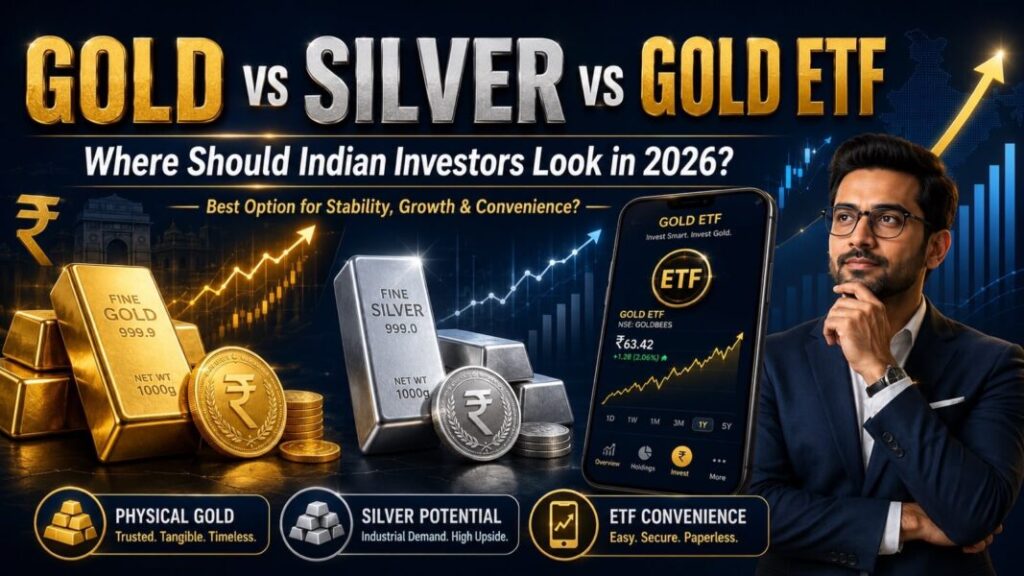
Gold vs Silver vs Gold ETF: Where Should Indian Investors Look in 2026?
Gold vs Silver vs Gold ETF in 2026: A Practical Guide for Indian Investors
Gold and silver are again in the spotlight in 2026. Prices have moved sharply, investors are looking for safety, and Gold ETFs have become a serious option for people who do not want the tension of buying and storing physical gold.
For Indian investors, the question is simple but important: should we buy physical gold, silver, or Gold ETFs in 2026?
The answer is not the same for everyone. A family buying jewellery for a wedding will think differently from a salaried investor building a long-term portfolio. A trader looking at silver price movement will think differently from someone who wants a stable hedge during market uncertainty.
This article explains gold, silver and Gold ETFs in simple words so that Indian investors can make a more informed decision in 2026.
Quick Summary: What Should Investors Understand First?
Gold is still the more trusted long-term hedge for Indian households. It works well during uncertainty, inflation pressure, rupee weakness and market fear.
Silver can give sharp returns, but it is more volatile than gold. Silver has both precious metal demand and industrial demand, so its price can move faster in both directions.
Gold ETFs are becoming more attractive because they offer exposure to gold without storage risk, making charges, purity issues or jewellery resale deductions.
For most long-term Indian investors, Gold ETFs may be a cleaner investment option than physical jewellery. Physical gold still has emotional and cultural importance, but it may not always be the best investment format.
Silver can be considered only by investors who can handle higher volatility and do not panic during sharp corrections.
Why Gold and Silver Are Trending in 2026
The interest in gold and silver in 2026 is not accidental. Several big factors are working together.
Global tensions have kept investors alert. Whenever geopolitical risk rises, investors usually look at safe-haven assets like gold. At the same time, crude oil prices, inflation fears and interest-rate expectations are affecting the short-term movement of precious metals.
In India, gold has always had cultural importance. But 2026 is different because investment demand is also very strong. More people are not just buying gold as jewellery; they are buying it as a portfolio hedge through ETFs, bars, coins and other regulated routes.
Silver is also getting attention because it has a dual character. It is a precious metal, but it is also used in industries such as electronics, solar, electric vehicles and other manufacturing areas. This makes silver exciting, but also risky.
Another reason this topic is trending is the updated SEBI mutual fund framework. From April 1, 2026, the mutual fund regulatory framework has been updated, and the valuation approach for physical gold and silver held by mutual fund schemes has also moved toward a more domestic exchange-linked price discovery framework. This matters because Gold ETFs and Silver ETFs need transparent and fair valuation of their underlying assets.
What Is Physical Gold?
Physical gold means jewellery, coins, bars or biscuits. For Indian families, this is the most familiar form of gold.
Physical gold has emotional value. It is used during weddings, festivals and family occasions. Many people feel comfortable because they can see and hold it.
But from an investment point of view, physical gold has some drawbacks.
Jewellery includes making charges, wastage, GST and possible resale deductions. If you buy jewellery for ₹1 lakh, your actual investment value may not be fully equal to ₹1 lakh because part of the cost goes into making charges and design charges.
Coins and bars are better than jewellery for investment, but they still require safe storage. You also need to check purity, hallmarking, buy-sell spread and seller reliability.
Physical gold is useful when the purpose is personal use, family need or emergency backup. But if the purpose is only investment, investors should compare it with Gold ETFs before deciding.
What Is Silver?
Silver is cheaper per gram compared to gold, so many retail investors feel it is easier to accumulate. But silver should not be treated as a “cheaper gold.” It behaves differently.
Silver demand comes from jewellery, silverware, investment and industrial usage. Because of its industrial link, silver can rise sharply when industrial demand is strong. It can also fall sharply when global growth worries increase.
This is why silver is often more volatile than gold.
In 2026, silver has attracted attention because prices have seen strong movement and global supply-demand discussions remain active. But Indian investors must remember that silver is not a low-risk asset. It can move very fast, and short-term corrections can be painful.
Physical silver also has practical issues. Storing large value in silver requires more space than gold. Purity and resale spread can also be concerns. For investment purposes, Silver ETFs may be easier than physical silver, but silver ETFs also carry price volatility.
What Is a Gold ETF?
A Gold ETF is an exchange-traded fund that tracks the domestic price of gold. It is listed on the stock exchange and can be bought or sold through a demat and trading account.
In simple words, Gold ETF allows you to invest in gold without physically buying gold.
The fund usually holds physical gold and some cash or money market instruments as per the scheme structure. The investor holds ETF units, not physical gold coins or jewellery.
Gold ETFs are useful because they reduce common problems linked to physical gold:
- No storage tension
- No purity concern for the investor
- No making charges
- Easy buying and selling through exchange
- Transparent NAV and market price
- Better fit for portfolio allocation
However, Gold ETFs are not risk-free. Their price can fall if gold prices fall. There can also be expense ratio, tracking difference, liquidity difference and bid-ask spread. Investors should compare ETF size, expense ratio, tracking error, liquidity and fund house record before investing.
Gold vs Silver vs Gold ETF: Main Difference
Physical gold is best for emotional, cultural and family usage. It is also useful for people who want direct ownership of metal. But as an investment, jewellery is less efficient because of extra costs.
Silver is better suited for investors who can accept higher volatility. It can perform strongly during certain cycles, but it is not as stable as gold. Silver should be treated as a satellite allocation, not the core safety asset of a portfolio.
Gold ETF is best for investors who want gold exposure in a cleaner, simpler and more investment-friendly format. It is suitable for long-term asset allocation, especially for people who already use mutual funds, stocks or demat accounts.
Why Gold ETFs Are Gaining Popularity in India
Gold ETFs have become more popular because investors are now thinking beyond jewellery. They want gold exposure, but they do not want locker charges, making charges, resale cuts or purity worries.
In early 2026, Gold ETFs saw strong inflows in India. This shows that investors are using gold not just as an ornament but as a financial asset.
Another important point is convenience. A person can buy Gold ETF units in small quantities through a demat account. This makes it easier for salaried investors and young investors to slowly build gold allocation.
Gold ETFs are also useful for portfolio rebalancing. If gold becomes too high in the portfolio, the investor can sell some ETF units easily. Selling physical jewellery is emotionally difficult and may involve deductions.
But Gold ETFs Also Have Some Risks
Gold ETFs are simple, but investors should not blindly buy any ETF.
First, check liquidity. A good ETF should have reasonable trading volume so that you can buy and sell without a large price difference.
Second, check expense ratio. A lower expense ratio can help long-term returns, but it should not be the only factor.
Third, check tracking difference. The ETF should closely follow the domestic gold price. If the tracking difference is high, investor returns may differ from actual gold movement.
Fourth, check the fund size and AMC reputation. A larger, well-managed ETF may provide better comfort.
Fifth, remember that Gold ETFs need a demat account. If someone does not have a demat account, Gold Fund of Funds may be an alternative, but FoFs have their own expense structure.
Physical Gold: When It Still Makes Sense
Physical gold still has a place in Indian households. It is useful when the purpose is not only investment.
Physical gold makes sense when:
- You are buying jewellery for marriage or family use
- You want some emergency gold at home or in a locker
- You are buying coins or bars from a trusted source
- You value emotional and cultural ownership
- You are not planning frequent buying and selling
But investors should avoid mixing jewellery purchase with investment planning. Jewellery is a consumption-plus-asset product. Gold ETF is a pure investment product.
For example, if someone buys a necklace for a wedding, that is perfectly fine. But if the same person says it is the best investment, the calculation may not be correct because making charges and resale deductions reduce efficiency.
Silver: Opportunity or Trap?
Silver can be a good opportunity, but only for the right investor.
Silver has strong long-term themes because of industrial usage. Solar panels, electronics, electric vehicles and new technologies can support silver demand. But this does not mean silver will move in a straight line.
Silver can be very volatile. In some phases, it can outperform gold. In other phases, it can fall much more than gold.
Indian investors should be careful about putting a large amount into silver only because it looks cheaper than gold. Price per gram does not decide value. Risk, volatility, demand, liquidity and investment purpose matter more.
Silver may be suitable for investors who already have a stable portfolio and want a smaller high-risk precious metal allocation.
Suggested Portfolio Approach for 2026
For a normal Indian investor, gold should be seen as a hedge, not a get-rich-quick investment.
A practical allocation can be:
- Conservative investors: around 5% to 10% in gold
- Moderate investors: around 10% to 15% in gold
- Aggressive investors: gold plus small silver exposure, but with strict limits
This is only a general educational view. The right allocation depends on age, income stability, liabilities, emergency fund, risk appetite and investment horizon.
Gold ETFs can be considered for the investment portion of gold allocation. Physical gold can be kept for personal or family needs. Silver should generally be smaller than gold allocation because of higher volatility.
Gold vs Silver vs Gold ETF: What Should Beginners Choose?
For beginners, Gold ETFs are usually easier to understand than silver trading. They are also more investment-friendly than jewellery.
A beginner can start by asking three questions:
Why am I buying precious metal?
How long can I hold it?
Can I handle price correction?
If the answer is “I want long-term portfolio protection,” Gold ETF may be a better option.
If the answer is “I want jewellery for family use,” physical gold is fine.
If the answer is “I want high return and I can accept high volatility,” silver may be considered in a limited way.
What Changed in 2026?
The biggest change in 2026 is investor behaviour. Indian investors are becoming more comfortable with ETF-based gold exposure.
Earlier, gold investment mostly meant jewellery, coins or bars. Now, many investors are choosing Gold ETFs because they are transparent, liquid and easier to manage.
The SEBI mutual fund framework has also brought more focus on valuation, reporting and transparency. For Gold ETFs and Silver ETFs, valuation of physical metal is very important because investor returns depend on fair pricing of the underlying asset.
Another major change is price volatility. Gold and silver have already seen sharp movement in 2026. This means investors should avoid lump-sum emotional buying after a big rally. Staggered buying may be more sensible for long-term investors.
How to Invest Carefully in Gold ETFs
Before investing in a Gold ETF, check these points:
1. Expense Ratio
Lower cost helps long-term returns. But do not select only based on the lowest expense ratio.
2. Tracking Error and Tracking Difference
The ETF should follow gold prices closely. A large gap can affect returns.
3. Liquidity
Check trading volume and bid-ask spread. Low liquidity can create difficulty while buying or selling.
4. Fund Size
A reasonable AUM gives comfort, though size alone is not enough.
5. Investment Horizon
Gold ETFs are better for medium to long-term holding. Short-term trading can be risky because gold prices react to global news, currency movement and interest-rate expectations.
Common Mistakes Indian Investors Should Avoid
Do not buy gold only because the price is rising.
Do not compare silver with gold only based on price per gram.
Do not treat jewellery as the same as investment gold.
Do not put emergency money into volatile assets.
Do not invest in unregulated digital gold products without understanding the risks.
Do not ignore tax rules while calculating actual return.
Do not invest the full amount at one high price point. Staggering the purchase can reduce timing risk.
Gold ETF vs Physical Gold: Which Is Better for Investment?
For pure investment, Gold ETF is usually better.
Physical gold is better for emotional and personal use.
Gold ETF avoids making charges, storage issues and purity concerns. It is also easier to sell in parts. If you hold ₹2 lakh worth of Gold ETF units and want to sell ₹20,000 worth, it is simple. But selling a small part of jewellery is not always practical.
However, Gold ETF needs a demat account and market access. Some traditional investors may still prefer physical gold because they understand it better. In that case, coins or bars from trusted sellers may be more investment-friendly than jewellery.
Should Investors Buy Silver in 2026?
Silver can be considered, but with caution.
Silver may benefit from industrial demand and supply-demand tightness. But it can also correct sharply when global growth slows or when traders book profits.
For most investors, silver should not replace gold. It can be an additional small allocation.
A simple rule is this: if you cannot tolerate a sharp fall, avoid large silver exposure.
Final View: Where Should Indian Investors Look in 2026?
For long-term Indian investors, Gold ETFs look more practical than physical gold for investment purposes in 2026.
Gold remains useful as a hedge against uncertainty, inflation pressure, currency weakness and market volatility. But the format matters. Jewellery is not the most efficient investment format because of extra costs. Gold ETFs solve many of those problems.
Silver can be attractive, but it is not for everyone. It should be treated as a higher-risk precious metal exposure. Investors should keep allocation limited and avoid chasing sudden rallies.
Physical gold still has a place in Indian families, especially for weddings, festivals and emotional needs. But investors should separate emotional gold buying from portfolio gold allocation.
A balanced approach for 2026 can be:
- Use Gold ETFs for investment exposure
- Use physical gold only for personal or family needs
- Use silver only as a small tactical allocation
- Avoid unregulated products
- Review allocation once or twice a year
- Do not treat gold or silver as guaranteed-return assets
In simple words, Gold ETF is the cleaner investment route, physical gold is the emotional route, and silver is the higher-volatility opportunity.
FAQs
Q1. Is Gold ETF better than physical gold?
For investment purposes, Gold ETF is usually more efficient because there are no making charges, storage issues or purity worries. Physical gold is better for jewellery or personal use.
Q2. Is silver a good investment in 2026?
Silver can perform well, but it is more volatile than gold. It may suit investors who can accept higher risk and sharp price movement.
Q3. Can Gold ETFs give guaranteed returns?
No. Gold ETFs track gold prices. If gold prices fall, Gold ETF value can also fall.
Q4. How much gold should an Indian investor keep in a portfolio?
Many investors keep around 5% to 15% in gold depending on risk profile and financial goals. The exact allocation should be based on personal financial planning.
Q5. Should beginners buy physical gold or Gold ETF?
For pure investment, beginners with a demat account can consider Gold ETFs. For family use, jewellery or coins may be suitable, but costs should be understood clearly.
IPO Investing Guide: Complete Beginner’s Guide to Check IPO Before Applying
FII and DII Data Explained for Beginners
ITR Filing AY 2026-27: Complete A to Z Guide for Beginners, Salaried People, Investors and Traders
Stock Market 101 – Lesson 33: Mutual Fund Basics: Equity, Debt, Hybrid
Disclaimer
Gold, silver and Gold ETFs are getting strong attention from Indian investors in 2026. Gold remains a trusted safe-haven asset, silver offers higher growth potential with higher risk, and Gold ETFs give a simple way to invest in gold without storage, purity or making charge issues. This article explains which option may suit Indian investors based on risk, purpose and investment horizon.
Article Information
Author: Kartalks Research Desk
Reviewed by: Kartalks Editorial Team
Content Type: Gold investment guide, silver investment guide, gold ETF comparison, precious metals investing, portfolio diversification, risk awareness, and investor education
Sources: SEBI, AMFI, RBI, NSE/BSE data, MCX commodity data, gold and silver market updates, mutual fund/ETF scheme documents, official public sources, and general finance education references
Last Updated: June 10, 2026