
Q1 FY27 Results Analysis: Deepak Fertilisers, JSW Infrastructure, Tata Steel, Tanla Platforms and KPIT Technologies
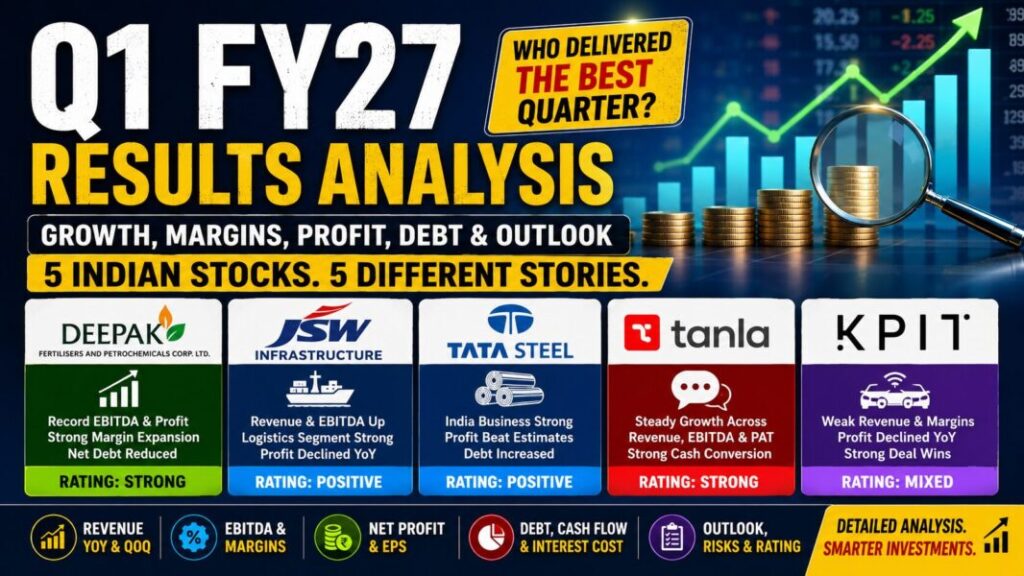
The Q1 FY27 results of these five companies show very different business trends.
Deepak Fertilisers delivered the strongest earnings growth, helped by better chemical prices and sharp margin expansion. Tata Steel reported a healthy improvement in operating profit, led by its Indian business. Tanla Platforms produced steady, cash-backed growth.
JSW Infrastructure’s operating business remained strong, but reported profit declined. KPIT Technologies faced the toughest quarter because of weak automotive demand, lower revenue and a sharp margin fall.
This article compares revenue, EBITDA, profit, margins, cash flow, debt, business segments, management commentary and key risks for everyday Indian investors.
Q1 FY27 Results: Quick Comparison
| Company | Main takeaway | Final rating |
|---|---|---|
| Deepak Fertilisers | Record EBITDA and profit with major margin expansion | Strong |
| JSW Infrastructure | Healthy revenue and EBITDA growth, but PAT declined | Positive |
| Tata Steel | Strong India performance and profit beat; debt increased | Positive |
| Tanla Platforms | Balanced growth, better margins and strong cash conversion | Strong |
| KPIT Technologies | Weak revenue, lower margins and falling profit despite strong deal wins | Mixed |
Deepak Fertilisers Q1 FY27 Results Analysis
Deepak Fertilisers and Petrochemicals Corporation delivered an exceptional quarter.
Revenue increased, but the bigger story was profitability. Better realisations in mining chemicals, industrial chemicals and ammonia helped the company report its highest-ever quarterly operating EBITDA and net profit.
Revenue, EBITDA and Net Profit Growth
Operating revenue increased 22% YoY and 8% QoQ to ₹3,256 crore.
Operating EBITDA rose 65% YoY and 139% QoQ to ₹845 crore.
Net profit doubled to ₹490 crore, compared with ₹244 crore in Q1 FY26. Sequentially, profit rose 252% from ₹139 crore in Q4 FY26.
These are very strong numbers. Profit grew much faster than revenue, showing that higher product realisations and operating efficiency had a major impact.
EBITDA Margin Movement
Operating EBITDA margin improved to 26%, from:
- 19.3% in Q1 FY26
- 11.8% in Q4 FY26
This means the margin expanded by around 670 basis points YoY and 1,420 basis points QoQ.
The sharp sequential improvement partly reflects the weak Q4 base. Still, a 26% operating margin is a strong result for the company.
EPS, Finance Cost and Debt
Based on reported profit and the outstanding equity base, quarterly EPS was approximately ₹35–₹37 per share. Investors should confirm the final diluted EPS from the statutory financial statement because the investor presentation focuses mainly on operating performance.
Finance cost increased 8% YoY and 1% QoQ to ₹95 crore. The increase was much slower than EBITDA growth, which is positive.
Net debt declined to ₹4,719 crore, despite capital expenditure of ₹515 crore during the quarter. Management said the reduction was supported by strong operational free cash flow. Short-term debt stood at ₹440 crore, mainly for working-capital requirements.
Net debt-to-EBITDA improved to around 1.4 times. This indicates that the balance sheet is becoming more comfortable as earnings rise.
Segment-Wise Performance
Mining Chemicals
Mining chemicals revenue increased 36% YoY and 15% QoQ, even though sales volume declined.
Volumes fell 12% YoY and 21% QoQ because of production and dispatch disruptions linked to changes in the PESO portal. Better realisations, supported by global supply tightness and geopolitical developments, more than offset the lower volume.
Business-to-consumer mining-chemicals revenue increased 42% YoY to ₹151 crore.
Industrial Chemicals
Industrial chemicals revenue declined 11% YoY but grew 10% QoQ.
Nitric-acid volumes were broadly stable YoY. However, IPA sales volume fell sharply because of restrictions on refinery-grade propylene availability. Higher product prices supported the sequential revenue recovery.
Crop Nutrition
Crop-nutrition revenue grew 9% YoY but declined 13% QoQ.
Delayed rainfall, phosphoric-acid shortages and high sulphur costs affected volumes and profitability. Specialty and Croptek products contributed 43% of crop-nutrition revenue, supporting a gradual move towards differentiated products.
Other Income and Exceptional Items
Other income fell to ₹6 crore from ₹24 crore in Q1 FY26.
Therefore, the profit growth was driven mainly by the operating business rather than treasury gains or large one-time income.
Management Outlook
Management expects mining demand to slow seasonally during the monsoon quarter. However, elevated ammonium-nitrate prices may continue supporting margins.
In crop nutrition, management expects rainfall conditions to remain manageable in most key districts. High raw-material costs and the price difference between DAP and complex fertilisers remain risks.
Performance Versus Market Expectations
The result was materially stronger than normal market expectations because EBITDA rose 139% sequentially and net profit more than tripled QoQ. The company’s record margin and profit were the main surprises.
However, the stock reaction was not uniformly positive, which suggests that some investors may have been concerned about the sustainability of peak chemical realisations and the high debt level.
Main Positives
- Record quarterly EBITDA and profit
- EBITDA margin expanded to 26%
- Strong chemical realisations
- Net debt declined despite heavy capital expenditure
- Profit growth came from operations, not other income
- Specialty-product contribution is increasing
Main Negatives and Risks
- Mining volumes declined
- Crop-nutrition demand remains weather-sensitive
- IPA operations were affected by raw-material availability
- Net debt remains sizeable
- Current chemical prices may not remain at peak levels
- Q2 mining demand may be seasonally weaker
Deepak Fertilisers Rating: Strong
The quarter was excellent on profit, margin and cash generation. The main question is whether these high chemical margins can be sustained.
Official source: Deepak Fertilisers Q1 FY27 earnings presentation
JSW Infrastructure Q1 FY27 Results Analysis
JSW Infrastructure reported healthy growth in revenue and operating EBITDA. Ports remained stable, while the logistics business expanded rapidly.
The weak point was net profit, which declined despite operating growth.
Revenue, EBITDA and Profit Growth
Revenue from operations increased 18% YoY to ₹1,445 crore.
Operating EBITDA rose 16% YoY to ₹674 crore.
Reported PAT declined to around ₹358 crore, from ₹390 crore in Q1 FY26. Profit attributable to owners was lower at around ₹347 crore.
Compared with Q4 FY26, revenue was broadly stable to slightly lower, while EBITDA declined from the seasonally strong March quarter. PAT was also lower than the previous quarter’s reported profit of roughly ₹418 crore.
EBITDA Margin Movement
Consolidated operating EBITDA margin slipped to 46.6%, from 47.5% in Q1 FY26.
The reported EBITDA margin, including other income, was around 48.7%, compared with 51.1% a year earlier.
The decline was mainly linked to business mix. The logistics segment is growing faster but currently has a lower margin than mature port operations.
EPS, Cash and Debt
Quarterly EPS was approximately ₹1.65 per share, based on profit attributable to shareholders and the expanded equity base following the QIP.
Cash and bank balances stood at ₹9,863 crore, while gross debt was ₹7,094 crore at the end of June 2026.
This means the company moved into a net-cash position of about ₹2,769 crore after completing a ₹7,503 crore qualified institutional placement.
The improved liquidity provides funding for large expansion projects. However, investors should remember that a meaningful portion of the QIP proceeds will be used for capital expenditure.
Segment-Wise Performance
Ports
Ports revenue increased around 11% YoY to ₹1,208 crore.
Operating EBITDA increased 7% to ₹601 crore. The port EBITDA margin declined to 49.8%, from 51.7%.
Cargo handled increased 6% YoY to 31 million tonnes. Strong performance at Jaigarh, Dharamtar, South West Port and Ennore supported growth.
Fujairah volumes were weak because of the challenging operating environment in the Middle East. Third-party cargo declined slightly, while JSW Group cargo increased.
Logistics
Logistics revenue increased from ₹138 crore to ₹237 crore.
Operating EBITDA jumped from ₹20 crore to ₹73 crore, and the margin improved from 14.5% to 30.6%.
Growth came from Navkar Corporation and the recently consolidated rail-rakes business. Domestic cargo volumes at Navkar rose 40%, while EXIM volumes increased 2%.
The logistics segment is becoming an important second growth engine.
Exceptional Items and Other Income
Total revenue increased 14.3%, slower than revenue from operations, because other income was lower.
The profit decline appears to have been linked to higher depreciation, finance cost and the larger capital base rather than a single major exceptional loss.
Management Guidance
The company retained aggressive FY27 and FY28 targets.
For FY27, consolidated operating revenue guidance is about ₹6,850 crore, with operating EBITDA of around ₹3,000 crore.
For FY28, management is targeting revenue of ₹10,800 crore and EBITDA of ₹5,000 crore. The company also aims to reach 400 MTPA port capacity by FY30.
Performance Versus Market Expectations
The operating result was broadly healthy, but the fall in PAT was weaker than investors would normally expect from an 18% revenue increase.
The QIP and strong balance sheet support future growth, but shareholders will now expect faster earnings conversion from the large project pipeline.
Main Positives
- Revenue and operating EBITDA grew in double digits
- Logistics EBITDA rose sharply
- Strong cash position after the QIP
- Cargo volumes increased
- Large port and logistics expansion pipeline
- Investment-grade rating with stable outlook
Main Negatives and Risks
- PAT declined YoY
- Port EBITDA margin fell
- Third-party cargo was slightly weak
- Fujairah remains exposed to Middle East disruptions
- Large capex programme creates execution risk
- QIP increased the equity base and may dilute near-term EPS
JSW Infrastructure Rating: Positive
The underlying business is expanding well, especially logistics. The rating is not “Strong” because profit declined and margins softened.
Official source: JSW Infrastructure Q1 FY27 results presentation
Tata Steel Q1 FY27 Results Analysis
Tata Steel reported a better-than-expected quarter, supported by strong Indian steel prices and improved domestic profitability.
Europe remained weak, but the UK loss narrowed and the Netherlands business moved close to operating break-even.
Revenue, EBITDA and Net Profit Growth
Consolidated revenue increased around 14% YoY to ₹60,794 crore.
Consolidated EBITDA rose 25% YoY to ₹9,370 crore.
Net profit attributable to shareholders increased about 12% to ₹2,318 crore.
Sequentially, revenue declined roughly 4%, EBITDA fell around 5%–6%, and profit declined about 21% from Q4 FY26.
The sequential fall should be viewed against a stronger March-quarter volume base.
EBITDA Margin Movement
Consolidated EBITDA margin improved to around 15.4%, from roughly 14% in Q1 FY26.
Sequentially, the margin was broadly stable to slightly lower than Q4 FY26.
India EBITDA margin was much stronger at 27%. India EBITDA per tonne increased to ₹19,162 from ₹15,907 in Q4 FY26.
EPS, Debt and Interest Cost
Diluted EPS was approximately ₹1.86, compared with ₹1.67 in Q1 FY26 and ₹2.34 in Q4 FY26.
Net debt increased to ₹84,173 crore, from around ₹78,309 crore in the previous quarter.
Net debt-to-EBITDA stood at 2.3 times. Liquidity remained comfortable at ₹45,950 crore, including cash and equivalents of ₹13,221 crore.
The increase in debt is a concern because Tata Steel continues to spend heavily on domestic expansion and the transition of its European operations.
Interest coverage remained comfortable at around 5.2 times.
Segment-Wise Performance
India
India revenue stood at ₹36,989 crore, with EBITDA of ₹9,908 crore.
Production and deliveries were affected by maintenance shutdowns, but domestic deliveries still grew 11% YoY. Better product mix and stronger steel realisations supported profitability.
India remains the company’s main profit engine.
Netherlands
Netherlands revenue was €1.45 billion, while EBITDA was only €4 million.
Production was affected by the shutdown of the Direct Sheet Plant. Trial operations have started ahead of a possible full restart.
United Kingdom
UK revenue stood at £484 million.
The EBITDA loss narrowed to £27 million as the business shifted to processing purchased steel substrate while the Port Talbot electric-arc-furnace project progresses.
Thailand and Other Operations
Thailand volumes remained relatively stable. These operations are smaller and did not materially change the consolidated result.
Exceptional Items and Other Income
There was no unusually large exceptional gain driving the reported profit.
The company continues to incur restructuring and transition costs in Europe, which remain an underlying drag on consolidated returns.
Management Guidance
Management expects Indian production and deliveries to normalise after the maintenance shutdowns.
The company is continuing investment in:
- Kalinganagar and NINL expansion
- The Ludhiana electric-arc furnace
- Downstream finishing facilities
- The Port Talbot electric-arc-furnace transition
- Netherlands environmental upgrades
Tata Steel also announced a large expansion investment for NINL, which increases long-term capacity but adds to near-term capital needs.
Performance Versus Market Expectations
Net profit of ₹2,318 crore was slightly above the LSEG consensus estimate of around ₹2,295 crore.
The better result was mainly supported by firm Indian steel prices and improved domestic EBITDA.
Main Positives
- EBITDA increased 25% YoY
- India margin improved strongly
- Profit beat market expectations
- UK losses narrowed
- Strong group liquidity
- Domestic capacity expansion supports long-term growth
Main Negatives and Risks
- Net debt increased
- Europe remains weak
- Coking-coal and iron-ore costs can affect margins
- Large capital-expenditure commitments
- Steel prices remain cyclical
- Sequential profit declined
Tata Steel Rating: Positive
The quarter was strong on operating performance and better than expected. High debt and continuing European losses prevent a “Strong” rating.
Official source: Tata Steel Q1 FY27 press release
Tanla Platforms Q1 FY27 Results Analysis
Tanla Platforms reported a balanced quarter with double-digit growth in revenue, EBITDA and net profit.
The best part of the result was that earnings converted into cash.
Revenue, EBITDA and Profit Growth
Revenue increased 17.8% YoY and 4.1% QoQ to ₹1,226 crore.
EBITDA rose 22.7% YoY and 4.9% QoQ to ₹201 crore.
PAT increased 20.1% YoY and 5.8% QoQ to ₹142 crore.
Gross profit grew faster than revenue, rising 25.1% YoY to ₹326 crore.
EBITDA Margin Movement
EBITDA margin improved to around 16.4%, from 15.8% in Q1 FY26.
The margin was also slightly higher sequentially. Better gross-profit growth shows that Tanla is improving the quality of revenue rather than focusing only on volume.
EPS, Cash Flow and Debt
EPS stood at ₹10.77.
Free cash flow was ₹126 crore, equal to 89% of PAT.
Tanla has historically maintained a debt-light balance sheet. Interest cost is not a major earnings risk compared with capital-intensive companies.
The strong cash conversion gives the company room for dividends, buybacks and investment in new platforms.
Segment-Wise Performance
Tanla broadly operates through:
- Enterprise communications
- Digital platforms and Wisely
- International operations
- AI-led fraud and spam-prevention solutions
Enterprise messaging remains the largest revenue contributor. Digital platforms carry higher margins and are more valuable for long-term profit growth.
The company continues to expand Wisely.ai and its anti-scam solutions across telecom markets. The platform already protects more than 100 million users in Indonesia.
Exceptional Items and Other Income
There was no major exceptional item affecting the quarter.
The earnings growth was supported by the operating business, and free cash flow closely matched PAT.
Management Guidance
Management stressed that the company is targeting profitable growth rather than low-margin revenue growth.
The priority remains expanding AI-native platforms, increasing digital-platform revenue and improving cash conversion.
Performance Versus Market Expectations
The market reacted positively after the results, with the stock rising sharply as investors focused on 17.8% revenue growth and faster EBITDA growth.
The result was therefore better than the cautious expectations surrounding the communications-platform sector.
Main Positives
- Revenue, EBITDA and PAT all grew
- EBITDA margin improved
- Free cash flow was 89% of PAT
- EPS increased
- Digital and AI platform opportunity
- Low balance-sheet risk
Main Negatives and Risks
- Enterprise messaging is competitive
- Dependence on telecom regulations
- Pricing pressure in communication services
- International expansion carries execution risk
- Digital-platform growth must remain faster than enterprise messaging
- Large customers can affect quarterly growth
Tanla Platforms Rating: Strong
The quarter combined growth, margin improvement and cash generation. It was one of the cleanest results in this group.
Official source: Tanla Platforms Q1 FY27 results
KPIT Technologies Q1 FY27 Results Analysis
KPIT Technologies reported a weak operating quarter because of lower spending by global automotive customers, particularly in Europe.
The company’s deal wins remained strong, but revenue and margins were under pressure.
Revenue, EBITDA and Net Profit Growth
Revenue increased 8.9% YoY in rupee terms to around ₹1,675 crore, but declined roughly 2% QoQ.
Constant-currency revenue was almost flat YoY and declined 3.6% QoQ.
Net profit fell 32% YoY and 28% QoQ to ₹117 crore.
Rupee revenue growth was largely supported by currency movement. Underlying business growth was weak.
EBITDA Margin Movement
EBITDA margin declined to 17.2%, from:
- 21% in Q1 FY26
- 20.6% in Q4 FY26
This was a sharp contraction of around 380 basis points YoY and 340 basis points QoQ.
The margin was affected by lower revenue, unfavourable business mix and continued investments.
EPS, Cash and Interest Cost
Quarterly EPS was approximately ₹4.25–₹4.35, based on the reported profit and equity base.
KPIT remained net-cash positive, with closing net cash of ₹900 crore, compared with ₹960 crore in the previous quarter.
Days sales outstanding stood at 51 days.
Debt and interest costs are not major risks. The main issue is earnings growth and margin recovery.
Segment-Wise Performance
KPIT serves global automotive manufacturers through:
- Autonomous driving and advanced driver-assistance systems
- Connected vehicles
- Electric and conventional powertrain
- Vehicle engineering and design
- After-sales software
- Software-defined vehicle platforms
- Products and solutions
The US geography and the after-sales and vehicle-engineering practices showed growth.
Europe remained weak because several large automotive clients reduced or postponed spending.
Exceptional Items and Other Income
The quarter included a foreign-exchange loss of ₹16.3 crore, compared with ₹31.2 crore in Q4 FY26.
KPIT also recognised a share of loss of ₹14 crore from Qorix, where revenue was postponed.
These items affected profit, though the bigger issue remained operating-margin contraction.
Management Guidance
Management said margins should improve successively in the coming quarters, helped by:
- Revenue recovery
- Better project mix
- AI-led productivity
- Growth in products and solutions
- Client and geography diversification
The company closed engagements worth $257 million during the quarter. Management also said Q1 performance was slightly ahead of its revised outlook.
Performance Versus Market Expectations
KPIT had already warned investors about weak Q1 performance before the result.
Reported dollar revenue of $176.8 million was slightly ahead of the company’s revised indication of around $176.2 million. This explains why the stock initially reacted positively despite weak reported profit.
Still, compared with expectations before the profit warning, the quarter was clearly disappointing.
Main Positives
- Strong deal wins of $257 million
- Net-cash balance sheet
- Q1 performance slightly beat revised guidance
- US and after-sales businesses showed growth
- Margin recovery expected over coming quarters
- Long-term software-defined vehicle opportunity remains intact
Main Negatives and Risks
- Profit fell 32% YoY
- Constant-currency revenue declined QoQ
- EBITDA margin dropped sharply
- High dependence on global automotive spending
- European clients remain under pressure
- Qorix losses and delayed revenue
- AI may change pricing and delivery models
KPIT Technologies Rating: Mixed
The operating result was weak, but the company remains financially sound and deal wins were healthy. The rating depends on whether revenue and margins recover from Q2 onward.
Official source: KPIT Technologies Q1 FY27 investor overview
Final Ranking of the Five Q1 FY27 Results
1. Deepak Fertilisers — Strong
Record EBITDA, record profit, higher margins and lower net debt made this the strongest headline result.
2. Tanla Platforms — Strong
Tanla delivered broad-based growth with good free-cash-flow conversion and limited balance-sheet risk.
3. Tata Steel — Positive
India performed very well and profit beat estimates. High debt and European weakness remain concerns.
4. JSW Infrastructure — Positive
Operating performance was healthy, especially in logistics. PAT decline and margin pressure limited the result.
5. KPIT Technologies — Mixed
The quarter showed weak revenue growth, margin compression and lower profit. Strong deal wins and management’s recovery commentary provided some support.
What Investors Should Watch in Q2 FY27
For Deepak Fertilisers, the key question is whether chemical realisations and the 26% EBITDA margin can continue.
For JSW Infrastructure, investors should monitor profit conversion, project execution and the use of QIP funds.
For Tata Steel, watch Indian steel prices, coking-coal costs, European losses and net debt.
For Tanla Platforms, focus on digital-platform growth, international business and cash conversion.
For KPIT Technologies, the most important indicators are constant-currency revenue recovery, EBITDA-margin improvement and spending by European automobile manufacturers.
Further Reading
Banking Sector Q1 FY27 Results Analysis for 5 Important Stocks
Q1 FY27 Results Analysis: Reliance, TCS, HCL Tech, Jio Financial and DMart
Stock Market 101 Lesson 39: ELSS vs PPF vs NPS – Ultimate Beginner Guide
Stock Market 101 – Lesson 40: Long-Term Wealth Habits
Stock Market 101 – Lesson 38: Tax-Saving Instruments Overview
Disclaimer
This article is for educational and informational purposes only. It is not a recommendation to buy, sell or hold any stock. Quarterly earnings can be affected by commodity prices, foreign exchange, one-time costs and changes in customer demand. Investors should review official filings, valuations and their own risk profile before making an investment decision.
Article Information
Author: Kartalks Research Desk
Reviewed by: Kartalks Editorial Team
Content Type: Q1 FY27 results analysis, quarterly earnings summary, revenue and profit performance, margin review, company fundamentals, sector outlook, management commentary, risk factors, valuation awareness, and investor education
Sources: NSE, BSE, company exchange filings, quarterly results, investor presentations, annual reports, management commentary, SEBI updates, and official public sources
Last Updated: August 1, 2026
Thank you for detailed info on different aspects of respective stocks performances.
Thank you! We’re glad you found the detailed stock performance analysis useful.