
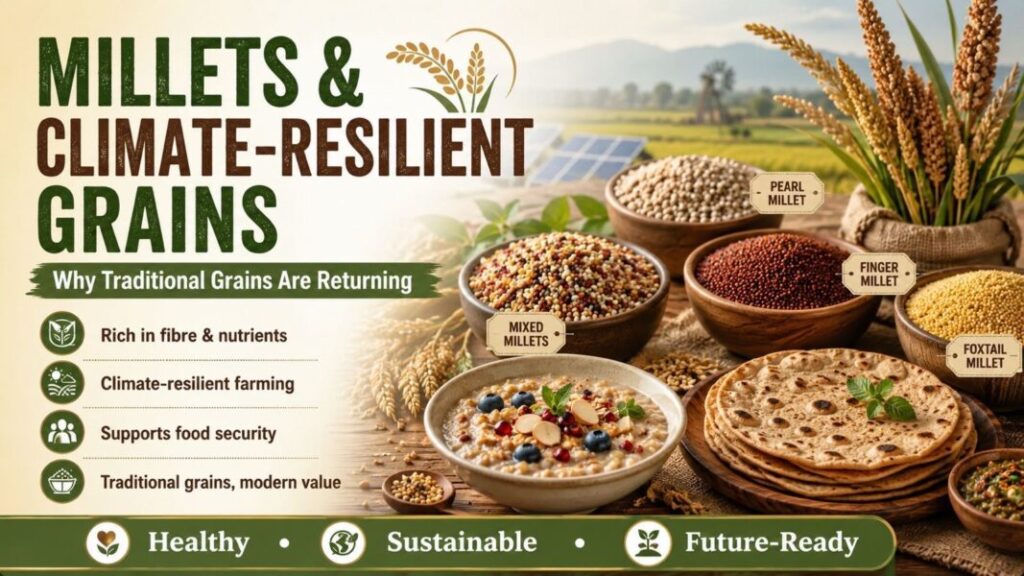
Millets and Climate-Resilient Grains: Why Traditional Grains Are Returning in 2026
Millets and climate-resilient grains are coming back into the conversation for a reason. This is not only about food nostalgia or reviving old recipes. It is about what the future of food may need: crops that can handle harsher growing conditions, support better nutrition, and create new opportunities for farmers and local food systems. FAO says millets can grow on arid lands with minimal inputs, are resilient to changing climate conditions, and can help countries improve self-sufficiency while reducing dependence on imported cereal grains.
That is why these grains are no longer being discussed only in farming circles. They are now showing up in public policy, food-security discussions, sustainable diet debates, and everyday health conversations. FAO’s 2024 updates described millets as a strong option for strengthening agrifood systems, food security, nutrition, and sustainable land management, while also opening economic opportunities for small-scale farmers and agribusinesses.
🌾 What are millets, exactly?
Millets are a diverse group of small-grained dryland cereals. FAO’s millet information pages list species such as pearl millet, finger millet, foxtail millet, proso millet, barnyard millet, little millet, kodo millet, and several other local grains. In practical Indian food language, many readers will know them through names like bajra, ragi, kangni, kodo, and sama.
That variety matters. When people say “millets are returning,” they are not talking about one single grain. They are talking about a broader family of traditional grains that have stayed important in dryland farming systems for generations, especially across parts of Asia and Africa. FAO says the International Year of Millets helped bring fresh attention to that wider heritage and to the future potential of these crops.
🌍 Why traditional grains are returning now
The return of millets is being pushed by three big forces at the same time.
1. Climate pressure is changing food priorities
As heat, drought, land stress, and uncertainty grow, crops that can perform under tougher conditions become more valuable. FAO says millets are drought-tolerant crops capable of growing in adverse environments with minimal inputs, and that they can contribute to food security, biodiversity, and sustainable land management. That is a major reason they are being talked about again as “grains for the future.”
2. Nutrition is back at the center of the food conversation
Millets are getting attention not only because they are hardy, but because they also bring nutritional value. FAO says millets contribute to healthy diets by providing dietary fibre, protein, and essential nutrients such as minerals and antioxidants. That makes them attractive in a time when more people want foods that are both functional and familiar.
3. Policy and public awareness have created momentum
The UN-declared International Year of Millets 2023 helped push millets into global awareness, and FAO has made clear that the goal is not to let that momentum fade. Its 2024 closure message said the year marked “the beginning” of stronger recognition for millets as climate-resilient crops and nutritious foods, while its final report emphasized that the end of the campaign should begin a new phase of sustainable production and consumption.
🇮🇳 Why this matters especially for India
For India, this is more than a global trend. It is a serious domestic opportunity. A 2025 Press Information Bureau note said India produced 180.15 lakh tonnes of millets in 2024–25, which was 4.43 lakh tonnes higher than the previous year. The same note said millets are being promoted through partnerships with state missions and agriculture departments, public procurement support, and wider awareness efforts around their climate resilience and nutritional value.
That is one reason this topic fits Kartalks well. It sits at the point where food, health, farming, sustainability, and everyday Indian eating habits meet. It also connects directly to a practical question many families and readers now ask: if these grains are so useful, how do we bring them back into normal meals without making food feel complicated? That is where the conversation becomes genuinely useful.
🌱 What makes millets “climate-resilient”?
The phrase gets used often, but it deserves a clear explanation.
Millets are called climate-resilient because FAO says they can be cultivated under adverse and changing climatic conditions, including on arid lands and with minimal inputs. In plain words, they are better suited than many mainstream grains to tough dryland environments and shifting weather stress. That is why FAO repeatedly describes them as a smart option for resilience, self-sufficiency, and sustainable agrifood systems.
FAO’s 2024 millet update also linked these crops with biodiversity and sustainable land management, which is important. A resilient crop is not useful only because it survives. It is useful because it can support broader farming systems, help farmers reduce risk, and fit into regions where agriculture is already under pressure. That makes millets relevant far beyond health-food shelves.
At the same time, climate-resilient does not mean “magic crop.” It does not mean zero risk, zero effort, or guaranteed results in every condition. What it does mean, based on FAO’s framing, is that millets deserve more space in future food planning because they are better adapted to difficult environments than many people realized. That is one of the biggest reasons these grains are returning.
🥗 Why health-conscious readers are paying attention
For consumers, the return of millets is not only about farming. It is also about daily eating.
Many people are now looking for grains that feel less refined, more filling, and more connected to traditional food culture. Millets fit that mood well. FAO says they can contribute dietary fibre, protein, minerals, and antioxidants, which helps explain why they are increasingly being positioned as part of healthier and more diverse diets.
There is also a psychological reason behind the comeback. Traditional grains feel more trustworthy to many readers than ultra-processed “superfood” trends. Millets do not need a fancy imported image to sound relevant. They already belong to long food traditions. FAO’s millet campaign leaned heavily into that combination of heritage and future potential, which is exactly why these grains now appeal to both nutrition-minded consumers and sustainability-minded readers.
👩🌾 Why farmers and food systems care
This is not just a consumer story. It is a livelihood story too.
FAO’s 2024 and 2025 millet work repeatedly connects these grains with dryland farming, smallholder opportunity, and better agrifood-system resilience. Its April 2024 message said millets could open new revenue streams for smallholders and value-chain actors, while its September 2024 update said they offer economic opportunities for small-scale farmers and agribusinesses.
In India, the policy side reflects that opportunity. The 2025 PIB note said IIMR is supporting improved seed development, farmer training, value addition, FPO formation, and public awareness efforts. That tells us the millet comeback is not only about telling consumers to eat differently. It is also about building the research, procurement, processing, and market links needed to make millet cultivation and consumption more viable at scale.
🍚 How to bring millets back into normal eating
This is where the topic becomes practical.
The biggest mistake people make is assuming millets must replace everything overnight. That usually does not work. A better approach is to treat millets as part of a gradual shift toward more diverse grain choices.
Easy ways to start
- Use bajra or jowar more often in rotis
- Try ragi porridge or ragi dosa as a breakfast option
- Replace one rice-based meal a week with foxtail millet or little millet
- Use millets in khichdi, upma, idli, or simple grain bowls
- Mix millets with familiar grains first instead of going 100 percent millet from day one
This kind of transition works better because taste, texture, and cooking habits matter. The point is not to make meals feel like a nutrition project. The point is to make traditional grains feel normal again.
🍽️ Why the “return” still has work to do
Even with all the positive attention, the comeback is not automatic.
FAO’s messaging after the International Year of Millets made it clear that awareness alone is not enough. It called for more research and development, more public and private investment, stronger value chains, support for sustainable production, and continued collaboration. That is a reminder that a real return needs more than social-media interest. It needs availability, affordability, recipe familiarity, and farmer confidence.
That is also why value addition matters. If millets stay limited to niche packaging or difficult cooking formats, many households will not adopt them consistently. But if they become easier to buy, easier to cook, and easier to fit into normal meals, their return becomes much more believable. India’s current millet push is essentially trying to solve that exact problem from both the farm side and the consumer side.
✅ Final takeaway
Millets and climate-resilient grains are returning because they answer multiple modern concerns at once. They speak to climate stress, better nutrition, traditional food culture, smallholder livelihoods, and the search for more sustainable food systems. FAO’s recent work makes the case clearly: millets are not only ancient grains with cultural value, but practical crops with real relevance to the future of food.
For everyday readers, the smartest way to think about millets is simple: they are not here to be treated as a passing food fad. They are returning because the world is rediscovering something useful that was never supposed to disappear in the first place.
❓ 5 FAQs
1. Why are millets being called climate-resilient grains?
FAO says millets can grow on arid lands with minimal inputs and are resilient to adverse and changing climatic conditions, which makes them useful for dryland and climate-stressed farming systems.
2. Are millets only important for farmers?
No. They matter to both farmers and consumers because FAO links them not only with resilience and food security, but also with healthy diets through fiber, protein, minerals, and antioxidants.
3. Which grains are included under millets?
FAO describes millets as a diverse group that includes pearl, finger, foxtail, proso, barnyard, little, kodo, brown top, and several other dryland cereals.
4. Is millet production actually growing in India?
According to a 2025 PIB note, India produced 180.15 lakh tonnes of millets in 2024–25, up 4.43 lakh tonnes from the previous year.
5. What is the easiest way to start eating millets?
The easiest way is to begin small by swapping one or two familiar meals each week with millet-based options such as rotis, porridge, dosa, upma, or khichdi.
Further reading
Healthy School Food: Why Kids’ Nutrition Is Back in the Spotlight in 2026
Brain-Healthy Foods: Why the MIND Diet Is Getting More Attention in 2026
Sustainable and Local Food Movement: Why Climate and Health Are Finally Sharing the Same Plate
Front-of-Pack Nutrition Labels: What New Food Labels May Mean for Shoppers in 2026
Low-Sodium Eating in 2026: Hidden Salt in Everyday Foods and Smarter Ways to Cut It
Clean Label And Natural Food Movement
Disclaimer:
This article is for general educational purposes only and should not be treated as medical, agricultural, or financial advice. Nutrition needs, crop suitability, and food choices can vary by person, region, climate, and farming conditions. For personal diet guidance, speak with a qualified healthcare professional. For cultivation advice, consult local agricultural experts or extension services.
Article Information
Author: Kartalks Editorial Team
Reviewed by: Kartalks Content Review Team
Sources: food safety references, nutrition awareness resources, and official public sources
Last Updated: May 23, 2026