
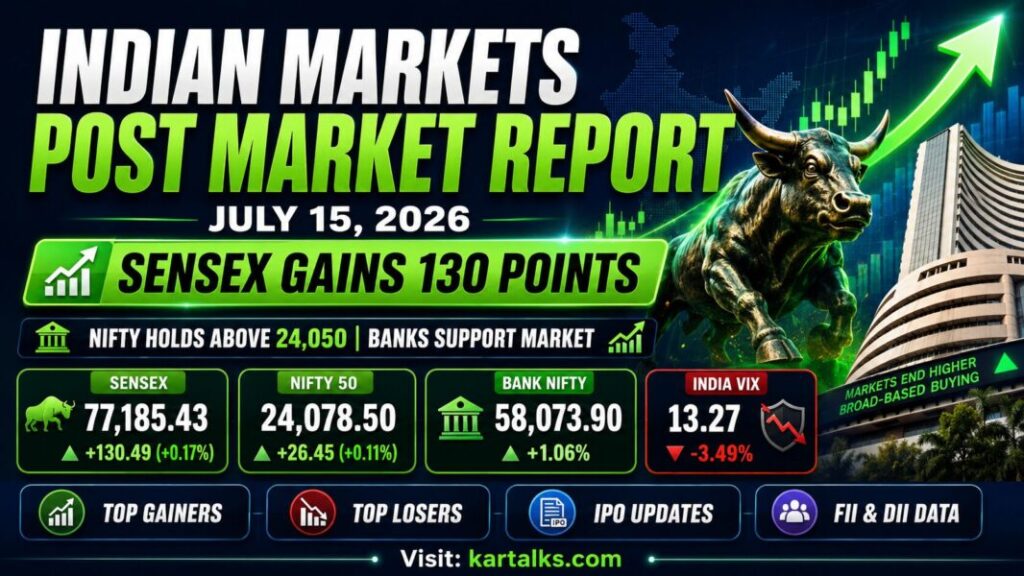
Indian Markets Post Market Report Today: July 15, 2026 Sensex Gains 130 Points, Nifty Holds Above 24,050
Indian Markets Post Market Report Today: Indian stock markets ended Wednesday, July 15, 2026, with modest gains after surrendering most of the strong rise seen during the morning session.
The BSE Sensex closed at 77,185.43, gaining 130.49 points or 0.17%. The Nifty 50 settled at 24,078.50, up 26.45 points or 0.11%.
Banking shares provided support. The Bank Nifty closed at 58,073.90, gaining around 1.06% after touching an intraday high near 58,149.
The session looked much stronger during the first half. Sensex had climbed by more than 550 points, while Nifty briefly moved above 24,200. Profit booking in information technology, metal, power and selected consumer shares pulled the indices away from their highs.
Still, the broader market remained positive. The Nifty Midcap 100 gained around 0.3%, while the Nifty Smallcap 100 advanced nearly 0.7%. Eleven of the 16 major sectoral indices closed higher.
Indian Markets Post Market Report Today: Closing Levels
| Index | Closing level | Daily movement |
| Nifty 50 | 24,078.50 | +0.11% |
| BSE Sensex | 77,185.43 | +0.17% |
| Bank Nifty | 57,757.85 | Around +0.51% |
| India VIX | Around 13.27 | -3.49% |
India VIX fell by approximately 3.5%, indicating a reduction in expected near-term market volatility. The decline came even as geopolitical tensions remained high, suggesting that domestic traders were less nervous than they were during Tuesday’s session.
A lower VIX does not mean that market risk has disappeared. Crude oil remained above $85 per barrel, the rupee stayed close to its recent low, and the conflict between the US and Iran continued to influence global markets.
Why Did the Indian Stock Market Rise Today?
The market ended slightly higher due to buying in banks, financial services, insurance, cement and selected automobile shares. However, the gains were restricted by losses in IT and metal stocks.
1. Banks and Financial Stocks Led the Recovery
Banking and financial shares rebounded after facing selling pressure in the previous session.
The Nifty Financial Services index gained around 0.6%. Bank Nifty rose about 1%, while the PSU Bank index advanced close to 1%.
State Bank of India, IndusInd Bank, Axis Bank, ICICI Bank and selected insurance companies attracted buying. Financial stocks carry a high weight in the benchmark indices, so their recovery helped Sensex and Nifty remain in positive territory.
Investors were also positioning themselves ahead of quarterly results from several banks, insurers and non-banking financial companies.
2. Softer US Inflation Improved Global Sentiment
US inflation for June came below market expectations, raising hopes that the US Federal Reserve may not need to increase interest rates aggressively.
This improved sentiment across several Asian and European markets. Lower expectations of US interest-rate increases can reduce pressure on emerging-market assets, including Indian equities.
However, the relief was limited because rising energy prices could push inflation higher again in the coming months.
3. Strong Buying in Insurance Stocks
Insurance companies were among the day’s notable performers.
ICICI Prudential Life gained around 3.8% after reporting higher quarterly profit. HDFC Life rose about 2.4%, while ICICI Lombard and HDB Financial also ended higher ahead of their results.
The buying showed that investors were looking beyond the large banks and adding exposure to financial businesses with long-term growth potential.
India’s insurance market still has room to expand as household incomes rise and more families seek health and life protection. But investors must also watch premium growth, claim ratios, expenses and regulatory changes.
4. Cement Stocks Attracted Buying
UltraTech Cement was among the top Nifty gainers. Several cement shares rose during the session as investors looked for businesses that could benefit from construction, housing and government infrastructure spending.
Cement companies may gain from improving demand, but fuel and transport costs remain important risks. Higher crude and energy prices can affect operating margins.
Investors should therefore focus on companies with strong regional positions, efficient plants and the ability to control costs.
5. Small-Cap and Mid-Cap Shares Outperformed
The Nifty Midcap 100 gained 0.28%, while the Nifty Smallcap 100 advanced 0.67%.
Broader-market participation was healthier than the modest movement in Sensex and Nifty suggested. Still, gains were uneven, with sharp company-specific reactions following earnings and business updates.
Tata Elxsi fell nearly 5% after brokerages reduced earnings estimates due to margin concerns. In contrast, Steel Strips Wheels and Landmark Cars rose sharply after encouraging business updates.
6. Profit Booking Erased Most Intraday Gains
The Sensex had gained more than 550 points during the morning, while Nifty moved above 24,200.
The early rally encouraged traders to book profits, particularly in stocks that had risen sharply. Weakness in IT, metals and power companies pulled the indices lower during the afternoon.
By closing time, Sensex retained only 130 points of its intraday gain. This shows that sellers remain active near higher market levels.
Reuters – Indian shares edge higher as financial stocks lead
Top Five Nifty Gainers and Losers
| Top gainers | Approximate move | Top losers |
| Eternal | +3.02% | Power Grid: around -1.90% |
| UltraTech Cement | Around +2.75% | Larson: around -1.67% |
| HDFC Life | Around +2.44% | Hindalco: around -1.90% |
| Shriram Finance | Around +1.96% | JSW Steel: around -1.67% |
| Eicher Motors | Around +1.72% | Tata Steel : around -1.60% |
Eternal led the Nifty gainers with a rise of just over 3%. UltraTech Cement, HDFC Life, Shriram Finance and Eicher Motors also ended among the leading performers.
The gains in HDFC Life and Shriram Finance reflected renewed buying across insurance and lending businesses. Eicher Motors benefited from positive sentiment in selected automobile companies.
Power Grid was one of the largest Nifty losers as investors booked profits in power and utility shares. Infosys declined after weak guidance from IBM affected sentiment across global technology stocks.
Hindalco and JSW Steel fell as metal shares remained weak. Dr Reddy’s Laboratories also closed lower after pharmaceutical stocks produced a mixed performance.
The exact percentage movement may differ slightly across market-data platforms because of rounding and closing-price adjustments.
Indian Markets Post Market Report Today’s Sector Performance
| Sector | Approximate move | Market view |
| Nifty PSU Bank | +1.0% | Strongest major sector |
| Nifty Bank | Around +1.0% | Financials support indices |
| Nifty Financial Services | +0.6% | Insurance and lenders gain |
| Nifty IT | -0.7% | Global technology weakness |
| Nifty Metal | Around -0.7% | Profit booking |
| Nifty Smallcap 100 | +0.67% | Broader market outperforms |
PSU Banks and Private Banks
Public-sector banks led the sectoral gains.
SBI rose around 1.5% and outperformed several private-sector peers. IndusInd Bank, ICICI Bank and other lenders also advanced.
The banking sector is entering an important earnings period. Investors will watch deposit growth, net interest margins, loan growth, asset quality and management guidance.
A single day’s rally is not enough to confirm a larger trend. Banks need healthy deposits and controlled credit costs to deliver sustainable earnings growth.
Information Technology
The Nifty IT index declined around 0.7%.
Indian IT stocks came under pressure after IBM projected weaker-than-expected quarterly revenue. Tata Elxsi fell approximately 4.8% after brokerages cut their FY27 earnings estimates due to margin concerns.
The sector remains sensitive to global technology budgets, AI-related spending and currency movements.
A weaker rupee can support reported revenue, but it cannot fully offset slow client spending or weak deal conversion.
Metals
Metal shares declined as investors reduced exposure to cyclical sectors.
Hindalco, JSW Steel and selected metal companies ended lower. The sector is influenced by global commodity prices, Chinese demand, the US dollar and energy costs.
Metal stocks may produce strong short-term rallies, but they can also fall quickly when global growth expectations weaken.
Automobiles
Selected automobile companies gained, with Eicher Motors and Bajaj Auto among the stronger Nifty shares.
Lower US inflation supported risk appetite, but expensive crude remains a concern. Higher fuel prices can influence vehicle demand, while a weaker rupee may raise the cost of imported parts.
Pharmaceuticals
Pharma shares produced mixed results.
The sector received some support because healthcare demand is less sensitive to economic cycles. However, Dr Reddy’s ended lower and Tata Elxsi’s decline affected the broader technology-related healthcare services space.
Export-focused pharmaceutical companies could benefit from a weaker rupee, though investors must watch US regulatory action and product-specific risks.
Two Growth Stocks Based on Q4 FY26 Results
The following companies reported encouraging Q4 FY26 operating performance. They are discussed for educational analysis, not as direct stock recommendations.
1. InterGlobe Aviation
InterGlobe Aviation can be analysed using its Q4 FY26 revenue growth, passenger demand, capacity expansion and profitability. The section should also explain the risk from rising aviation turbine fuel prices and the weaker rupee.
2. Bharat Electronics
Bharat Electronics can be covered based on its Q4 FY26 earnings, defence order book, execution outlook and government defence spending. Risks such as project delays, dependence on government orders and high valuation should also be included.
India VIX Update
India VIX declined around 3.49% and ended near 13.27.
The fall indicates that traders expected less near-term volatility than they did on Tuesday. Midcap and small-cap participation also improved while the fear gauge declined.
The current VIX level is not extremely high, but uncertainty remains due to geopolitical tensions and oil prices.
Short-term traders should still:
- Use defined stop-loss levels
- Keep overnight positions limited
- Avoid oversized derivatives exposure
- Watch crude oil and currency movements
- Avoid chasing sudden intraday rallies
For long-term investors, VIX is better used as a sentiment indicator than as a direct buy or sell signal.
Existing and Upcoming IPO Updates
SBI Funds Management IPO
The ₹9,813 crore SBI Funds Management IPO was fully subscribed on its second day.
Reuters reported that investors submitted bids for approximately 212 million shares against nearly 124.56 million shares available. The retail portion was subscribed about 1.26 times at the time of reporting.
The issue closes on July 16, with listing scheduled for July 21.
SBI Funds Management had assets under management of about ₹12.5 trillion as of March 2026. At the IPO price, the company is valued at approximately ₹1.17 trillion, or around 38 times FY26 earnings per share.
The company has a strong brand and distribution network. Still, investors should compare its valuation with listed asset-management companies before applying.
The issue is an offer for sale, meaning the IPO proceeds go to the selling shareholders rather than being used directly to expand the company.
Kusumgar Listing
Kusumgar made a strong stock-market debut on July 15.
The stock listed at ₹574 on the BSE, representing a 36.99% premium over its IPO price of ₹419. It opened at ₹569 on the NSE, a gain of around 35.8%.
The listing delivered an impressive initial return. However, investors should not assume that the same pace of gains will continue.
Post-listing performance depends on earnings, valuation, business quality and market conditions.
Laser Power and Infra
Laser Power and Infra’s prospectus was published through SEBI’s public-issue section on July 15.
The issue had earlier attracted investor attention due to demand in the power-infrastructure segment. Investors should check the final listing details and company fundamentals through official disclosures.
Alpine Texworld IPO
The ₹126.25 crore Alpine Texworld IPO entered its second day of bidding on July 15.
Its unofficial grey-market premium was around 10% above the upper price band of ₹105. GMP is not regulated and may change before listing.
The company operates in the textile sector, which can be affected by raw-material costs, export demand and currency fluctuations.
Retail investors should examine debt, working-capital requirements, customer concentration and promoter history before applying.
FII and DII Activity Today
The provisional institutional cash-market data for July 15 showed:
- FII net selling: ₹735.83crore
- DII net buying: ₹704.93 crore
Domestic institutional purchases were significantly larger than foreign selling, helping support the market during afternoon profit booking.
This continues the pattern of domestic mutual funds and insurance companies absorbing foreign outflows.
One day’s flow should not be treated as a trading signal. A consistent pattern over several sessions is more useful when assessing institutional sentiment.
Reuters – SBI Funds IPO fully subscribed on the second day
Commodity and Currency Market Updates
| Asset | Latest level or move | Market direction |
| Brent crude WTI | Around $84.90/barrel Around $79.72/barrel | Flat
Flat |
| Spot gold | Around $4,063/ounce | Down 0.7% |
| MCX gold silver | Around ₹1,42,200/10g ₹2,22,492/kg | Weak Weak |
| USD/INR | ₹96.2550 | Rupee slightly weaker |
Crude Oil
Brent crude rose approximately 2% to $84.93 per barrel after fresh developments in the US-Iran conflict increased concerns about supplies.
The US reinstated a naval blockade on Iran, while Iranian forces issued further threats involving energy-export routes.
High crude oil is a major risk for India because it can increase:
- The import bill
- Inflation
- The current-account deficit
- Transport and manufacturing costs
- Pressure on the rupee
Oil producers may benefit, while airlines, paints, tyres, chemicals and logistics companies could face higher operating costs.
Gold and Silver
The metal came under pressure because rising oil prices increased inflation concerns and made the future path of US interest rates less certain. Higher interest rates can reduce the appeal of gold because it does not generate regular income.
On MCX, gold fell by around ₹1,500 per 10 grams, while silver declined approximately ₹2,100 per kilogram.
Long-term investors using gold for diversification may prefer staggered purchases instead of reacting to every daily price movement.
Reuters – Gold declines as oil rally raises inflation worries
Indian Rupee
The rupee closed almost flat at ₹96.2550 per US dollar, compared with the previous close of ₹96.20.
The currency strengthened briefly to around ₹96.06 before demand for dollars from Indian companies pushed it lower again.
Modest foreign inflows provided support, but rising oil prices and corporate dollar demand restricted the recovery.
A weak rupee can support IT and pharmaceutical exporters. It can also increase costs for businesses dependent on imported fuel, machinery and raw materials.
Reuters – Rupee ends nearly flat as crude oil limits gains
Stock of the Day: Eternal
Eternal was the stock of the day after gaining approximately 3.02% and leading the Nifty 50 gainers.
The stock attracted buying as investors returned to consumer-technology and digital-platform businesses. The move also came during a session when financial and consumer-facing companies outperformed IT and metals.
Why Eternal Attracted Buyers
- Strong price momentum
- Renewed interest in consumer platforms
- Improving broader-market participation
- Short covering after recent volatility
- Positive sentiment in selected growth stocks
Long-term investors should focus on revenue growth, profitability, cash generation, competitive intensity and valuation.
A strong one-day gain alone is not enough to justify buying. The stock can remain volatile because expectations are already high.
Latest SEBI Updates
New Mutual Fund and ETF Filings
SEBI’s July 15 public list included filings for the JioBlackRock Nifty 50 ETF, Motilal Oswal Nifty Energy Index Fund, Motilal Oswal Nifty Metal ETF and Motilal Oswal Nifty Oil & Gas ETF.
These products may give investors more options for sector-based and index-based exposure after launch.
Sector ETFs are more concentrated than broad-market index funds. They should not be treated as low-risk simply because they track an index.
Master Circular for Merchant Bankers
SEBI issued an updated Master Circular for Merchant Bankers on July 14.
The circular brings together applicable operational and regulatory requirements for entities managing public issues and other capital-market transactions.
For retail investors, the update supports clearer compliance and accountability in public-market fundraising.
Recovery Action in Illiquid Stock-Option Matters
SEBI published several recovery proceedings on July 15 involving illiquid stock-option cases and other enforcement matters.
Such action serves as a reminder that investors should avoid manipulated, illiquid or unsolicited trading opportunities.
Retail investors should be cautious when promised guaranteed returns through options, Telegram groups, social-media tips or unregistered advisers.
SEBI – Master Circular for Merchant Bankers
Short-Term Investment View
The Nifty remains inside a narrow and volatile range.
Immediate support can be watched near 24,000, followed by 23,850–23,800.
Resistance is visible near 24,200, followed by 24,300–24,400.
The failure to hold the morning rally above 24,200 shows that sellers remain active at higher levels.
Short-term traders may focus on:
- Banks holding above key support levels
- Insurance shares after earnings
- Cement companies showing relative strength
- Select automobile stocks
- Companies with better-than-expected quarterly results
Avoid aggressive positions in IT and metals until price action becomes more stable.
Crude oil and geopolitical headlines can cause sharp overnight movements, so position sizes should remain controlled.
Long-Term Investment View
Long-term investors should focus on business quality instead of daily index movements.
A well-balanced equity portfolio can include:
- Large private and public-sector banks
- Telecom companies with improving cash flow
- IT companies with diversified global clients
- Healthcare and pharmaceutical leaders
- Consumer businesses with pricing power
- Index funds and diversified mutual funds
Use staggered investments rather than putting the full amount into the market after one positive session.
Investors with limited experience may find SIPs easier to manage than frequent stock selection.
Money needed within the next one to three years should generally not be heavily invested in equities.
Five FAQs
Q1. Why did the Indian stock market rise today?
Indian markets gained because of buying in banks, financial services, insurance and cement shares. Weakness in IT and metals limited the upside.
Q2. What was the Nifty closing level on July 15, 2026?
The Nifty 50 closed at 24,078.50, gaining 26.45 points or 0.11%.
Q3. What was the Sensex closing level today?
The Sensex closed at 77,185.43, up 130.49 points or 0.17%.
Q4. Were FIIs buyers or sellers?
As per latest available data FIIs were net sellers of approximately ₹739.70 crore, while DIIs purchased shares worth around ₹2,927.70 crore.
Q5. Which sector performed best today?
The PSU Bank index was one of the best-performing major sectors, gaining around 1%.
Final Market View
The July 15 session ended positively, but the closing numbers do not show the full story.
Sensex had gained more than 550 points during the morning before profit booking erased most of the rise. Banks, financial services and insurance companies supported the market, while IT and metal shares remained weak.
Domestic institutional buying continued to provide a cushion against foreign selling.
The main near-term risks are high crude prices, rupee weakness and the continuing US-Iran conflict. Quarterly earnings will also guide stock-specific movement over the coming sessions.
Investors should stay selective. Quality companies with consistent earnings, strong cash flow and manageable debt deserve preference over speculative shares.
Further Reading
Indian Markets Weekly View (July 13–July 17, 2026): Cautiously Bullish Sentiment
Rupee Fall 2026 Explained: Why INR May Stay Weak Against Dollar
Stock Market 101 – Lesson 38: Tax-Saving Instruments Overview
SBI Mutual Fund IPO 2026: Date, Issue Size, Business Model
Disclaimer
This article is published only for educational and informational purposes. It does not constitute investment advice, financial advice, a research report or a recommendation to buy, sell or hold any security. Kartalks.com and the author are not acting as SEBI-registered investment advisers or research analysts through this article.
Article Information
Author: Kartalks Research Desk
Reviewed by: Kartalks Editorial Team
Content Type: Indian stock market post-market report, closing levels, market movement, sector performance, top gainers and losers, FII/DII activity, IPO updates, commodity trends, currency movement, and investor education
Sources: NSE, BSE, SEBI, market closing data, sector performance data, FII/DII activity, IPO filings, commodity market data, currency market updates, company filings, and official public sources
Last Updated: July 15, 2026