
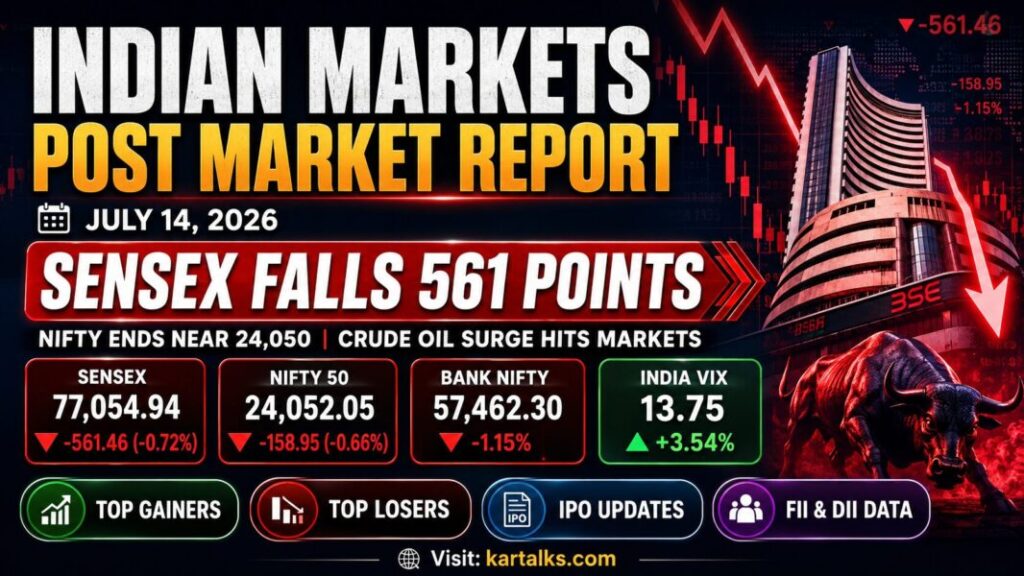
Indian Markets Post Market Report Today July 14, 2026 : Sensex Falls 561 Points, Nifty Ends Near 24,050
Indian Markets Post Market Report Today: Indian stock markets ended lower on Tuesday, July 14, 2026, as a sharp rise in crude oil prices increased concerns about inflation, the rupee and corporate costs.
The Nifty 50 closed at 24,052.05, down 158.95 points or 0.66%. The BSE Sensex declined 561.46 points or 0.72% to settle at 77,054.94.
Banking shares faced heavier selling. The Bank Nifty closed at 57,462.30, falling about 1.15%.
The market opened weak and remained under pressure for most of the day. Buying in pharmaceuticals and selected large-cap stocks helped the indices recover from their intraday lows, but it was not enough to reverse the decline.
Twelve of the 16 major sectoral indices ended in the red. Auto, financial services, banking and realty stocks were among the main laggards, while pharmaceutical shares outperformed.
Indian Markets Post Market Report Today: Closing Levels
| Index | Closing level | Daily movement |
| Nifty 50 | 24,052.05 | -0.66% |
| BSE Sensex | 77,054.94 | -0.72% |
| Bank Nifty | 57,462.30 | -1.15% |
| India VIX | 13.75 | +3.54% |
India VIX rose to 13.75, indicating that traders were expecting larger short-term swings in the market. The volatility gauge opened near 13.28 and touched an intraday high of around 13.87.
A higher VIX does not automatically mean that the market will continue falling. It shows that option premiums and expectations of near-term volatility have increased.
Why Did the Indian Stock Market Fall Today?
The decline was caused by a mix of geopolitical, commodity, currency and earnings-related concerns.
1. Crude Oil Jumped to a One-Month High
Brent crude rose more than 4% to nearly $87 per barrel after fresh tensions in the Middle East raised concerns about oil supplies.
The United States carried out another round of strikes against Iran, while developments involving Iranian shipping and the Strait of Hormuz added to supply fears. Reports of attacks on oil tankers also pushed energy prices higher.
High crude oil is a concern for India because the country imports a large portion of its energy requirement.
When oil becomes expensive, it can:
- Increase India’s import bill
- Put pressure on the rupee
- Raise fuel and transport costs
- Add to inflation
- Reduce the possibility of lower interest rates
- Affect profit margins of crude-dependent companies
Airlines, paint companies, tyre manufacturers, chemical businesses and logistics firms can face higher costs when crude remains elevated.
2. The Rupee Fell Below ₹96 per Dollar
The Indian rupee weakened sharply during the session and closed near ₹96.20 against the US dollar, down around 58 paise.
It touched an intraday low of approximately ₹96.24 before recovering slightly. The Reserve Bank of India was reportedly active in currency markets to control excessive volatility.
A weaker rupee can support exporters such as IT and pharmaceutical companies because they earn a large share of their revenue overseas.
However, it also makes imports more expensive. This can affect companies that import oil, machinery, electronics or raw materials.
3. Banks and Financial Stocks Faced Selling
Financial services and banking indices declined around 1.1%, putting pressure on the Nifty and Sensex.
State Bank of India fell more than 2%, while Kotak Mahindra Bank, HDFC Bank and several other lenders ended lower. ICICI Bank showed relative strength but still closed marginally down.
Banking stocks carry a large weight in Indian benchmark indices. Weakness in this group can pull down the Nifty even when a few other sectors remain positive.
Investors were also cautious about the possible effect of higher inflation on interest rates, credit costs and loan demand.
4. Auto Stocks Declined on Cost Concerns
The Nifty Auto index fell around 1.6%, making it one of the weakest sectors of the day.
Mahindra & Mahindra, Maruti Suzuki and other automobile shares faced pressure. Higher oil prices can affect fuel demand and customer sentiment, while expensive crude-linked inputs may raise manufacturing costs.
Auto companies may be able to pass some costs to customers, but repeated price increases can affect demand, especially in price-sensitive categories.
5. HCL Technologies Fell After Its Results
HCL Technologies declined around 4.5% despite reporting better quarterly revenue and profit.
The market was disappointed because the company retained its FY27 revenue growth guidance of 1% to 4%. Analysts viewed the unchanged outlook as a sign that discretionary technology spending remains uncertain.
This pulled down the Nifty IT index, though gains in TCS limited some of the damage.
6. Foreign Investors Returned to Selling
Foreign institutional investors were net sellers in the cash market, while domestic institutions remained buyers.
Continued foreign selling can affect market sentiment, particularly when it is combined with a weak rupee and rising crude oil.
Domestic mutual funds and insurance companies once again provided support, reducing the impact of foreign outflows.
Reuters – Indian shares decline as Middle East conflict raises inflation worries
Top Five Nifty Gainers and Losers Today
| Top gainers | Move | Top losers |
| Bharti Airtel | +1.82% | HCL Technologies: -4.46% |
| Apollo Hospitals | +1.34% | Shriram Finance: -3.26% |
| Sun Pharma | +1.10% | HDFC Life: -3.17% |
| Dr Reddy’s Laboratories | +0.95% | Tata Motors PV: -2.60% |
| TCS | +0.88% | InterGlobe Aviation: -2.32% |
Bharti Airtel led the Nifty gainers and helped reduce the index’s decline. Pharmaceutical companies such as Apollo Hospitals, Sun Pharma and Dr Reddy’s also gained as investors moved towards defensive sectors.
TCS ended higher despite weakness in the wider IT pack. The stock benefited from recent earnings optimism and deal-related interest.
On the losing side, HCL Technologies was the biggest laggard after its unchanged growth guidance disappointed investors. Shriram Finance and HDFC Life declined as financial stocks came under pressure.
InterGlobe Aviation was affected by the rise in crude oil. Aviation turbine fuel is a major cost for airlines, and sustained higher oil prices can reduce margins.
Indian Markets Post Market Report Today’s Sector Performance
| Sector | Approximate move | Market view |
| Nifty Pharma | +1.0% | Strongest sector |
| Nifty IT | -1.0% | HCLTech weighs |
| Nifty Financial Services | -1.1% | Broad selling |
| Nifty Bank | -1.15% | Banks under pressure |
| Nifty Auto | -1.61% | Weakest major sector |
| Nifty Midcap 100 | -0.44% | Broader weakness |
Pharmaceuticals
The Nifty Pharma index gained around 1% and was the best-performing major sector.
Biocon surged more than 6% after a large block deal involving approximately 46 million shares. Divi’s Laboratories, Sun Pharma, Cipla and selected healthcare companies also gained.
Pharma stocks are often treated as defensive because medicine demand is less sensitive to economic cycles. Export-oriented companies may also benefit from a weaker rupee.
Still, investors should watch US regulatory inspections, product concentration and pricing pressure in generic drugs.
Information Technology
The Nifty IT index declined about 1%.
HCL Technologies fell sharply after management retained its cautious growth outlook. Infosys also ended lower, while TCS provided some support.
The sector’s near-term performance will depend on global technology spending, large-deal conversion, AI-related demand and company guidance.
Banks and Financial Services
Banking and financial stocks remained under pressure for most of the session.
State Bank of India, Kotak Mahindra Bank and HDFC Bank were among the major index drags. Investors were concerned that high oil prices could keep inflation elevated and reduce the space for easier monetary policy.
Private banks with steady deposits, manageable credit costs and strong capital positions may remain relatively better placed over the long term.
Automobile Sector
Auto stocks declined as crude oil and the rupee moved against the sector.
Higher fuel prices can affect vehicle running costs, while a weak rupee may increase the cost of imported components. Premium valuations in parts of the auto sector also encouraged profit booking.
Mid-Cap and Small-Cap Shares
The Nifty Midcap 100 declined around 0.4%, while the Nifty Smallcap 100 fell about 1%.
The broader market decline was sharper than the headline indices in several pockets. Reuters reported that small-cap shares fell around 1%, showing reduced risk appetite beyond large-cap stocks.
Investors should be careful with companies that have weak earnings, high debt or low trading liquidity.
Two Growth Stocks Based on Q4 FY26 Results
The following companies reported encouraging Q4 FY26 business performance. They are discussed for educational analysis and should not be treated as direct buy recommendations.
1. Bharti Airtel
Bharti Airtel reported Q4 FY26 consolidated revenue of ₹55,383 crore, up 15.7% from the same quarter last year and 2.6% from the previous quarter.
Consolidated EBITDA stood at ₹32,038 crore, with an EBITDA margin of 57.8%.
India revenue reached ₹39,566 crore, growing 7.7% year-on-year. India mobile revenue rose 8.3%, supported by higher customer realisations and an expanding subscriber base.
Why Airtel Deserves Attention
- Strong position in mobile services
- Improving revenue per customer
- Growth in broadband and enterprise services
- Expanding African operations
- Healthy operating cash flow
- Reduction in debt relative to earnings
Airtel’s consolidated net debt excluding lease obligations declined to about ₹91,049 crore by March 2026, while its net debt-to-EBITDA ratio excluding leases improved to 0.79 times.
Risks to Watch
The telecom business requires high capital expenditure. Spectrum costs, competition and regulatory decisions can affect cash flows.
The stock also trades at a premium valuation, so long-term investors may prefer gradual accumulation during corrections rather than buying the full intended quantity at once.
Bharti Airtel – Official Quarterly and Annual Results
2. State Bank of India
State Bank of India reported a Q4 FY26 net profit of ₹19,684 crore.
For the full financial year, net profit reached ₹80,032 crore, representing year-on-year growth of 12.88%.
SBI’s total business crossed ₹109 trillion. Deposits stood at approximately ₹59.8 trillion, while advances reached ₹49.3 trillion.
The bank reported a full-year return on assets of 1.12% and return on equity of 18.57%.
Why SBI Remains Interesting
- India’s largest banking network
- Large and diversified deposit base
- Strong retail and corporate lending presence
- Improving profitability
- Better asset quality compared with earlier cycles
- Reasonable valuation against several private-sector peers
Risks to Watch
Deposit costs can put pressure on net interest margins. A slowdown in economic activity could also affect credit growth and asset quality.
SBI declined more than 2% on July 14, but a one-day fall does not change the full long-term business picture. Investors should track quarterly loan growth, deposit growth, slippages and margins before making a decision.
India VIX Update
India VIX closed at approximately 13.75, up 3.54%.
The rise reflected nervousness around oil prices, geopolitical developments and quarterly earnings.
A VIX reading near 14 is not a panic level, but it is higher than the calmer levels seen earlier. Option premiums may remain expensive while uncertainty continues.
For short-term traders, the increase suggests:
- Reduce oversized positions
- Avoid trading without a stop-loss
- Be careful with overnight exposure
- Expect sudden intraday reversals
- Avoid selling options without understanding the risk
Long-term investors do not need to react to every change in VIX. It is more useful as a measure of market anxiety than as a direct investment signal.
State Bank of India – Official Q4 FY26 Results
Existing and Upcoming IPO Updates
SBI Funds Management IPO
The SBI Funds Management IPO opened on July 14 and will close on July 16, 2026.
The issue has a price band of ₹545 to ₹574 per share, with a minimum application of 26 shares. At the upper price band, one retail lot requires ₹14,924.
The offering is primarily an offer for sale by SBI and Amundi. The company will not receive fresh capital from the shares sold through the main IPO.
SBI Funds Management raised approximately ₹2,663 crore from anchor investors at ₹574 per share. The anchor list included the Government of Singapore, Abu Dhabi Investment Authority, Norway’s sovereign wealth fund, BlackRock, LIC and major Indian mutual funds. Listing is expected on July 21.
The issue was subscribed around 0.45 times by early afternoon on its first day, according to the live market report. Final first-day numbers may differ after all bids are processed.
Retail investors should compare its valuation with listed asset-management companies and understand that a large brand name does not guarantee listing gains.
Alpine Texworld IPO
Alpine Texworld’s SME IPO also opened on July 14.
The issue received a moderate response during the first half of the day and was subscribed around 0.22 times by early afternoon.
SME IPOs can experience large price swings and lower liquidity after listing. Investors should check business size, debt, customer concentration and promoter history before applying.
Kusumgar Listing
Kusumgar Limited’s prospectus was published through SEBI’s public-issue section on July 14.
The company’s IPO had received strong subscription interest before listing. High subscription can improve listing sentiment, but it does not guarantee long-term returns.
Caliber Mining and Logistics
SEBI’s public-issue list also showed the red herring prospectus for Caliber Mining and Logistics on July 14.
Investors considering the issue should review revenue concentration, working-capital needs, debt and sector-specific risks in the offer document.
FII and DII Data
The latest provisional institutional-flow update published on July 14 showed:
- FII net selling: ₹739.69 crore
- DII net buying: ₹2,927.71 crore
Foreign selling was less than domestic buying,
Month-to-date data still showed foreign investors as modest net buyers, while domestic institutional buying remained strong.
Daily FII-DII numbers should not be used alone to make an investment decision. A trend lasting several sessions is usually more meaningful than one day’s activity.
Commodity and Currency Market Updates
| Asset | Latest level | Market direction |
| Brent crude | Around $86.18/barrel | Up over 4% |
| WTI crude | Around $79.88/barrel | Strong |
| Gold | Around ₹1,41,098 | Higher |
| USD/INR | ₹96.20 | Rupee weaker |
Crude Oil
Crude oil was the most important market factor of the day.
Brent traded near $87 per barrel, its highest level in around a month. The sharp move followed renewed concerns about supplies through the Strait of Hormuz.
If crude stays at elevated levels, Indian inflation and the current-account deficit may come under pressure.
Oil producers may benefit from higher prices, while airlines, paints, tyres and other oil-consuming businesses may face margin pressure.
Reuters – Middle East crude prices rise after tanker attacks
Gold
Indian gold futures traded near ₹1,41,098 and gained around 0.56% and silver near₹2,20,772.
Gold received support from geopolitical uncertainty and rupee weakness. However, its movement may also be affected by US inflation data and global interest-rate expectations.
Investors buying gold for portfolio diversification should use staggered purchases rather than entering after a sudden price spike.
Indian Rupee
The rupee closed at around ₹96.20 per dollar, marking a fall of approximately 0.6%.
Higher crude prices increased dollar demand from importers, while global risk aversion added pressure. RBI intervention reportedly helped prevent a sharper fall.
A weaker rupee can help export-focused IT and pharmaceutical companies, but it may raise costs for import-heavy businesses.
Reuters – Rupee slides past ₹96 per dollar as crude oil climbs
Stock of the Day: Biocon
Biocon was the stock of the day after gaining approximately 6.4%.
The stock rose following a large block deal in which around 46 million shares changed hands. Reports indicated that Mylan, part of Viatris, planned to sell up to 92 million Biocon shares worth as much as $363 million. The sharp rise suggests that market demand absorbed the available supply better than investors initially expected.
Why Biocon Attracted Attention
- Large block-deal activity
- Strong trading volumes
- Buying interest in pharmaceutical stocks
- Defensive-sector preference
- Support from rupee weakness
Long-term investors should look beyond the one-day move. Biocon’s future performance depends on biosimilar launches, regulatory approvals, debt reduction and profit growth.
A high-volume rally may attract traders, but it should not be treated as proof that all business risks have disappeared.
Latest SEBI Updates
Intraday Borrowing Facility for Mutual Funds
SEBI issued a circular on July 10 covering intraday borrowing facilities used by mutual funds.
The rules are intended to improve operational flexibility while keeping borrowing controlled and monitored.
This is mainly an operational change for fund houses. Mutual-fund investors do not need to take immediate action.
Use of Depository Investor Protection Funds
SEBI reviewed rules for using interest or income earned by depository Investor Protection Funds.
These funds support investor awareness, education and permitted protection activities.
Handling of Unpaid Client Securities
SEBI updated the procedure for shares purchased by clients who have not completed payment.
The revised process uses an automated pledge system. Retail investors should maintain enough funds before placing delivery trades to avoid pledge or forced-sale complications.
Corporate Bond Awareness
SEBI launched two investor-awareness videos focused on corporate bonds.
Corporate bonds can provide regular income, but they carry credit, liquidity and interest-rate risks. A higher interest rate often comes with higher risk and should not be viewed as guaranteed income.
Short-Term Investment View
The Nifty has immediate support near 24,000.
A sustained fall below this level could push the index towards the 23,850–23,800 zone.
On the upside, resistance is visible near 24,300–24,400. A convincing move above this range is needed to improve short-term momentum.
Short-term traders may focus on:
- Pharmaceutical stocks showing relative strength
- Telecom companies holding above key support
- Select IT stocks after results-related volatility
- Companies with better-than-expected quarterly earnings
- Oil producers if crude remains elevated
Avoid chasing stocks after sudden intraday jumps. Keep position sizes manageable and use a defined stop-loss.
Long-Term Investment View
Long-term investors should not make major portfolio changes because of one weak session.
Periods of geopolitical uncertainty can create opportunities, but stock selection and valuation remain important.
A sensible long-term portfolio may include:
- Large banks with stable asset quality
- Telecom companies with improving cash flows
- IT exporters with diversified clients
- Healthcare and pharmaceutical leaders
- Consumer companies with pricing power
- Index funds or diversified mutual funds
Investors with a five-year or longer horizon may continue systematic investments.
Money required within the next one to three years should generally not be placed heavily in equities.
FAQs
Q1. Why did the Indian stock market fall today?
The market declined because crude oil jumped, the rupee weakened and geopolitical tensions increased concerns about inflation and corporate costs.
Q2. What was the Nifty 50 closing level on July 14, 2026?
The Nifty 50 closed at 24,052.05, down 0.66%.
Q3. Which sector performed best today?
The Nifty Pharma index was the strongest major sector, gaining around 1%.
Q4. Were FIIs buyers or sellers today?
The latest provisional figures showed FIIs as net sellers of approximately ₹3,062 crore, while DIIs bought around ₹2,172 crore.
Q5. Is Nifty’s 24,000 level important?
Yes. Market analysts see support close to 24,000. A sustained break below it could increase short-term selling pressure.
Final Market View
The July 14 decline was broad-based and reflected concerns beyond normal profit booking.
Rising crude oil, a weaker rupee and renewed geopolitical tension are the biggest near-term risks. Selling in banks, automobiles and HCL Technologies added to the pressure.
Pharmaceuticals, Bharti Airtel and selected defensive stocks offered some support.
The Nifty remains close to its important 24,000 support. Investors should watch crude oil, the rupee, foreign flows and quarterly earnings before taking aggressive positions.
Long-term investors may continue gradual accumulation in quality companies, while short-term traders should keep strict risk controls.
Further Reading
Indian Markets Pre Market Report Today July 14, 2026: GIFT Nifty Signals Weak Start
Indian Markets Weekly View (July 13–July 17, 2026): Cautiously Bullish Sentiment
Rupee Fall 2026 Explained: Why INR May Stay Weak Against Dollar
Stock Market 101 – Lesson 38: Tax-Saving Instruments Overview
SBI Mutual Fund IPO 2026: Date, Issue Size, Business Model
Disclaimer
This article is published only for educational and informational purposes. It does not constitute investment advice, financial advice, a research report or a recommendation to buy, sell or hold any security. Kartalks.com and the author are not acting as SEBI-registered investment advisers or research analysts through this article.
Article Information
Author: Kartalks Research Desk
Reviewed by: Kartalks Editorial Team
Content Type: Indian stock market post-market report, closing levels, market movement, sector performance, top gainers and losers, FII/DII activity, IPO updates, commodity trends, currency movement, and investor education
Sources: NSE, BSE, SEBI, market closing data, sector performance data, FII/DII activity, IPO filings, commodity market data, currency market updates, company filings, and official public sources
Last Updated: July 14, 2026