
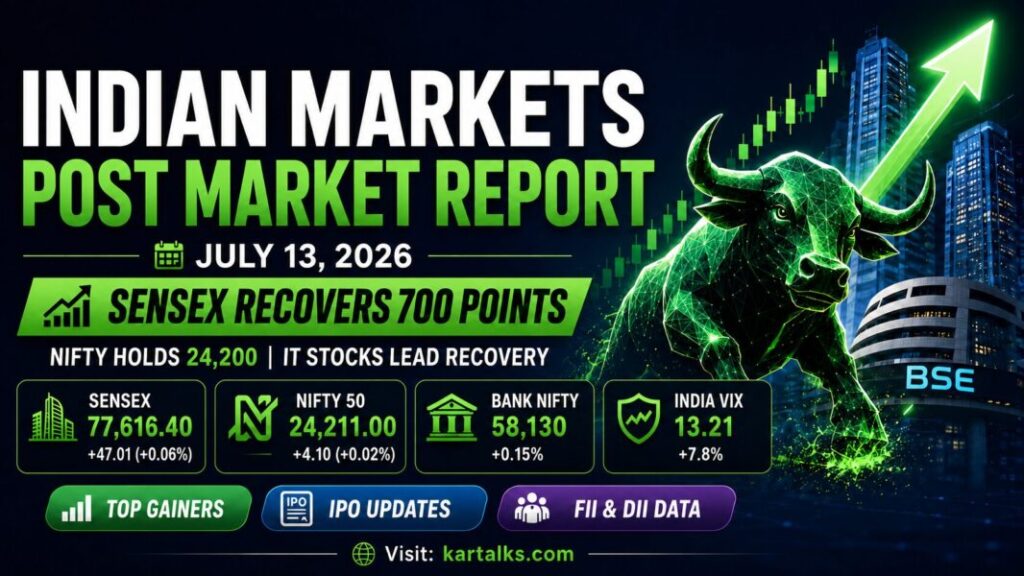
Indian Markets Post Market Report Today July 13, 2026: Sensex Recovers 700 Points, Nifty Holds 24,200
Indian markets post market report today: Indian stock markets ended a highly volatile session with marginal gains on Monday, July 13, 2026.
The market opened sharply lower as renewed tensions between the US and Iran pushed crude oil prices close to $79 per barrel. The Sensex fell by nearly 700 points during the morning session, while the Nifty briefly tested the 24,000 level.
But the mood changed during the second half.
Strong buying in Tata Consultancy Services, HCL Technologies, Infosys and other IT shares helped the benchmarks recover almost all their losses. The Sensex finally closed 47.01 points higher at 77,616.40, while the Nifty 50 gained 4.10 points to settle at 24,211.
Bank Nifty also recovered from its morning low and closed around 0.15% higher, near the 58,130 zone.
The recovery looked impressive on the chart, but the session remained mixed underneath. Only 20 of the 50 Nifty companies ended in positive territory, while 30 closed lower. IT stocks carried most of the market’s weight.
Indian markets post market report today’s Closing Levels
| Index | Closing level | Daily change |
| Nifty 50 | 24,211.00 | +4.10 points, +0.01% |
| BSE Sensex | 77,616.40 | +47.01 points, +0.06% |
| Bank Nifty | Around 58,131.45 | Around +0.14% |
| India VIX | Around 13.28 | About +8.40% |
India VIX rose sharply and ended near 13.28. The volatility index touched an intraday high of around 13.52 as traders reacted to rising crude oil prices and geopolitical news.
A rise in VIX means the options market expects larger price swings over the next 30 days. It does not directly predict whether the Nifty will rise or fall.
For retail investors, the message is simple: volatility has increased, so short-term positions require tighter risk management. (Investing.com UK)
Why Did the Indian Stock Market Recover Today?
The market’s journey from a sharp fall to a flat positive close was driven by a combination of negative global cues and strong buying in IT shares.
1. US-Iran Tensions Triggered the Morning Fall
Fresh military exchanges between the US and Iran raised concerns about oil supplies through the Strait of Hormuz.
Brent crude jumped by more than 3% and traded close to $79 per barrel. India imports a large part of its crude oil requirement, so higher oil prices can affect inflation, the rupee, government finances and corporate margins.
Airlines, paint companies, tyre makers, chemicals and other crude-dependent sectors may face higher input costs if oil remains elevated.
This was the main reason behind the weak opening in Indian equities.
2. IT Stocks Led a Powerful Recovery
The Nifty IT index gained around 3.6% to 4%, making it the strongest sector of the day.
TCS rallied after announcing a multi-million-dollar, multi-year agreement with ABB to modernise the company’s global network operations using artificial intelligence.
HCL Technologies, Infosys, Tech Mahindra and LTIMindtree also gained.
IT shares have faced heavy selling during 2026. Some investors used the recent fall to buy quality technology stocks at lower prices. The IT index remains down sharply for the year, even after its July recovery.
3. Foreign Investors Returned as Buyers
Provisional institutional data showed that foreign investors were net buyers in the Indian cash market on July 10.
Foreign institutional investors purchased shares worth a net ₹2,603.70 crore, while domestic institutional investors were also net buyers of around ₹2,019.70 crore.
Combined institutional buying provided support when the indices approached their morning lows. (5paisa)
4. Short Covering Helped the Nifty
The Nifty moved close to 24,000 during the morning sell-off but failed to stay below that level.
Traders who had created short positions began covering them as IT shares strengthened. This accelerated the afternoon recovery.
The ability to defend 24,000 is positive for the near term. However, the Nifty still needs to sustain above 24,300 to create stronger upward momentum.
5. Broader Markets Remained Cautious
Mid-cap and small-cap indices were largely flat despite the recovery in the benchmarks.
This shows that the rally was not fully broad-based. The market depended heavily on a few large IT companies.
Investors should not treat the flat positive close as a clear signal that every sector has turned bullish.
Top 5 Nifty Gainers and Losers
| Top gainers | Change | Top losers |
| TCS | Around +5.43% | Nestlé India: around -1.93% |
| HCL Technologies | Around +4.90% | Tata Steel: around -2.13% |
| Tech Mahindra | Around +3.41% | Grasim Industries: around -2.15% |
| Infosys | Around +3.23% | Tata Consumer: around -1.19% |
| ONGC | Around +1.42% | InterGlobe Aviation: around -1.55% |
TCS was the clear stock-market leader. Its gain contributed significantly to both the Nifty and Sensex recovery.
HCL Technologies followed closely, while Tech Mahindra and Infosys benefited from sector-wide buying.
On the losing side, Nestlé India and Tata Consumer Products were affected by weakness in the FMCG sector. Tata Steel declined as metal shares came under pressure.
InterGlobe Aviation also traded lower because rising crude oil prices can increase aviation turbine fuel costs and put pressure on airline margins.
Indian Markets Post Market Report Today’s Sector Performance
| Sector | Approximate move | Market view |
| Nifty IT | +3.6% to +4.0% | Strongest sector |
| Nifty Media | Around +1.9% | Positive momentum |
| Consumer Durables | Around +1.2% | Selective buying |
| Nifty FMCG | Around -1.1% | Weak |
| Nifty Metal | Around -0.8% | Oil and global concerns |
| Nifty Realty | Around -0.6% | Profit booking |
Information Technology
IT was the only sector to provide strong leadership.
The sector gained after TCS announced a major deal with ABB and LTIMindtree entered into a partnership with Anthropic. Investors are watching whether artificial intelligence contracts can translate into sustained revenue growth.
The sector may remain volatile because global clients are still cautious about discretionary technology spending.
Media
Media shares continued their recent recovery and gained for a third consecutive session.
The sector is smaller than banking or IT, so it has a limited impact on the benchmark indices. Still, improving momentum attracted short-term traders.
Consumer Durables
Consumer durables ended higher as investors bought selected companies linked to urban spending and housing demand.
The sector may benefit from rising incomes, premiumisation and improving demand. Valuation remains an important risk in several consumer-durable stocks.
FMCG
FMCG shares were among the weakest.
Nestlé India, Tata Consumer Products and other consumer companies faced selling. Higher crude and packaging costs may affect margins if companies cannot pass the increase to customers.
Metals
Metal stocks declined due to weak global risk sentiment and concerns about economic demand.
Tata Steel was among the leading Nifty losers. Metal stocks remain sensitive to global prices, China’s economic activity, currency movements and energy costs.
Realty
Realty stocks witnessed profit booking after their strong performance in the previous session.
The long-term housing demand story remains intact, but real estate shares can move sharply in both directions due to interest-rate expectations and high valuations.
Two Growth Stocks Based on Q4 FY26 Results
The following companies reported encouraging Q4 FY26 operational numbers. They are not guaranteed recommendations. Investors should study valuation and risks before taking any position.
1. Bharti Airtel
Bharti Airtel reported consolidated Q4 FY26 revenue of ₹55,383 crore, representing growth of 15.7% from the previous year and 2.6% from the previous quarter.
Consolidated EBITDA stood at ₹32,038 crore, with a margin of 57.8%. India revenue grew 7.7% year-on-year to ₹39,566 crore.
India mobile revenue increased 8.3%, supported by better realisation per customer and expansion in the subscriber base. (assets.airtel.in)
Why Airtel Deserves Attention
- Strong position in India’s telecom market
- Improving average revenue per user
- Growth in broadband and enterprise services
- Expanding Africa operations
- Healthy operating cash generation
Airtel may suit investors looking for exposure to India’s growing data consumption and digital-services story.
The main risks are high capital expenditure, competition, spectrum costs and premium valuation.
Instead of buying after a sharp rise, long-term investors may consider gradual accumulation during market corrections.
2. State Bank of India
State Bank of India reported a Q4 FY26 net profit of approximately ₹19,684 crore, up around 6% year-on-year.
Its full-year profit increased to more than ₹80,000 crore. Loan growth, improving asset quality and a large low-cost deposit franchise continue to support the bank’s long-term outlook.
Why SBI Remains a Growth Candidate
- India’s largest banking network
- Strong retail and corporate lending business
- Improving bad-loan position
- Reasonable valuation compared with many private banks
- Growing digital banking platform
- Regular dividend potential
The key risks include slower credit growth, pressure on net interest margins and rising deposit costs.
SBI may be suitable for investors with a three-to-five-year horizon, but purchases should be spread across different market levels.
India VIX Update
India VIX ended near 13.28, rising around 8.40%.
The index jumped because of the sharp morning fall, rising crude prices and uncertainty around the US-Iran conflict.
Although VIX remains far below panic levels, the increase shows that traders are paying more for protection against sudden market moves.
Short-term traders should avoid oversized positions. Investors using derivatives should understand that option premiums usually become more expensive when VIX rises.
Long-term investors do not need to react to every daily VIX movement. They should use volatile sessions to review asset allocation rather than make emotional decisions.
Existing and Upcoming IPO Updates
India’s primary market remains busy, with several mainboard and SME issues attracting investor attention.
Laser Power and Infra IPO
The ₹742 crore Laser Power and Infra IPO closed for subscription on July 13.
The issue received bids for around 19.13 times the shares on offer. The retail category was subscribed approximately 4.57 times.
The IPO’s price band was ₹203 to ₹214 per share, with listing scheduled for July 16, 2026.
The grey-market premium indicated a possible listing gain of around 17%. GMP is unofficial and can change before listing.
SBI Funds Management IPO
The SBI Funds Management IPO will open on July 14 and close on July 16, 2026.
The company reduced its public issue size from nearly ₹11,693 crore to approximately ₹9,813 crore after completing a pre-IPO placement.
The offering is entirely an offer for sale by existing shareholders, including State Bank of India and Amundi India Holding. SBI Funds Management will not receive fresh capital from the IPO.
The company has a strong position in India’s mutual-fund industry, but investors should compare its valuation with listed asset-management companies before applying.
Kusumgar IPO
The Kusumgar IPO closed on July 10 and is expected to list on July 15.
The issue price was fixed at ₹419 per share. It received strong investor demand, with subscription exceeding 100 times based on final exchange data shown by IPO trackers.
The grey-market premium remained near ₹160 on July 13, suggesting high listing expectations. This is not a guaranteed return.
Devson Catalyst IPO
The Devson Catalyst SME IPO closed on July 13.
Its price band was ₹112 to ₹118 per share, with listing scheduled for July 16.
SME IPOs can produce strong listing moves, but they also carry liquidity and business-size risks. Retail investors should read the offer document carefully.
Happy Steels IPO
The Happy Steels SME IPO also closed on July 13, with a price band of ₹62 to ₹66 per share.
The stock is expected to list on July 16. Investors should avoid relying only on subscription numbers or unofficial premiums when evaluating an SME issue.
FII and DII Activity Today
Foreign and domestic institutions on July 13, 2026
- FII/FPI net selling: ₹3,062.27crore
- DII net buying: ₹2,171.70 crore
Foreign investors had remained cautious because of crude oil, currency weakness and global uncertainty. Their return as net buyers helped the market recover.
Investors should not use one day’s FII data as a standalone buy or sell signal. A consistent trend over several sessions provides a better picture.
Commodity and Currency Market Update
| Asset | Latest level or move | Market trend |
| Brent crude | Around $79.46 a barrel | Strong rise |
| WTI crude | Around $74.65 a barrel | Higher |
| International gold | Around $4,015 an ounce | Down about 1.5% |
| USD/INR | Around ₹95.62 | Rupee weaker |
| MCX gold | Down about ₹2,500/10g | Selling pressure |
| MCX silver | Down about ₹3,00kg | Sharp decline |
Crude Oil
Brent crude rose sharply after renewed attacks raised fears about supplies through the Strait of Hormuz.
Higher oil is negative for India because it can:
- Increase the import bill
- Add pressure on inflation
- Weaken the rupee
- Raise transport and production costs
- Reduce household spending power
Oil-related companies may benefit from higher crude, while airlines, paints, tyres and chemicals may face pressure.
Gold and Silver
Gold and silver prices declined despite geopolitical tensions.
Gold fell towards $4,060 per ounce as rising oil prices increased inflation fears and pushed investors to expect higher interest rates for longer.
On MCX, gold fell by around ₹2,000 per 10 grams, while silver dropped by approximately ₹5,400 per kilogram. (The Guardian)
Long-term buyers should avoid chasing gold after sharp moves. Staggered buying is generally easier to manage.
Indian markets post market report today’s Indian Rupee
The rupee weakened by around 0.3% and closed near ₹95.62 per US dollar, its lowest level in about a month.
Rising crude oil prices increased demand for dollars from Indian importers. The currency was also affected by global risk aversion.
A weak rupee may support IT and pharmaceutical exporters, but it increases costs for companies that depend on imported fuel, machinery or raw materials.
Indian Markets Post Market Report Today’s
Stock of the Day: Tata Consultancy Services
TCS was the clear stock of the day after gaining around 5.4%.
The company announced a multi-million-dollar, multi-year agreement with ABB to transform its global network operations using AI-led technology.
The deal improved investor confidence at a time when the Indian IT sector has been under pressure.
Why TCS Attracted Buyers
- Large new deal announcement
- Strong global client relationships
- AI and cloud-service opportunities
- Recent correction in IT valuations
- Short covering after prolonged weakness
TCS remains a high-quality company, but near-term growth depends on global technology spending.
Investors should not assume that one large contract will immediately change overall earnings growth. Long-term buyers should watch deal conversion, margins, attrition and management guidance.
Latest SEBI Updates
Intraday Borrowing Facility for Mutual Funds
On July 10, SEBI issued a circular related to intraday borrowing facilities used by mutual funds.
The rules are aimed at improving operational flexibility while ensuring that short-term borrowing remains controlled and properly monitored.
Investors do not need to take any immediate action, but the update supports smoother settlement and liquidity management in mutual-fund operations.
Investor Protection Fund Rules
SEBI reviewed the rules governing the use of interest or income earned by depository Investor Protection Funds.
These funds are used for investor education, awareness and permitted investor-protection activities.
Handling of Unpaid Client Securities
SEBI recently updated the process for securities purchased by clients who have not completed payment.
The revised system uses an automated pledge mechanism. Investors should maintain sufficient funds before buying shares to avoid forced sale or pledge-related complications.
Corporate Bond Investor Awareness
SEBI launched two investor-awareness videos explaining the corporate bond market.
Corporate bonds may provide regular interest income, but they carry credit, liquidity and interest-rate risks. A high interest rate does not automatically mean a bond is safe.
Short-Term Investment View
The Nifty’s recovery from 24,000 was positive, but the overall setup remains cautious.
Immediate support is visible near 24,100, followed by 24,000 and 23,800.
Resistance may be seen near 24,300, followed by 24,500–24,600.
Short-term traders may focus on:
- IT stocks holding above Monday’s breakout levels
- Private banks showing relative strength
- Oil and gas companies benefiting from crude prices
- Stocks reporting better-than-expected quarterly results
Avoid aggressive positions in airlines, paints and other crude-sensitive companies while oil remains volatile.
A strict stop-loss is important because geopolitical headlines can cause sudden gaps in the market.
Long-Term Investment View
Long-term investors should not change their full investment plan because of one volatile session.
The better approach is to invest gradually in companies with:
- Consistent revenue and profit growth
- Manageable debt
- Strong cash flow
- Good corporate governance
- Sustainable competitive advantages
- Reasonable valuations
Investors who cannot analyse individual companies may use diversified index funds, flexi-cap funds or large-and-mid-cap mutual funds.
SIPs can help reduce the pressure of selecting the perfect market level.
Keep emergency funds and short-term financial goals outside equity markets.
FAQs
Q1. Why did the Sensex recover after falling 700 points?
Strong buying in TCS, HCL Technologies, Infosys and other IT shares helped the Sensex recover its morning losses.
Q2. What was the Nifty closing level on July 13, 2026?
The Nifty 50 closed at 24,211, gaining 4.10 points or 0.02%.
Q3. Which sector performed best today?
Nifty IT was the top-performing sector, gaining around 3.6% to 4%.
Q4. Why did the rupee weaken today?
The rupee weakened because rising crude oil prices increased dollar demand from importers and raised concerns about India’s trade deficit and inflation.
Q5. Is the market bullish after today’s recovery?
The recovery was positive, but the market remains cautious. Nifty needs to sustain above 24,300 for stronger short-term momentum.
Final Market View
The July 13 session showed both the strength and weakness of the current market.
The Sensex and Nifty successfully recovered from a sharp morning fall, showing that buyers remain active near important support levels.
At the same time, the recovery was heavily dependent on IT stocks. FMCG, metals, realty and several other sectors remained under pressure.
Rising crude oil, a weaker rupee and geopolitical uncertainty are the main risks for Indian equities. Strong institutional buying and the start of the earnings season provide support.
Investors should remain selective rather than chase the index. Quality companies with visible earnings, good balance sheets and reasonable valuations deserve priority.
Further Reading
Indian Markets Weekly View (July 13–July 17, 2026): Cautiously Bullish Sentiment
Indian Markets Pre Market Report Today July 13, 2026: Nifty Faces Oil Shock
Rupee Fall 2026 Explained: Why INR May Stay Weak Against Dollar
Stock Market 101 – Lesson 38: Tax-Saving Instruments Overview
Rupee Fall 2026 Explained: Why INR May Stay Weak Against Dollar
Disclaimer
This article is intended only for educational and informational purposes. It does not constitute investment advice, a research recommendation, financial planning advice or an offer to buy or sell any security. Kartalks.com and the author are not acting as SEBI-registered investment advisers or research analysts through this article.
Article Information
Author: Kartalks Research Desk
Reviewed by: Kartalks Editorial Team
Content Type: Indian stock market post-market report, closing levels, market movement, sector performance, top gainers and losers, FII/DII activity, IPO updates, commodity trends, currency movement, and investor education
Sources: NSE, BSE, SEBI, market closing data, sector performance data, FII/DII activity, IPO filings, commodity market data, currency market updates, company filings, and official public sources
Last Updated: July 13, 2026