
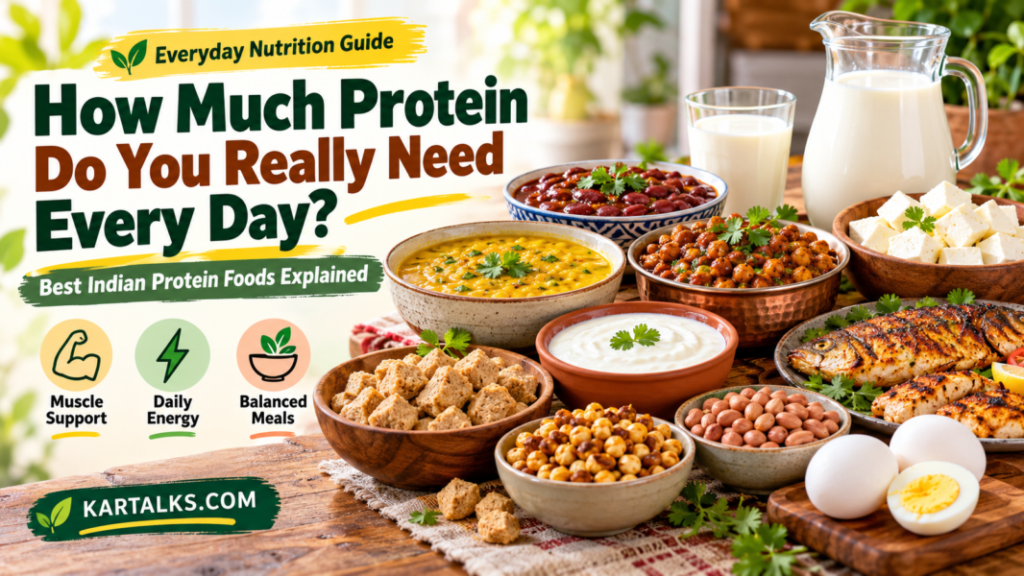
How Much Protein Do You Really Need Every Day? Best Indian Protein Foods Explained
Protein has become one of the loudest words in nutrition.
Walk into a supermarket and you will see high-protein cereal, protein biscuits, protein shakes and protein bars. Social media makes it sound as if everyone needs a shaker bottle in hand.
But most Indian households already have access to useful protein foods: dal, curd, paneer, milk, eggs, chana, rajma, soy, fish and chicken.
The bigger question is simpler: how much protein do you really need every day?
For a healthy adult, protein needs depend on body weight, age, activity level, pregnancy, illness and fitness goals. A common reference point is around 0.8 grams of protein per kilogram of body weight per day for healthy adults, although individual requirements can be higher in some situations.
That means a 60 kg adult may need roughly 48 grams per day as a basic reference point.
You do not have to hit that number with supplements.
What Does Protein Actually Do?
Protein is made of amino acids, which the body uses to build and maintain tissues.
Protein contributes to:
- Muscle maintenance and repair
- Enzymes and hormones
- Immune function
- Skin, hair and connective tissues
- Growth and development
- Recovery after illness or exercise
Protein is important, but eating more and more of it does not automatically create more muscle.
Muscle growth also depends on resistance training, total calorie intake, sleep, recovery and the rest of the diet.
How Much Protein Do You Need Every Day?
A widely used minimum recommendation for healthy adults is about 0.8 g per kg of body weight per day.
Here is a simple estimate:
| Body weight | Approximate daily protein |
|---|---|
| 50 kg | 40 g |
| 60 kg | 48 g |
| 70 kg | 56 g |
| 80 kg | 64 g |
These numbers are a starting point, not a personalised prescription.
Protein needs may increase for:
- Athletes
- People doing regular resistance training
- Older adults
- Pregnant or breastfeeding women
- People recovering from illness or surgery
- People with specific medical or nutritional needs
For people doing strenuous resistance or endurance training, sports-nutrition recommendations can be higher, often around 1.4–2.0 g/kg/day, depending on training and goals.
That does not mean everyone who goes to the gym needs 2 g/kg.
ICMR-NIN Dietary Guidelines for Indian
Indian Protein Foods: You Have More Options Than You Think
Protein does not have to mean chicken breast and whey powder.
Indian food patterns naturally include several good protein sources.
ICMR-NIN’s Dietary Guidelines for Indians include pulses and beans, milk and curd, nuts and seeds, eggs and flesh foods as part of a balanced diet. Its suggested food-group pattern for adults includes meaningful amounts of pulses and beans along with milk or curd and other food groups.
That is useful because protein becomes easier to meet when it is spread across meals rather than packed into dinner.
Best Affordable Vegetarian Protein Foods
Dal
Dal is probably India’s most practical protein food.
Moong, masoor, toor and urad dal all contribute protein along with carbohydrates, fibre and micronutrients.
One bowl alone may not meet your entire protein requirement, but dal eaten regularly with other protein foods can add up quickly.
Chana and Rajma
Chickpeas and kidney beans are useful because they provide both protein and fibre.
They are also inexpensive compared with many packaged “high-protein” products.
Rajma-rice and chana-rice are sometimes criticised because rice is carbohydrate-rich. But meals do not need to be made of protein alone.
A balanced portion of rice with rajma, vegetables and curd can be a perfectly reasonable meal.
Soy and Soy Foods
Soybeans are among the more protein-dense plant foods.
Practical options include:
- Soy chunks
- Tofu
- Soybeans
- Unsweetened soy milk
Soy chunks are especially affordable and easy to add to pulao, curry or mixed vegetables.
Milk and Curd
Milk and curd provide protein as well as calcium and other nutrients.
ICMR-NIN includes milk and curd in its balanced-diet guidance.
Choose versions that suit your digestion and calorie needs.
Sweetened flavoured yoghurts may contain plenty of added sugar, so plain curd is often the simpler everyday option.
Paneer
Paneer is a convenient vegetarian protein food, but portions matter because it can also contain significant fat depending on how it is prepared.
Grilled paneer, paneer bhurji and lightly cooked paneer dishes usually fit better into a balanced diet than cream-heavy gravies.
Groundnuts, Nuts and Seeds
Groundnuts, almonds, sesame, flax and other seeds contribute protein, healthy fats and minerals.
But they are calorie-dense.
A handful can be useful. A very large bowl eaten casually while watching television can turn into far more energy than expected.
Best Non-Vegetarian Protein Foods
Eggs
Eggs are convenient, affordable and provide high-quality protein.
WHO includes eggs among animal-source foods that can form part of a varied healthy diet.
Boiled eggs, omelettes and egg bhurji can easily improve the protein content of breakfast or dinner.
Fish
Fish provides protein and, depending on the type, may also provide omega-3 fats and other nutrients.
Grilled, steamed or lightly cooked fish usually makes more sense for regular meals than heavily fried preparations.
Chicken
Chicken is a lean protein option when skinless cuts are cooked with moderate oil.
Again, cooking method matters.
Chicken cooked in a simple curry is nutritionally very different from deep-fried chicken.
Does Vegetarian Protein Count as “Complete” Protein?
This topic often becomes more complicated than it needs to be.
Animal proteins generally provide all essential amino acids in favourable proportions.
Many plant foods are lower in one or more essential amino acids, but people who eat a varied diet do not usually need to combine specific foods at every single meal.
Traditional Indian combinations already help.
Think of:
- Dal + rice
- Roti + dal
- Khichdi
- Chana + roti
- Curd + cereal-based meals
WHO nutrition guidance also recognises legumes, nuts, seeds, grains and animal-source foods as useful components of a varied healthy diet.
The more useful question is whether your total diet provides enough protein and enough variety over the day.
A Simple High-Protein Indian Day Without Supplements
You do not need to eat huge portions.
Breakfast
Choose one:
- 2 eggs + vegetable poha
- Besan chilla + curd
- Paneer-stuffed roti + curd
- Oats cooked with milk + nuts
- Idli + generous sambar
Lunch
A practical plate could include:
- Rice or roti
- One bowl of dal or rajma
- Vegetables
- Curd
Or:
- Roti
- Chicken or fish
- Sabzi
- Salad
Evening Snack
Instead of relying on biscuits every day, try:
- Roasted chana
- Milk
- Curd
- Groundnuts
- Boiled eggs
- Sprouts prepared hygienically
Dinner
Keep it similar to lunch, but rotate the protein.
If lunch was dal, dinner might include paneer, tofu, eggs or fish.
This rotation makes meals less repetitive and improves nutrient variety.
Harvard Nutrition Source – Protein
Are Protein Powders Necessary?
For most people, no.
Protein powder is a convenience product, not a compulsory health product.
It may help someone who has high protein requirements, limited appetite, a busy schedule or difficulty meeting needs through food.
But if you can reach your protein requirement through normal meals, there is no nutritional rule saying you must take whey.
A scoop of protein powder also does not compensate for a diet lacking vegetables, fruits, fibre and whole foods.
WHO recommends meeting protein, vitamin and mineral needs through a varied diet, largely from minimally processed foods.
Is More Protein Always Better?
No.
Once requirements are met, pushing protein extremely high does not automatically improve health or muscle growth.
And high-protein eating can become unbalanced if it pushes out:
- Vegetables
- Fruits
- Whole grains
- Fibre-rich foods
- Healthy fats
The quality of the protein source matters too.
A diet rich in dal, beans, fish, curd, nuts and eggs is very different from a diet that gets much of its “protein” from processed meat and packaged high-protein snacks.
Harvard’s Nutrition Source also stresses that the protein package matters—the fats, fibre, sodium and other nutrients that come along with the protein food.
Protein and Weight Loss
Protein can help meals feel more filling and may help preserve lean body mass during weight loss.
But protein does not guarantee weight loss.
If total calorie intake consistently exceeds what your body uses, weight can still increase—even on a high-protein diet.
The practical strategy is to build meals around sensible portions rather than adding protein on top of everything you already eat.
For example, replacing a biscuit snack with roasted chana makes more sense than eating the biscuits and then adding a protein shake.
Harvard Nutrition Source – Protein and Exercise
Protein and Muscle Building
If muscle gain is the goal, resistance training matters.
Protein gives the body the building material, but training provides the stimulus.
People doing serious strength training may benefit from higher protein intakes than sedentary adults.
Spreading protein across the day may also be more practical than eating very little at breakfast and lunch and trying to consume most of it at dinner.
That could mean:
- Eggs or curd at breakfast
- Dal at lunch
- Chana as a snack
- Paneer or chicken at dinner
Nothing complicated.
Who Should Be Careful With High-Protein Diets?
People with certain medical conditions should not copy high-protein fitness diets without professional advice.
This particularly includes people with:
- Chronic kidney disease
- Significant liver disease
- Certain metabolic disorders
- Medically prescribed protein restrictions
Pregnancy, ageing and recovery from illness may also change protein needs, but the amount should be individualised.
If you have a medical condition, protein targets should come from your doctor or dietitian rather than an online calculator.
NHS – Healthy Eating and Protein Foods
Common Protein Myths
“Vegetarians cannot get enough protein”
False.
A varied diet containing pulses, beans, dairy or soy, nuts, seeds and grains can provide plenty of protein for many people.
“You need protein powder to build muscle”
No.
Protein powder is convenient, but food can meet protein needs too.
“Dal is pure protein”
No.
Dal contains protein, but also carbohydrates, fibre and other nutrients.
That is not a problem. Foods do not need to contain only protein to be healthy.
“More protein means faster muscle growth”
Not necessarily.
Training, total calorie intake, sleep and recovery all matter.
“High-protein packaged foods are automatically healthy”
Definitely not.
Check the complete nutrition label. Some products may also contain substantial sugar, sodium, saturated fat or calories.
A Better Way to Think About Protein
Instead of asking, “How can I eat the maximum possible protein?” ask:
“Where is the protein in this meal?”
If breakfast is only tea and toast, add eggs or curd.
If lunch is mainly rice, add a good serving of dal, rajma or chicken.
If your snack is biscuits every day, sometimes replace them with roasted chana, milk or nuts.
Small changes are easier to maintain than suddenly redesigning your entire diet around protein.
Frequently Asked Questions
Q1. How much protein does a 60 kg adult need?
Using the common reference intake of 0.8 g/kg/day, a healthy 60 kg adult would need about 48 grams of protein daily. Individual requirements may be higher depending on age, exercise, pregnancy or medical conditions.
Q2. Which is the cheapest Indian protein food?
Dal, roasted chana, groundnuts, soy chunks and eggs are among the most affordable everyday protein options in many parts of India.
Q3. Is dal enough protein for the whole day?
Usually not by itself. Dal can be an important part of your intake, but a varied diet containing other pulses, dairy, soy, eggs, fish, chicken, nuts or seeds makes it easier to meet daily needs.
Q4. Do gym beginners need whey protein?
Not automatically. If your food intake already provides enough protein, whey is optional. It is mainly a convenient concentrated protein source.
Q5. Is eating protein at night bad?
There is no general rule that protein must be avoided at night. Total daily intake and meal quality matter more. Choose portions and foods that suit your digestion and health needs.
Final Takeaway
Protein deserves attention, but it does not need to become expensive or complicated.
For most Indian households, the easiest approach is to use familiar foods consistently: dal, chana, rajma, soy, milk, curd, paneer, eggs, fish, chicken, nuts and seeds.
Your requirement depends on your body weight and lifestyle. For many healthy adults, around 0.8 g/kg/day is a useful starting reference, while active people and certain groups may need more.
The real goal is not to “max out” protein.
It is to eat enough of it, from sensible sources, as part of a balanced diet you can actually continue.
Further Reading
Vitamin D Deficiency in India: Symptoms, Food Sources, Sunlight and When to Get Tested
Soluble vs Insoluble Fibre: How Much Fibre Do You Really Need Every Day?
Festive Season Health Guide: Enjoy Indian Sweets Without Overeating Sugar and Fat
Fibermaxxing Diet: Is the Viral High-Fibre Food Trend Actually Healthy?
Health Disclaimer
This article is for general informational and educational purposes only and is not a substitute for professional medical advice, diagnosis or treatment. Protein requirements vary with age, body weight, activity, pregnancy and health conditions.
Article Information
Author: Kartalks Editorial Team
Reviewed by: Kartalks Health Content Desk
Content Type: Food, health, nutrition awareness, daily protein requirement, Indian protein foods, vegetarian and non-vegetarian protein sources, muscle health, weight management awareness, and general public health information
Sources: official public health references, nutrition awareness resources, dietary guidelines, food safety references, wellness references, and official public sources
Last Updated: September 27, 2026