
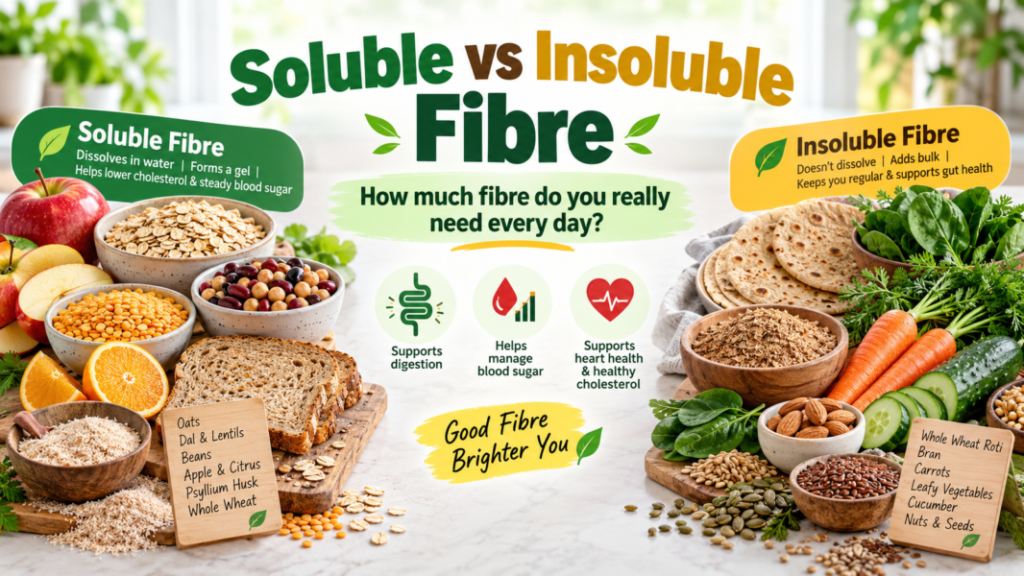
Soluble vs Insoluble Fibre: How Much Fibre Do You Really Need Every Day?
Fibre is having a bit of a comeback.
For years, nutrition conversations were dominated by protein, low-carb diets and calorie counting. Now fibre is getting fresh attention, especially because of its role in digestion, bowel health, blood sugar control and cholesterol.
But there is one part of the discussion that often gets skipped: soluble vs insoluble fibre.
Both matter, but they do not behave exactly the same way in the body.
One can form a gel-like substance in the gut and may help slow digestion. The other adds bulk and helps food move through the digestive tract. Most fibre-rich foods contain a mixture of both, which is why eating a varied diet usually works better than obsessing over one specific type.
So how much fibre do you actually need each day? And should you be counting soluble and insoluble fibre separately?
Here is the practical answer.
What Is Dietary Fibre?
Dietary fibre is the part of plant foods that our digestive enzymes do not completely break down in the small intestine.
It passes into the large intestine, where some types may be fermented by gut bacteria while others mainly help add bulk to stools.
Fibre naturally occurs in foods such as:
- Vegetables
- Fruits
- Whole grains
- Pulses
- Beans
- Nuts
- Seeds
WHO recommends that adults and children over 10 years aim for at least 25 grams of naturally occurring dietary fibre per day, mainly from foods such as whole grains, vegetables, fruits and pulses.
Other dietary guidance may give slightly different targets depending on age, sex and energy intake. NIDDK, for example, notes that adults generally need around 22 to 34 grams per day.
The exact number is useful, but food quality matters just as much.
Soluble vs Insoluble Fibre: What Is the Difference?
The names describe how these fibres behave in water.
Soluble fibre
Soluble fibre dissolves or swells in water and can form a gel-like material in the digestive tract.
It is commonly found in:
- Oats
- Barley
- Beans
- Lentils
- Peas
- Apples
- Citrus fruits
- Psyllium or isabgol
- Some seeds
This type of fibre can slow digestion and may influence how quickly glucose is absorbed.
Certain soluble fibres can also help lower blood cholesterol. The FDA recognises physiological effects of dietary fibre that include reductions in blood glucose and blood cholesterol, depending on the fibre involved.
Insoluble fibre
Insoluble fibre does not dissolve easily in water.
Instead, it adds bulk to stool and helps material move through the digestive tract.
Common sources include:
- Whole wheat
- Wheat bran
- Brown rice
- Vegetable skins
- Carrots
- Beans
- Nuts
- Seeds
NIDDK describes soluble fibre as being common in beans, fruits and oats, while insoluble fibre is often found in whole grains and vegetables.
In real life, though, foods rarely fit neatly into one category.
An apple contains more than one kind of fibre. So do dal, oats and vegetables.
That is why you usually do not need to build two separate fibre lists.
NIDDK Daily Fibre Recommendation
A Simple Comparison
| Fibre type | What it tends to do | Common foods |
|---|---|---|
| Soluble fibre | Forms a gel, may slow digestion | Oats, dal, beans, fruit, isabgol |
| Insoluble fibre | Adds stool bulk and supports bowel movement | Whole wheat, bran, vegetables, nuts |
| Both together | Support digestive and metabolic health | Most whole plant foods |
The takeaway is not that one is better.
Your body benefits from both.
How Soluble Fibre May Help Blood Sugar
One reason soluble fibre receives attention is its effect on digestion.
Because some forms become viscous or gel-like in the gut, they can slow gastric emptying and carbohydrate absorption. This may help reduce sharp rises in blood glucose after a meal.
The FDA includes lowering blood glucose among the recognised beneficial physiological effects associated with qualifying dietary fibres.
But this does not mean adding one spoon of fibre cancels out a high-sugar meal.
The whole meal still matters.
For example, compare:
Meal A: sweetened drink + white bread + sugary spread
with
Meal B: dal + vegetable sabzi + whole-wheat roti + curd
Meal B naturally contains more fibre, protein and minimally processed foods.
That combination usually matters more than chasing fibre in isolation.
People with diabetes should still follow their prescribed meal plan, medicines and glucose-monitoring advice. Fibre can support a healthy diet, but it does not replace treatment.
What About Cholesterol?
Certain soluble fibres can help lower LDL cholesterol, sometimes called “bad cholesterol”.
This is especially associated with viscous fibres such as beta-glucan found in oats and barley, and psyllium.
The mechanism is partly related to how these fibres interact with bile acids in the digestive tract, which can influence cholesterol metabolism.
The FDA notes that fibre-containing fruits, vegetables and grain products, particularly some soluble fibres, may help lower cholesterol levels.
Again, this is not a licence to ignore the rest of the diet.
A bowl of oats does not undo a diet consistently high in fried foods, excess saturated fat and refined snacks.
Think of fibre as one piece of the cardiovascular-health picture.
Insoluble Fibre and Digestion
If constipation is the concern, insoluble fibre often gets attention because it adds bulk to stool.
That can help bowel movements become more regular.
NIDDK recommends getting enough fibre and drinking sufficient fluids for people dealing with constipation. It also advises increasing fibre gradually rather than making a sudden jump.
This is where many people make a mistake.
They suddenly add bran cereal, large salads, chia seeds, sprouts and extra dal all in one day.
Then comes bloating.
More fibre is not automatically better if your digestive system has not adjusted.
How Much Fibre Do You Really Need Every Day?
For most adults, a useful practical range is roughly 25 to 30-plus grams per day, depending on age, sex, calorie intake and individual needs.
WHO recommends at least 25 grams a day for people over 10 years old.
NIDDK gives an adult range of approximately 22–34 grams per day.
You do not generally need to track exactly how many grams are soluble and how many are insoluble.
Instead, try to get fibre from different food groups throughout the day.
That naturally gives you a mix.
Can an Indian Diet Provide Enough Fibre?
Very easily—at least in theory.
Traditional Indian meals already contain many excellent fibre sources:
- Dal
- Rajma
- Chana
- Green gram
- Whole wheat
- Millets
- Vegetables
- Fruits
- Groundnuts
- Seeds
ICMR-NIN’s Dietary Guidelines for Indians encourage meals built around whole grains, pulses, beans, vegetables, fruits, nuts and seeds rather than heavily processed foods.
The problem is usually not a lack of fibre-rich Indian foods.
It is that many modern eating patterns replace them with refined or packaged options.
For example:
Breakfast becomes biscuits and tea instead of poha with vegetables.
Lunch becomes white rice with very little dal or sabzi.
Evening snacks become chips.
Dinner becomes refined-flour takeaway food.
Fibre gradually disappears without anyone noticing.
What Does 25–30 Grams of Fibre Look Like?
You do not have to calculate every gram, but a day might look something like this:
Breakfast
Vegetable oats or vegetable poha with one fruit.
Lunch
Two whole-wheat rotis, one bowl of dal and a generous serving of sabzi.
Snack
Guava, apple or orange with a small handful of groundnuts or roasted chana.
Dinner
Rice with rajma, chole or sambar plus cooked vegetables.
This kind of pattern can bring you much closer to your fibre needs without powders, bars or expensive imported products.
Is Fruit Juice a Good Fibre Source?
Not compared with whole fruit.
Juicing removes or reduces much of the fibre found in the intact fruit.
WHO recommends obtaining carbohydrates primarily from whole grains, vegetables, fruits and pulses and notes that fruit juice can contain significant amounts of free sugars even when no sugar is added.
So if fibre is your goal, eating the orange is usually more useful than drinking orange juice.
The same applies to many smoothies if they are heavily strained.
Do You Need Fibre Supplements?
Most people should first try to meet their fibre needs through food.
Supplements such as psyllium can be useful in some situations, especially for constipation or when recommended by a healthcare professional.
But fibre powder should not become a substitute for vegetables, pulses, fruit and whole grains.
Whole foods provide far more than fibre.
They also give you:
- Vitamins
- Minerals
- Plant compounds
- Protein in the case of pulses
- Healthy fats from nuts and seeds
The number on the nutrition label is only part of the story.
Too Much Fibre Can Be Uncomfortable
Going from very little fibre to a very high intake overnight can cause:
- Gas
- Bloating
- Abdominal discomfort
- Changes in bowel movements
- A feeling of fullness
NIDDK advises increasing fibre gradually so the digestive system has time to adapt.
Drinking enough fluids also matters.
Fibre absorbs water, and poor fluid intake may make constipation worse in some people.
There is no need to force an arbitrary amount of water, though. Your needs depend on climate, activity, body size, medical conditions and diet.
What If You Have IBS?
This is where “eat more fibre” becomes too simplistic.
People with irritable bowel syndrome can respond differently to different fibres.
NIDDK notes that soluble fibre may be more helpful than insoluble fibre for some people with IBS.
Some high-fibre foods are also high in fermentable carbohydrates called FODMAPs, which may worsen gas, bloating or abdominal discomfort in sensitive people.
If you have persistent IBS symptoms, a personalised approach with a doctor or registered dietitian makes more sense than aggressively increasing fibre.
Soluble vs Insoluble Fibre: Common Myths
Myth: Soluble fibre is healthier
Not really.
Soluble and insoluble fibre have different functions. A healthy diet generally contains both.
Myth: Bran is the best way to fix constipation
It may help some people, but not everyone tolerates large amounts of bran well.
Gradually increasing total fibre and fluids is usually more sensible.
Myth: You need chia seeds every day
No.
Chia seeds are one fibre source, but dal, rajma, oats, vegetables, whole wheat, fruit and groundnuts are equally practical ways to improve your diet.
Myth: Higher fibre always means healthier food
A packaged snack can advertise “high fibre” and still contain excess sugar, sodium or saturated fat.
Read the entire label, not just the front-of-pack claim.
An Easy Rule Instead of Counting Every Gram
Try this simple approach:
Include a fibre-rich food at most meals.
That could mean:
- Fruit at breakfast
- Dal and vegetables at lunch
- Roasted chana as a snack
- Whole grains or pulses at dinner
Then rotate your choices.
Rajma one day, moong the next. Oats today, millet tomorrow. Guava in season, oranges later.
Variety naturally brings different types of fibre to the table.
Frequently Asked Questions
Q1. Which is better: soluble or insoluble fibre?
Neither is universally better. Soluble fibre is particularly associated with effects on digestion, blood sugar and cholesterol, while insoluble fibre helps add bulk to stools. Most healthy diets contain both.
Q2. Do I need exactly 30 grams of fibre every day?
Not necessarily. Recommendations vary. WHO advises at least 25 grams per day for people over 10, while other guidelines give ranges depending on age and sex.
Q3. Is dal soluble or insoluble fibre?
Dal contains a mixture of fibre types, including soluble fibre. You do not need to classify every food into only one category.
Q4. Can fibre help lower cholesterol?
Certain soluble fibres, particularly viscous fibres such as those in oats, barley and psyllium, may help lower LDL cholesterol when eaten as part of a balanced diet.
Q5. Why do I feel bloated after increasing fibre?
A sudden rise in fibre intake can increase gas and bloating. Increase it gradually and make sure you are drinking enough fluids. Persistent or severe symptoms should be discussed with a healthcare professional.
Final Takeaway
The soluble vs insoluble fibre debate is less complicated than it sounds.
You need both.
Soluble fibre tends to be especially useful for slowing digestion and is linked with effects on blood glucose and cholesterol. Insoluble fibre contributes bulk and supports regular bowel movements.
Instead of trying to calculate the perfect ratio, focus on eating a wider variety of minimally processed plant foods.
Dal, vegetables, whole grains, fruit, beans, nuts and seeds can do most of the work.
For most people, that is a far easier—and far more sustainable—approach than turning fibre into another number to obsess over.
Further Reading
Festive Season Health Guide: Enjoy Indian Sweets Without Overeating Sugar and Fat
Fibermaxxing Diet: Is the Viral High-Fibre Food Trend Actually Healthy?
Healthy Indian Food Combinations Explained: Dal Rice, Curd Jeera and Turmeric Pepper
Food as Medicine: Why This Movement Is Exploding
Health Disclaimer
This article is for general informational and educational purposes only. It is not a substitute for professional medical advice, diagnosis or treatment. People with diabetes, IBS, inflammatory bowel disease, kidney disease, chronic digestive symptoms or medically prescribed dietary restrictions should consult an appropriate healthcare professional before making major changes to their fibre intake.
Article Information
Author: Kartalks Editorial Team
Reviewed by: Kartalks Health Content Desk
Content Type: Food, health, nutrition awareness, soluble fibre explanation, insoluble fibre explanation, digestive health, heart health, blood sugar awareness, and general public health information
Sources: official public health references, nutrition awareness resources, dietary guidelines, food safety references, wellness references, and official public sources
Last Updated: September 13, 2026