
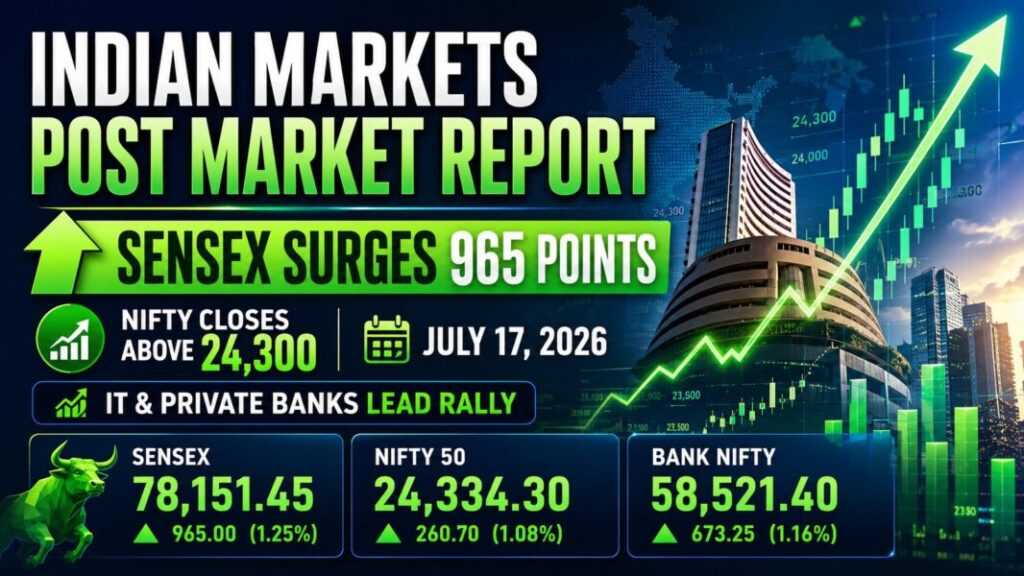
Indian Markets Post Market Report Today July 17, 2026: Sensex Surges 965 Points, Nifty Closes Above 24,300
Indian Markets Post Market Report Today: Indian stock markets ended Friday, July 17, 2026, with strong gains as buying returned to information technology, private banks, financial services and heavyweight stocks.
The BSE Sensex closed at 78,151.45, rising 964.58 points or 1.25%. The Nifty 50 gained 261.55 points, or 1.09%, to settle at 24,334.30.
Banking shares also participated in the rally. The Bank Nifty closed at 58,521.40, up 939.15 points or 1.63%.
The market’s performance looked even stronger because it came during a weak session across several Asian markets. Heavy selling in semiconductor and technology shares pulled down Japan and Taiwan, but Indian benchmarks remained firm.
Strong quarterly numbers from Tech Mahindra and Jio Financial Services improved domestic sentiment. Buying ahead of results from Reliance Industries and large private banks added further support.
Indian Markets Post Market Report Today: Closing Levels
| Index | Closing level | Daily movement |
|---|---|---|
| Nifty 50 | 24,334.30 | +261.55, +1.09% |
| BSE Sensex | 78,151.45 | +964.58, +1.25% |
| Bank Nifty | 58,521.40 | +939.15, +1.63% |
| India VIX | Around 13.15 | Around +2% |
India VIX rose to around 13.15 despite the strong market rally. This indicates that traders were still paying attention to global technology weakness, expensive crude oil and geopolitical risks.
A rising VIX does not always mean that the market must fall. It means the options market expects wider price swings over the coming weeks.
Why Did the Indian Stock Market Rise Today?
The July 17 rally was led by earnings, heavyweight stocks and aggressive buying in private banks and IT companies.
1. Tech Mahindra’s Results Lifted the IT Sector
Tech Mahindra reported a better-than-expected June-quarter performance.
Its consolidated profit increased 28% year-on-year to around ₹1,465 crore. The market was also encouraged by revenue execution and expectations that Tech Mahindra could deliver better growth than some large IT peers during FY27 and FY28.
Tech Mahindra shares gained around 4.1%, making the company one of the leading Nifty performers. The positive reaction spread to TCS, Infosys and HCL Technologies.
The Nifty IT index gained about 1.8% during the session. IT stocks ended the week around 4.3% higher, while TCS recorded its strongest weekly rise in about six years.
2. Jio Financial Delivered Strong Profit Growth
Jio Financial Services gained after reporting a sharp increase in its quarterly profit.
Its consolidated net profit more than doubled to approximately ₹830 crore from ₹325 crore in the corresponding period last year. The company’s lending, payments, insurance-distribution and asset-management operations are beginning to contribute more meaningfully to earnings.
The stock rose as much as 6.1% during the session before closing around 3.1% higher at ₹242.98.
This was an important signal because the market had earlier viewed Jio Financial largely as a treasury-income story. Investors are now watching whether its operating businesses can produce sustained revenue and profit growth.
3. Private Banks Attracted Heavy Buying
HDFC Bank, ICICI Bank, Kotak Mahindra Bank and Axis Bank gained ahead of their quarterly results.
Kotak Mahindra Bank rose about 3.37%, while ICICI Bank gained around 1.8% and HDFC Bank added approximately 1.4%.
Investors entered these stocks with expectations of healthy loan growth, stable asset quality and manageable pressure on net interest margins. The private-bank rally pushed Bank Nifty more than 900 points higher.
Large banks carry significant weight in the Nifty and Sensex. When several private banks move together, the impact on the benchmark indices can be substantial.
4. Reliance Industries Supported the Indices
Reliance Industries gained around 2.4% ahead of its Q1 FY27 results, which were scheduled after market hours.
The company also disclosed that its promoter-group holding increased to 50.48% during the June quarter from 50% earlier.
Because Reliance is one of India’s largest listed companies, its movement has a major influence on the Nifty and Sensex.
Investors were looking for signs of recovery in the oil-to-chemicals business, continued growth in digital services and improvement in the retail segment.
5. Softer US Inflation Supported IT Buying
Recent US inflation data came below market expectations.
This reduced some concerns about aggressive interest-rate increases by the US Federal Reserve. Lower rate expectations can support technology valuations and emerging-market investments.
The softer inflation reading encouraged bargain hunting in Indian IT companies after the sector’s steep fall during 2026.
Still, rising crude oil could create fresh inflation pressure. Investors should not assume that the global interest-rate risk has fully disappeared.
6. Technical Breakout Added Momentum
The Nifty had spent several sessions trading inside a narrow range.
When the index moved above the 24,270–24,300 zone, short covering and technical buying accelerated. It eventually closed at 24,334.30, near the upper end of its weekly trading range.
The Nifty traded within a 368-point range during the week, its narrowest weekly band of 2026. Friday’s move helped the index finish the week around 0.5% higher.
Reuters – Indian markets gain as IT and financial stocks lead the rally
Top Five Nifty Gainers and Losers Today
| Top gainers | Approximate move | Top losers |
|---|---|---|
| Tech Mahindra | +4.14% | Hindalco: -1.58% |
| Kotak Mahindra Bank | +3.39% | Sun Pharma: around -0.90% |
| Jio Financial Services | +3.11% | Wipro: around -1.0% |
| Reliance Industries | +2.4% | Sun Pharma: around -1.0% |
| ICICI Bank | +1.67% | Max Healthcare: below -1% |
Tech Mahindra led the Nifty gainers after its quarterly earnings beat market expectations.
Kotak Mahindra Bank and ICICI Bank gained ahead of their results, while Jio Financial benefited from its sharp profit increase. Reliance Industries provided major support to the benchmark indices.
Hindalco was the leading Nifty loser, falling around 2%. Metal shares struggled amid weak global sentiment.
Wipro also underperformed after reporting a cautious revenue forecast. The company projected constant-currency revenue movement between a decline of 1.5% and growth of 0.5% for the September quarter. Several brokerages reduced their target prices after the announcement.
Sun Pharma, Trent and Bharti Airtel were among the other weaker large-cap shares. Percentage moves may vary slightly across platforms due to closing-price adjustments and rounding.
HDFC Sky – Nifty 50 top gainers and losers on July 17, 2026
Indian Markets Post Market Today’s Sector Performance
| Sector | Approximate move | Market view |
|---|---|---|
| Nifty Private Bank | Around +2.12% | Strongest group |
| Nifty IT | +1.8% | Earnings-led rally |
| Nifty Financial Services | +1.3% | Broad buying |
| Nifty Bank | +1.63% | Private banks lead |
| Nifty Pharma | Below -1.4% | Main laggard |
| Nifty Midcap 100 | Around -0.4% | Weak breadth |
Information Technology
IT was one of the strongest sectors.
Tech Mahindra’s results supported the rally, while HCL Technologies announced a seven-year agreement with Guardian Life Insurance Company of America. The deal will focus on technology modernisation and AI-related operations.
TCS, Infosys and HCLTech also gained. However, Wipro remained weak after its cautious forecast.
The sector still faces challenges from slower client spending, longer decision cycles and uncertainty about how AI will affect billing and employee requirements.
Banking and Financial Services
Private banks and financial companies provided the largest support to the market.
Jio Financial’s earnings, combined with buying in HDFC Bank, ICICI Bank, Kotak Mahindra Bank and Axis Bank, pushed financial services higher by around 1.3%.
Investors will closely watch:
- Deposit growth
- Net interest margins
- Slippages and bad loans
- Loan-growth guidance
- Credit costs
- Management commentary
Strong results could support Bank Nifty next week. Weak margin guidance could lead to profit booking.
Pharmaceuticals
Pharma was the main sectoral laggard.
Sun Pharma declined, while defensive buying seen earlier in the week reduced. The sector has performed well during 2026, so some investors used Friday’s broader rally to book profits.
Pharmaceutical companies remain exposed to US regulatory action, product approvals, pricing pressure and currency movement.
Mid-Caps and Small-Caps
The headline rally was not fully reflected in the broader market.
The Nifty Midcap 100 and Nifty Smallcap 100 slipped by up to 0.4% during Friday’s session. On a weekly basis, small-cap and mid-cap indices fell approximately 0.6% and 1%, respectively.
This means the rally was concentrated in large companies rather than spread evenly across the market.
Retail investors should avoid assuming that a 965-point Sensex rise means every stock participated.
Two Different Growth Stocks Based on Q4 FY26 Results
To avoid repeating the same companies from earlier reports, today’s growth-stock section focuses on Bharat Electronics and Mahindra & Mahindra.
These are educational observations, not direct buy recommendations.
1. Bharat Electronics
Bharat Electronics reported Q4 FY26 revenue of approximately ₹10,177 crore, up 11.6% year-on-year.
Quarterly profit after tax was around ₹2,203 crore, increasing about 4.7% from the previous year. EBITDA rose to roughly ₹2,876 crore, although the EBITDA margin declined because of higher operating costs.
The company ended FY26 with an order book of approximately ₹73,882 crore, providing strong revenue visibility.
Why BEL Deserves Attention
BEL is one of India’s major defence-electronics companies. It supplies radar systems, communication equipment, electronic warfare systems and other strategic products.
Its growth case is supported by:
- Rising defence capital expenditure
- Greater use of locally manufactured equipment
- A large order pipeline
- Expansion into non-defence electronics
- Export opportunities
- Strong balance-sheet position
Risks Investors Should Consider
BEL’s valuation has risen as defence stocks gained popularity.
Any delay in government orders or project execution can affect quarterly revenue. Margins may also fluctuate depending on the mix of contracts.
Investors should track fresh orders, execution speed, receivables and valuation instead of buying only because the defence sector is popular.
Bharat Electronics – Official investor and Q4 FY26 results page
2. Mahindra & Mahindra
Mahindra & Mahindra reported Q4 FY26 consolidated profit of ₹4,668 crore, rising 42% year-on-year.
For the full financial year, consolidated profit reached ₹17,099 crore, increasing 35%. The company also announced a dividend of ₹33 per share, up 30%.
Its Q4 performance was supported by SUVs, tractors, financial services and other group businesses.
M&M retained leading positions in several key categories:
- Number one in SUVs by revenue market share
- Number one in tractors
- Number one in light commercial vehicles below 3.5 tonnes
- Number one in electric three-wheelers
The farm business reported quarterly volumes of around 120,000 units, up 36%, while tractor market share reached 42.1%.
Why M&M Remains Interesting
The company benefits from India’s demand for SUVs, rural vehicles, tractors and electric mobility.
Its diversified businesses reduce dependence on a single product category. Improving rural income and normal monsoon conditions could support tractor demand.
Risks Investors Should Consider
Automobile demand is cyclical. Higher fuel prices, weak rural income or expensive vehicle financing can affect sales.
Competition in SUVs and electric vehicles is also increasing. Investors should track margins, product launches and valuation before considering an entry.
Mahindra & Mahindra – Official Q4 FY26 and FY26 results
India VIX Update
India VIX ended near 13.24, rising around 3%.
The increase shows that traders remained cautious despite the strong benchmark rally. Global semiconductor shares faced heavy selling, while oil prices rose due to the US-Iran conflict.
A VIX near 13 is not normally treated as a panic reading. Still, the rise indicates that option premiums may remain elevated.
Short-term traders should:
- Avoid excessive overnight positions
- Maintain stop-losses
- Reduce position size in volatile stocks
- Watch crude oil and global markets
- Avoid selling uncovered options without understanding the risk
Long-term investors should use VIX as a sentiment indicator rather than a direct market-timing tool.
Existing and Upcoming IPO Updates
SBI Funds Management IPO
The SBI Funds Management IPO received bids worth around ₹3 trillion, or approximately $31 billion.
The offering was subscribed nearly 42 times and became one of India’s most heavily bid large IPOs. The institutional portion attracted especially strong demand, while retail and SBI shareholder categories were subscribed around 3.6 times and 9.5 times.
The issue price was fixed at ₹574 per share, with listing scheduled for July 21.
The IPO is an offer for sale. This means the money raised goes to the selling shareholders rather than directly to SBI Funds Management.
Strong subscription does not guarantee listing gains. Investors should consider valuation, market conditions and the company’s future earnings growth.
Alpine Texworld IPO
Alpine Texworld’s allotment was expected to be finalised on July 17.
The unofficial grey-market premium had fallen to around 1%, suggesting expectations of a muted or flat listing. GMP is unregulated and can change before the shares begin trading.
Textile companies can be affected by cotton prices, export demand, working-capital requirements and currency movement.
Reuters – SBI Funds Management IPO attracts ₹3 trillion in bids
Caliber Mining and Logistics IPO
The ₹450 crore Caliber Mining and Logistics IPO opened on July 17 and will close on July 21.
The price band is ₹402–₹424 per share, with a lot size of 35 shares. At the upper price band, the minimum retail application is ₹14,840. Listing is expected on July 24.
The issue received around 61% subscription by midday on its opening day. Its unofficial GMP suggested positive listing expectations, but investors should not apply only because of grey-market activity.
Mining and logistics businesses face commodity-cycle, debt, environmental and customer-concentration risks. The offer document should be reviewed carefully.
FII and DII Activity
The latest confirmed figures available were for July 17, 2026:
- FII net selling: ₹376.41crore
- DII net buying: ₹1,017.89 crore
Daily institutional data should not be treated as a standalone signal. A trend across several sessions gives a more reliable picture.
Commodity and Currency Market Update
| Asset | Latest level | Market direction |
|---|---|---|
| Brent crude | Around $86.45/barrel | Strong weekly rise |
| WTI crude | Around $81.30/barrel | Firm |
| Spot gold | Around $3,993/ounce | Slight daily recovery |
| USD/INR | ₹96.28 | Rupee weak |
Crude Oil
Brent crude traded near $86 per barrel and gained approximately 12.5% during the week.
Escalating conflict between the United States and Iran created concerns about supplies through important Middle Eastern shipping routes.
Higher oil is negative for India because it can:
- Increase the import bill
- Weaken the rupee
- Raise inflation
- Increase transport costs
- Reduce room for interest-rate cuts
- Pressure margins of oil-consuming companies
Airlines, paints, tyres and chemical companies may face higher costs if crude remains elevated.
Gold and Silver
Spot gold recovered slightly to around $3,993 per ounce on Friday but remained on course for a weekly decline of about 3%.
Rising oil prices increased inflation concerns and strengthened expectations that global interest rates could remain high. Gold does not produce interest income, so higher rate expectations can reduce its appeal.
Silver also recorded a weekly decline.
Investors using gold for portfolio diversification may prefer staggered purchases rather than reacting to daily moves.
Indian Rupee
The rupee closed at approximately ₹96.28 per US dollar and recorded its sharpest weekly fall in nine weeks.
The currency declined about 1% during the week as crude oil surged. RBI intervention through state-owned banks helped reduce extreme volatility, but dollar demand from importers remained strong.
A weak rupee can help IT and pharmaceutical exporters. It raises costs for businesses dependent on imported oil, machinery and electronic components.
Stock of the Day: Tech Mahindra
Tech Mahindra was the stock of the day after rising around 4.1%.
The company’s quarterly revenue beat expectations, while profit increased 28% year-on-year to approximately ₹1,465 crore.
Brokerages welcomed the earnings performance and improved execution, particularly in the telecom segment.
Why Tech Mahindra Attracted Buyers
- Better-than-expected Q1 results
- Improved deal execution
- Strong telecom-sector performance
- Better growth expectations
- Short covering in IT stocks
- Recovery from depressed valuations
Investors should still watch revenue guidance, deal conversions, margins and client spending.
One good quarter does not remove the wider slowdown facing the IT-services industry.
Latest SEBI Updates
SWP and STP Instructions for Demat Mutual-Fund Units
On July 17, SEBI extended the facility for creating standing instructions for Systematic Withdrawal Plans and Systematic Transfer Plans involving mutual-fund units held in demat form.
The change can make automated withdrawals and transfers easier for investors who hold mutual-fund units through demat accounts.
Investors should still check exit loads and tax implications before setting up withdrawals.
Warning About “Boss Scam”
SEBI issued a caution to regulated entities and listed companies regarding a fraud referred to as the “Boss Scam.”
Such scams usually involve fraudsters impersonating senior company officials and asking employees to make urgent payments or share confidential information.
Companies should verify unusual financial requests through official channels. Retail investors should also remain cautious about unsolicited messages claiming to come from promoters, executives or regulators.
Action in Illiquid Stock-Options Cases
SEBI continued adjudication and recovery action involving illiquid stock-option transactions.
Illiquid contracts may be used to create artificial trades or transfer profits and losses. Retail investors should avoid unfamiliar derivatives promoted through social media or messaging groups.
Short-Term Investment View
The Nifty’s close above 24,300 improves the immediate technical setup.
Support can be watched near:
- 24,250
- 24,150
- 24,000
Resistance may emerge near:
- 24,370
- 24,500
- 24,650
The index must remain above 24,300 for the breakout to gain strength.
Short-term traders may focus on IT and private banks that hold above Friday’s breakout levels. Fresh earnings will remain the main driver of individual stocks.
High crude oil and weak global markets can create sudden reversals. Position sizes should remain controlled.
Long-Term Investment View
Long-term investors should focus on earnings rather than daily index points.
A balanced portfolio may include:
- Large private and public-sector banks
- Defence-electronics companies
- Automobile leaders
- IT businesses with diversified clients
- Healthcare companies
- Consumer businesses with pricing power
- Broad-market index funds
Use staggered investments instead of committing the entire amount after a one-day rally.
Stocks that have already risen sharply should be evaluated on valuation, cash flow and future earnings. A good company can still produce poor returns when purchased at an excessive price.
FAQs
Q1. Why did the Sensex rise 965 points today?
The rally was driven by strong buying in IT, private banks, Reliance Industries and Jio Financial Services following positive earnings updates.
Q2. What was the Nifty closing level on July 17, 2026?
The Nifty 50 closed at 24,334.30, gaining 261.55 points or 1.09%.
Q3. What was the Bank Nifty closing level?
Bank Nifty closed at 58,521.40, rising 939.15 points or 1.63%.
Q4. Which sector performed best today?
Private banks and IT were among the strongest sectors. Nifty IT gained around 1.8%.
Q5. Which stock was the stock of the day?
Tech Mahindra was the stock of the day after rising around 4.1% following better-than-expected quarterly earnings.
Final Market View
The July 17 rally was a strong finish to a range-bound week.
Large IT companies, private banks, Reliance Industries and Jio Financial Services led the move. The Nifty closed above 24,300, while Bank Nifty gained more than 900 points.
However, mid-cap and small-cap indices did not participate fully. India VIX also rose, showing that traders remain alert to crude oil, geopolitical tension and weak global technology markets.
The next market direction will depend heavily on results from Reliance Industries and private banks, along with crude-oil movement and foreign institutional flows.
Investors should remain positive but selective. Strong earnings, manageable debt and reasonable valuations matter more than one day’s price movement.
Further Reading
Indian Markets Weekly View (July 13–July 17, 2026): Cautiously Bullish Sentiment
Rupee Fall 2026 Explained: Why INR May Stay Weak Against Dollar
Stock Market 101 – Lesson 38: Tax-Saving Instruments Overview
RBI Repo Rate 2026 Explained: Impact on Home Loan EMI, FD Returns
India’s New Labor Codes: Why Companies Are Taking “Thousand-Crore”
Disclaimer
This article is published only for educational and informational purposes. It does not constitute investment advice, financial advice, a research report or a recommendation to buy, sell or hold any security. Kartalks.com and the author are not acting as SEBI-registered investment advisers or research analysts through this article.
Article Information
Author: Kartalks Research Desk
Reviewed by: Kartalks Editorial Team
Content Type: Indian stock market post-market report, closing levels, market movement, sector performance, top gainers and losers, FII/DII activity, IPO updates, commodity trends, currency movement, and investor education
Sources: NSE, BSE, SEBI, market closing data, sector performance data, FII/DII activity, IPO filings, commodity market data, currency market updates, company filings, and official public sources
Last Updated: July 17, 2026