
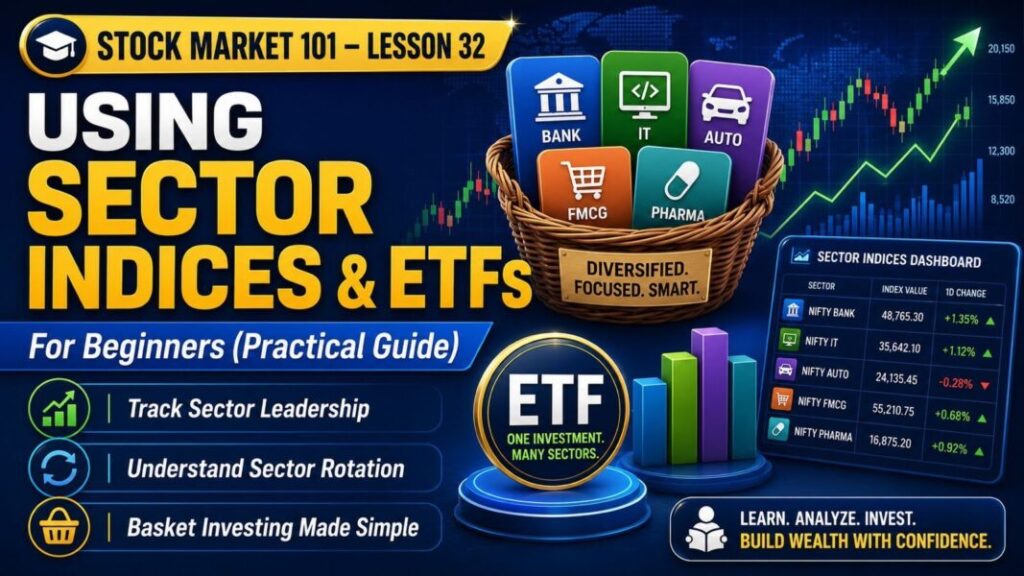
Stock Market 101 – Lesson 32: Using Sector Indices & ETFs for Beginners: Practical Guide
Many beginners enter the stock market by looking at individual stocks only.
One day they check a bank stock. Next day they check an IT stock. Then someone says auto sector is strong, pharma is defensive, metals are moving, or FMCG is safe.
After a few days, it becomes confusing.
A simple way to reduce this confusion is to first understand the sector. Before asking, “Which stock should I track?”, ask, “Which sector is strong or weak right now?”
That is where Using Sector Indices and ETFs becomes useful. Sector indices help you read the market sector by sector. ETFs help investors get exposure to an index-based basket instead of depending only on one company. NSE lists several Indian sectoral indices such as Nifty Auto, Nifty Bank, Nifty Financial Services, Nifty FMCG, Nifty Healthcare, Nifty IT, Nifty Metal, Nifty Pharma, Nifty Realty and others.
Using Sector Indices and ETFs: Simple Meaning
Let us keep this very simple.
A sector index is like a scoreboard for one sector.
For example:
- Nifty Bank shows the broad movement of banking stocks.
- Nifty IT shows the broad movement of IT companies.
- Nifty FMCG shows the broad movement of FMCG companies.
- Nifty Auto shows the broad movement of automobile companies.
- Nifty Pharma shows the broad movement of pharma companies.
So instead of checking ten different banking stocks separately, a beginner can first check the banking index and understand the sector mood.
An ETF, or Exchange Traded Fund, is different. SEBI explains that ETFs are funds that track indices such as Sensex or Nifty, and when investors buy ETF units, they buy units of a portfolio that tracks that index.
In very simple words:
- Sector index helps you study a sector.
- ETF helps you invest in an index-linked basket.
- Sector ETF gives exposure to one sector through an ETF structure.
What Are Sector Indices?
A sector index groups companies from the same sector and shows how that sector is performing.
Think of it like this.
If one bank stock is rising, it may be a company-specific move. But if the whole Nifty Bank index is strong, then the broader banking sector may be getting market support.
That difference is important.
Sector indices help beginners understand:
- which sector is leading
- which sector is weak
- whether a stock move is sector-wide
- whether market money is rotating from one sector to another
- whether the market is favoring growth sectors or defensive sectors
NSE’s sectoral index page includes many sector groups, including Auto, Bank, Financial Services, FMCG, Healthcare, IT, Metal, Pharma, Private Bank, PSU Bank, Realty, Consumer Durables, Oil & Gas and others.
Why Sector Indices Are Useful for Beginners
Beginners usually make one mistake.
They look at a single stock and immediately decide the full story.
But one stock cannot tell the whole sector story.
Example:
A single IT stock may fall because of poor results. But if the Nifty IT index is also weak, then the problem may be bigger than one company.
Another example:
One auto stock may rise because of company news. But if the whole Nifty Auto index is strong, then the sector itself may be improving.
This is why sector indices are helpful. They give you the background before you judge the stock.
A beginner can use sector indices like a market map.
What Are ETFs?
ETFs are investment products that trade on the stock exchange.
NSE explains that ETFs are baskets of securities that are traded like individual stocks on an exchange. Unlike regular open-ended mutual funds, ETFs can be bought and sold throughout the trading day like stocks.
That is why ETFs are popular with many investors.
They combine two ideas:
- basket-based investing
- exchange-based trading
SEBI also explains that ETFs reflect the performance of the index they track. So, if an ETF tracks Nifty 50, it tries to follow Nifty 50. If an ETF tracks a sector index, it tries to follow that sector index.
Sector Index vs Sector ETF
This difference is very important.
Many beginners mix both terms.
Sector Index
A sector index is only a benchmark.
You can:
- track it
- compare it
- study sector strength
- use it for market understanding
But you do not directly buy the index like a normal stock.
Sector ETF
A sector ETF is an investment product.
You can:
- buy ETF units
- sell ETF units
- get basket exposure
- participate in index-linked sector movement
So remember this simple line:
Sector index shows the sector. Sector ETF gives exposure to the sector.
Why Beginners Should First Track Sector Indices
Before buying any ETF or stock, beginners should first build the habit of tracking sectors.
Do not rush.
Start with a weekly routine.
Check these sector indices:
- Nifty Bank
- Nifty IT
- Nifty Auto
- Nifty FMCG
- Nifty Pharma
- Nifty Metal
- Nifty Realty
- Nifty Healthcare
NSE provides sectoral indices for these market groups, which makes sector tracking easier for Indian market readers.
Ask simple questions:
- Is this sector rising?
- Is this sector falling?
- Is this sector stronger than Nifty 50?
- Is this sector weak even when the market is strong?
- Is money moving from one sector to another?
These questions slowly improve market understanding.
How Sector Indices Help in Sector Rotation
Sector rotation means leadership moves from one sector to another.
This happens often in the stock market.
Sometimes banks lead.
Sometimes IT leads.
Sometimes FMCG protects.
Sometimes metals or realty suddenly become strong.
Sector indices help you see this rotation clearly.
A simple method:
- Check 1-week sector performance
- Check 1-month sector performance
- Check 3-month sector performance
- Compare strong sectors with weak sectors
- See whether leadership is changing
If a sector is strong for one day, it may be noise.
If a sector is strong across many timeframes, it may be real leadership.
This is a useful habit for beginners because it reduces social media confusion.
How ETFs Can Help Beginners
ETFs can help beginners because they provide basket exposure.
Suppose a beginner likes the banking sector but does not know which bank stock to choose.
Instead of guessing one stock, the investor may study a banking ETF or a broader financial ETF. That way, exposure is spread across a basket instead of one company.
NSE says ETFs can be used for gaining instant exposure to equity markets, and India’s first ETF, Nifty BeES, based on Nifty 50, was launched in January 2002 and can be bought and sold like any other stock on NSE.
But here is the important part.
ETF does not mean guaranteed safety.
If the index falls, the ETF can also fall.
Advantages of ETFs for Beginners
ETFs can be useful, but only when understood properly.
Simple basket exposure
An ETF gives exposure to a group of securities.
That reduces the need to select every stock manually.
Easy to trade
ETFs trade on the exchange like stocks. NSE explains that ETFs can be bought and sold throughout the trading day.
Useful for index-based investing
If you want to follow an index, ETFs can be a simple route.
Good learning tool
Even if you do not invest immediately, watching ETFs and indices helps you understand market structure.
Risks of ETFs Beginners Should Know
This part is very important.
Many people explain only the benefits of ETFs. But a good beginner lesson should also explain the risks.
Market risk
If the market or index falls, the ETF can fall too.
Sector concentration risk
A sector ETF may hold many stocks, but they may all belong to the same sector.
Example:
A banking ETF may hold several banks, but it is still exposed to banking-sector risk.
Liquidity risk
Some ETFs may not trade actively.
If volume is low, buying and selling may not be smooth.
Tracking difference
An ETF may not always match the index perfectly because of costs, liquidity, portfolio adjustments and market conditions.
Wrong timing risk
Buying a sector ETF after a huge rally can still be risky.
ETF is a product. It is not a magic shield.
Key Things to Check Before Buying an ETF
Before buying any ETF, beginners should check a few things.
1. Underlying index
Ask:
Which index does this ETF track?
This is the first question.
If it tracks Nifty 50, it is broad-market exposure.
If it tracks one sector, it is sector exposure.
2. Liquidity
Check whether the ETF is actively traded.
Look at:
- trading volume
- bid-ask spread
- regular market activity
3. Expense ratio
Costs matter, especially in long-term investing.
NSE says ETFs generally have lower transaction costs and annual charges compared with index funds, though investors should still check product-specific details before investing.
4. Tracking quality
The ETF should follow the index closely.
If it regularly behaves very differently from the index, beginners should be careful.
5. Portfolio overlap
This is a very common mistake.
Suppose your mutual fund already holds many banking stocks. If you also buy a banking ETF, your banking exposure increases.
So always check overlap.
Sector ETF vs Individual Stock
Beginners often ask:
Should I buy a sector ETF or one company stock?
There is no single answer.
Individual stock may suit someone who:
- can study balance sheets
- understands valuation
- can handle company-specific risk
- is ready to track results and management commentary
Sector ETF may suit someone who:
- wants sector exposure
- does not want to choose one company
- wants a basket approach
- is still learning stock selection
Both have risks.
The difference is simple.
A stock gives company-specific exposure.
A sector ETF gives sector-based basket exposure.
Practical Guide: How Beginners Can Use Sector Indices and ETFs
Here is a simple weekly method.
Step 1: Check the broad market
Start with Nifty 50 or Sensex.
Ask:
Is the market strong, weak or sideways?
Step 2: Check sector indices
Then check major sector indices.
Look at:
- Bank
- IT
- Auto
- FMCG
- Pharma
- Metal
- Realty
- Healthcare
Step 3: Compare sector performance
Do not look only at one day.
Compare:
- 1 week
- 1 month
- 3 months
- 6 months
This helps you avoid reacting to noise.
Step 4: Understand the reason
Ask why the sector is moving.
Examples:
- Banks may move due to credit growth or rate expectations.
- Auto may move due to demand recovery.
- FMCG may move during uncertainty or consumption stability.
- IT may move due to global technology spending.
- Metals may move due to commodity prices.
- Realty may move due to interest-rate expectations.
Step 5: Decide whether ETF exposure is needed
Ask yourself:
- Do I understand this sector?
- Is the ETF liquid?
- Is the sector already overvalued?
- Am I already exposed through mutual funds?
- Is this for short-term tracking or long-term allocation?
This kind of thinking is better than buying because someone posted a tip.
Common Mistakes Beginners Make
Mistake 1: Buying ETF without knowing the index
Many beginners buy an ETF only because the name looks attractive.
That is risky.
Always know the index.
Mistake 2: Thinking ETF means no risk
ETF reduces single-stock selection risk, but it does not remove market risk.
Mistake 3: Ignoring liquidity
Low-volume ETFs can be difficult to enter or exit smoothly.
Mistake 4: Chasing the hottest sector
A sector may already be overextended.
Late entry can be painful.
Mistake 5: Forgetting portfolio overlap
If your mutual funds already hold similar stocks, adding a sector ETF may increase concentration.
Mistake 6: Ignoring valuation
Even a good sector can become expensive.
Sector strength should be checked with valuation and earnings quality.
Simple Portfolio Thinking for Beginners
Sector indices and ETFs should first be used for learning.
Do not make it complicated.
A simple thought process:
- Use broad-market indices to understand overall market mood.
- Use sector indices to understand leadership.
- Use ETFs only after understanding the index and risk.
- Use individual stocks only after understanding company fundamentals.
A beginner does not need to own every theme.
The goal is to know what you own and why you own it.
Using Sector Indices and ETFs: Final Learning
The biggest learning is simple:
Sector indices help you read the market. ETFs help you take basket-based exposure.
Both are useful, but both should be used with care.
For beginners, sector indices can make market learning easier. You can see which sector is leading, which sector is weak, and where rotation may be happening.
ETFs can be helpful when you want index-based exposure without selecting every company manually. SEBI explains that ETFs track indices, and NSE explains that ETFs are baskets of securities traded on exchanges like individual stocks.
But never buy blindly.
Check the index, liquidity, cost, tracking quality, valuation and your own risk profile.
That is how Using Sector Indices & ETFs can become a practical beginner tool, not just another market term.
5 FAQs – Using Sector Indices and ETFs
1. What is a sector index?
A sector index tracks the performance of companies from one specific sector, such as banking, IT, auto, FMCG or pharma.
2. What is an ETF?
An ETF is an Exchange Traded Fund that usually tracks an index and trades on the stock exchange like a stock. SEBI says ETFs track indices such as Sensex and Nifty.
3. Are ETFs safe for beginners?
ETFs can be simpler than selecting individual stocks, but they are not risk-free. If the index falls, the ETF can also fall.
4. What should beginners check before buying an ETF?
Beginners should check the underlying index, liquidity, expense ratio, tracking quality, sector risk and portfolio overlap.
5. Can sector indices help in sector rotation?
Yes. Sector indices help beginners identify which sectors are leading, lagging or rotating over different timeframes.
Further reading
Stock Market 101 – Lesson 31: Interest Rates & Inflation
Stock Market 101 – Lesson 28: Market Cycles Explained
Stock Market 101 – Lesson 25: Notes to Accounts: Hidden Clues Most People Ignore
Stock Market 101-Lesson 22: Profit and Loss in Annual Report
Disclaimer:
This article is only for educational and informational purposes. It is not investment advice or a stock recommendation. Stock market investments are subject to market risks. ETF investments also carry market risk, liquidity risk, tracking risk and sector concentration risk. Readers should consult a certified financial advisor before making investment decisions.
Article Information
Author: Kartalks Education Desk
Reviewed by: Kartalks Editorial Team
Sources: SEBI investor education material, NSE/BSE educational resources, official public sources, and general finance learning references
Last Updated: May 30, 2026