
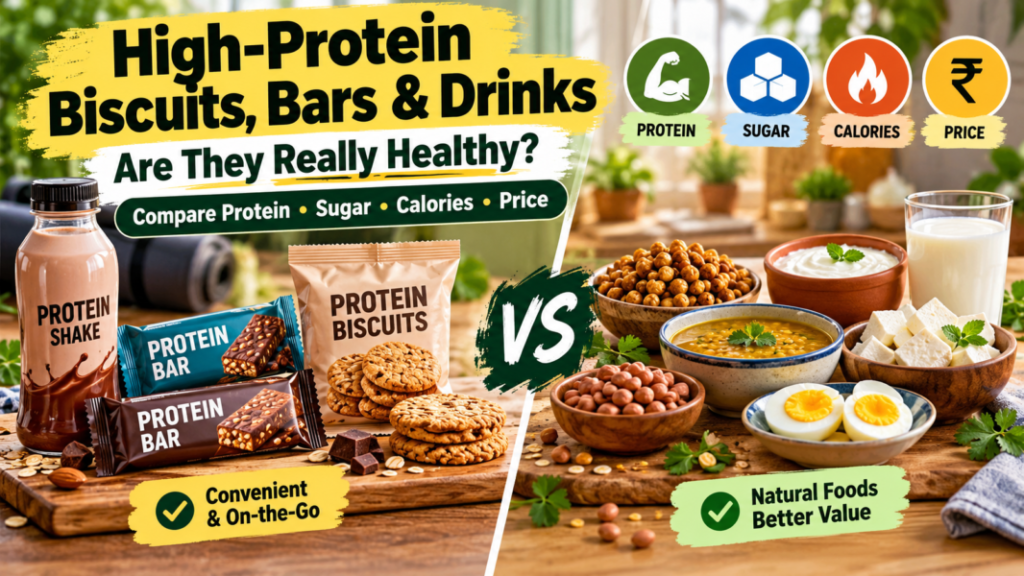
High-Protein Biscuits, Bars and Drinks: Are These Packaged Foods Really Healthy?
Protein is everywhere right now.
Walk through a supermarket aisle and you will see high-protein biscuits, protein bars, protein shakes, protein lassi, protein chips and even protein desserts. The packaging usually looks sporty, modern and healthy.
But a bigger protein number on the front does not automatically make a packaged food a better choice.
A biscuit can contain extra protein and still be high in calories, added sugar or saturated fat. A protein bar may provide useful protein but cost several times more than eggs, curd or roasted chana. A ready-to-drink protein beverage may be convenient after a workout, but unnecessary for someone who already gets enough protein from meals.
So how should you judge high-protein packaged foods?
The easiest approach is to look beyond the protein claim and compare the whole product: protein, sugar, calories, fat, ingredients, serving size and price.
Why High-Protein Packaged Foods Are So Popular
Protein has become one of India’s biggest nutrition conversations.
There are good reasons for the interest. Protein is needed for muscle maintenance, tissue repair, enzymes, hormones and many other functions in the body.
At the same time, busy lifestyles have created demand for foods that promise nutrition without cooking.
A protein bar fits into a handbag.
A bottled protein drink can be consumed between meetings.
A high-protein biscuit feels easier than preparing eggs, dal or paneer.
Convenience is real.
The problem starts when the word protein becomes a health halo and makes us stop reading the rest of the label.
What Does “High Protein” Actually Mean on a Food Label?
In India, nutrition claims such as “source of protein” and “high protein” are regulated.
Under FSSAI’s Advertising and Claims Regulations, a solid food can generally make a “source of protein” claim when it provides at least 10% of the applicable recommended dietary allowance per 100 g, or meets the specified energy-based criterion.
For a “high” or “rich in protein” claim, the threshold is higher: generally at least 20% of the applicable RDA per 100 g for solid foods, with separate criteria for liquids and calories.
That is useful—but it tells you only that the product meets the protein-claim criteria.
It does not mean the product is automatically low in sugar, low in calories, high in fibre or minimally processed.
High-Protein Packaged Foods: What Should You Check?
Instead of asking only, “How many grams of protein?”
Ask six questions.
1. How Much Protein Do I Get Per Serving?
Manufacturers often display nutrition values per 100 g, but you may eat only 30 or 40 g.
For example, a biscuit may show an impressive protein value per 100 g while one actual serving provides much less.
Check:
- Protein per serving
- Serving size
- Number of servings in the pack
Then compare that with ordinary foods.
Two eggs, a bowl of curd or a serving of dal may provide a similar amount of protein without needing a special “protein” label.
2. How Much Sugar Comes With That Protein?
This is one of the most useful label checks.
A protein bar can sometimes resemble a sweet snack with protein added.
Look for:
- Total sugars
- Added sugars
- Sugar, glucose syrup or similar sweeteners high in the ingredient list
WHO recommends limiting free sugars to less than 10% of daily energy intake, with a lower intake providing additional benefits.
For someone eating around 2,000 calories per day, 10% works out to roughly 50 g of free sugars.
That does not mean 49 g is a daily target.
It is an upper limit.
If one protein snack contributes a large chunk of that amount, the protein claim does not cancel it out.
3. What About Calories?
Protein foods still contain calories.
This sounds obvious, but packaging can make people forget it.
A protein bar may contain nuts, dates, chocolate coatings, oils, sweeteners and protein concentrates. Together, those ingredients can make a small bar surprisingly energy-dense.
That is not automatically bad.
Someone hiking, travelling or exercising heavily may find it useful.
But if you add a 250-calorie protein bar on top of your usual meals while assuming it is a “healthy free food”, those calories still count.
If weight management is your goal, ask whether the product is replacing another snack or simply being added to the day.
4. Check Saturated Fat Too
Biscuits, bars and desserts often need fat for texture and taste.
Depending on the recipe, that fat may come from:
- Nuts and seeds
- Dairy fat
- Cocoa butter
- Palm oil
- Coconut oil
- Other vegetable fats
These sources are not nutritionally identical.
WHO recommends keeping saturated fat below 10% of total daily energy and limiting foods high in unhealthy fats, sugars and sodium.
So if a product gives 10 g of protein but also comes with substantial saturated fat, it deserves a more careful look.
5. Read the Ingredient List
The front of the pack is advertising.
The ingredient list tells you much more.
Protein may come from:
- Whey protein
- Milk protein
- Casein
- Soy protein
- Pea protein
- Chickpea protein
- Groundnuts
- Nuts and seeds
- Pulses
There is nothing inherently wrong with using a protein concentrate.
But check what surrounds it.
A product whose first few ingredients are refined flour, sugar and fat may still be closer to a snack food than a balanced meal, even if protein powder has been added later.
ICMR-NIN’s Dietary Guidelines for Indians recommend regular inclusion of pulses, nuts, seeds, vegetables, seasonal fruits, eggs and other whole foods while restricting foods high in fat, salt and sugar and highly processed foods.
That is a useful benchmark.
FSSAI Advertising and Claims Regulations
High-Protein Biscuits: Better Than Regular Biscuits?
Sometimes—but not automatically.
Regular biscuits are typically made from refined flour, fat and sugar. Adding protein may improve their protein content, but it does not erase the rest of the formulation.
A high-protein biscuit might still contain:
- Refined flour
- Added sugar
- Palm oil or other fats
- Considerable calories
- Relatively little fibre
So compare it with the ordinary version.
If the high-protein biscuit provides significantly more protein, similar or lower sugar, reasonable saturated fat and useful fibre, it may be a better packaged option.
If it provides only a few extra grams of protein but costs twice as much, the value is less convincing.
What About Protein Bars?
Protein bars have one major advantage: convenience.
They can be useful:
- During travel
- Between long meetings
- After training when a meal is unavailable
- For someone who struggles to meet protein needs
But the category varies enormously.
One bar may contain mostly nuts, seeds and protein concentrate.
Another may resemble a chocolate bar with added protein.
A useful comparison looks something like this:
| What to check | Better sign | Watch for |
|---|---|---|
| Protein | Meaningful amount per bar | Tiny serving-based claim |
| Sugar | Lower added sugar | Syrups/sugar high on ingredient list |
| Calories | Fits your needs | Very calorie-dense for a small snack |
Do not judge bars only by words such as “fitness”, “clean”, “natural” or “energy”.
Read the numbers.
FSSAI Labelling and Display Regulations
Are Ready-to-Drink Protein Beverages Healthy?
They can be convenient.
Some provide a useful amount of milk or whey protein in a single bottle and may work well after exercise or when you cannot have a regular meal.
But again, check:
- Protein per bottle
- Added sugar
- Total calories
- Saturated fat
- Ingredients
- Serving size
Sweetened protein drinks can deliver a surprising amount of sugar.
WHO specifically advises limiting sugar-containing beverages because liquid calories can accumulate easily.
An unsweetened or low-added-sugar protein drink will generally compare better than a heavily sweetened one.
Does More Protein Make a Processed Food Healthy?
No.
Protein is one nutrient.
A healthy diet depends on the complete food pattern.
WHO’s 2026 healthy-diet guidance emphasises adequacy, balance, moderation and diversity, with a foundation of minimally processed foods and diets low in excess free sugars, sodium and unhealthy fats.
So think of protein as one column in your comparison—not the final verdict.
A packet containing 15 g of protein can still be nutritionally less useful than a normal meal that gives protein, fibre, vegetables and micronutrients together.
What About Artificial Sweeteners?
Some protein foods reduce sugar by using non-sugar sweeteners.
That may reduce calories or added sugar, but it does not automatically turn the product into an ideal everyday food.
WHO advises against relying on non-sugar sweeteners as a long-term strategy for controlling body weight.
For most people, the bigger question remains:
How often are you eating packaged sweet foods in the first place?
Occasional use is different from building most snacks around artificially sweetened products.
Are Protein Products Worth the Extra Price?
This is where ordinary Indian foods often win.
Imagine spending ₹70–₹150 on a protein bar.
Depending on local prices, that same amount may buy:
- Several eggs
- A packet of roasted chana
- Milk or curd
- Groundnuts
- A portion of paneer
- Dal for several meals
- Soy chunks for multiple servings
Prices vary by city and brand, so there is no universal winner.
But if the goal is simply protein per rupee, traditional foods are often difficult to beat.
Affordable Indian Alternatives to Protein Snacks
You do not need to completely avoid packaged products.
But before buying one every day, compare it with these options.
Roasted chana
Cheap, portable and provides protein plus fibre.
Eggs
Easy to prepare and provide high-quality protein.
Curd
Works as a snack and pairs easily with meals.
Milk
Simple and widely available.
Groundnuts
Affordable protein plus unsaturated fats, though portions should remain moderate because nuts are calorie-dense.
Dal and pulses
Moong, masoor, chana and rajma provide protein, fibre and several micronutrients.
Soy chunks
One of the most protein-dense affordable vegetarian options.
Paneer
Convenient for vegetarian meals, though the fat content depends on the type and portion.
ICMR-NIN encourages regular intake of pulses, nuts, oilseeds, milk or curd, eggs and other nutrient-dense foods rather than building the diet around highly processed foods.
ICMR-NIN Dietary Guidelines for Indians
A Simple Protein Snack Comparison
Instead of memorising every nutrition number, think about what you are buying.
Protein bar: highly convenient, often expensive, nutrition varies widely.
Protein biscuit: familiar and easy, but may still contain substantial refined flour, sugar and fat.
Protein drink: convenient protein, but check added sugar and calories.
Roasted chana: inexpensive, fibre-rich and portable.
Eggs: high-quality protein, inexpensive in many places.
Curd: protein plus calcium and easy to add to an Indian meal.
There is no need to declare one category universally “good” or “bad”.
The better option depends on why you are eating it.
When High-Protein Packaged Foods Make Sense
They can be genuinely useful when convenience matters.
For example:
- You are travelling and cannot access a proper meal.
- You finish a workout away from home.
- Your work schedule makes regular meals difficult.
- You have higher protein requirements and food alone is difficult.
- A dietitian has recommended a specific product.
In those situations, paying for convenience may make sense.
But that is very different from assuming everyone needs specialised protein foods every day.
Harvard Nutrition Source – Protein
Who Should Be More Careful?
People with certain conditions should not dramatically increase protein intake without medical guidance.
This includes people with chronic kidney disease or a medically prescribed protein restriction.
People with diabetes should also look beyond protein claims and check carbohydrates, added sugar and total calories.
Those with milk, soy, nut or other food allergies need to inspect protein-source ingredients carefully.
Children should not routinely be given adult fitness products without appropriate professional advice.
Common Myths About High-Protein Packaged Foods
“High protein means healthy”
No. Check sugar, calories, saturated fat, fibre and ingredients too.
“Protein bars are always better than chocolate”
Some are. Some are surprisingly similar in calories and sugar. Compare labels.
“Protein biscuits are good for unlimited snacking”
No food becomes unlimited because protein has been added.
“Everyone who exercises needs packaged protein foods”
No. Many people can meet their needs through meals.
“Expensive protein products have better-quality protein”
Price alone tells you very little about protein quality.
Five Questions to Ask Before Buying
Before putting a high-protein product in your basket, check:
- How many grams of protein does one actual serving provide?
- How much added sugar does it contain?
- How many calories does that serving provide?
- What are the first five ingredients?
- Could an ordinary food give me similar protein for less money?
If the answers still make sense, buy it.
If not, the protein label may be doing more work than the food.
Frequently Asked Questions
Q1. Are high-protein biscuits healthy?
They may contain more protein than ordinary biscuits, but healthfulness depends on the full nutrition profile. Check added sugar, saturated fat, calories, fibre and ingredients before deciding.
Q2. How much protein should a protein bar have?
There is no single ideal number. The amount should be meaningful for the serving size and your daily protein needs. A bigger number is not automatically better if the bar is also very high in sugar or calories.
Q3. Are protein drinks good for weight loss?
Not automatically. Protein may improve satiety, but drinks still provide calories. Weight loss depends on the complete eating pattern and energy balance.
Q4. Is roasted chana better than a protein bar?
For an everyday budget snack, roasted chana offers protein and fibre at a relatively low cost. A protein bar may be more convenient or provide more concentrated protein. The better choice depends on your situation.
Q5. How can I tell if a packaged protein food is genuinely healthy?
Ignore the large front-of-pack protein number for a moment. Read the nutrition panel and ingredient list. Compare protein, added sugar, calories, saturated fat, fibre, serving size and price.
Final Takeaway
High-protein packaged foods are not automatically unhealthy, and they are not automatically healthy either.
Protein bars, biscuits and drinks can be convenient. Some are well formulated and genuinely useful.
But the word “protein” should not distract you from the rest of the packet.
Check how much protein you actually receive per serving, then look at sugar, calories, saturated fat, ingredients and cost.
For everyday eating, ordinary Indian foods such as dal, chana, milk, curd, eggs, paneer, soy and groundnuts can often provide protein at a much lower price while contributing other useful nutrients too.
Use packaged protein foods when their convenience genuinely helps.
You do not need to turn every snack into a fitness product.
Further Reading
Festive Season Health Guide: Enjoy Indian Sweets Without Overeating Sugar and Fat
Vitamin D Deficiency in India: Symptoms, Food Sources, Sunlight and When to Get Tested
Fibermaxxing Diet: Is the Viral High-Fibre Food Trend Actually Healthy?
Monsoon Diet 2026: Foods to Eat and Avoid During the Rainy Season
Real Paneer vs Fake Paneer: How to Identify Dairy Analogues?
Article Information
Author: Kartalks Editorial Team
Reviewed by: Kartalks Health Content Desk
Content Type: Food and health awareness, high-protein packaged foods, protein biscuits, protein bars, protein drinks, nutrition label reading, added sugar awareness, calorie comparison, food marketing claims, healthy Indian food alternatives, and consumer education
Sources: FSSAI food labelling guidelines, ICMR-NIN dietary guidelines, WHO nutrition guidance, packaged food ingredient lists, nutrition labels, and official public health references
Last Updated: October 18, 2026
Health Disclaimer
This article is for general informational and educational purposes only and is not a substitute for professional medical advice, diagnosis or treatment. Individual protein needs vary with age, body weight, physical activity, pregnancy and health conditions. People with kidney disease, diabetes, food allergies or prescribed dietary restrictions should seek individual advice from a qualified healthcare professional.