
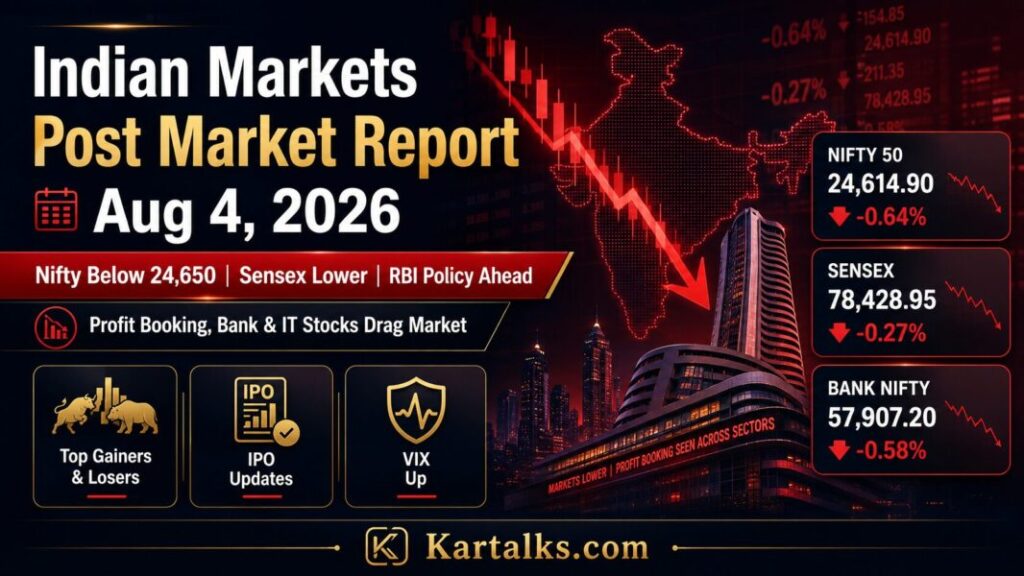
Indian Markets Post Market Report Today August 4, 2026: Nifty Breaks Four-Day Rally Ahead of RBI Policy
Indian Markets Post Market Report Today: Indian markets ended lower on Tuesday, August 4, 2026, after four consecutive sessions of gains.
The Nifty 50 slipped below 24,650, while Bank Nifty lost more than 300 points. Sensex also closed in the red after moving between gains and losses during a volatile session.
The fall was not very broad in the morning. However, selling increased in financial services, IT, insurance, cement and selected heavyweight shares as the session progressed.
Weekly derivatives expiry added to the volatility. Traders were also cautious ahead of the Reserve Bank of India’s monetary policy decision.
Another factor was the new Closing Auction Session introduced for futures and options stocks. The auction created unusual swings near the closing bell and temporarily produced different Nifty and Sensex snapshots across market platforms.
Indian Markets Post Market Report Today: Closing Levels
| Index | Closing level | Daily movement |
| Nifty 50 | 24,614.90 | -159.40 points, -0.64% |
| BSE Sensex | 78,428.95 | -210.08 points, -0.27% |
| Bank Nifty | 57,907.20 | -340.75 points, -0.58% |
Nifty Midcap 100 declined 0.29%, while the Nifty Next 50 lost 0.53%. Market breadth weakened as the session progressed, although selected small-cap shares continued to outperform large-cap stocks.
Reuters reported that the closing auction later pushed the officially displayed Nifty to 24,469.45 and Sensex to 78,326.32. This difference reflects the transition to the new closing-price mechanism rather than a normal intraday move.
Why Did the Indian Stock Market Fall Today?
1. Profit booking after a four-day rally
Indian benchmarks entered Tuesday’s session after four straight days of gains.
On Monday, Nifty had jumped 390.70 points to 24,774.30, while Sensex gained 544.39 points. Bank Nifty had also risen sharply to 58,248.
Such a fast recovery encouraged short-term traders to book profits, especially in stocks that had gained strongly during the previous sessions.
2. Financial and banking shares weakened
Banks and financial companies were among the major index drags.
Bank Nifty declined 0.58%, while the broader financial-services index also remained under pressure. Selling in large financial shares affected both Nifty and Sensex because banks carry significant weight in the benchmark indices.
Investors were cautious ahead of the RBI policy announcement. The central bank was expected to keep interest rates unchanged, but the market was waiting for its comments on inflation, liquidity and the impact of higher crude-oil prices.
3. IT stocks corrected after recent gains
The Nifty IT index declined around 0.8% to 1.2%, depending on the closing snapshot.
IT shares had rallied strongly during the previous week as investors shifted funds away from expensive global artificial-intelligence stocks and returned to Indian technology services companies.
Tuesday’s decline appeared to be normal profit booking after that sharp rise.
4. Weekly expiry increased volatility
August 4 was the weekly Nifty derivatives expiry.
Expiry sessions can produce sharper movements because traders close, roll over or hedge futures and options positions. This effect was stronger because the new Closing Auction Session was being used for only the second day.
Market participants expressed concern that sudden auction-driven price changes could affect index settlements and option positions.
5. New closing auction caused confusion
The new mechanism runs from 3:15 pm to 3:35 pm for eligible futures and options stocks. It replaced the earlier method of calculating closing prices using the volume-weighted average of the final 30 minutes.
The aim is better price discovery. However, because the NSE and BSE use separate auction order books, prices can temporarily diverge.
This explains why several platforms displayed different Nifty and Sensex closing figures after the normal session. Traders may need a few sessions to adjust their strategies to the new system.
6. Crude oil recovered from Monday’s fall
Brent crude rebounded towards $85 per barrel after falling sharply in the previous session.
Oil prices moved higher as investors remained uncertain about possible US-Iran negotiations and the outlook for shipping through key Middle East routes.
Higher crude is a concern for India because it can increase the import bill, inflation and pressure on the rupee.
7. Selling in LIC and Reliance affected sentiment
LIC shares fell sharply after the government announced an offer for sale involving a 6.5% stake at a discounted price.
Reliance Industries also declined after a rise in taxes on fuel exports raised concerns about refining and export profitability.
DLF weakened following slower pre-sales growth and softer cash collections. These stock-specific developments added pressure to the broader market.
Indian shares fall ahead of RBI policy as financial and IT stocks weaken
Top Five Nifty Gainers Today
| Stock | Movement | Key reason |
| Apollo Hospitals | +2.61% | Buying in healthcare stocks |
| Hindalco Industries | Around +2.52% | Strength in selected metals |
| Trent | Around +1.89% | Results |
| Jio Financials | Around +0.76% | financials |
| Maruti Suzuki | Around +0.31% | Positive demand outlook |
Apollo Hospitals emerged among the strongest Nifty performers and gained 2.61%.
Hindalco received support from selective buying in metal stocks. Titan and auto companies also showed resilience even as most major indices closed lower.
Top Five Nifty Losers Today
| Stock | Movement | Main trigger |
| Grasim Industries | -3.74% | Sharp profit booking |
| HDFC Life | More than -3.10% | Weakness in insurance stocks |
| Baja Auto | Around -2.16% | Selling after recent gains |
| Reliance | Around -2.13% | Profit booking |
| Tata Consumer Products | Around -1.62% | FMCG and consumer weakness |
Grasim Industries was among the largest Nifty losers.
HDFC Life declined with weakness across insurance and financial shares. Bharat Electronics and Coal India also faced heavy selling after strong earlier performance.
The exact percentages may vary slightly between the normal close and closing-auction prices.
Sensex falls 210 points and Nifty closes below 24,650
Indian Markets Post Market Report Today’s Sector Performance
Thirteen of the 16 major sector indices ended lower in the initial reported closing snapshot.
Financial services and banking
Financial shares declined as investors reduced positions ahead of the RBI decision.
Bank Nifty closed at 57,907.20, down 0.58%. Private banks and insurance companies were among the main drags.
Information technology
Nifty IT declined around 0.8%. The sector had rallied strongly in recent sessions, making it vulnerable to short-term profit booking.
Realty
Realty stocks remained weak. DLF fell after reporting softer pre-sales and cash collections, which raised questions about the near-term demand outlook.
Energy and oil-related shares
Reliance Industries and selected energy stocks declined.
The increase in fuel-export taxes affected sentiment towards refiners, while the recovery in crude oil created fresh concerns about inflation and input costs.
Healthcare and metals
Healthcare and selected metal stocks performed better than the wider market.
Apollo Hospitals and Hindalco were among the leading gainers, providing some support to Nifty.
Mid-cap and small-cap performance
Nifty Midcap 100 fell 0.29%. Small-cap stocks performed relatively better during much of the session, indicating that some domestic buying continued outside the large-cap index.
India VIX Today
India VIX closed around 12.19, up approximately 2.1% from the previous close of 11.93.
The volatility index moved between an intraday low of about 11.43 and a high of 12.55.
A VIX level near 12 is still considered relatively low. However, the daily rise shows that traders expected larger short-term swings because of the weekly expiry, the RBI decision and uncertainty created by the new closing auction.
Retail traders should remember that a low VIX does not remove risk. Sudden expiry-related or geopolitical moves can still produce sharp losses in leveraged positions.
Latest FII and DII Data
The provisional August 4 institutional cash-market figures were not available when this report was prepared.
The latest confirmed data is for August 3:
- FII net buying: ₹922.26 crore
- DII net buying: ₹1,571.18 crore
Both foreign and domestic institutions supported Monday’s rally.
The next important signal will be whether FIIs continue buying after Tuesday’s correction or return to selling ahead of the RBI policy decision.
Commodity Market Update
MCX was still trading when this report was prepared. Therefore, domestic gold and silver values should be treated as live or indicative prices rather than final settlement figures.
Brent crude oil
Brent crude traded around $83.47 per barrel, up roughly.3% during Tuesday’s trade.
The rebound followed Monday’s sharp decline. Traders remained uncertain about US-Iran negotiations and the possibility of a lasting agreement that could improve oil supplies through the region.
WTI crude oil
US West Texas Intermediate crude traded near $79.44 per barrel, up around 1.12%.
A sustained rise in WTI and Brent could once again pressure Indian equities, particularly airlines, paints, tyres, chemicals and oil-marketing companies.
MCX gold
MCX gold remained around the ₹1,43,820 lakh per 10-gram zone, with traders watching the dollar, global interest-rate expectations and geopolitical developments.
International gold had settled at $4,063 per ounce on August 3 before attempting a modest rebound.
MCX silver
MCX silver remained above approximately ₹2.20 lakh per kg in available market snapshots.
Silver continued to show wider price swings than gold because it is influenced by safe-haven demand as well as industrial consumption in electronics, solar equipment and manufacturing.
Currency Market Update
The Indian rupee closed almost unchanged at ₹95.3775 per US dollar, compared with ₹95.3375 in the previous session.
The currency was caught between positive portfolio inflows and dollar demand from importers.
Traders also avoided large positions before the RBI policy decision. A rise in crude oil limited the rupee’s ability to strengthen further.
Existing and Upcoming IPO Updates
Fusion Klassroom Edutech IPO
The Fusion Klassroom Edutech SME IPO closed for subscription on August 4.
Its price band was ₹151–₹159 per share, with listing scheduled for August 7. Investors should assess the company’s revenue concentration, education-sector competition and SME-market liquidity before considering it after listing.
G V Electricals IPO
G V Electricals also closed its SME issue on August 4.
The price band was ₹123–₹130 per share, with the proposed listing date set for August 7. SME IPOs may experience limited trading liquidity and large price swings.
Anawil Wire and Engineering IPO
Anawil Wire and Engineering opened on August 3 and is scheduled to close on August 5.
Its price band is ₹257–₹270 per share, with listing expected on August 10. Investors should review order-book quality, customer concentration and working-capital requirements.
Manipal Health Enterprises listing
Manipal Health Enterprises is scheduled to list on August 5.
Grey-market indicators suggested subdued listing expectations, but investors should not treat GMP as a reliable measure of long-term business quality. Hospital occupancy, debt, margins and expansion costs remain more important.
Juniper Green Energy and MV Electrosystems
Juniper Green Energy and MV Electrosystems closed their IPOs on August 3 and are scheduled to list on August 6.
Juniper’s price band was ₹214–₹225, while MV Electrosystems was offered at ₹400–₹425.
Upcoming mainboard IPOs
Ardee Industries will open from August 5 to August 7 at ₹50–₹53 per share.
Technocraft Ventures and Leap India are scheduled to open from August 7 to August 11. Their price bands are ₹200–₹212 and ₹151–₹159, respectively.
Latest and upcoming IPOs on Zerodha
Two Growth Stocks with Strong Q4 FY26 Results
These stocks are different from the companies discussed in recent Kartalks reports.
They are research ideas only, not direct buy calls.
1. Coforge
Coforge reported Q4 FY26 revenue of ₹4,450.4 crore, representing strong year-on-year growth.
The company’s quarterly profit more than doubled, supported by large deal wins and improved operating performance. For FY26, revenue grew 29.2%, while EBIT margin expanded to 14.4%.
Why Coforge may interest long-term investors
- Strong order intake
- Exposure to banking, insurance and travel technology
- Growing cloud, data and AI services
- Improving operating margins
- Faster growth than many larger IT companies
Risks to watch
- Integration risk from acquisitions
- Dependence on overseas clients
- Currency volatility
- High employee expenses
- Premium valuation after strong rallies
Investors may consider staggered accumulation during corrections rather than buying after a sharp price increase.
Coforge quarterly reports and Q4 FY26 investor presentation
2. PNB Housing Finance
PNB Housing Finance reported a 19% year-on-year rise in Q4 FY26 profit.
Growth was supported by healthy home-loan demand and improved asset quality. The company has also been rebuilding its retail lending business while reducing stress in its older loan portfolio.
Why the stock may be worth studying
- Growth in retail housing loans
- Improving asset quality
- Lower bad-loan pressure
- Opportunity from India’s housing demand
- Recovery in return ratios
Risks to watch
- Interest-rate changes
- Competition from banks and housing-finance firms
- Funding costs
- Property-market slowdown
- Risk from rapid loan growth
Investors should track loan growth, net interest margin and gross non-performing assets in future quarters.
PNB Housing Finance investor presentations and Q4 FY26 results
Stock of the Day: Apollo Hospitals
Apollo Hospitals gained about 2.61% and was among the strongest Nifty shares during a weak market.
The stock benefited from buying in healthcare companies, which are often preferred when the wider market turns uncertain.
Apollo’s long-term business case is linked to hospital occupancy, medical tourism, pharmacy operations and digital healthcare. However, investors should also examine valuation, expansion costs and the profitability of newer businesses before buying.
Latest SEBI Updates
Closing Auction Session enters its second day
The most important market-structure change was the new Closing Auction Session for eligible futures and options stocks.
The mechanism is intended to improve closing-price discovery, but the first two sessions produced unusual index swings and differences between NSE and BSE closing values.
Broker representatives were reportedly discussing possible improvements with regulators and exchanges.
PaRRVA enrolment timeline extended
SEBI issued a circular on August 3 extending the timeline for enrolment with PaRRVA under its earlier April 29 circular.
Investors and intermediaries should refer to the official circular for the revised compliance dates and applicability.
New SEBI executive director
Prasanta Mahapatra took charge as an Executive Director of SEBI on August 3.
The regulator also continued publishing orders, public-issue documents and recovery proceedings through its official portal.
Short-Term Investment View
Nifty has broken its four-day winning streak and closed below 24,650 in the commonly reported snapshot.
The immediate resistance zone may be near 24,750–24,850. Support may emerge around 24,500 and 24,350.
Short-term traders should monitor:
- RBI policy commentary
- Closing-auction behaviour
- Brent crude
- FII activity
- Bank Nifty around 57,700–58,000
- Fresh Q1 FY27 results
Avoid carrying oversized leveraged positions until the market becomes more comfortable with the new closing mechanism.
Long-Term Investment View
Long-term investors should not react strongly to one volatile expiry session.
A staggered approach remains suitable for:
- Index funds
- Quality banks and housing-finance companies
- Healthcare
- IT services
- Consumer companies
- Capital goods
- Select manufacturing businesses
- Gold as a portfolio diversifier
The focus should remain on earnings growth, cash flow, manageable debt and reasonable valuation.
FAQs
Q1. Why did Nifty fall today?
Nifty declined due to profit booking, weakness in financial and IT stocks, weekly expiry volatility and uncertainty around the new closing auction.
Q2. What was Bank Nifty’s closing level?
Bank Nifty closed around 57,907.20, down 340.75 points or 0.58%.
Q3. Why were different Nifty closing levels displayed?
The new Closing Auction Session produced additional price changes after the regular session, leading to different snapshots across platforms.
Q4. What was India VIX today?
India VIX closed near 12.19, up about 2.1%.
Q5. Should long-term investors buy this correction?
Long-term investors may gradually accumulate quality companies, but should avoid investing the full amount in one session.
Final Market View
Tuesday’s correction ended the market’s four-day winning streak.
The decline was driven by profit booking, banking and IT weakness, weekly expiry pressure and confusion around the new closing-price mechanism.
The RBI policy decision is now the next major domestic trigger.
Investors should also track crude oil, the rupee and institutional flows. The market may remain volatile until traders become familiar with the closing auction and receive greater clarity on interest rates.
Further Reading
Indian Markets Pre Market Report Today: August 4, 2026: Global Rally Supports Niftya
Positive Indian Markets Weekly View: Nifty, Bank Nifty and Sensex Outlook for August 3–7, 2026
Banking Sector Q1 FY27 Results Analysis for 5 Important Stocks
Q1 FY27 Results Analysis: Reliance, TCS, HCL Tech, Jio Financial and DMart
Disclaimer:
This article is published only for educational and informational purposes. It does not constitute investment advice, a stock recommendation, research advice, an offer to buy or sell securities, or a guarantee of returns.
Article Information
Author: Kartalks Research Desk
Reviewed by: Kartalks Editorial Team
Content Type: Indian stock market post-market report, closing levels, market movement, sector performance, top gainers and losers, FII/DII activity, IPO updates, commodity trends, currency movement, and investor education
Sources: NSE, BSE, SEBI, market closing data, sector performance data, FII/DII activity, IPO filings, commodity market data, currency market updates, company filings, and official public sources
Last Updated: August 4, 2026