
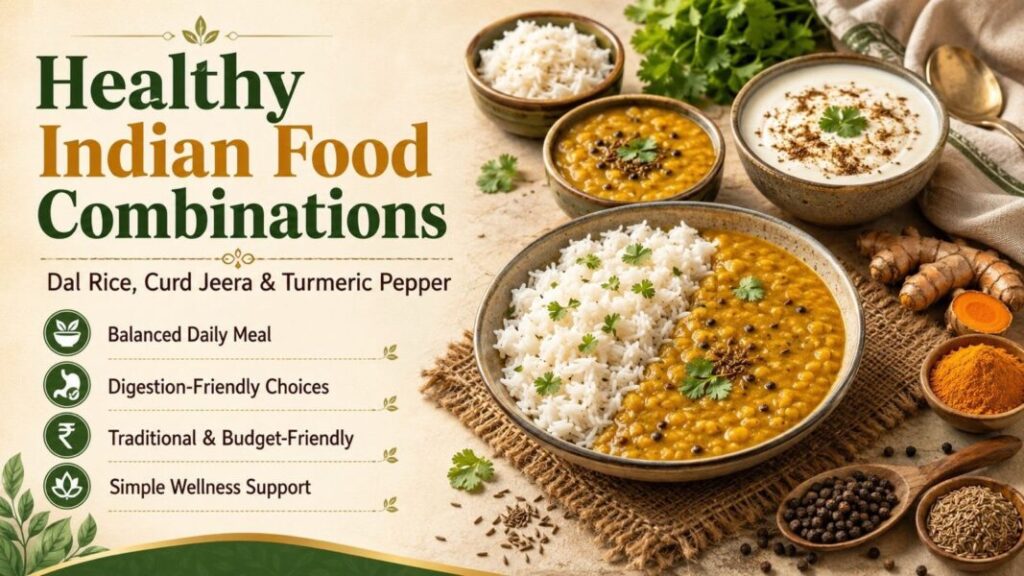
Dal Rice, Curd Jeera and Turmeric Pepper: Healthy Indian Food Combinations Explained
🍽️ Introduction: Simple Indian Food Can Be Powerful
Indian food is not only about taste. Many traditional food combinations were created with common sense, seasonal needs, digestion comfort and daily energy in mind.
Some combinations are very simple:
Dal with rice.
Curd with jeera.
Turmeric with black pepper.
These are not fancy foods. They are normal kitchen ingredients. But when used in the right way, they can make a regular Indian meal more balanced, more satisfying and more useful for daily health.
The important point is this: no single food combination is a magic cure. Dal rice will not solve every health problem. Curd jeera will not cure all digestion issues. Turmeric pepper is not a replacement for medicine.
But these combinations can support a healthier eating pattern when they are part of a balanced diet. ICMR-NIN’s 2024 Dietary Guidelines for Indians also focus on food variety, balanced meals, pulses, vegetables, fruits, milk products, nuts, seeds and limiting excess salt, sugar and ultra-processed foods.
In this article, let us understand these healthy Indian food combinations in a simple, practical and trustable way.
🍚 1. Dal Rice: The Comfort Food With Better Balance
Dal rice is one of the most loved meals in India. It is soft, warm, easy to eat and budget-friendly.
For many people, dal rice means comfort. For children, elderly people and anyone recovering from tiredness, a simple bowl of dal rice feels light and satisfying.
But dal rice is not only emotional food. It also has nutritional logic.
Rice mainly gives carbohydrates, which provide energy. Dal gives plant protein, fibre, minerals and some B vitamins. When they come together, the meal becomes more balanced than eating only plain rice.
FAO explains that protein quality depends on essential amino acids and digestibility. In simple words, different plant foods can support each other when eaten as part of a mixed diet.
✅ Why Dal Rice Is a Useful Combination
Dal rice can be useful because:
- Rice gives quick and easy energy
- Dal adds protein and fibre
- The meal is easy to digest for many people
- It is affordable for daily eating
- It can be upgraded with vegetables, ghee, curd or salad
- It suits children, adults and elderly people
🍛 Best Way to Make Dal Rice Healthier
A common mistake is eating a big plate of rice with very little watery dal. That makes the meal mostly carbohydrate-heavy.
A better plate looks like this:
- Moderate rice portion
- One good bowl of thick dal
- One vegetable side dish
- One small bowl of curd
- Salad or cooked greens
- Small amount of ghee if suitable
This gives better balance.
Harvard’s Healthy Eating Plate also recommends building meals with vegetables and fruits, whole grains, healthy protein and healthy oils instead of depending only on refined grains.
🌿 Best Dal Options for Daily Meals
You can rotate different dals:
- Toor dal
- Moong dal
- Masoor dal
- Chana dal
- Urad dal
- Mixed dal
- Sambar dal with vegetables
Rotation is better than eating the same dal every day. Different dals bring different taste, texture and nutrients.
🥣 2. Curd Jeera: A Simple Cooling and Digestive-Friendly Combo
Curd with jeera is another beautiful Indian food combination.
You may see it in many forms:
- Jeera curd
- Jeera raita
- Curd rice with roasted jeera
- Buttermilk with jeera
- Cucumber raita with jeera
- Boondi raita with roasted jeera powder
Curd is a fermented dairy food. It provides protein, calcium and other nutrients. Yogurt and fermented milk foods are also studied for their live bacteria and nutrient density, especially calcium, phosphorus, potassium, vitamin B2 and vitamin B12.
Jeera adds flavour, aroma and a light earthy taste. In Indian homes, roasted jeera powder is commonly used in curd, buttermilk, raita and chaas.
✅ Why Curd Jeera Works Well
Curd and jeera work well because:
- Curd gives creaminess and cooling feel
- Jeera improves taste without needing heavy masala
- Roasted jeera powder makes curd more flavourful
- Curd can balance spicy meals
- It pairs well with rice, roti, paratha and pulao
- It can reduce the need for packaged sauces or salty dips
This is why curd jeera is very practical for daily Indian meals.
🥄 Easy Curd Jeera Recipe
Take one bowl of fresh curd.
Add:
- Roasted jeera powder
- Pinch of salt
- Chopped coriander
- Optional grated cucumber
- Optional black pepper
Mix well and serve with lunch.
For a lighter option, make jeera buttermilk. Add curd, water, roasted jeera powder, coriander and a little salt. Mix and drink fresh.
⚠️ Curd Jeera Safety Tips
Curd is healthy for many people, but it may not suit everyone in the same way.
Be careful if:
- You are lactose intolerant
- You get bloating after dairy
- You have frequent acidity after curd
- You are advised to restrict dairy
- You are eating very salty raita daily
Also, avoid using too much salt in curd or buttermilk. A healthy food can become less healthy when salt is added heavily every day.
🌶️ 3. Turmeric Pepper: Traditional Spice Combo With Modern Interest
Turmeric and black pepper are often used together in Indian cooking.
Turmeric gives colour and earthy flavour. Black pepper gives heat and sharpness. In Indian kitchens, turmeric is added to dal, curries, sabzi, rasam, soups, milk and rice dishes.
The main active compound in turmeric is curcumin. Curcumin has been widely studied, but one issue is that the body does not absorb it very well. Black pepper contains piperine, which can improve curcumin absorption. Research has shown that piperine can increase curcumin bioavailability, but the exact effect depends on dose, form and context.
✅ Why Turmeric Pepper Is Popular
This combination is popular because:
- Turmeric adds colour and traditional flavour
- Pepper improves taste and warmth
- Pepper may support better curcumin absorption
- The combination is easy to use in normal cooking
- It fits soups, dal, rasam, sabzi and turmeric milk
But remember, food-level turmeric and high-dose curcumin supplements are not the same.
🥘 Best Ways to Use Turmeric Pepper in Food
Use it in simple cooking:
- Add turmeric and pepper to dal
- Add to vegetable stir-fry
- Use in rasam or soup
- Add a pinch to turmeric milk
- Add to khichdi
- Add to egg bhurji or paneer bhurji
- Add to chicken soup or pepper rasam
A small amount is enough. The goal is flavour and balance, not overdose.
⚠️ Important Safety Note on Turmeric
Turmeric used as a cooking spice is usually different from concentrated supplements. NCCIH notes that oral turmeric can cause side effects like nausea, acid reflux, stomach upset, diarrhea or constipation in some people, especially in supplement form or higher intake.
So do not treat turmeric pepper as medicine. Avoid high-dose turmeric or curcumin supplements unless a qualified doctor advises it.
Be extra careful if you:
- Take blood thinner medicines
- Have gallbladder problems
- Have liver disease
- Are pregnant and considering supplements
- Are taking diabetes or heart medicines
- Already have acidity or stomach irritation
Food-level use is generally different, but personal health matters.
🥗 How to Build a Healthy Indian Plate Using These Combinations
A healthy Indian meal does not need to be complicated.
You can build a simple plate like this:
Option 1: Daily Lunch Plate
- Rice
- Thick dal
- Vegetable poriyal or sabzi
- Curd jeera
- Salad
- Pickle in small quantity
Option 2: Light Dinner Plate
- Moong dal khichdi
- Curd jeera or plain curd
- Cooked vegetables
- Pepper rasam
Option 3: South Indian Style
- Rice
- Sambar with vegetables
- Curd rice with roasted jeera
- Beans poriyal
- Pepper rasam
Option 4: North Indian Style
- Roti
- Dal tadka
- Jeera curd raita
- Turmeric vegetable sabzi
- Salad
Option 5: Recovery-Friendly Meal
- Soft rice
- Moong dal
- Jeera buttermilk
- Light cooked vegetable
- Pepper rasam
This type of eating is simple and realistic. It does not require imported foods or costly diet products.
🌾 Why Traditional Food Combinations Still Matter
Many people are now moving towards expensive diet products, protein snacks, detox drinks and imported superfoods.
But Indian kitchens already have many useful combinations.
Dal rice gives comfort and balance.
Curd jeera adds cooling taste and dairy nutrition.
Turmeric pepper adds flavour and traditional spice value.
The key is not only the combination. The full meal matters.
For example, dal rice becomes healthier when you add vegetables. Curd jeera becomes better when salt is controlled. Turmeric pepper is useful when used in food, not blindly taken in high-dose supplements.
A balanced diet is always more powerful than one “viral” food hack.
🧠 Common Mistakes to Avoid
❌ Mistake 1: Eating Too Much Rice and Too Little Dal
Dal rice is healthy only when dal quantity is meaningful. A big rice plate with two spoons of dal is not balanced.
❌ Mistake 2: Making Curd Jeera Too Salty
Buttermilk and raita can become high in salt. Keep it mild.
❌ Mistake 3: Thinking Turmeric Pepper Can Cure Diseases
It is a food combination, not a medical treatment.
❌ Mistake 4: Ignoring Vegetables
Dal, rice and curd are useful, but vegetables add fibre, colour and micronutrients.
❌ Mistake 5: Following Social Media Food Hacks Blindly
Use traditional combinations wisely. Do not copy extreme diet claims.
💡 Practical Daily Tips
- Use thick dal instead of very watery dal.
- Add vegetables to sambar, dal or khichdi.
- Use roasted jeera powder in curd instead of heavy masala.
- Keep salt low in raita and buttermilk.
- Use turmeric and pepper in normal cooking quantities.
- Avoid high-dose turmeric supplements without medical advice.
- Add salad or cooked greens to dal rice.
- Rotate dals and grains during the week.
- Use homemade curd when possible.
- Eat slowly and observe what suits your digestion.
✅ Final Takeaway
Dal rice, curd jeera and turmeric pepper are simple examples of smart Indian food combinations.
They are not expensive.
They are not complicated.
They are not social media gimmicks.
They are practical kitchen combinations that can support daily health when used as part of a balanced Indian diet.
For most families, the best health upgrade is not a costly product. It is improving the daily plate with better portions, more variety, less processed food and simple traditional combinations.
🙋♀️ 5 FAQs
Q1. Is dal rice a healthy meal?
Yes, dal rice can be healthy when the dal portion is good and the meal includes vegetables, curd or salad.
Q2. Can I eat curd jeera daily?
Many people can eat curd jeera regularly, but it depends on digestion, lactose tolerance and salt intake.
Q3. Why is black pepper added to turmeric?
Black pepper contains piperine, which may improve the absorption of curcumin from turmeric.
Q4. Is turmeric pepper a medicine?
No. It is a food combination. It should not replace medical treatment or prescribed medicines.
Q5. Which is better: curd rice or dal rice?
Both can be useful. Dal rice gives more plant protein, while curd rice gives dairy nutrients and a cooling feel. A balanced diet can include both.
🧘♀️ Mindful Eating and Mental Wellness: How a Calm Plate Heals the Mind
High-Protein Indian Foods: Best Budget Options for Daily Health
Healthy School Food: Why Kids’ Nutrition Is Back in the Spotlight in 2026
Brain-Healthy Foods: Why the MIND Diet Is Getting More Attention in 2026
Front-of-Pack Nutrition Labels: What New Food Labels May Mean for Shoppers in 2026
Low-Sodium Eating in 2026: Hidden Salt in Everyday Foods and Smarter Ways to Cut It
⚠️ Disclaimer:
This article is for general health and educational purposes only. It is not medical advice. Food suitability differs from person to person. If you have kidney disease, liver disease, diabetes, acidity, lactose intolerance, gallbladder issues, pregnancy-related concerns or are taking regular medicines, please consult a qualified doctor or dietitian before making major diet changes or using supplements.