
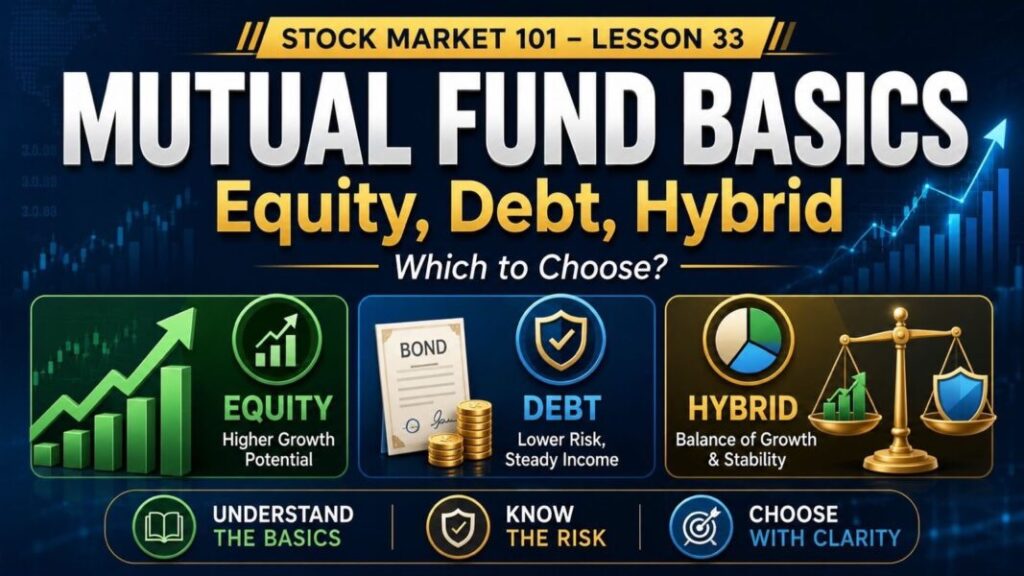
Stock Market 101 – Lesson 33: Mutual Fund Basics: Equity, Debt, Hybrid – Which to Choose?
Hook
Many beginners want to start investing, but they get confused the moment they see words like equity fund, debt fund, hybrid fund, SIP, riskometer, NAV, and expense ratio.
It feels simple at first: “I will invest in mutual funds.”
But the real confusion starts after that.
Which fund should you choose?
Should you take more risk for growth?
Should you choose a safer option?
Or should you pick something balanced?
That is why understanding Mutual Fund Basics is important before investing. A mutual fund is not just one product. There are different types of mutual funds, and each one has a different purpose.
In this lesson, we will understand equity, debt, and hybrid mutual funds in simple words, so beginners can choose based on their goal, time period, and risk comfort — not just by looking at past returns.
Mutual Fund Basics: Simple Meaning
A mutual fund collects money from many investors and invests it according to a defined objective.
That objective can be:
- long-term wealth creation
- regular income
- capital preservation
- balanced growth
- tax saving
- retirement planning
- child education planning
SEBI’s investor education material explains that equity funds invest in equity securities, debt funds aim to provide regular income, and hybrid funds invest in a combination of equity and debt securities.
A simple way to remember:
- Equity funds = more growth potential, higher risk
- Debt funds = relatively more stable, lower return expectation than equity
- Hybrid funds = mix of equity and debt
But do not think this means debt funds are risk-free or hybrid funds are always safe. Every mutual fund carries some level of risk.
That is why SEBI requires mutual fund schemes to display a Riskometer, which shows the risk level of a scheme from low to very high.
What Are Equity Mutual Funds?
Equity mutual funds mainly invest in shares of companies.
These funds are linked to the stock market, so their value can move up and down depending on market conditions, company earnings, sector performance, valuations, interest rates, and investor sentiment.
Equity mutual funds are usually suitable for:
- long-term investors
- investors who can handle market ups and downs
- people investing for goals 5 years or more away
- investors looking for wealth creation
- people who understand that returns are not guaranteed
Equity funds can create wealth over the long term, but they can also fall sharply during market corrections.
That is why beginners should not enter equity funds only by looking at past returns.
They should check:
- investment objective
- fund category
- riskometer
- time horizon
- consistency
- fund portfolio
- expense ratio
- their own risk comfort
Simple example
Suppose a beginner is investing for retirement after 15 years.
Equity funds may suit that goal better than very short-term instruments because there is enough time to handle market volatility.
But if the same person needs money after 6 months, equity funds may not be suitable because markets can fall in the short term.
What Are Debt Mutual Funds?
Debt mutual funds invest mainly in fixed-income instruments such as government securities, corporate bonds, treasury bills, and money market instruments.
The goal is usually more stability than equity funds.
SEBI’s investor education material describes debt funds as schemes that aim to provide regular income.
Debt mutual funds may suit investors who want:
- relatively lower volatility than equity
- short- to medium-term parking of money
- more predictable behaviour than stocks
- portfolio balance
- lower equity exposure
But here is the important part:
Debt funds are not the same as fixed deposits.
They can face risks such as:
- interest rate risk
- credit risk
- liquidity risk
- duration risk
- reinvestment risk
Simple example
If interest rates rise, some debt fund prices may fall, especially longer-duration debt funds.
If a fund holds low-quality debt papers and the issuer faces trouble, the fund may face credit risk.
So beginners should not think:
“Debt means no risk.”
A better way to think is:
“Debt funds may be less volatile than equity funds, but they still need proper checking.”
What Are Hybrid Mutual Funds?
Hybrid mutual funds invest in a mix of equity and debt.
They are designed for investors who do not want full equity risk but also do not want only debt exposure.
SEBI’s investor education material explains that hybrid funds invest in a combination of equity and debt securities, and the proportion of equity and debt may vary.
Hybrid funds may suit investors who want:
- a balanced approach
- partial equity growth
- some debt stability
- easier diversification
- lower volatility than pure equity funds, depending on category
But all hybrid funds are not the same.
Some hybrid funds may have higher equity exposure. Some may have higher debt exposure. Some may change allocation dynamically.
So beginners must read the scheme objective clearly.
Simple example
If a person wants to invest for 3 to 5 years and is not comfortable with full equity risk, a suitable hybrid category may be easier to understand than pure equity exposure.
But even then, the investor should check risk level, asset allocation, past behaviour, and suitability.
Equity vs Debt vs Hybrid: Key Difference
Here is the simplest comparison.
Equity Mutual Funds
- Invest mainly in stocks
- Higher growth potential
- Higher market risk
- Better suited for long-term goals
- Can be volatile in the short term
Debt Mutual Funds
- Invest mainly in fixed-income instruments
- Lower volatility than equity in many cases
- Return expectation is usually lower than equity
- Can be useful for short- to medium-term goals
- Still carry interest rate and credit risk
Hybrid Mutual Funds
- Mix equity and debt
- Balanced approach
- Risk depends on equity-debt allocation
- Can suit moderate investors
- Useful for people who want one fund with mixed exposure
This is the heart of Mutual Fund Basics.
Do not choose a fund only by return.
Choose it by purpose.
Which Mutual Fund Should Beginners Choose?
There is no single answer for everyone.
The right choice depends on:
- your goal
- your time horizon
- your risk appetite
- your income stability
- your existing investments
- your need for liquidity
- your ability to tolerate short-term losses
Choose equity funds when:
- your goal is long term
- you can stay invested for many years
- you can handle market volatility
- you want wealth creation
- you are not depending on this money soon
Choose debt funds when:
- your goal is short to medium term
- you want relatively lower volatility
- you do not want full stock market exposure
- you want to balance equity risk
- you understand debt fund risks
Choose hybrid funds when:
- you want a middle path
- you are not ready for full equity exposure
- you want equity plus debt in one product
- your risk appetite is moderate
- you want smoother behaviour than pure equity funds
Why SIPs Are Popular With Beginners
Many beginners start mutual funds through SIPs.
SIP means Systematic Investment Plan.
Instead of investing a large amount at one time, you invest a fixed amount regularly.
AMFI explains that rupee cost averaging through SIP helps investors buy more units when prices are low and fewer units when prices are high.
This does not guarantee profit.
But it can help beginners build discipline.
SIP can help because:
- it builds a regular investing habit
- it reduces the stress of timing the market
- it allows small starting amounts
- it helps long-term compounding
- it keeps investing simple
But beginners should remember:
SIP is a method of investing.
It does not remove market risk.
If the fund is risky, SIP also carries that risk.
How to Read Riskometer Before Investing
Before choosing any mutual fund, beginners should check the Riskometer.
SEBI explains that the Riskometer is a risk-measuring tool used in the mutual fund industry to show the risk level of a scheme, ranging from low to very high.
This is very useful because fund names can sometimes confuse beginners.
A fund may sound safe, but its Riskometer may show higher risk.
Check these before investing:
- Riskometer level
- Scheme objective
- Fund category
- Asset allocation
- Past volatility
- Exit load
- Expense ratio
- Your own goal
Do not ignore the Riskometer.
It is one of the easiest beginner tools.
Common Mistakes Beginners Make
1. Choosing funds only by past returns
This is the most common mistake.
A fund that performed well last year may not perform well next year.
Past return is useful information, but it should not be the only reason to invest.
2. Not understanding the fund category
Many beginners buy equity funds thinking they are safe like savings products.
That is risky.
First understand whether the fund is equity, debt, hybrid, index, sectoral, thematic, or solution-oriented.
3. Ignoring risk
Every mutual fund has risk.
Even debt funds can face risk.
This is why SEBI’s Riskometer matters.
4. Investing short-term money in equity funds
If you need money soon, equity funds may not be suitable because markets can be volatile.
5. Buying too many funds
Some beginners buy 10 or 15 funds thinking it creates diversification.
But many funds may hold similar stocks.
This creates overlap and makes tracking difficult.
6. Stopping SIP during market fall
Market falls are uncomfortable.
But stopping SIP only because markets are down may hurt long-term discipline.
If your goal and fund choice are still valid, review calmly before stopping.
Simple Beginner Method to Choose Mutual Funds
Use this simple step-by-step method.
Step 1: Define your goal
Ask:
- Why am I investing?
- When do I need the money?
- Is this for emergency, home, education, retirement, or wealth creation?
Step 2: Match time horizon
A simple educational view:
- very short-term money: avoid high-risk equity exposure
- medium-term goals: consider lower-risk or balanced options
- long-term goals: equity funds may play a larger role
Step 3: Check risk appetite
Ask honestly:
- Can I handle a 10% to 20% fall?
- Will I panic if markets correct?
- Do I need stability more than high return?
Step 4: Choose category first, fund later
Do not start with fund names.
Start with category:
- equity
- debt
- hybrid
- index
- sectoral
- ELSS
- liquid
- short duration
Step 5: Compare funds carefully
Check:
- fund objective
- riskometer
- expense ratio
- portfolio quality
- fund manager consistency
- rolling performance
- downside behaviour
- exit load and tax impact
Mutual Fund Basics for Indian Investors
For Indian readers, mutual funds are useful because they offer access to different asset classes and strategies under regulated fund structures.
But the investor must still take responsibility.
A beginner should remember:
- do not invest only because a fund is trending
- do not trust social media tips blindly
- do not chase last year’s best fund
- do not ignore risk level
- do not mix emergency money with long-term equity investing
Mutual funds can be simple, but they should not be used casually.
Equity, Debt, or Hybrid: Final Learning
The final learning is very simple.
Equity funds are more suitable for long-term growth but come with higher volatility.
Debt funds may offer relatively more stability but are not risk-free.
Hybrid funds try to balance equity and debt, but their risk depends on the actual allocation.
So the question is not:
“Which mutual fund gives highest return?”
The better question is:
“Which mutual fund category suits my goal, time horizon, and risk appetite?”
That is the real meaning of Mutual Fund Basics.
A good investor does not choose randomly.
A good investor chooses with purpose.
5 FAQs – Mutual Fund Basics
1. What are mutual funds in simple words?
Mutual funds collect money from many investors and invest it in securities based on the scheme objective.
2. What are equity mutual funds?
Equity mutual funds mainly invest in shares of companies and are generally more suitable for long-term growth goals.
3. What are debt mutual funds?
Debt mutual funds mainly invest in fixed-income instruments and usually aim for relatively more stable income than equity funds.
4. What are hybrid mutual funds?
Hybrid mutual funds invest in a mix of equity and debt securities. Their risk depends on how much they invest in each asset class.
5. Which mutual fund is best for beginners?
There is no single best fund for everyone. Beginners should choose based on goal, time horizon, risk appetite, fund category, and Riskometer level.
Stock Market 101 – Lesson 32: Using Sector Indices & ETFs for Beginners
Stock Market 101 – Lesson 30: Defensive vs Cyclical Sectors
Stock Market 101 – Lesson 28: Market Cycles Explained
Stock Market 101-Lesson 22: Profit and Loss in Annual Report
Disclaimer:
This article is only for educational and informational purposes. It is not investment advice or a mutual fund recommendation. Mutual fund investments are subject to market risks. Please read all scheme-related documents carefully and consult a certified financial advisor before making investment decisions.
Article Information
Author: Kartalks Education Desk
Reviewed by: Kartalks Editorial Team
Content Type: Stock market education, beginner-friendly investing concepts, finance learning, and investor awareness
Sources: SEBI investor education material, NSE/BSE educational resources, official public sources, and general finance learning references
Last Updated: June 6, 2026