
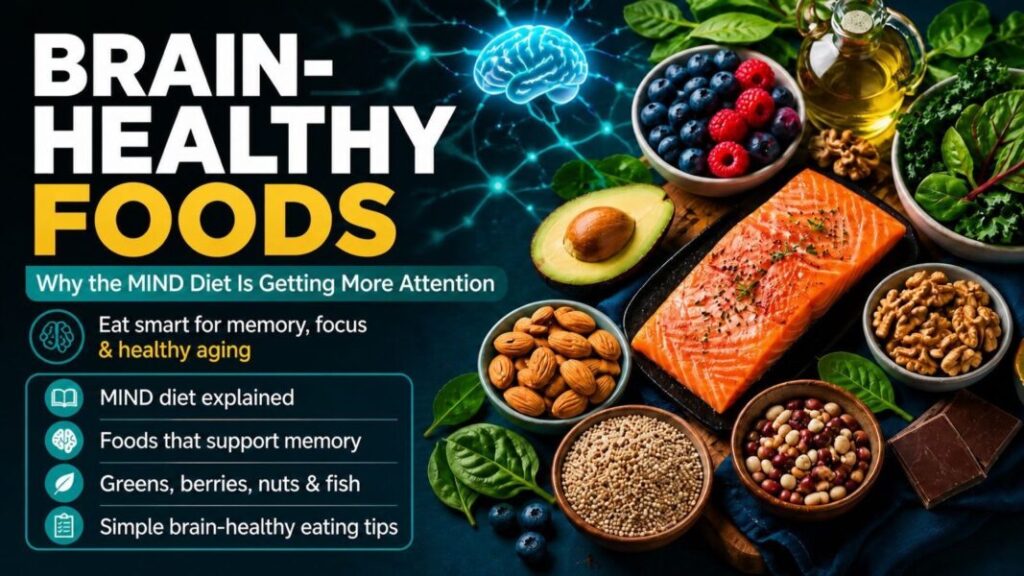
Brain-Healthy Foods: Why the MIND Diet Is Getting More Attention in 2026
Brain health has moved from being a niche wellness topic to a mainstream long-term health conversation. That shift is not hard to understand. People are living longer, cognitive decline is a growing fear, and many readers want practical habits they can actually use, not just vague advice. One eating pattern that keeps coming up in that discussion is the MIND diet. NIH explains that MIND stands for Mediterranean-DASH Intervention for Neurodegenerative Delay, and describes it as a blend of key features from the Mediterranean and DASH eating patterns, built specifically around foods linked with cognitive health.
The reason the MIND diet is getting more attention now is simple: newer research continues to keep it in the conversation. In 2024, NIH highlighted data showing that closer adherence to the MIND diet was associated with a lower risk of cognitive impairment and slower cognitive decline. In 2025, the large U.S. POINTER randomized clinical trial added more momentum by showing that a structured lifestyle program that included adherence to the MIND diet improved cognition in older adults at risk of cognitive decline, with greater gains in the more structured group than in the self-guided group.
That does not mean the MIND diet has been proven to prevent dementia on its own. The strongest way to say it is this: the evidence is promising, but still developing. NIH and the American Academy of Neurology both make that clear. The 2024 Neurology findings were observational, so they show an association, not proof of cause and effect. And a 2023 randomized trial found that both the MIND-diet group and the control group improved cognition, with no clear difference in brain MRI findings between them.
Article Information
Author: Kartalks Editorial Team
Reviewed by: Kartalks Health Content Desk
Content Type: Food, health, wellness, and general awareness content
Sources: public health references, nutrition awareness resources, official public sources, and general wellness information
Last Updated: May 3, 2026
Why the MIND Diet Stands Out
The MIND diet gets attention because it feels more targeted than a generic “eat healthy” message. NIH says it features green leafy vegetables and other vegetables, gives preference to berries over other fruits, and emphasizes whole grains, beans, nuts, and at least one weekly serving of fish, while limiting red meat, sweets, cheese, fast food, and fried foods. The American Academy of Neurology describes a very similar pattern and notes that olive oil and poultry also play an important role.
In practical terms, that means the MIND diet is not built around rare or expensive foods. It is mostly a pattern of everyday choices:
- more leafy greens
- more berries
- more beans and lentils
- more nuts
- more whole grains
- more fish
- more olive oil
- less fried food
- less processed sweets
- less red and processed meat
That is one reason it resonates with readers. It sounds doable.
What the Latest Research Really Says
1. The 2024 NIH-backed findings were encouraging
NIH reported in 2024 that among about 14,000 participants in the REGARDS cohort, people with the greatest adherence to the MIND diet had a 4% reduced risk of cognitive impairment compared with those with the lowest adherence. NIH also said closer adherence was linked to slower rates of cognitive decline, with an 8% lower risk of cognitive decline in female participants, while no difference was seen in males.
The American Academy of Neurology’s release on the same study adds useful context: participants were followed for about 10 years, and the association appeared stronger for slower decline in Black participants than in White participants. Again, the researchers were careful to say these results do not prove the diet prevents impairment, only that stronger adherence was linked with lower risk.
2. The 2025 U.S. POINTER trial made brain-health nutrition harder to ignore
This is one of the biggest reasons the MIND diet is getting more attention now. The Alzheimer’s Association says U.S. POINTER was a large, two-year, randomized clinical trial in 2,111 older adults at risk of cognitive decline and dementia. Both intervention groups improved cognition, but the more structured program did better. That structured program included regular exercise, adherence to the MIND diet, cognitive and social challenge, and health monitoring.
The key point here is important: U.S. POINTER was multidomain, not a pure diet-only test. So it does not prove that food alone created the benefit. But it strongly supports the idea that a brain-healthy eating pattern belongs inside a broader brain-health routine.
3. A balanced reading matters
Harvard’s Nutrition Source notes that a 2023 randomized controlled trial in adults aged 65 and older found that both the MIND group and the control group improved cognitive performance and lost similar weight, while MRI findings did not differ between groups. That is a useful reminder not to oversell the diet as a miracle solution.
So the honest message is this: the MIND diet is promising, practical, and worth attention, but it should be treated as one part of a larger healthy-lifestyle strategy, not as a guaranteed shield against dementia.
The Core Brain-Healthy Foods to Focus On
If you want to explain the MIND diet simply to readers, these are the food groups that matter most.
Green leafy vegetables
Spinach, kale, collard greens, and similar greens are central. NIH specifically lists green leafy vegetables as a defining MIND feature.
Other vegetables
The diet does not stop at salad. A wider range of vegetables matters too. NIH and AAN both describe the MIND diet as including leafy greens plus other vegetables.
Berries
This is one of the signature MIND-diet details. NIH says the pattern prefers berries over other fruit, which is one reason blueberries and strawberries are so often associated with brain-health discussions.
Whole grains
Whole grains are another basic pillar. AAN’s scoring description included three or more daily servings of whole grains in the higher-adherence pattern.
Beans and lentils
Beans are simple, affordable, and repeatedly mentioned in MIND-diet descriptions. NIH includes beans among the core foods, and AAN’s framework counted three weekly servings of beans.
Nuts
Nuts are also part of the pattern, both in NIH’s general description and in the AAN scoring system.
Fish and olive oil
Fish and olive oil help connect MIND to its Mediterranean roots. NIH says the diet endorses at least one weekly serving of fish, while the Alzheimer’s Association’s U.S. POINTER “brain health recipe” highlights dark leafy greens, berries, nuts, whole grains, olive oil, and fish.
Foods the MIND Diet Tries to Limit
This part matters just as much as the “eat more” list.
The main foods the MIND diet asks people to cut back on are:
- red meat
- processed meat
- fried or fast food
- sweets and pastries
- cheese
- butter or margarine in excess
That does not mean perfection is required. One reason the MIND diet feels realistic is that it is more about direction than food fear. You do not need a flawless plate every day. You need a pattern that trends more often toward vegetables, beans, fish, nuts, grains, and olive oil, and less often toward fried, sugary, and highly processed food. That interpretation matches how NIH and Rush describe the overall pattern.
Why Readers Like This Topic
This article topic works well because it sits at the intersection of:
- aging well
- preventive health
- practical food choices
- long-term reader interest
It also gives readers something better than vague advice. Instead of saying “eat healthy,” you can say:
- add leafy greens more often
- choose berries regularly
- swap refined grains for whole grains
- use more beans and nuts
- choose fish more often
- cut back on fried and sugary foods
That is useful, memorable, and realistic.
A Practical Everyday MIND-Style Plate
For readers who want a simple picture, a MIND-style day of eating could look like this:
Breakfast
Oats or another whole grain with berries and nuts.
Lunch
A leafy green salad or vegetable-heavy bowl with beans, olive oil, and whole grains.
Dinner
Fish with vegetables and a whole grain side.
Snacks
Nuts, fruit, or a simple bean-based snack instead of pastries or fried packaged foods.
That is not a rigid prescription. It is just an easy way to translate the pattern into real life.
Final Take
The MIND diet is getting more attention because it sits in a sweet spot: it is research-backed enough to be credible, practical enough to follow, and flexible enough to feel realistic. The latest evidence does not justify calling it a cure or a guaranteed dementia-prevention plan. But it does support the idea that brain-healthy food patterns belong in any serious conversation about aging well. In 2026, that is exactly why the MIND diet keeps showing up in brain-health discussions.
FAQs
క్. What is the MIND diet?
It is a brain-focused eating pattern that combines parts of the Mediterranean and DASH diets.
క్. Which foods are most important in the MIND diet?
Leafy greens, other vegetables, berries, whole grains, beans, nuts, fish, olive oil, and poultry are key foods.
Q3. Does the MIND diet prevent dementia?
It has been linked with lower risk and slower decline in some studies, but that does not prove prevention.
Q4. Why is the MIND diet getting more attention now?
Recent research, including the 2024 Neurology analysis and the 2025 U.S. POINTER trial, has kept it in the spotlight.
Q5. What foods should be limited on the MIND diet?
Red meat, fried food, fast food, sweets, excess butter, and cheese are commonly limited.
👉Further reading
Front-of-Pack Nutrition Labels: What New Food Labels May Mean for Shoppers in 2026
Sustainable and Local Food Movement: Why Climate and Health Are Finally Sharing the Same Plate
Sleep-Friendly Eating: What to Eat for Better Sleep in 2026
Low-Sodium Eating in 2026: Hidden Salt in Everyday Foods and Smarter Ways to Cut It
7 No-Cook Breakfasts Recipes for Healthy and Budget Indian Mornings.
Plant-Based Diet 2.0: The New Era of Eating
GLP-1 Influence on Diet and Health (2026): What It Means for Weight, Metabolism, and Everyday Eating
Cabbage and Gut Health Rising: Why This Humble Veg Is Becoming 2026’s Favorite “Functional Food”
Disclaimer
This article is for general educational purposes only and is not medical advice. Brain health is influenced by many factors, including age, genetics, blood pressure, sleep, exercise, hearing, social engagement, and overall lifestyle. For personal guidance, speak with a qualified healthcare professional.