
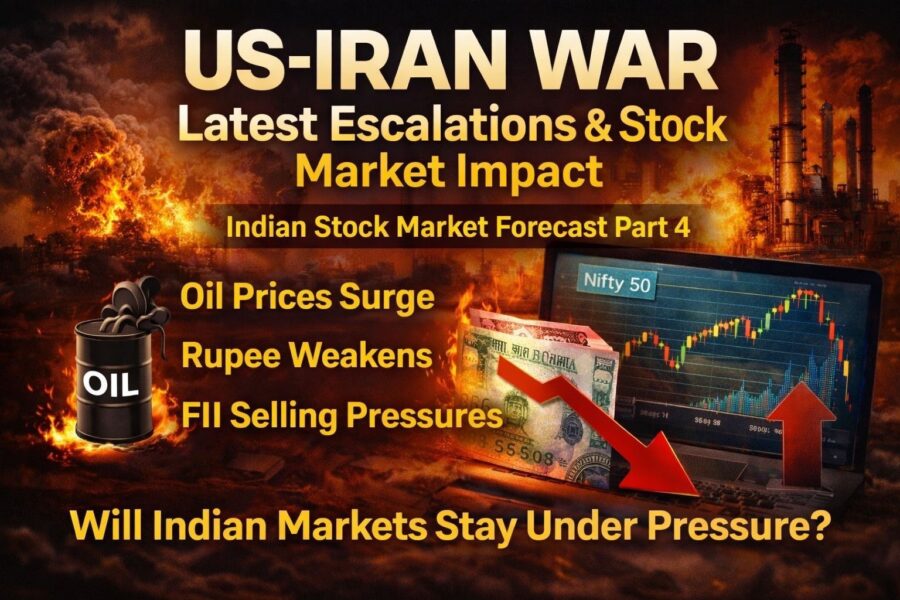
US-Iran War Latest Escalations and Stock Market Impact – Part 4: Will Indian Markets Stay Under Pressure?
The market does not panic because of headlines alone. It panics when those headlines begin to hit oil, currency, inflation and foreign money flows at the same time. That is exactly what is happening now. The US-Iran war latest escalation has turned from a geopolitical story into a full market risk story for India, and investors can no longer treat it as background noise.
Why this story matters right now
The conflict has entered a more dangerous phase. Reuters reported on March 27 that twelve U.S. troops were wounded, including two seriously, in an Iranian strike on Prince Sultan Air Base in Saudi Arabia. On the same day, U.S. Secretary of State Marco Rubio said Washington still expects the operation to finish in “weeks, not months” and that the U.S. believes it can achieve its objectives without ground troops. That combination tells markets two things at once: the war is still escalating militarily, but there is still no clear end in sight.
Diplomatically, the tone is just as tense. G7 foreign ministers have called for an immediate end to attacks on civilians and stressed the need to restore safe, toll-free navigation through the Strait of Hormuz. Reuters also reported that several Gulf states want any endgame to do more than produce a ceasefire; they want Iran’s missile and drone capabilities permanently degraded. That makes this look less like a short-lived flare-up and more like a conflict whose aftershocks could remain in the system even if fighting cools.
The real market trigger: oil and Hormuz
For investors, the biggest issue is not just the war itself. It is the Strait of Hormuz. Reuters reported that around 20% of global oil and gas transits move through that chokepoint, which is why even partial disruption there can shake markets everywhere. Reuters also reported that Brent crude has jumped more than 50% since the war began, briefly moved above $119 a barrel, and is expected by analysts polled by Reuters to average about $134.62 under current conditions and $153.85 if major Iranian export infrastructure is hit.
That matters even more for India because the country remains heavily dependent on imported crude. Reuters reported that India imports about 85% to 90% of its crude needs. When oil rises this sharply, the pressure does not stop at fuel bills. It spreads into inflation expectations, corporate margins, bond yields, the rupee and foreign investor sentiment.
What has already happened to Indian markets
The damage is no longer theoretical. Reuters reported that on March 27 the Nifty 50 fell 2.09% to 22,819.60 and the BSE Sensex dropped 2.25% to 73,583.22. Both benchmarks also logged their fifth straight weekly loss, the longest losing streak in nearly eight months. Since the conflict began on February 28, Indian markets have fallen roughly 9.5%, while volatility has risen to its highest level since June 2024.
The rupee has delivered an equally clear warning. Reuters reported that it hit a record low, touching 94.7875 per U.S. dollar, and has lost 4.2% since the war began. At the same time, foreign investors have sold a record net $12.14 billion of Indian equities since the conflict started, while also reducing bond exposure. That is the kind of combination that makes every market bounce look fragile unless oil cools meaningfully.
The message from large institutions has also turned more cautious. Reuters reported that Goldman Sachs cut India’s 2026 GDP growth forecast from 7% to 5.9% and downgraded its equities outlook. That does not mean India suddenly loses its long-term growth story, but it does mean the market is being forced to reprice near-term risk more aggressively than many investors expected just a few weeks ago.
Which sectors are feeling the most heat
When crude stays above $100, the pain rarely gets distributed evenly. Import-heavy and energy-sensitive businesses usually feel it first. Based on the current oil shock, rupee weakness and foreign outflows, sectors like aviation, paints, chemicals, logistics and other businesses with high fuel or imported input exposure are likely to remain under pressure. Banks and rate-sensitive sectors may also stay nervous because persistent oil inflation can push bond yields higher and keep monetary conditions tighter for longer. This is my inference from the market and macro signals Reuters documented this week.
There are still a few pockets of relative strength. Reuters reported that ONGC rose 6.2% over the week, clearly benefiting from higher crude prices even as the broader market sold off. That is a reminder that in geopolitical sell-offs, the index can look weak while a few oil-linked names or defensives hold up much better than the rest of the market.
US-Iran War Latest Escalations: Global cues are not helping
This is not an India-only issue. Reuters reported that the Dow has now confirmed a correction, falling 10% from its February high, as investors worry about war-driven inflation and energy disruption. When Wall Street is under pressure and oil is still elevated, emerging markets like India usually struggle to attract aggressive risk capital. That is one reason FII selling has stayed heavy instead of quickly reversing.
The G7 statement also matters for markets because it explicitly highlighted disruptions to energy, fertilizer and commercial supply chains. That broadens the story from oil alone to a wider cost-push problem across the global economy. For India, that can mean higher imported inflation and tougher margin conditions for companies that depend on commodities, shipping or globally traded inputs.
US-Iran War Latest Escalations – Indian stock market forecast: what comes next?
My base-case view is that the Indian stock market will remain highly headline-driven in the near term. If Brent remains above $100, the rupee stays near record lows and FII selling continues, the market is unlikely to sustain a strong relief rally. In that scenario, every bounce may face selling pressure because traders will worry that higher oil will eventually squeeze earnings, inflation and growth. This is an inference based on Reuters’ reporting on crude, rupee weakness, GDP downgrades and record foreign outflows.
A more constructive outcome is still possible. If war headlines cool, Hormuz navigation improves and Brent starts moving decisively lower, Indian equities could stage a meaningful rebound because sentiment is already badly bruised. In such a setup, quality large caps, selective private financials, export-oriented technology names and businesses with stronger balance sheets could recover first. This is my inference from the current positioning and the way markets have reacted to oil swings during the conflict.
The bearish scenario is straightforward and should not be ignored. If the war deepens, Hormuz disruption worsens or major Iranian oil infrastructure is attacked, Reuters’ scenario analysis suggests oil could stay much higher for longer. In that environment, India would likely face another round of rupee pressure, more FII selling, higher inflation fear and a weaker risk appetite across equities. For traders, that means caution. For long-term investors, that means being selective rather than blindly buying every dip.
What investors should watch now
The four signals that matter most are simple. First, Brent crude. Second, rupee stability. Third, any fresh military escalation around Saudi assets or the Strait of Hormuz. Fourth, foreign investor flows into or out of Indian equities. If these four stop worsening together, the market can stabilize. If they keep deteriorating together, volatility could remain the dominant trend. That is an inference grounded in the way these variables have moved since the war began.
US-Iran War Latest Escalations: Final take
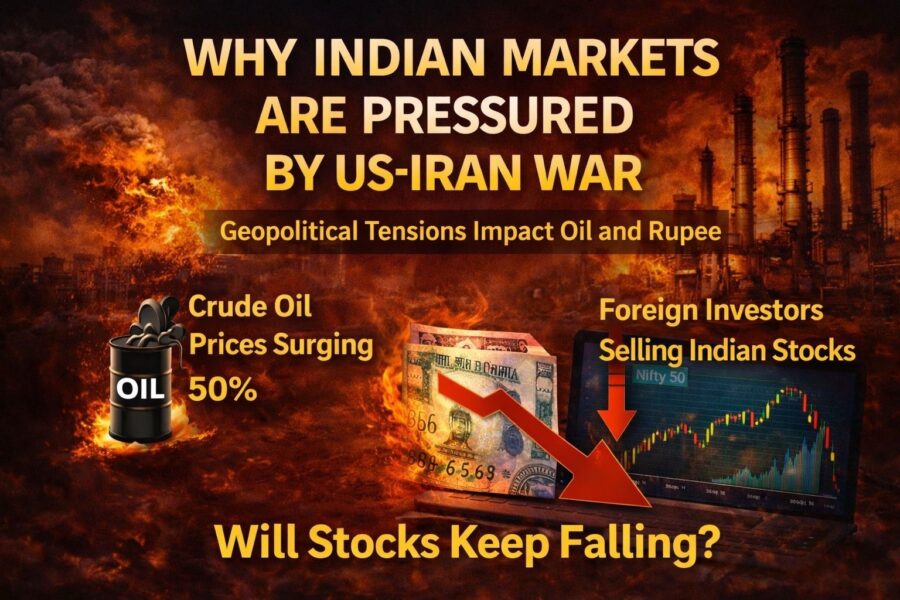
US-Iran War Latest Escalations Part 4 of this story is not about fear for the sake of fear. It is about understanding the chain reaction. The latest US-Iran war escalations are hitting oil, oil is hitting inflation expectations, inflation fears are hitting the rupee and bond markets, and all of that is feeding into Indian equity weakness. Until that chain begins to break, the Indian stock market outlook stays cautious, volatile and highly sensitive to global cues.
5 FAQs (US-Iran War Latest Escalations)
1. Why is the US-Iran war affecting Indian markets so much?
Because India imports most of its crude oil, and this war has sharply lifted oil prices while also weakening the rupee and hurting investor sentiment.
2. What is the biggest risk for Indian stocks right now?
The biggest near-term risk is sustained crude above $100 along with continued FII outflows and rupee weakness.
3. Has the Indian market already corrected meaningfully?
Yes. Reuters reported Indian benchmarks are down about 9.5% since the conflict began and have logged five straight weekly losses.
4. Which sector may benefit from this crisis?
Oil-linked producers such as ONGC have shown relative strength because higher crude prices support their earnings outlook.
5. What should investors track next week?
Watch Brent crude, the rupee, Hormuz-related headlines and FII flow data before taking aggressive positions. This is an inference based on current market behavior.
Further reading
US-Iran War Latest Escalations: What It Means for the Indian Stock Market
US-Iran War Risk and the Indian Stock Market
U.S-Iran War Risk: How It Could Impact the Indian Economy and Stock Market
Indian Markets Post Market Report Today Mar 27, 2026 (Friday)
Stock Market 101-Lesson 22: Profit and Loss in Annual Report
Cryptocurrency Guide 2026 – Part 3
Disclaimer:
This article is for educational and informational purposes only. It is not investment advice, trading advice or a recommendation to buy or sell any security. Markets can react sharply to geopolitical developments, and investors should consult a registered financial advisor before making financial decisions.