
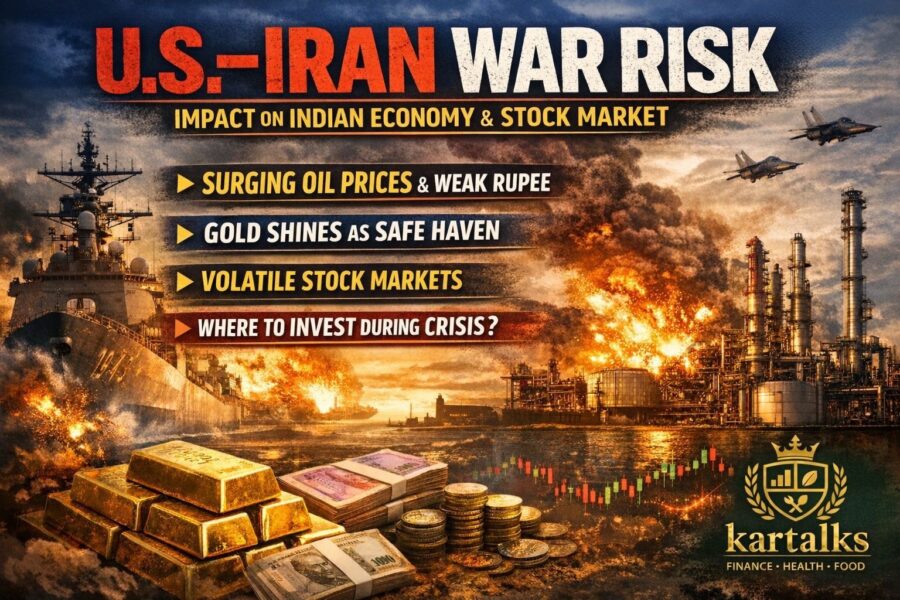
U.S-Iran War Risk: How It Could Impact the Indian Economy and Stock Market
U.S-Iron War Risk: The sudden escalation in the U.S.–Iran conflict has turned into a serious global market trigger. As of March 3, 2026, the situation is no longer being seen as a short-lived geopolitical headline. Reuters reports that the conflict has already led to U.S. military casualties, rising fears of further retaliation, and a much sharper focus on the Strait of Hormuz—one of the world’s most important oil routes.
For Indian readers and investors, this matters because India remains heavily dependent on imported crude. Reuters noted that Iran’s disruption of navigation through the Strait of Hormuz threatens a route that handles nearly 20% of global oil flows, and that more than 40% of India’s crude imports are exposed to that corridor.
So the big question is simple: Will this hit India badly, or will it create selective opportunities? The answer is: both. In the near term, it raises risk. In the medium term, it may also open windows for disciplined investors.
🌍Global Scenario: Why the World Is Nervous
The global market reaction has been classic “risk-off.” Oil has jumped sharply, gold has rallied as a safe haven, and equity markets globally have turned cautious as traders price in the possibility of a prolonged regional conflict. Reuters said oil surged more than 8% initially, with analysts warning Brent could even spike toward $100 per barrel if the disruption worsens.
Reuters also reported that oil prices are expected to remain elevated for at least the next few days because traders are watching whether flows through the Strait of Hormuz normalize or remain constrained.👉Reuters
At the same time, investors have rushed toward defensive assets. Spot gold climbed to around $5,297 per ounce on March 2, while U.S. gold futures settled near $5,311.60, as markets priced in prolonged uncertainty.
That combination—higher oil, stronger gold, weaker risk appetite—is usually bad for import-heavy emerging markets in the short run, and India is one of the first markets investors examine in such a setup.
U.S-Iran War Risk: For the Indian Economy, the Biggest Risk Is Imported Inflation
India entered this phase from a relatively strong base. Reuters reported that India’s GDP grew 7.8% in the October–December quarter, and that FY2026 growth is being seen around 7.6% under the revised data series. The Economic Survey had also projected 6.8%–7.2% growth for FY2026/27, though it explicitly flagged geopolitical risks as a concern.
That is the good news.
The bad news is that a sustained crude spike can quickly feed into:
higher import bills
pressure on the rupee
costlier transport and logistics
inflation risks in fuel-linked sectors
tighter pressure on corporate margins
Reuters has already reported that traders expect the RBI to support the rupee as the oil jump hurts the currency.
So, if the conflict remains intense for more than a few weeks, India’s macro story may shift from “high growth, stable inflation” to “strong growth, but under cost pressure.” Reuters specifically noted that while India has enjoyed solid growth and low inflation recently, an oil shock and shipping disruption could upset that balance.
📈 Indian Stock Market Forecast: What Could Happen Next
The stock market usually reacts before the economy does, and that has already started. Reuters reported that Indian shares tumbled as Middle East war fears hurt sentiment and pushed crude higher.
The logic is straightforward:
Higher crude hurts India’s macro profile.
Higher uncertainty reduces foreign risk appetite.
A weaker rupee can trigger broader market caution.
Inflation fears can cap valuation expansion.
In the short term, that means the market may stay volatile, with any bounce likely to be selective rather than broad-based.
My practical market view for readers:
Near term (days to 2 weeks): volatile, headline-driven, gap moves likely
Short term (2–6 weeks): depends heavily on oil staying below or above the high-$70s / $80 zone
Medium term: if the conflict cools, India could recover faster than many peers because domestic growth remains relatively strong
This is not the kind of environment where investors should chase momentum blindly. It is the kind of market where cash discipline, staggered buying, and stock selection matter more than index predictions.
💰U.S-Iran War Risk: FII Flows — Why Foreign Money Matters Even More Now
Foreign flows were already fragile before this conflict. Reuters reported that foreign investors sold about $19 billion worth of Indian equities in 2025 and another $4 billion in January 2026. There was some improvement in February, with foreigners buying about $2.2 billion in the first three weeks, which hinted at a possible stabilization.👉Reuters
But geopolitical shocks can reverse that quickly.
If oil stays high and risk aversion deepens, FIIs may again reduce exposure to India, especially in sectors where valuations are still rich. NSE also notes that its daily FII/FPI data is provisional and can change after custodial confirmations, so daily numbers should be treated carefully.
For readers, the takeaway is simple: FII behavior may remain volatile, and that can create sharp swings in index-heavy names even when the long-term India story stays intact.
🛢️ Crude Oil Forecast: This Is the Main Market Driver
Crude is the single biggest variable to watch now.
Reuters said Brent had surged to about $78.8 per barrel as the conflict escalated, and analysts warned prices could remain high for days, with upside risk if Strait of Hormuz disruptions worsen.
My working crude scenarios
1) Mild de-escalation scenario
If shipping normalizes and no major further escalation happens, Brent may cool back toward the low-to-mid $70s. That would reduce panic in Indian markets. This is an inference based on Reuters reporting that the immediate spike is closely tied to supply-route fears.
2) Prolonged conflict scenario
If the conflict continues and disruptions persist, Brent can remain elevated in the high $70s to $90s range.
3) Severe supply shock scenario
If Hormuz disruptions deepen materially, the market may start pricing a move toward $100 per barrel. Reuters explicitly cited analysts discussing that possibility.
For India, the third scenario is the one that would do the most damage to sentiment, inflation expectations, and fiscal comfort.
🥇U.S-Iran War Risk: Gold and Silver — Safe Haven Strength, But Watch Volatility
Gold has already responded exactly as expected in a geopolitical crisis. Reuters reported spot gold near $5,297.31 per ounce and said the move was driven by fears that the conflict could stretch over weeks.
That means gold is once again doing its traditional job: acting as a hedge against uncertainty.
Silver has also seen strong geopolitical support, though it is usually more volatile because it behaves partly like a precious metal and partly like an industrial metal. Reuters separately noted that global silver demand in 2026 is expected to remain steady, supported by investment demand.
For Indian investors:
Gold looks stronger as a hedge asset in this phase
Silver can outperform in sharp bursts, but may swing more violently
Fresh buying is better done in phases, not in one lump-sum move
🏭 Investment Opportunities: Where Smart Money Can Look During Panic
A war-led correction is never comfortable, but it often creates the best long-term watchlist entries.
Due to this U.S-Iran War Risk: Sectors that may stay under pressure
These areas could face short-term pain if oil remains elevated:
paints
aviation
logistics
tyres
oil marketing companies
consumer businesses with thin margins
That is because crude-linked input costs and freight pressures can squeeze earnings. This is a market-based inference from the oil-shock setup described in Reuters coverage.
Sectors that can remain relatively resilient
These may hold up better:
domestic private banks with strong balance sheets
large-cap IT on sharp dips
defence-related themes if spending sentiment stays firm
select capital goods and infrastructure names tied to domestic demand
upstream energy producers, if crude strength persists
U.S-Iron War Risk: Best strategy
Instead of trying to “buy the exact bottom,” readers should think in three layers:
first tranche on panic fall
second tranche if crude stays elevated and markets correct more
third tranche only after signs of stabilisation in oil and FII flows
That approach reduces emotional decision-making.
🚀 Growth Stocks to Accumulate During a Fall
I’d focus on quality businesses with strong cash flows, pricing power, and manageable debt rather than speculative names.
Categories worth watching
1) Large private banks
If the index corrects, high-quality lenders often become attractive because they benefit from India’s domestic growth story once macro panic settles. India’s growth backdrop is still relatively strong, which supports this view.
2) Large-cap IT leaders
Global uncertainty can hurt sentiment, but strong balance-sheet IT names often become better buys during broad risk-off phases.
3) Select energy producers
Upstream energy players can benefit if crude remains elevated for longer. That is one of the few natural hedges inside equities when oil spikes.
4) Defence and strategic manufacturing
In periods of geopolitical instability, these themes often stay in focus longer than the headline cycle.
5) Consumption leaders with pricing power
Not every consumer stock is a good buy in an oil shock—but businesses that can pass on costs may recover faster than weaker peers.
The key is not “what is cheap today,” but what remains strong even if volatility lasts longer than expected.
📊 What Readers Should Watch Every Day Now
For the next few sessions, these are the most important signals:
Brent crude trend
Strait of Hormuz headlines
rupee movement
FII selling or buying tone
gold’s ability to hold gains
whether Indian indices fall with panic or absorb the shock gradually
If crude cools and the rupee stabilises, the market can recover faster than the news headlines suggest. If crude keeps climbing, caution should remain the default.
🧭U.S-Iran War Risk: Bottom Line
The U.S.–Iran conflict is a serious macro event for India mainly because of oil, not because India is directly involved. The biggest near-term risks are:
imported inflation
a weaker rupee
renewed FII caution
short-term pressure on Indian equities
But India is not entering this phase from weakness. Growth is still relatively strong, and that gives the market a cushion once the first round of panic is absorbed.
So for investors, the right mindset is:
Don’t panic. Don’t chase. Don’t ignore the risk either.
Use volatility to build positions gradually in high-quality names while keeping a close eye on crude.
❓ 5 FAQs
Q1) Will the U.S-Iran war risk conflict crashes the Indian stock market?
Not necessarily. It can create sharp short-term volatility, but the biggest deciding factor is whether crude remains elevated for long.
Q2) Why is crude oil the biggest issue for India?
Because India imports a large share of its crude, and Reuters says more than 40% of India’s crude imports are exposed to the Strait of Hormuz route.
Q3) Is gold a better buy than stocks right now?
Gold is the better hedge during peak uncertainty, while stocks may offer better long-term upside if bought gradually after panic corrections. Gold has already rallied on safe-haven demand.
Q4) Will FIIs continue selling Indian shares?
They may stay cautious if oil and geopolitical risk remain high. Foreign flows had started to improve in February, but that recovery can become unstable in a fresh risk-off phase.
Q5) What is the best strategy for retail investors now?
Focus on staggered buying, quality stocks, and cash discipline. Avoid leveraged or impulsive trades until oil and headlines cool down.
👉Further reading
Cryptocurrency Guide 2026 (Part 1): What It Is, Types, Real Uses
Cryptocurrency Guide 2026 – Part 2 Platforms, Wallets, Storage, and Tracking Tools for Beginners
Why FIIs &FPIs Are Selling Indian Stocks
How Much Should You Invest Every Month? A Simple Guide for Salaried People
Stock Market 101 – Lesson 19 Futures & Options Primer
Stock Market 101 – Lesson 18: Risk Management (Position Sizing & Stop-Losses)
Disclaimer:
This article is for educational and informational purposes only and should not be treated as investment advice. Markets can react sharply to geopolitical developments, and price action may change quickly as new information emerges. Please do your own research or consult a qualified financial advisor before making any investment decisions.