
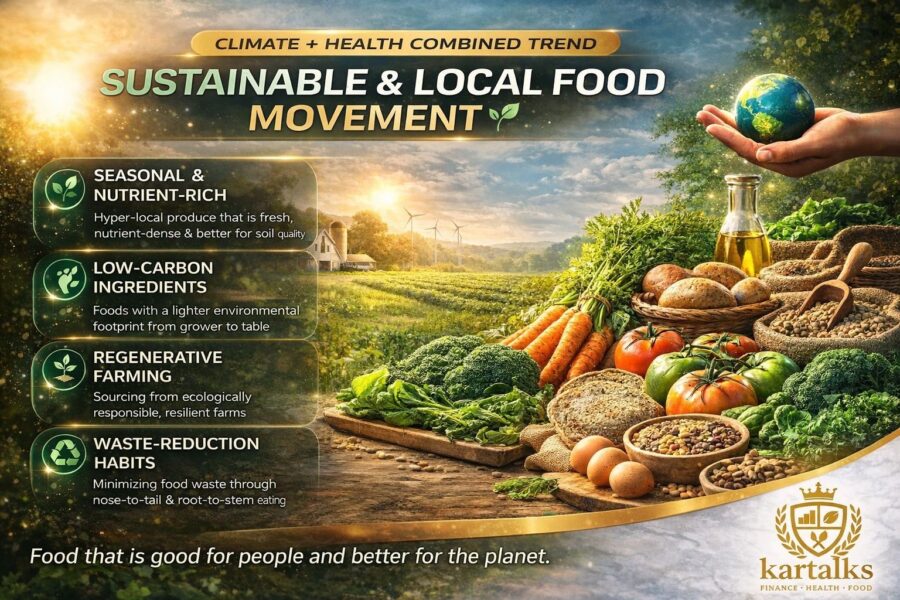
🌍 Sustainable and Local Food Movement: Why Climate and Health Are Finally Sharing the Same Plate
Sustainable and Local Food Movement: For years, food conversations were split into separate boxes. One box was about health: calories, protein, sugar, gut health, and weight. The other was about the planet: emissions, waste, soil, water, and packaging. Today, those boxes are finally coming together.
The Sustainable and Local Food Movement is growing because more people want food that does two jobs at once: support personal health and reduce pressure on the environment. That shift is now being backed not just by lifestyle trends, but by major public-health, agriculture, and climate institutions.
🌱 What the Sustainable and Local Food Movement Really Means
At its core, this movement is about building diets and food systems that are good for people and realistic for the planet. WHO describes healthy diets from sustainable food systems as diets that are health-promoting and disease-preventing, while also being available, affordable, accessible, and appealing, and produced in ways that sustain soil, water, biodiversity, and decent work. FAO’s guidance adds an equally important reminder: sustainability is not only environmental. It also includes profitability and social and economic equity.
The “local” part is also more nuanced than many people think. USDA says there is no single consensus definition of local food based purely on distance. In some U.S. programs, local or regional food may mean food sold within 400 miles or within the same state, territory, or Tribal land, but USDA also recognizes that real local food systems often work through farmers’ markets, CSA models, farm stands, schools, restaurants, and regional business networks rather than one rigid mileage rule.
So when readers hear phrases like sustainable food, local food, or hyper-local cuisine, they should not think only about geography. They should think about a bigger system: how food is grown, how far it travels, how fresh it is, how much waste it creates, whether farmers can stay viable, and whether ordinary families can actually afford it.
📈 Why the Sustainable and Local Food Movement Is Growing Now
This is not happening by accident. Climate change is already affecting food security, crop yields, and food prices. The IPCC says climate change has already negatively affected yields of some important crops in many lower-latitude regions, and projects that climate change could raise cereal prices in 2050 while increasing hunger risk for millions of people. That means sustainable eating is no longer just a lifestyle preference. It is becoming part of a resilience conversation.
At the same time, affordability remains a huge issue. FAO reported in 2025 that 2.6 billion people still could not afford a healthy diet in 2024. That is why the best versions of the Sustainable & Local Food Movement cannot be built only around premium labels or luxury grocery baskets. If sustainability ignores affordability, it will remain a fashionable idea instead of a practical food solution.
That tension shows up clearly in OECD’s 2025 work on household food choices. The OECD notes that affordability, nutritional value, and taste tend to matter more to households than environmental impacts. In plain language, people may care about climate and sustainability, but when they are standing in a grocery aisle, price and usefulness often decide what goes into the basket. That is exactly why this movement is shifting toward practical, everyday habits instead of abstract ideals.
🚜 Regenerative Farming Foods Are Becoming a Major Part of the Trend
One of the biggest ideas inside the Sustainable & Local Food Movement is regenerative farming. USDA Agricultural Research Service explains regenerative agriculture as an approach that looks not only at food and fiber production, but also at the ecosystem services agriculture can provide. FAO describes regenerative agriculture as holistic farming systems that can improve water and air quality, enhance biodiversity, and support long-term resilience.
That is why regenerative farming foods are drawing so much attention. Readers see these products as more than “farm fresh.” They are increasingly marketed as foods linked to better soil stewardship, biodiversity, water care, and long-term land health. Still, readers should be smart here: “regenerative” is a promising direction, but what matters most is evidence on actual farming practices and outcomes, not just a feel-good label. The strongest claims are the ones that are transparent about sourcing, farming methods, and measurable impacts.
For a WordPress audience, this is a useful framing point: regenerative agriculture matters because it turns farming into a health story, a climate story, and a soil story at the same time. That makes it one of the clearest examples of why the Sustainable & Local Food Movement is growing so quickly.
🥗 Hyper-Local Cuisine Is More Than a Restaurant Trend
Hyper-local cuisine sounds trendy, but the idea is actually simple: source as close as possible, work with what is seasonal, and shorten the supply chain where it makes sense. USDA’s National Institute of Food and Agriculture says local and regional food systems can help reduce food waste, support local economies, increase freshness and nutritional value, and reduce food insecurity. USDA also notes that these systems can strengthen resilience, especially when supply chains are under stress.
This is why local food movements often gain momentum during times of inflation, supply disruption, or public concern about food quality. A local grower network, community-supported agriculture model, or school-to-farm supply chain is not just about romanticizing “old-fashioned food.” It can also be about freshness, economic circulation within communities, and stronger food access.
At the same time, local food should not be oversimplified. USDA itself says findings are mixed on the exact economic-development and nutrition impacts of local food systems, even though the systems are widely valued for resilience and market access. That is a healthy reminder for readers: local food is important, but it works best when it is supported by good infrastructure, fair pricing, and strong community demand.
🌿 Low-Carbon-Footprint Ingredients Need a Smarter Lens
This is where the conversation gets more interesting. Many consumers assume that if a product is local, organic, minimally packaged, or seasonal, it must automatically be the most sustainable option. OECD’s 2025 analysis cautions against that kind of shortcut. It says households often associate those traits with sustainability, but such products are not always more environmentally sustainable, and it is difficult to make broad general statements because food systems are complex and highly context-specific.
OECD also notes that “food miles” are only an incomplete predictor of environmental impact, because transport is usually just one part of a product’s footprint. In some cases, production methods matter more than distance alone. That means a nearby product grown in a resource-intensive way is not automatically better than a farther-away product produced more efficiently. For readers, this is one of the most important takeaways in the whole movement: local is valuable, but local alone is not a full sustainability guarantee.
A smarter low-carbon food strategy usually looks broader: more seasonal produce where practical, more legumes and plant-based proteins where suitable, less avoidable waste, and more attention to farming practices rather than labels alone. OECD specifically notes that in many cases plant-based proteins such as legumes are currently less expensive than meat, which makes them one of the rare food choices that can support both affordability and environmental goals together.
♻️ Waste-Reduction Eating Is Moving to the Center of the Plate
No conversation about sustainable food is complete without food waste. UNEP’s Food Waste Index Report 2024 says that in 2022 the world wasted 1.05 billion tonnes of food at the retail, food-service, and household levels, equal to 19% of food available to consumers. Households alone accounted for 631 million tonnes, which UNEP describes as more than one billion meals’ worth of food thrown out every day.
That is why waste-reduction eating is no longer a side topic. It is now central to the Sustainable & Local Food Movement. Whether people call it nose-to-tail eating, root-to-stem cooking, leftover intelligence, or upcycled food, the idea is the same: use more of what you buy, waste less of what is edible, and treat food as valuable before it becomes trash.
The U.S. EPA’s updated Wasted Food Scale is especially useful here. EPA ranks preventing wasted food, donating food, and upcycling food as the most environmentally preferred actions, while landfilling, incineration, and sending food down the drain are among the least preferred. That is a powerful message for readers: the most sustainable food is often the food you bought and actually used well.
💰 Sustainability Must Work in Real Kitchens, Not Just in Theory
One reason this movement is lasting longer than earlier food trends is that it is becoming more practical. Readers are not only asking, “Is this eco-friendly?” They are asking, “Can I cook this easily? Will my family eat it? Is it affordable this week? Can I store it without waste?” That practical shift is consistent with OECD’s finding that affordability strongly shapes food behavior and that policy or messaging works better when sustainable choices also feel realistic and cost-conscious.
That means the most useful sustainable food advice is often simple: buy seasonal produce that you will actually finish, choose legumes more often, support local producers when the value is clear, plan leftovers on purpose, and avoid paying premium prices for vague sustainability promises with no transparency behind them. Those habits are more durable than trend-based shopping.
✅ Final Take
The Sustainable and Local Food Movement matters because it reflects a healthier way to think about food. Instead of choosing between health and climate, it asks how food can support both. It brings together regenerative farming, local supply chains, seasonal thinking, practical affordability, and food-waste reduction into one bigger idea: better food systems should nourish people without placing unnecessary strain on land, water, biodiversity, and household budgets.
The most credible version of this movement is not perfection. It is balance. It is food that is healthy, realistic, less wasteful, more transparent, and more rooted in long-term resilience than short-term hype. That is why this topic is no longer just a lifestyle trend. It is becoming one of the most important food conversations of our time
👉Further reading
Plant-Based Diet 2.0: The New Era of Eating
Bio-Engineered and Future Functional Foods: How Science Is Reshaping What We Eat
7 No-Cook Breakfasts Recipes for Healthy and Budget Indian Mornings.
Metabolic Fitness: The Health Shift Everyone’s Quietly Making in 2025
GLP-1 Influence on Diet and Health (2026): What It Means for Weight, Metabolism, and Everyday Eating
Clean Label And Natural Food Movement
Disclaimer:
This article is for informational and educational purposes only. It is not professional dietary, health, or environmental advice.