
Stock Market 101 – Lesson 23: Balance Sheet Deep Dive: Debt, Assets, Equity (Beginner View)
Hook
Have you ever looked at a company’s balance sheet and felt like it was just a wall of numbers?
You are not alone.
Many beginners think the balance sheet is the hardest financial statement to understand. But once you learn one simple idea, everything starts becoming much easier:
A balance sheet tells you what a company owns, what it owes, and what is left for shareholders. That is the heart of it. The U.S. SEC explains that a balance sheet shows assets, liabilities, and shareholders’ equity at a fixed point in time, while its investor education material also points readers to the 10-K as a key source for audited financial statements.
In this lesson, we will break down debt, assets, and equity in a very simple way so your readers can build real confidence. By the end, you should be able to open a company annual report and understand what the balance sheet is really trying to say.
What Is a Balance Sheet?
A balance sheet is a financial statement that shows a company’s financial position on a specific date. It is often called a statement of financial position under IFRS, and IFRS guidance says it presents an entity’s assets, liabilities, and equity at the end of the reporting period.
The structure is based on one very important equation:
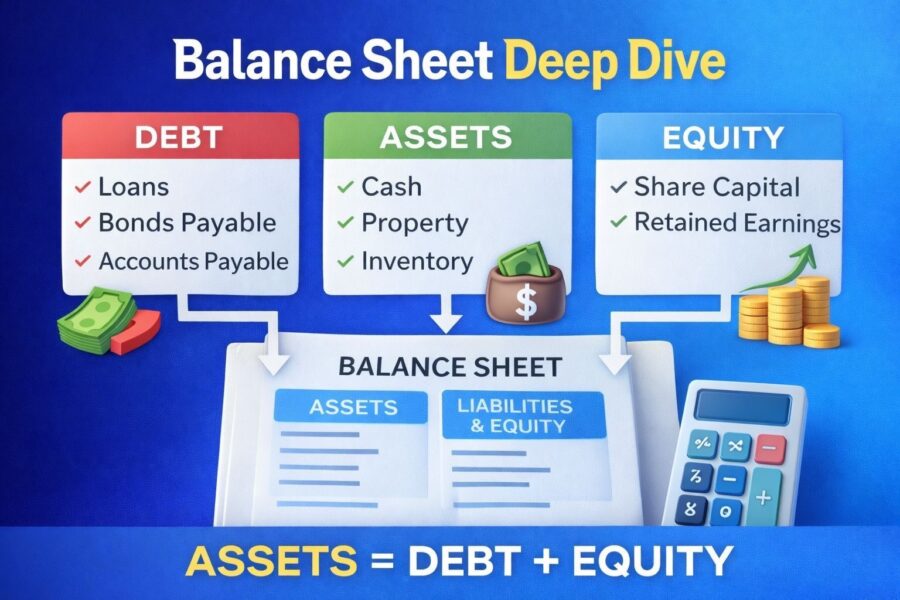
Assets = Liabilities + Shareholders’ Equity
The SEC’s beginner guide explains that companies generally list assets on one side and liabilities plus shareholders’ equity on the other.
So whenever you read a balance sheet, remember this:
- Assets = what the company owns or controls
- Liabilities = what the company owes
- Equity = what remains for owners after liabilities are deducted from assets
That is why the balance sheet is called a “balance” sheet. Both sides must match.
Why the Balance Sheet Matters for Investors
A profit number alone never tells the full story.
A company may report good profit, but if it has too much debt, weak cash, or poor asset quality, it may still be risky. The balance sheet helps investors judge:
- financial strength
- debt burden
- liquidity
- long-term stability
- shareholder backing
The SEC and Investor.gov both highlight that annual filings such as the 10-K give a deeper picture of a company’s business and financial condition, including the financial statements investors use for research.
So, for a beginner, the balance sheet is not just an accounting statement. It is a health report card.
Understanding Assets in a Balance Sheet Deep Dive
What Are Assets?
Assets are resources with value that a company owns or controls and expects to use for future benefit. SEC guidance describes assets as what a company owns that has value.
Simple examples include:
- cash
- bank balances
- inventory
- land
- machinery
- buildings
- trade receivables
- patents or goodwill in some cases
Assets are usually divided into two big parts.
1. Current Assets
These are assets expected to be converted into cash, sold, or used up within one year or within the normal operating cycle. Common examples include cash, receivables, and inventory.
Examples:
- Cash and cash equivalents
- Trade receivables
- Inventory
- Short-term investments
- Prepaid expenses
Why they matter:
Current assets help us understand whether the company can manage day-to-day operations smoothly.
2. Non-Current Assets
These are long-term assets the company plans to use for more than one year.
Examples:
- Property, plant, and equipment
- Land and buildings
- Machinery
- Long-term investments
- Intangible assets like patents, trademarks, or goodwill
These assets show what the company has built for long-term business growth.
Understanding Liabilities and Debt in Balance Sheet Deep Dive
What Are Liabilities?
Liabilities are obligations a company must pay in the future. SEC material describes liabilities as what a company owes to others.
This can include:
- loans
- dues to suppliers
- taxes payable
- salaries payable
- lease obligations
- bonds issued
Liabilities are also divided into two categories.
1. Current Liabilities
These are obligations due within one year. Common items include accounts payable, accrued expenses, current portions of long-term debt, and deferred or unearned revenue.
Examples:
- Accounts payable
- Short-term borrowings
- Current portion of long-term debt
- Outstanding expenses
- Tax payable
Why they matter:
If current liabilities are too high compared to current assets, the company may face liquidity pressure.
2. Non-Current Liabilities
These are obligations due after more than one year.
Examples:
- Long-term loans
- Bonds payable
- Lease liabilities
- Deferred tax liabilities
- Long-term provisions
These tell us about the company’s long-term financial commitments.
What Is Debt and Why Beginners Must Watch It Carefully
Debt is a very important part of liabilities.
Not all liabilities are debt, but all debt is a liability.
For example:
- A bank loan is debt
- A bond issued by the company is debt
- Money payable to a supplier is a liability, but not always considered interest-bearing debt
Debt can help a business grow faster. A company may borrow to build factories, expand operations, or invest in new technology. But too much debt can also become dangerous, especially when profits fall or interest costs rise.
That is why beginners should ask:
- How much total debt does the company have?
- Is the debt mostly short term or long term?
- Does the company have enough cash to manage repayments?
- Is the company using debt productively?
A business with manageable debt and strong cash flow may be healthy. A business with heavy debt and weak earnings may be under stress. That is the practical takeaway from any balance sheet deep dive.
Understanding Equity in a Balance Sheet Deep Dive
What Is Shareholders’ Equity?
Shareholders’ equity is the residual value left after subtracting liabilities from assets. SEC guidance defines it as what would be left for shareholders if the company sold its assets and paid off its liabilities.
So:
Equity = Assets – Liabilities
Equity usually includes:
- share capital
- retained earnings
- reserves
- sometimes treasury shares and other accumulated items
Share Capital
This is the money invested by shareholders in exchange for shares.
Retained Earnings
This is the profit kept in the business over time instead of being paid out fully as dividends.
Reserves
These are accumulated balances created for specific accounting or business purposes.
Why equity matters:
A stronger equity base often gives a company more financial stability. If equity is shrinking or negative, that is usually a warning sign.
A Simple Example to Understand Assets, Debt, and Equity
Let us say a company has:
- Total assets = ₹100 crore
- Total liabilities = ₹60 crore
Then:
Equity = ₹40 crore
This means the business owns resources worth ₹100 crore, owes ₹60 crore, and the balance value for shareholders is ₹40 crore.
Now imagine liabilities rise to ₹90 crore while assets stay the same.
Then:
Equity = ₹10 crore
That tells you the company is becoming more dependent on borrowed money and other obligations. This is why debt levels matter so much.
How to Read a Balance Sheet Like a Beginner Investor
When you open a balance sheet, do not try to study every line first.
Instead, follow this order:
Step 1: Look at Total Assets
Is the asset base growing over time?
Step 2: Check Total Liabilities
Are liabilities rising too quickly compared with assets?
Step 3: See Shareholders’ Equity
Is equity healthy and growing?
Step 4: Compare Current Assets and Current Liabilities
This helps you judge short-term financial strength. CFI notes that current assets and current liabilities are commonly reviewed together to assess liquidity and working capital.
Step 5: Identify Debt
Check short-term borrowings and long-term borrowings separately.
Step 6: Read Notes to Accounts
The balance sheet summary is useful, but important details often sit in the notes, and annual filings like the 10-K provide that broader context.
Red Flags to Watch in a Balance Sheet Deep Dive
A beginner should be careful when seeing:
- debt rising much faster than assets
- current liabilities higher than current assets for long periods
- falling cash despite rising borrowings
- shrinking equity
- negative net worth
- large receivables or inventory growing without matching sales growth
These signs do not always mean the company is bad, but they tell you to investigate more deeply.
What a Good Balance Sheet Usually Looks Like
A healthy balance sheet often shows:
- enough cash or liquid assets
- manageable debt
- stable or rising equity
- balanced short-term obligations
- assets that support future earnings
Different industries look different, though. A bank balance sheet, a manufacturing balance sheet, and a technology company balance sheet will not look the same. So always compare companies within the same sector.
Final Lesson Summary
In this Balance Sheet Deep Dive, the biggest idea is simple:
- Assets show what the business owns
- Liabilities show what the business owes
- Equity shows what belongs to shareholders after obligations are covered
If you understand this one structure, you already have a strong base.
The balance sheet is not just for accountants. It is one of the best tools for beginners who want to understand whether a company is financially strong, overburdened with debt, or building value steadily for shareholders.
Once you learn to read assets, debt, and equity together, you stop looking at stocks like price charts only. You start looking at the actual business underneath.
FAQs on Balance Sheet Deep Dive
1. What is the main purpose of a balance sheet?
A balance sheet shows a company’s financial position on a specific date by listing assets, liabilities, and shareholders’ equity.
2. Is debt the same as liabilities?
No. Debt is one part of liabilities. Loans and bonds are debt, but items like accounts payable are liabilities that are not always interest-bearing debt.
3. Why is equity important for investors?
Equity shows the value left for shareholders after liabilities are deducted from assets. Higher and stable equity often indicates better financial strength.
4. What are current assets?
Current assets are assets expected to be converted into cash, sold, or used within one year, such as cash, receivables, and inventory.
5. Where can beginners find a company’s balance sheet?
Public company investors often review the annual report or Form 10-K, which includes audited financial statements and broader business context.
Further reading
Stock Market 101-Lesson 22: Profit and Loss in Annual Report
Stock Market 101 – Lesson 21 Annual Report Basics: What to Read (and What to Skip)
Stock Market 101 – Lesson 20 Your 12-Month Wealth Plan & Rebalancing
Stock Market 101 – Lesson 19 Futures & Options Primer
Stock Market 101 – Lesson 18: Risk Management (Position Sizing & Stop-Losses)
Stock Market 101 – Lesson 17: Trading Psychology (Biases, FOMO, and Discipline)
Stock Market 101 – Lesson 11 MA, RSI & MACD
Disclaimer:
This lesson is for educational purposes only and should not be treated as investment advice. Always do your own research or consult a qualified financial advisor before making investment decisions.