
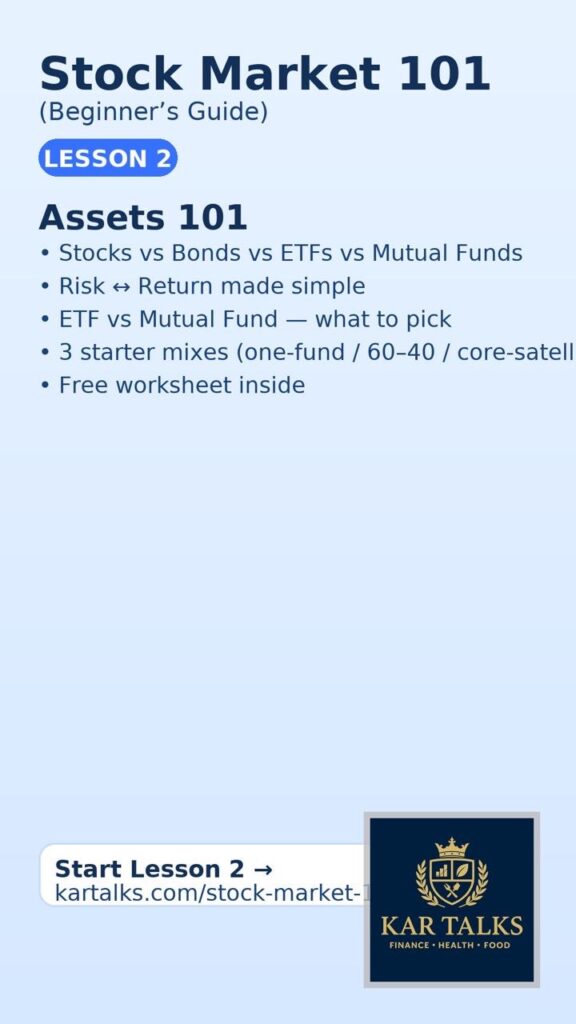
Assets 101: Stocks vs Bonds vs ETFs vs Mutual Funds
Hook
“Where should I put my first ₹/$?” Most beginners hear about stocks, funds, and ETFs but don’t know the differences. This lesson breaks it down in plain English so you can choose a simple, sensible starting mix.
Key takeaways
- Stocks = ownership, higher potential return, higher ups/downs.
- Bonds = lending to governments/companies, steadier, lower return.
- ETFs = baskets you trade like a stock (low fees, intraday liquidity).
- Mutual funds = baskets priced once per day (good for automated investing).
- Fees, liquidity, and risk match matter more than fancy names.
1) What is an “asset class”?
An asset class is a big bucket of similar investments—like stocks (ownership in companies) or bonds (IOUs you lend to governments/companies). Knowing the bucket tells you the typical risk/return and how it behaves in different markets. Your portfolio is just a mix of buckets.
Plain analogy: If your money is a team, asset classes are the player types—strikers (stocks, aggressive), defenders (bonds, steady), and support roles (cash, gold, etc.). Good teams balance roles.
2) Stocks (Equities)
What they are: Tiny slices of a company.
How you make/lose money: Price changes + possible dividends.
Risk/return: Historically higher return over long periods, but volatile day to day.
When good: Long time horizon, can handle ups/downs, want growth.
Costs: Trading fees + bid–ask spread; if you use a stock fund, the fund charges a small expense ratio.
Liquidity: Generally high for large, popular companies.
Example: Owning a piece of a retailer means you benefit if it expands profitably; you suffer if it struggles.
3) Bonds (Fixed Income)
What they are: Loans you give to a government or company; you receive interest (coupon) and principal back at maturity (if all goes well).
Risk/return: Lower average return than stocks; steadier. Sensitive to interest rates (when rates rise, existing bond prices usually fall).
Types: Government (usually safer, lower yield), corporate (higher yield, more risk), short vs long duration (shorter = less rate sensitivity).
When good: Balancing risk in a portfolio, stabilizing returns.
Costs: If you buy via a bond fund/ETF, you pay an expense ratio (often low).
Liquidity: High in broad bond funds; individual bonds vary.
Example: A 3-year government bond fund may move far less than a small-cap stock fund—useful to steady a beginner’s portfolio.
4) ETFs (Exchange-Traded Funds)
What they are: Baskets (often index-tracking) that you trade like a stock during market hours.
Why beginners like them:
- Low cost: Many have small expense ratios.
- Diversification: One buy gives you dozens/hundreds of holdings.
- Intraday flexibility: Can place limit or stop orders, see live prices.
Trade-offs: You pay the bid–ask spread, and thin ETFs can have wider spreads.
Use cases: Broad market exposure (e.g., a total-market or large-cap index), sector slices, or bond exposure via a bond ETF.
5) Mutual Funds
What they are: Baskets priced at day’s end (NAV). You don’t trade them intraday; you place an order and get filled at that day’s closing price.
Why beginners like them:
- Good for automatic monthly investing (SIP/auto-invest).
- Some are actively managed (a team picks holdings); others are index funds (rules-based).
Trade-offs: No intraday trading. Some active funds have higher fees and may underperform their benchmarks after fees.
Use cases: Hands-off investing; retirement or long-term goals where you won’t monitor intraday.
6) Stocks vs Bonds vs ETFs vs Mutual Funds — the essentials
| Feature | Stocks | Bonds | ETFs | Mutual Funds |
|---|---|---|---|---|
| What you own | Single company | Issuer’s debt | Basket (often an index) | Basket (active or index) |
| Risk/Volatility | Higher | Lower–Medium | Depends on basket | Depends on basket |
| Liquidity | Intraday | Varies | Intraday (like a stock) | End-of-day pricing |
| Costs | Trading + spread | Trading + spread (or fund ER) | Expense ratio + spread | Expense ratio (no spread) |
| Ease for beginners | Medium | Medium | High | High |
| Good for | Growth | Stability | Cheap diversification | Automated long-term plans |
Fees matter. Small annual fees compound. Example (illustrative): ₹10,000 at 8% for 20 years grows to ~₹46,600 with no fund fee. If a fund fee trims it to a 7% net return, it’s ~₹38,700—nearly ₹8,000 difference just from cost. Lower fees = more of the growth stays with you.
7) Picking a simple starter mix (3 recipes)
These are templates, not advice—always match your risk and goals.
A) Super-simple Core (one fund)
- 100% broad market index (ETF or index mutual fund).
- Rebalance annually (or just keep contributing regularly).
For long horizons and comfort with ups/downs.
B) Balanced Starter (60/40 idea)
- 60% stock index + 40% bond fund/ETF (short/intermediate term).
- Rebalance once a year to keep the percentages steady.
For a smoother ride than 100% stocks.
C) Core-Satellite (80/20)
- 70–80% broad stock index (core)
- 20–30% satellite: either a bond fund or a sector/tilt ETF you understand.
Keeps things diversified while letting you explore a small tilt.
Tip: Write a one-page rule: target mix, how often you contribute, when you rebalance, and maximum % you’ll ever put in any single “satellite.” Keeping rules simple prevents emotional decisions.
8) Common beginner pitfalls (and fixes)
- Owning too many single stocks at the start.
- Fix: Begin with a broad ETF/index fund; add single stocks later if you want.
- Ignoring fees (high ER, loads).
- Fix: Prefer low-cost index funds/ETFs; read the expense ratio.
- No cash buffer and forced selling during dips.
- Fix: Keep an emergency fund separate from investing.
- Chasing last year’s winners.
- Fix: Stick to your written allocation and rebalance on a schedule.
- Confusing ETFs with “safe.”
- Fix: ETFs can be stock or bond—risk depends on what’s inside the basket.
9) Mini-FAQ
ETF or mutual fund for a beginner?
If you want intraday control and low fees, ETFs are great. If you prefer automatic monthly investing and don’t care about intraday pricing, index mutual funds are equally beginner-friendly.
How many funds do I need?
Often 1–3 total funds can give you global diversification. More funds ≠ better.
Are bonds “risk-free”?
No. Bonds can fall when interest rates rise, and credit risk exists for corporate bonds. But relative to stocks, they often swing less.
Should I pick active funds?
Some do well; many don’t after fees. If you pick active, watch fees and compare to a low-cost index in the same category.
10) Quick Quiz (5 Qs)
- An ETF is best described as:
A) A single stock B) A loan to a company
C) A basket you can trade like a stock D) A savings account - Mutual funds are priced:
A) Every minute B) Once per day (NAV) C) Once per week D) Intraday like ETFs - Bonds usually offer:
A) Lower average return with lower volatility than stocks
B) Higher return with higher volatility than stocks
C) No risk
D) The same as cash - The expense ratio (ER) is:
A) A one-time fee B) An annual % fee charged by a fund
C) The bid–ask spread D) A tax - A simple “balanced starter” often means:
A) 100% stocks B) 100% bonds
C) Mix of stocks and bonds (e.g., 60/40) D) Only cash
Answers: 1-C, 2-B, 3-A, 4-B, 5-C.
11) Action checklist (copy into your notes)
- ✅ Decide your risk comfort (big swings OK or prefer smoother?).
- ✅ Pick one broad stock index fund/ETF you understand (low fee).
- ✅ If you want smoother returns, add a bond fund/ETF (short/intermediate).
- ✅ Write a one-page plan (allocation %, contribution day, rebalance rule).
- ✅ Set a small automatic contribution (monthly works well).
- ✅ Revisit in 3 months: Did you stick to your plan?
- “Asset Class Spectrum” (stocks ↔ bonds, risk/return arrows).
- Alt: “Spectrum from lower-risk bonds to higher-risk stocks with return rising as risk rises.”
- ETF vs Mutual Fund Cheat Box
- Alt: “Comparison of ETF and mutual fund: trading, pricing, fees, auto-invest.”
- Fee Drag Over Time (bar/line showing growth with 0.1% vs 1% fee).
- Alt: “Two lines show how higher annual fees reduce long-term growth.”
Disclaimer:
This lesson is educational and not financial advice. Fees, rules, and taxes change—check official/regulated sources before acting and pick products suitable for your situation.
CTA (for the end of Lesson 2)
Next week: Exchanges & Indices — What Nifty/Sensex (or S&P/Dow) really mean and how they’re built.
Further reading 👇
Stock Market 101: Learn Stocks from Zero