
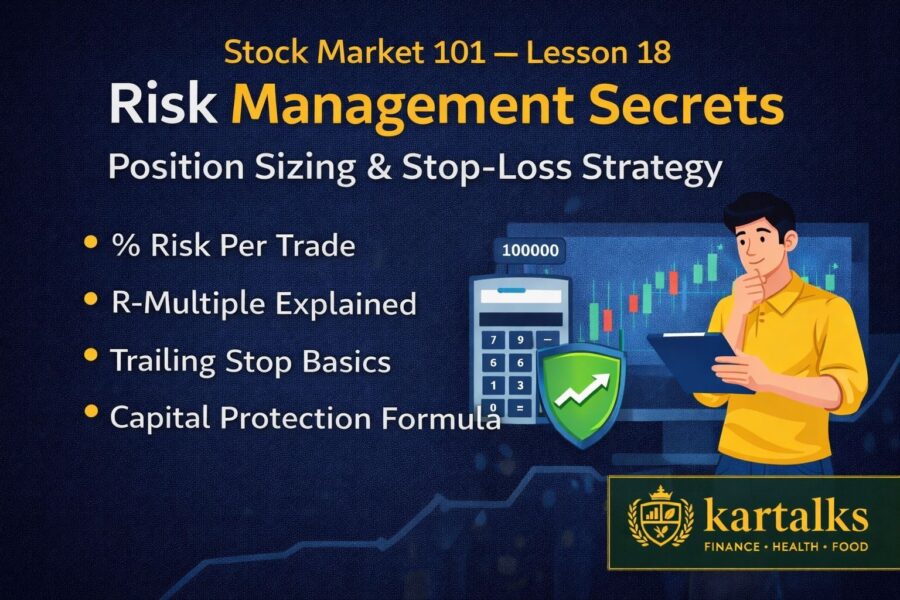
Stock Market 101 – Lesson 18: Risk Management (Position Sizing & Stop-Losses)
Hook: One bad trade shouldn’t be able to ruin your account
Stock Market 101 brings you Lesson 18 – Risk Management: Position Sizing & Stop-Loss Strategy. Most beginners don’t blow up because they “don’t know charts.” They blow up because they risk too much on one idea… then panic, average down, or refuse to exit.
Risk management is your safety belt. It doesn’t make you win every trade. It makes sure a losing trade stays small, so you can come back tomorrow with the same confidence and capital.
In this lesson, we’ll keep it practical: how much to risk per trade, how to calculate position size, what R-multiple means, and how to use stop-losses (including trailing stops) without getting “shaken out” every time.
What Risk Management Really Means (Simple Definition)
Risk management is not “being scared.”
It’s deciding before you enter:
How much you can lose if you’re wrong
Where you’ll exit
How big your position should be
How you’ll lock profits if the trade works
If you do this properly, your trading becomes boring in a good way.
👉CFI – Risk Management in Trading CFI
Step 1: Choose Your % Risk Per Trade
This is the number that protects you from damage.
A beginner-friendly starting point:
0.5% to 1% risk per trade (good for most beginners)
Maximum 2% only when you’re consistent and disciplined
Example
If your trading capital is ₹1,00,000:
1% risk = ₹1,000 max loss on a trade
0.5% risk = ₹500 max loss
That’s it. No matter how “confident” you feel, your maximum loss stays fixed.
Step 2: Stop-Loss First, Position Size Second (Always)
Many traders do the opposite. They buy a quantity first and then “figure out” stop-loss later. That’s where trouble starts.
Correct order:
Decide entry idea
Decide stop-loss level (where your idea is invalid)
Calculate position size based on your max risk
👉Investopedia – Stop-Loss Order Explained Investopedia
The Position Sizing Formula (Your Core Weapon)
Position Size = (Risk Amount) ÷ (Stop-Loss Distance)
Where:
Risk Amount = your max loss per trade (₹500, ₹1,000, etc.)
Stop-Loss Distance = Entry price – Stop-loss price (per share)
Worked Example (Very Important)
Capital: ₹1,00,000
Risk per trade: 1% = ₹1,000
You want to buy a stock at ₹200
Your stop-loss (logical level) is ₹190
Stop-loss distance = ₹10 per share
Position size = ₹1,000 ÷ ₹10 = 100 shares
So you buy 100 shares, not 300 or 500.
If price hits ₹190, your loss is roughly:
100 × ₹10 = ₹1,000 (plus small charges)
That’s professional risk control.
Why “Big Quantity + Tight SL” Is a Trap
A common beginner mistake:
Taking huge quantity
Putting an unrealistically tight stop-loss
Getting stopped out repeatedly
Then entering again out of anger
A tight stop-loss is not “smart” if it’s not logical.
Your stop-loss should be placed where your trade idea is clearly wrong, not where you “feel comfortable.”
Step 3: Understand R-Multiple (The Cleanest Way to Measure Trades)
R = the amount you risk in a trade.
If you risk ₹1,000 on a trade:
1R = ₹1,000
2R profit = ₹2,000
-1R loss = -₹1,000
Why R is powerful
It keeps you focused on quality, not emotions.
A good trading system might win only 40–50% of the time, but if winners are 2R and losers are 1R, you can still grow steadily.
👉Van Tharp – R-Multiple Concept vantharp
Stop-Loss Types (And When to Use Each)
1) Fixed Stop-Loss (Price-Based)
This is the classic SL level:
Below support
Below swing low
Below breakout zone
Best when your setup has clear invalidation.
2) Time-Based Stop-Loss
If the stock is not moving as expected within a time window, you exit.
Example:
“If it doesn’t move in my direction within 2–3 sessions, I exit.”
This prevents capital getting stuck.
3) Trailing Stop-Loss (Profit Protection)
Trailing stops are used after the trade starts working.
Simple trailing methods:
Trail below previous swing low (for long trades)
Trail below short-term moving average (advanced)
Trail by a fixed % (simple but may be rough)
Important: Trailing stop is not for entry. It’s for managing a winning trade.
The “Beginner Safe” Stop-Loss Approach
If you’re new and keep getting stopped out:
Try this structure:
Put SL at a logical invalidation level
Reduce quantity using the position size formula
Accept the small loss if you’re wrong
Most beginners want the stop-loss to be “small.”
Pros want the loss to be controlled.
There’s a difference.
Common Risk Management Mistakes (That Kill Accounts)
1) Averaging down without a plan
If your stop-loss is hit, your idea is invalid.
Adding more is emotion, not strategy.
2) Moving stop-loss further away
This is how small losses become big losses.
3) Overtrading after one loss
One loss doesn’t require revenge. It requires review.
4) Risking more after a winning streak
Confidence should increase process quality, not position size randomly.
5) Ignoring gap risk (especially overnight)
A stop-loss is not guaranteed at your exact price during fast moves or gaps.
This is why position sizing matters even more.
A Simple Risk Plan You Can Copy (Starter Rules)
Use this as your “minimum discipline system”:
Risk per trade: 1% (or 0.5% if you’re very new)
Stop-loss: based on invalidation (support/swing)
Position size: Risk ÷ SL distance
Max open trades at once: 2–4 (based on comfort)
Max total risk at any time: 2%–3% combined
No averaging down unless it’s part of a tested strategy
Journal every trade: entry, SL, target, result in R
CTA: Position Size Calculator (Quick Template)
You can create this in Google Sheet:
Capital = 100000
Risk % = 1%
Risk Amount = Capital × Risk%
Entry price = 200
Stop-loss price = 190
SL distance = Entry – SL
Qty = Risk Amount ÷ SL distance
This single sheet will upgrade your trading discipline instantly.
5 Quick FAQs (Short Answers)
1) What is the best risk % per trade for beginners?
Start with 0.5% to 1%. It protects your capital while you learn.
2) Should I always use a stop-loss?
Yes—especially as a beginner. It prevents one trade from becoming a disaster.
3) What if my stop-loss keeps getting hit?
Your SL may be too tight or not placed logically. Keep SL logical and reduce quantity.
4) What is a good risk-reward ratio?
Many traders aim for 1:2 (2R), but consistency matters more than a perfect number.
5) Is trailing stop better than fixed stop?
Trailing stop is great after you’re in profit. Fixed SL is better for entry control.
Further reading
Stock Market 101 – Lesson 17: Trading Psychology (Biases, FOMO, and Discipline)
Corporate Actions Made Simple for Beginners Stock Market 101-Lesson 15
Stock Market 101–Lesson 14 IPOs for Beginners: Process & Allotment Basics
Stock Market 101 – Chart Patterns Explained
Disclaimer:
This content is for education only and not financial advice. Markets involve risk. Please do your own research or consult a SEBI-registered advisor before investing or trading.