
Why India’s Currency Shock Matters?
There are weeks when the rupee quietly moves in the background, and then there are weeks like this one, when the currency becomes the main financial story in India.
In late March 2026, the Indian rupee came under intense pressure and slipped to a series of record lows as oil prices surged, foreign investors sold Indian assets aggressively, and global risk sentiment worsened because of the Middle East conflict. The Reserve Bank of India did not sit back. It stepped in with unusually sharp measures aimed at reducing speculation and choking off arbitrage trades that were adding to the pressure on the currency.
This is why rupee volatility and RBI action is not just a forex-market headline. It matters to stock investors, importers, exporters, borrowers, companies with foreign exposure, and even ordinary households. A weak rupee can push up imported inflation, increase fuel-linked costs, and change market sentiment very quickly. When the central bank acts this forcefully, it means currency stability has become a serious policy concern.
💥 What happened to the rupee in March 2026?
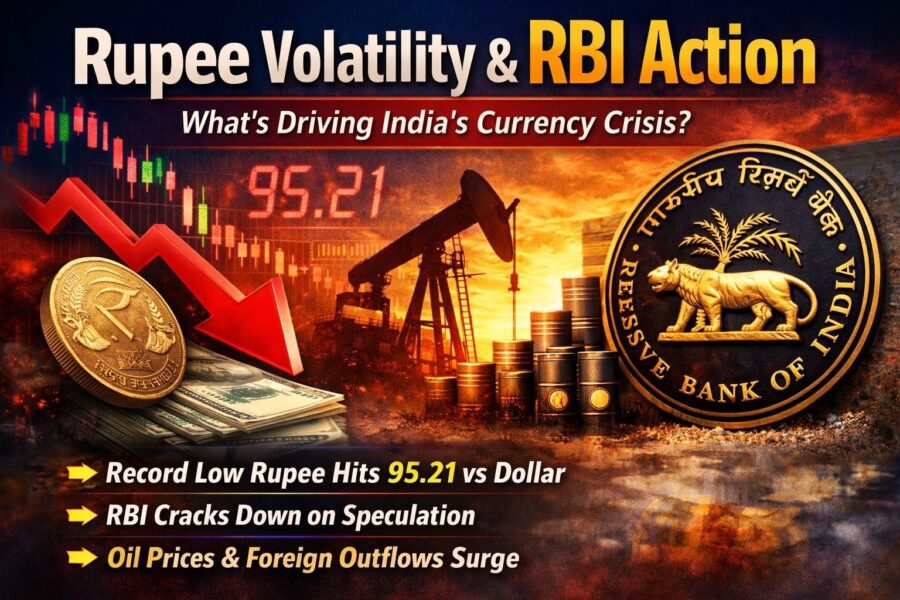
The rupee did not weaken in a slow, orderly way. It fell sharply. Reuters reported that the currency dropped 4.24% in March 2026, its worst monthly fall in six years. It also hit a string of all-time lows, including 94.84 per U.S. dollar on March 27 and later 95.21 on March 30 as pressure intensified.
That move was not happening in isolation. Foreign investors pulled money out of Indian assets at an aggressive pace. Reuters reported that since the Iran war began on February 28, 2026, foreign investors sold a net $12.14 billion of Indian equities, while net bond sales under the Fully Accessible Route reached 152 billion rupees, the highest since that category was introduced. Those outflows added direct pressure on the rupee.
At the same time, oil became a major problem. India imports roughly 85% to 90% of its crude oil needs, so a sharp jump in global crude prices can quickly worsen inflation fears, increase the import bill, and weaken the rupee. Reuters noted Brent crude rose to around $115.25 a barrel on March 30, with gains for the month nearing 60%. That is the kind of shock that can spill into every corner of the economy.
🏦 Rupee Volatility and RBI Action: What exactly did the RBI do?
The RBI first moved to restrict banks’ rupee positions. On March 28, 2026, it said banks must ensure that their net open rupee positions in the onshore deliverable market do not exceed $100 million at the end of each business day, with compliance required by April 10, 2026. The goal was clear: cut speculative and arbitrage-heavy positioning that had grown large during the currency selloff.
Then came the second blow. On April 1, 2026, the RBI tightened the rules further by barring banks from offering rupee non-deliverable forwards, or NDFs, to resident and non-resident clients. It also said that companies cannot rebook cancelled forward contracts. Reuters reported that this step was taken because the earlier curbs had not fully relieved pressure on the rupee, as some positions were simply being shifted to corporate clients.
In simple words, the RBI was not just defending the rupee through intervention. It was also trying to shut down the market channels through which speculative pressure was spreading. That is why the policy response felt much stronger than a routine central bank nudge.
🔄 Why were NDFs and arbitrage trades such a big issue?
This part sounds technical, but the logic is simple.
An NDF, or non-deliverable forward, is a currency derivative that settles without physical delivery of the underlying currency. These contracts are widely used in offshore markets. When the offshore NDF price and the onshore forward price move apart, traders and banks can try to profit from that gap. That is called arbitrage. Under normal conditions, this may look like a low-risk strategy. But during a period of panic and volatility, it can magnify pressure on the local currency.
Reuters reported that the RBI’s position cap was expected to trigger an unwinding of large arbitrage bets between the offshore NDF market and the onshore deliverable market. One Reuters report said those positions were estimated in the $25 billion to $50 billion range. Another report said corporate arbitrage flows at just one bank were estimated at $750 million to $800 million. That shows how big the build-up had become.
So the RBI’s message was direct: if the rupee is under attack, nobody should expect to use loopholes between onshore and offshore markets to make easy money while the currency is sliding.
📈 Rupee Volatility and RBI Action: Did the RBI action work immediately?
Yes, at least in the short term, the impact was visible.
After the first set of curbs, Reuters reported that the rupee rebounded sharply from its record lows and rose nearly 1% to 93.85 per dollar in early trade on March 30. After the second round of tightening, Reuters said the rupee was up about 1.4% to 93.53 in early trade on April 2. The policy shock forced traders and banks to unwind positions, and that created onshore dollar selling.
But the bigger question is whether this solves the underlying problem. That answer is more complicated.
The RBI can cool speculative pressure, reduce arbitrage-driven distortions, and buy time. What it cannot fully control is the broader macro backdrop. If oil stays high, foreign outflows continue, and global risk appetite remains weak, the rupee can remain vulnerable even after a strong policy response. That is exactly why this topic matters beyond the forex market.
🛢️ Rupee Volatility and RBI Action: Why this matters to the Indian economy
A weak rupee is not just a market number flashing on a trading screen. It feeds into the real economy.
When the rupee falls, imported goods become costlier. For India, the biggest concern is energy. Higher oil prices and a weaker currency together can worsen inflation. That can affect fuel-linked costs, transport, input prices, and profit margins across sectors. India’s government itself warned in its latest monthly economic review that higher energy costs and supply disruptions linked to the Middle East conflict pose downside risks to growth in FY27, while the current account deficit could widen further.
A falling rupee can also change investor behavior. Hedging costs rise, foreign investors become more cautious, and equities and bonds may both come under pressure. Reuters reported that heightened volatility expectations and rising hedging costs reduced the appeal of Indian assets for overseas investors. That feedback loop matters because once outflows gather pace, the rupee can weaken further, making the market nervous again.
🏛️ What about banks and the stock market?
The RBI’s action may support the rupee, but it also has costs.
Reuters reported that banking stocks fell after the tougher RBI curbs because the market began worrying about losses linked to the forced unwinding of these positions. The Nifty Bank index slid as much as 2.8% on April 2, and Jefferies estimated potential losses at 40 billion to 50 billion rupees for the sector. In other words, stabilizing the rupee may come with short-term pain for banks that had built or intermediated these trades.
That does not mean the RBI made the wrong choice. It simply shows the trade-off. When a central bank acts to protect currency stability, some parts of the financial system may have to absorb losses. From a policy perspective, the RBI seems to be signaling that allowing the rupee to slide uncontrollably would be a much bigger risk than forcing a painful cleanup now.
🎯 What should investors watch next?
The next phase of this story will depend on four things.
First, watch oil prices. If crude remains elevated, rupee pressure may return quickly. Second, watch foreign investor flows. If equities and bonds continue to see heavy selling, the rupee story stays fragile. Third, watch whether the RBI keeps tightening market rules or leans more on direct intervention. Fourth, watch for any easing in geopolitical tension, because that could improve sentiment faster than any technical market rule.
For now, the RBI has made one thing very clear: it is willing to move beyond verbal comfort and use hard regulatory action when currency volatility becomes disorderly. That is why rupee volatility and RBI action has become one of the most important financial themes in India at the start of the new financial year.
❓ 5 FAQs (Rupee Volatility and RBI Action)
1. Why did the rupee fall so sharply in March 2026?
Because of rising oil prices, heavy foreign investor outflows, and global risk-off sentiment linked to the Middle East conflict.
2. Rupee Volatility and RBI Action: What was the RBI’s biggest move?
It capped banks’ net open rupee positions at $100 million per day and later barred banks from offering rupee NDFs to clients.
3. Did the rupee recover after RBI action?
Yes. The rupee rebounded strongly after the new curbs, including a move to around 93.53 in early trade on April 2.
4. Why should common investors care about rupee volatility?
Because it can affect inflation, fuel costs, market sentiment, foreign flows, and the performance of stocks and bonds.
5. Is the rupee crisis over?
Not fully. RBI action has reduced immediate speculative pressure, but oil prices, global tensions, and foreign flows still matter.
Further reading
US-Iran War Latest Escalations and Stock Market Impact – Part 4
US-Iran War Latest Escalations: What It Means for the Indian Stock Market
Cryptocurrency Guide 2026 – Part 3
Cryptocurrency Guide 2026 – Part 2 Platforms, Wallets, Storage, and Tracking Tools for Beginners
How Much Should You Invest Every Month? A Simple Guide for Salaried People
Stock Market 101 – Lesson 24: Cash Flow Statement in Real Life: Profit vs Cash (Red Flags)
Mutual Funds Explained:Types, Returns & Risks
Disclaimer:
This article is for educational and informational purposes only and should not be treated as investment, trading, or financial advice. Investors should use their own judgment or consult a qualified financial advisor before making any decision.