
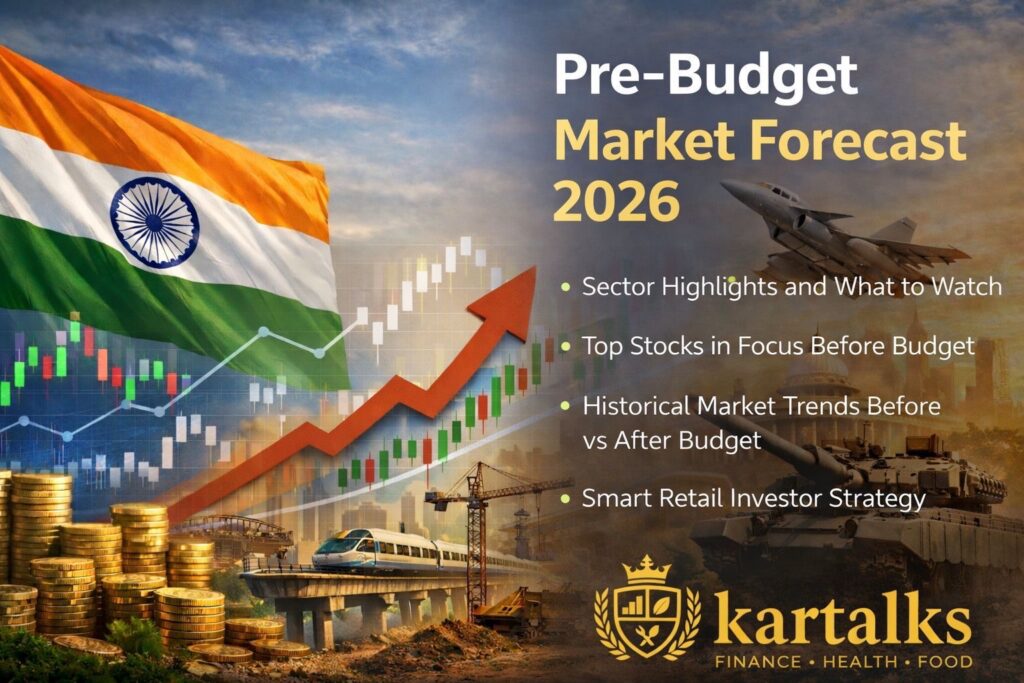
Pre-Budget Market Outlook (Union Budget 2026-27) — What the Market Is Pricing In
Pre Budget market outlook 2026: India’s Union Budget 2026-27 is scheduled to be presented on Sunday, 1 February 2026 at 11:00 AM in Parliament.
Going into Budget Day, market mood is usually driven less by the final document and more by expectations + positioning. This year’s dominant “base case” in street estimates is:
Fiscal consolidation continues (no big shock to deficit path)
Capex remains supportive, but growth in capex may be more measured because the base is already high
Targeted support for consumption/MSMEs could be preferred over broad giveaways
A Reuters poll of economists suggests the government is expected to stay on the consolidation path, with economists forecasting a fiscal deficit around 4.2% of GDP for the next year (down from 4.4% this year, per the poll), while still keeping capital spending elevated (the poll references capex expectations around ₹12 trillion).👉Reuters
What that means for markets (practically):
If the Budget matches the “expected” framework, the market reaction can be muted on the day, and leadership often shifts to earnings + global cues soon after.
A positive surprise is typically either (a) stronger-than-feared consumption push without hurting fiscal math, or (b) capex push with credible funding.
A negative surprise is usually an unexpected hit to fiscal arithmetic, new sector-specific burdens, or policy uncertainty.
Pre-Budget Sector Radar — Where the Action Usually Builds
Below are the key sectors/themes that typically see higher attention into Budget week, and what to watch for this time based on current public expectations and reported asks:
1) Infrastructure, Industrials, and Capex Beneficiaries
Capex has been a major growth lever. Commentary and expectation notes continue to highlight government spending and strategic projects as a core focus area.
Budget signals to track
Any continued prioritisation of large projects and execution pipeline
Whether allocation keeps the capex momentum intact (even if growth rate moderates)
2) Railways and “Mobility” Ecosystem
Market narratives and expert commentary suggest railways could remain a highlighted theme under capex/strategic focus.
Budget signals to track
Rolling stock, station upgrades, freight corridors, safety, and manufacturing push
Order pipeline visibility (and execution clarity)
3) Defence and Strategic Manufacturing
Multiple expectation round-ups point to defence as a likely continued focus under strategic capex.
Budget signals to track
Domestic procurement tilt, R&D, exports facilitation
Clarity on multi-year procurement roadmaps
4) MSMEs, Exports, and GST / Incentive Continuity
Ahead of the Budget, MSMEs and exporters have publicly pushed for GST rationalisation and continuity of export support such as RoDTEP.👉TheEconomicTimes.
Budget signals to track
Any steps that improve working capital cycles
Policy continuity for export-linked sectors and simplification measures
5) Pre Budget market outlook 2026 – Healthcare and Pharma Ecosystem
Industry bodies have called for higher public healthcare spending, including a push to take spending above 2.5% of GDP (as urged by NATHEALTH, per reporting).
Budget signals to track
Preventive care, infrastructure, diagnostics, and capacity-building
Any incentives that help affordability and penetration 👉times of india
6) Consumption: Discretionary and Rural Demand (Selective Watch)
A common expectation theme is “targeted consumption support” rather than large-scale giveaways, given fiscal discipline priorities.
Budget signals to track
Measures that improve disposable income in a fiscally responsible way
Rural programs, jobs, and schemes that lift demand without distortion
Stocks in Focus Before Budget (Theme-Based Watchlist)
Not stock tips—this is a theme map of where traders/investors typically look during Budget week. Keep position sizing risk-managed because Budget moves can reverse fast.
Theme A: Capex / Infra / Industrials
Why watched: capex continuity has been a core macro driver.
Watchlist types: EPC leaders, capital goods, engineering, and cement/logistics plays that benefit from project awards and execution.
Theme B: Railways & Railway Suppliers
Why watched: railways feature frequently in strategic capex expectations.
Watchlist examples (categories): railway PSUs, EPC contractors, signalling, rolling-stock makers, and rail logistics.
Theme C: Defence & Aerospace
Why watched: defence is repeatedly highlighted in pre-budget expectation coverage.
Watchlist examples (categories): defence PSUs, electronics/avionics suppliers, shipbuilding ecosystem names.
Theme D: Manufacturing / Export Enablers / MSME-linked
Why watched: MSMEs/exporters are pushing for GST simplification and RoDTEP continuity.
Watchlist categories: export-oriented manufacturing, logistics, and “China+1” beneficiaries (where policy continuity matters).
Theme E: Healthcare Delivery, Diagnostics, and Pharma Adjacent
Why watched: public calls for higher healthcare spending ahead of Budget 2026.
Watchlist categories: hospitals, diagnostics, medical devices, select pharma segments linked to domestic demand.
Theme F: Consumption (Selective, Not Broad)
Why watched: expectation of targeted consumption support (not a free-for-all).
Watchlist categories: staples, discretionary leaders, two-wheelers/consumer durables (where demand signals matter most).
What History Says: Market Before vs After Budget
Budget day is important—but history suggests the bigger story is often the window around it, not just the single session.
1) Budget day average returns (long-run snapshot)
A Business Today report citing data compiled by SAMCO Securities suggests:
Nifty has averaged around 0.19% return on Budget days since 2010
Bank Nifty has averaged around 0.42% return on Budget days since 2010
Takeaway: Budget day moves can be noisy; the long-run average is not a guaranteed “big up day”.
2) The “Budget window” effect (3 months and 6 months)
A market study summary reported via Moneycontrol/TradingView notes that since 2014:
Markets have often delivered positive returns over 3 months and 6 months before the Budget, and similarly, over 3 months and 6 months after the Budget on many occasions.
Takeaway: The broader trend matters more than the headline reaction—earnings, liquidity, and global risk appetite can dominate the post-Budget path.
3) Short-term post-budget probabilities can vary
A separate Economic Times snapshot (from prior-year analysis) highlights that post-budget outcomes can differ by timeframe and sector, showing mixed probabilities depending on the window chosen.
Takeaway: Expect rotation. Even if the index stays calm, sector leadership can change quickly.
How Retail Investors Should Position (Risk-Managed View)
1) Don’t bet the portfolio on a single day
Budget day can produce sharp moves in either direction, and reversals are common. Use the Budget more as a risk event, not a “sure-shot trade”.
2) Prefer a “barbell” approach for the week
Core (stable): quality large-caps / diversified funds / index exposure
Satellite (small): theme baskets (capex, railways, defence, consumption) with tight risk limits
3) Avoid leverage or oversized option punts
If you trade options, keep it small. Implied volatility often rises into events and can collapse after, hurting option buyers even if direction looks right.
4) Have a simple post-budget plan (48-hour rule)
Day 0–1: market reacts to headlines
Day 2: market digests details (fine print, allocations, tax implications)
A practical retail rule: wait for confirmation rather than chasing the first spike.
5) Track only a few “budget truth” indicators
Instead of reading everything, focus on:
Fiscal deficit path (credibility + funding)
Capex intent/trajectory (even if growth moderates)
Targeted supports (MSMEs/exports, healthcare, consumption)
👉Further reading
Indian Markets Post Market Report-Jan 23,2026
India’s New Labor Codes: Why Companies Are Taking “Thousand-Crore”
How Much Should You Invest Every Month? A Simple Guide for Salaried People
💰Why Gold and Silver Keep Rising|kartalks
Mutual Funds Explained:Types, Returns & Risks
Stock Market 101–Lesson 14 IPOs for Beginners: Process & Allotment Basics
Stock Market 101 – Lesson 13 ETFs & Index Funds: Fees, Tracking, and How to Choose
Q3 FY26 Results Update: TCS, Infosys, HCLTech
Disclaimer:
This article is for educational and informational purposes only and does not constitute investment advice or a recommendation to buy or sell any security. Please do your own research and consult a SEBI-registered financial advisor before making investment decisions.