
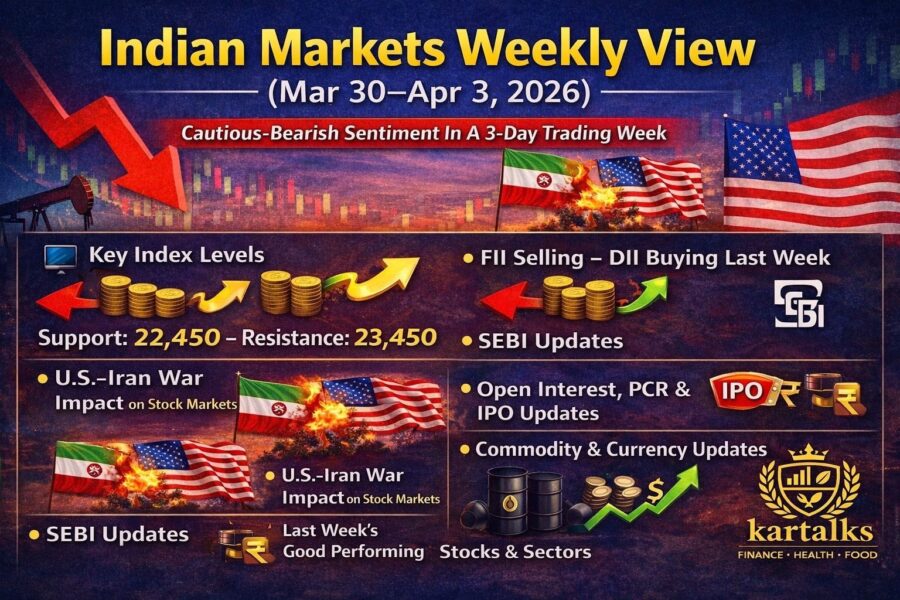
Indian Markets Weekly View (Mar 30–Apr 3, 2026): Cautious-Bearish Sentiment In A 3-Day Trading Week
📊 Indian Markets Weekly View: Market Snapshot
This Indian Markets Weekly View starts with one important reality: it is a holiday-shortened 3-session week. NSE and BSE are shut on March 31 for Mahavir Jayanti and April 3 for Good Friday, so traders will get fewer sessions but likely more volatility per session. That matters because the market has already logged five straight weekly losses, with the Nifty and Sensex both down about 1.3% last week and India VIX staying elevated.
Indian equities ended Friday, March 27, on a weak note. The Nifty 50 closed at 22,819.60, the Sensex at 73,583.22, and the Bank Nifty at 52,274.60. Reuters also noted that the volatility index rose to 27.09, the highest zone since June 2024, showing that fear is still very much present in the system.
🔑 Indian Markets Weekly View: Current Key Levels
- Nifty 50: 22,819.60
- Sensex: 73,583.22
- Bank Nifty: 52,274.60
- India VIX: 27.09
- Gift Nifty 30-Mar futures: 22,769.50
These are the key reference levels traders will carry into the new week.
📉 Indian Markets Weekly View: Weekly Levels and View
The broader tone for this Indian Markets Weekly View remains cautious to bearish. Economic Times’ weekend setup says the market is under sustained pressure, that rebounds are likely to face selling, and that the focus should remain on capital preservation instead of aggressive long positions. Business Today echoed the same tone, calling this a sell-on-rise structure in a condensed trading week.
Nifty 50 Levels
For Nifty, the market is watching 22,500–22,450 as the first key support band. Below that, the next important downside zone is 22,400 and then 21,700 on the broader weekly structure. On the upside, 23,000 is the first hurdle, followed by 23,150–23,200, and then 23,450 as the bigger resistance zone.
Bank Nifty Levels
Bank Nifty is still the weak pocket. Immediate support is seen around 52,000–51,800, and if that zone breaks, the next downside targets open toward 51,500–51,000. On the upside, 52,700–52,800 is the first resistance zone, then 53,000–53,600, while a stronger hurdle sits at 54,000–54,700.
Sensex Levels
For Sensex, 73,500 is the first pivot and near-term support zone. Below that, 73,000 remains a strong support level, followed by 72,700–72,900 as the next demand area. On the upside, a recovery band around 74,500–75,000 looks important; this upper band is an inference based on Friday’s close and the Nifty resistance map, not an official exchange level.
Weekly Range Forecast
My practical weekly range for this Indian Markets Weekly View is:
Nifty 50: 22,450 – 23,450
Bank Nifty: 51,000 – 53,600
Sensex: 72,700 – 75,000
This range is inferred from the latest published support-resistance bands and the still-elevated volatility setup.
💼 Indian Markets Weekly View: FII and DII Overview In Last Week
Last week’s institutional flow again favored caution. Based on the four trading sessions of March 23, 24, 25, and 27—with March 26 closed for Ram Navami—FIIs were net sellers on all four sessions, while DIIs were net buyers throughout. That puts weekly FII selling at roughly ₹24,596.46 crore and weekly DII buying at about ₹26,897.05 crore.
The daily pattern was also heavy:
- Mar 23: FII -₹10,414.23 cr | DII +₹12,033.97 cr
- Mar 24: FII -₹8,009.56 cr | DII +₹5,867.15 cr
- Mar 25: FII -₹1,805.37 cr | DII +₹5,429.78 cr
- Mar 27: FII -₹4,367.30 cr | DII +₹3,566.15 cr
This is still a market where domestic institutions are absorbing damage while foreign money remains in exit mode.
🌍 Indian Markets Weekly View: U.S.-Iran War Updates and Market Impact
The U.S.-Iran war is still the biggest external driver. Reuters reported that the conflict has now entered a more dangerous phase, with no immediate diplomatic breakthrough, with the Strait of Hormuz still a core pressure point, and with the war already creating what Reuters described as the biggest-ever disruption to global energy supplies. Reuters also reported that Yemen’s Houthis entered the conflict, increasing the risk to regional shipping beyond Hormuz.
For Indian markets, the transmission is straightforward: higher oil prices, weaker rupee, inflation worries, earnings pressure, and then FII selling. Reuters said Brent has risen more than 50% since the war began, and Indian equities have fallen roughly 9.5% since the conflict started on February 28.
That is why this week’s Indian Markets Weekly View stays defensive. As long as the Middle East situation remains unsettled, rallies in Indian equities are likely to remain tactical rather than fully trusted.
🏛️ Indian Markets Weekly View: SEBI New Updates
SEBI’s latest official circular list shows several fresh items that matter for market structure and compliance. The most relevant recent ones are:
- Mar 25: Addendum to SEBI Circular on Borrowing by Mutual Funds
- Mar 23: Ease of doing business measures for certain stock brokers and removal of some demat-account reporting requirements
- Mar 20: Master Circular for Mutual Funds
- Mar 16: Review of Coverage of Settlement Guarantee Fund for Commodity Derivatives Segment
- Mar 11: Relaxation in certification requirement for Persons Associated with Research Services (PARS)
- Mar 06: Voluntary lock-in / debit freeze facility to mutual fund folios.
These are not immediate index-moving triggers like crude or war headlines, but they are useful for investor protection, smoother market functioning, and compliance simplification. In the present volatile environment, those things matter.
🧮 Indian Markets Weekly View: Open Interest and Put-Call Ratio
The derivatives setup still shows a nervous market. NSE’s derivatives snapshot around the close showed activity centered around the 30-Mar weekly expiry, while an updated derivatives report for that expiry put the Nifty PCR at 1.25, up from 1.05, with maximum call OI at 24,000 followed by 23,500, and maximum put OI at 23,000 followed by 22,500. That same report flagged a working range of 23,200–23,500 for the expiry setup, though spot has since closed below that band and traders should treat this as fluid rather than fixed.
A separate exchange snapshot also showed the derivatives action clustering around nearby strikes, with 23,100 call interest and 22,950 put interest in the most-active contracts, which reinforces the idea that traders are tightly hedged and still not positioned for a clean straight-line upside move.
🚀 Indian Markets Weekly View: IPO Updates
The IPO lane remains active despite weak secondary sentiment. Zerodha’s live IPO tracker shows the following key listings around this week:
- CMPDI (Central Mine Planning and Design Institute): listed 30 Mar, price band ₹163–₹172
- Speciality Medicines: listed 30 Mar, price band ₹117–₹124
- Tipco Engineering India: listed 1 Apr, price band ₹84–₹89
- Amir Chand Jagdish Kumar Exports: listed 2 Apr, price band ₹201–₹212
- Powerica: listed 2 Apr, price band ₹375–₹395
- Sai Parenterals: listed 2 Apr, price band ₹372–₹392
- Highness Microelectronics: listed 2 Apr, price band ₹114–₹120.
Among recent listings, Apsis Aerocom was one of the strongest standouts with a 46% listing gain, while other March issues like SEDEMAC Mechatronics, Acetech E-Commerce, and Elfin Agro India also posted positive listing outcomes. The message remains clear: IPO appetite still exists, but investors are rewarding select quality and pricing, not everything blindly.
🛢️Commodity Market Update
Crude is still the macro variable that matters most for Indian equities. Reuters reported Friday settlements at Brent $112.57 per barrel and WTI $98.09, as traders doubted the chances of a quick ceasefire in the Iran war. Business Today also noted Brent staying elevated near $106.29 during the weekend setup.
For domestic precious metals, Moneycontrol’s late March 27 update showed MCX gold at ₹1,44,500 per 10 grams and MCX silver at ₹2,27,750 per kg. That tells you safe-haven demand is still active, even if intraday swings remain large.
💱 Currency Update
The rupee remains another major stress signal. Reuters said it settled at a record low of 94.8125 per dollar on March 27, while Business Today said it had already moved close to the 95 per dollar mark in the week. NSE’s own market snapshot also showed USDINR 02-Apr futures at 94.9000.
Reuters also reported that the RBI has now restricted banks’ net open rupee positions in the onshore deliverable market to $100 million by the end of each business day, with compliance required by April 10, showing how seriously policymakers are taking currency volatility.
🏆 Indian Markets Weekly View: Last Week’s Better Performers
In a weak tape, ONGC was the clearest standout, rising 6.2% for the week because elevated crude prices improved the earnings narrative for upstream energy names. Another stock showing notable relative strength into the weekend screens was Coal India, which ET flagged as a stock holding up better than the benchmark despite the broader market weakness.
At the sector level, Nifty IT was one of the relative outperformers and rose more than 1% for the week, while Pharma featured in ET’s leading relative-strength quadrant for the coming period. So, in practical terms, IT and Pharma remain two of the better-behaving pockets versus the broader market.
💡Investment View
Short-Term View
For short-term traders, the right approach is still capital preservation, lower leverage, and selective trades only. The market structure is weak, volatility is high, and the week has only three trading sessions. Until Nifty regains 23,000–23,150 and Bank Nifty moves back above 52,700–53,000, aggressive long positioning does not look attractive.
Indian Markets Weekly View for Long-Term
For long-term investors, corrections can still be used for staggered buying, but only in strong businesses with pricing power, stable balance sheets, and lower sensitivity to raw-material shocks. Given the oil, rupee, and geopolitical backdrop, quality large-caps and relatively defensive sectors still deserve priority over speculative names. That is an inference, but it is consistent with the current market risks highlighted by Reuters, ET, and Business Today.
Indian Markets Weekly View: 5 FAQs
Q1. What is the sentiment for the Indian Markets Weekly View this week?
The sentiment is cautious-bearish because crude is still elevated, the rupee is at record lows, and FIIs remain heavy sellers.
Q2. Is this a full 5-day trading week?
No. It is a 3-session week because markets are shut on March 31 and April 3.
Q3. What are the most important Nifty levels this week?
The key support area is 22,500–22,450, while the upside hurdle is 23,000–23,150, followed by 23,450.
Q4. Why is the U.S.-Iran war so important for Indian markets?
Because it is disrupting energy flows, lifting crude prices, weakening the rupee, and worsening inflation and earnings expectations for an oil-importing economy like India.
Q5. Which pockets look relatively better right now?
Relative strength is visible in ONGC, Coal India, IT, and Pharma, while the broader market trend still remains fragile.
👉Further reading
Cautious Indian Markets Weekly View (Mar 23–27, 2026)
US-Iran War Latest Escalations and Stock Market Impact – Part 4
Stock Market 101 – Lesson 23: Balance Sheet Deep Dive: Debt, Assets, Equity (Beginner View)
US-Iran War Latest Escalations: What It Means for the Indian Stock Market
Stock Market 101-Lesson 22: Profit and Loss in Annual Report
SIP vs Lump Sum: Which Is Better for Mutual Fund Investors?
How Much Should You Invest Every Month? A Simple Guide for Salaried People
Disclaimer:
This article is for educational and informational purposes only. It is not investment advice, trading advice, or a recommendation to buy or sell any security. Market conditions are highly volatile and can change quickly due to global events, oil prices, currency movement, and policy actions. Please consult a SEBI-registered financial advisor before taking investment decisions.