
Banking Sector Q3 Results (FY26): 4 Major Banks With Key Takeaways, CMP, Fundamentals + Technical View (Updated Jan 2026)
India’s Banking Sector Q3 Results (FY26, quarter ended Dec 31, 2025) has been a “quality + growth” story for many lenders: credit demand stayed healthy, deposit competition remained real, and investors focused on three things—loan growth, margin trajectory (NIM), and asset quality (GNPA/NNPA + credit cost).
Below are 4 widely-tracked banking stocks that have already announced Q3FY26 numbers, with what moved the quarter, management tone, fundamental markers, CMP, and a practical technical roadmap.
1) HDFC Bank (NSE: HDFCBANK) — Q3FY26 Results Highlights
CMP (Close)
₹916 (close: 23 Jan 2026)
Q3FY26 headline numbers (standalone)
PAT: ₹18,654 crore (up ~11.5% YoY) 👉moneycontrol
NII: ₹32,620 crore (up ~6.4% YoY)
Core NIM: 3.35% on total assets (3.51% on interest-earning assets)
Asset quality: GNPA 1.24%, NNPA 0.42%
Deposits (EOP): ₹28.6 lakh crore (up ~11.6% YoY)
What mattered this quarter (key factors readers search for)
Profit beat with steady core income: PAT growth stayed strong even with margin pressure being watched closely.
Deposit strategy stayed disciplined: Management reiterated it is not chasing deposits with aggressive pricing; focus remains on granular mobilization.
Credit growth momentum turning supportive: Management sounded confident about growth building up across segments as liquidity conditions stabilize.
Management briefing (what they signaled after results)
Loan-to-deposit / LDR glide path: Management acknowledged the topic and reiterated a downward glide path; CFO indicated the bank expects to move toward “90s/low 90s” over 1–2 years, depending on opportunities and seasonality.
Growth outlook: CEO reiterated optimism about outpacing system loan growth in FY27, with liquidity + benign credit costs as tailwinds.
Fundamentals snapshot (practical read)
Quality remains “best-in-class” (management’s stance) with stable asset quality trends and controlled credit costs.
For investors, the ongoing checklist is: deposit traction → LDR normalization → margin stability.
Banking Sector Q3 Results – Technical view (support/resistance using recent price behavior)
CMP zone: ₹916 👉screener.in
If price holds above the recent close zone, watch for resistance near the recent swing area (₹930–₹950) (recent trading/earnings reaction range referenced in coverage).
A conservative approach: treat ₹900–₹910 as a key demand area (psychological + recent market memory), and avoid over-leveraging ahead of market-wide events.
2) ICICI Bank (NSE: ICICIBANK) — Q3FY26 Results Highlights
CMP (Close)
₹1,343.40 (close: 23 Jan 2026)
Q3FY26 headline numbers
PAT: ₹11,318 crore 👉icici.bank
NII: ₹21,932 crore (up ~7.7% YoY)
NIM: 4.30% (steady vs Q2FY26)
Provisions: ₹2,556 crore (incl. additional standard asset provision linked to RBI supervisory review)
Domestic loan portfolio: ₹14,30,895 crore (up ~11.5% YoY)
NNPA: 0.37% (very strong)
Capital adequacy / CET-1 (standalone): CAR 17.34%, CET-1 16.46%
What mattered this quarter
Margin resilience: NIM stayed firm at ~4.30%, which is a big investor comfort point in a competitive deposit environment.
Clean credit profile: NNPA at 0.37% with decent provisioning coverage keeps ICICI in the “quality compounder” bucket for many investors.
Provisioning transparency: The note on additional standard asset provision (RBI annual supervisory review) is something serious readers track.
Management briefing (how the quarter reads)
The press release framing emphasizes core operating profit growth, controlled provisions, and stable balance-sheet metrics—typically interpreted as “no negative surprise.”
Fundamentals snapshot
ICICI’s Q3FY26 profile looks like: steady growth + stable NIM + strong asset quality + high capital comfort.
Technical view (clean levels from recent tape)
CMP zone: ₹1,343 👉investing.com
Recent range guide from the last few sessions:
Support zone: ~₹1,335 (recent low area)
Resistance zone: ~₹1,355–₹1,372 (recent swing highs)
Trend-friendly plan: if it reclaims and holds above the ₹1,355 band with volume, it often invites momentum traders; if it loses ₹1,335, short-term risk increases.
3) Kotak Mahindra Bank (NSE: KOTAKBANK) — Q3FY26 Results Highlights
CMP (Close)
₹422.80 (close: 23 Jan 2026)👉investing.com
Q3FY26 headline numbers (bank)
Standalone PAT: ₹3,446 crore (up ~4% YoY)
Net advances: ₹4,80,673 crore (up from ₹4,13,839 crore YoY) 👉kotak.bank.in
Deposits: ₹5,42,638 crore (vs ₹4,73,497 crore YoY); CASA ratio 41.3%
NIM: 4.54%
GNPA / NNPA: 1.30% / 0.31%
What mattered this quarter
Loan growth stayed healthy: Net advances grew strongly YoY, supporting core earnings.
Asset quality improved: GNPA improved vs prior periods (and street commentary highlighted the improvement).
Margin steady, but watched: Reuters noted NIM steady at 4.54% while the quarter’s profit missed analyst estimates—important context for “why stock reacts” questions.
Management briefing (post-results narrative)
Kotak’s investor deck highlights stability metrics like CD ratio ~88.6% and CET-1 ~21.5%, which the market usually reads as “balance sheet strength.”
Fundamentals snapshot
Investors typically bucket Kotak as capital-strong, conservative credit culture, steady retail + SME mix; Q3FY26 continues that tone with stable NIM and improved GNPA/NNPA.
Technical view
CMP zone: ₹422.8
Recent range guide:
Support: ~₹420 (recent low)
Resistance: ~₹430 (recent high band)
If price stays below ₹430, it’s often range-bound; a clean close above that band can shift sentiment positive.
4) Bank of India (NSE: BANKINDIA) — Q3FY26 Results Highlights
CMP (Close)
₹159.65 (close: 23 Jan 2026)
Q3FY26 headline numbers (as per press release)
Global advances: up 13.63% YoY; domestic advances up 15.16% YoY
Global deposits: up 11.64% YoY; CASA ratio 37.97%
Net profit (Q3FY26): ₹2,705 crore (up ~7% YoY)
NII (Q3FY26): ₹6,461 crore
NIM (Q3FY26): Global 2.57%, Domestic 2.80%
Asset quality: GNPA 2.26%, NNPA 0.60%, PCR 93.60%
Capital adequacy (CAR): 17.09%
What mattered this quarter
PSU bank “quality upgrade” theme: GNPA improvement and high PCR are exactly what PSU-bank investors screen for.
RAM mix improving: Retail/Agriculture/MSME share in advances increased (management highlights this as a stability lever).
Volatility around results: The stock’s daily swings around results week are visible in the recent historical price tape.
Fundamentals snapshot
BOI’s press release presents a more confident picture: improving NPA ratios, controlled credit cost, and decent capital adequacy—all supportive for a PSU re-rating narrative if credit costs stay contained.
Technical view
CMP zone: ₹159.65 👉investing.com
Recent range guide:
Support: ~₹156–₹159 (recent lows)
Resistance: ~₹166–₹168 (recent highs)
PSU banks can move fast; position sizing matters more than prediction.
Quick Comparison Table
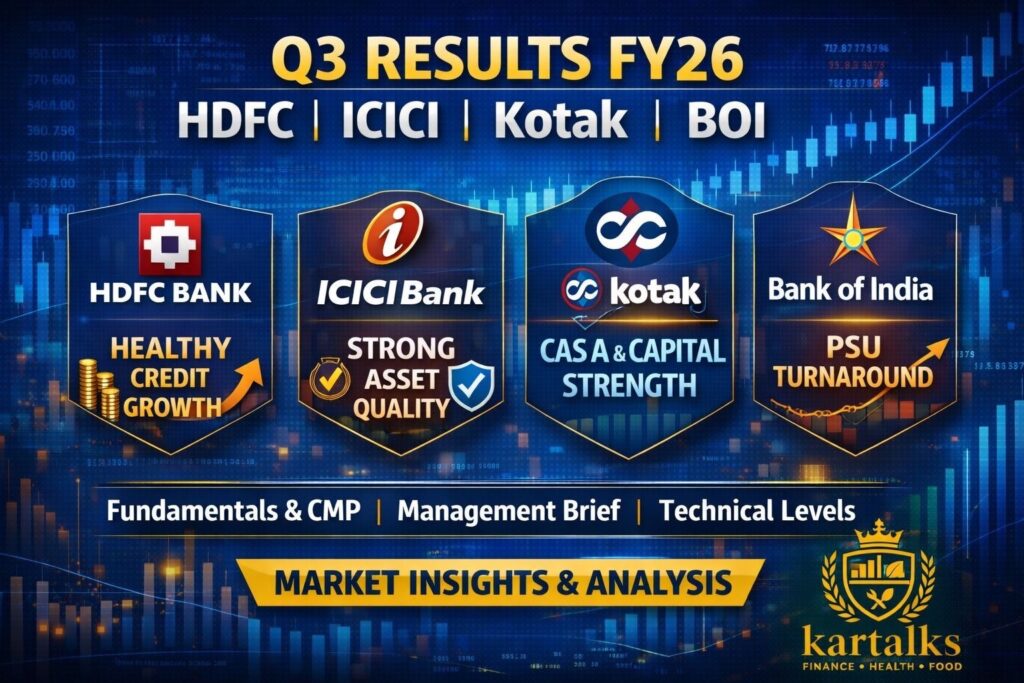
HDFC Bank: scale + deposit execution + LDR normalization focus
ICICI Bank: stable NIM + strong capital + very low NNPA
Kotak Bank: capital strength + steady NIM + improving GNPA/NNPA
Bank of India: PSU turnaround markers—GNPA down, PCR high, growth steady
❓ FAQs
1.So, how was HDFC Bank’s Q3 result overall?
It was a steady quarter. Nothing flashy, but no red flags either. Profits grew, asset quality stayed under control, and the bank looks set up for better growth ahead.
2. What was the main message from HDFC Bank management?
They clearly said not to worry about short-term noise. The focus is on fixing the loan–deposit balance and building growth patiently.
3.Did ICICI Bank surprise the market this quarter?
Not really — in a good way. ICICI did what it usually does these days: delivered stable numbers and avoided negative surprises.
4.Is ICICI Bank still one of the stronger banks fundamentally?
Yes. Low NPAs, strong capital, and consistent margins keep ICICI in a comfortable position compared to peers.
5.What kind of quarter did Kotak Mahindra Bank have?
It was a calm quarter. Growth wasn’t aggressive, but margins and asset quality stayed healthy, which is very Kotak-like.
6.Why do long-term investors still like Kotak Bank?
Mainly because of its conservative style. High capital, low risk appetite, and steady balance-sheet discipline.
7.What stood out in Bank of India’s Q3 numbers?
The improvement in asset quality. NPAs are coming down, and provisioning remains strong — that’s what matters for a PSU bank.
8.Is Bank of India actually improving or is it just a one-off?
The trend looks genuine. It’s not a turnaround overnight, but the direction is clearly better than a few years ago.
👉Further reading
Q3 FY26 Results Update: TCS, Infosys, HCLTech
Pre-Budget Market Outlook (Union Budget 2026-27) — What the Market Is Pricing In
Stock Market 101–Lesson 14 IPOs for Beginners: Process & Allotment Basics
Stock Market 101 – Lesson 12 Building a Starter Portfolio: 3 Simple Recipes for Beginners
Disclaimer:
This article is for education and information only based on publicly available results/press releases and market data. It is not investment advice or a recommendation to buy/sell/hold any stock. Stock markets carry risk; please do your own research or consult a SEBI-registered financial advisor before investing.