
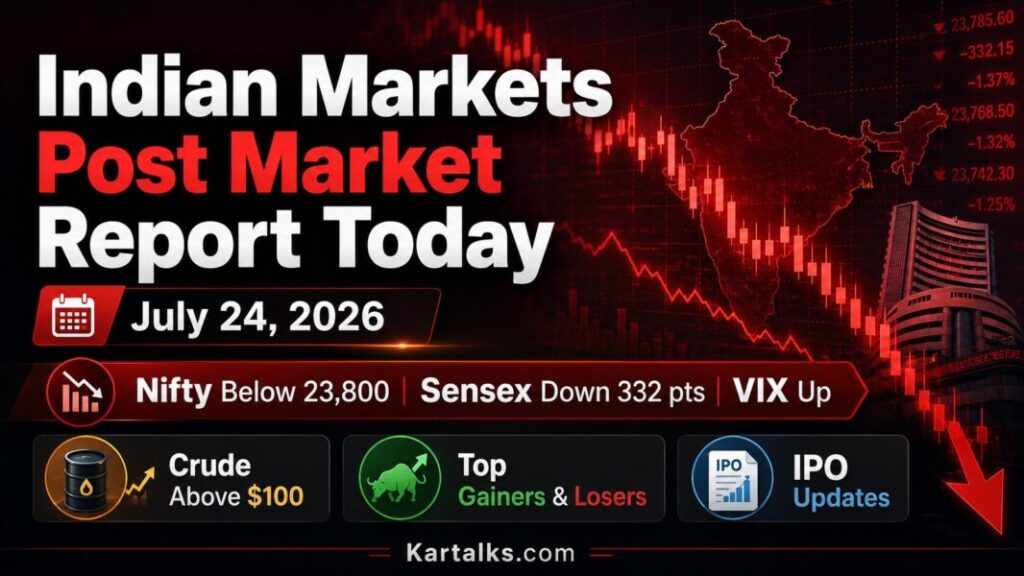
Indian Markets Post Market Report Today July 24: Nifty Below 23,800 as Crude Oil and Global Tensions Hurt Sentiment
Indian Markets Post Market Report Today: Indian stock markets ended lower for the fifth straight session on Friday, July 24, 2026. The market recovered sharply from the day’s low, but selling in financial, auto, realty and oil-sensitive stocks kept the benchmark indices in negative territory.
The Nifty 50 closed below the important 23,800 level. Sensex lost more than 330 points, while Bank Nifty remained under pressure as investors stayed cautious about high crude oil prices, foreign investor selling and rising global bond yields.
Market volatility also increased. India VIX rose more than 5% during the session, showing that traders expect larger price swings in the coming days.
Indian Stock Market Closing Levels Today
| Index | Closing level | Day’s change |
|---|---|---|
| Nifty 50 | 23,767.45 | -102.15 points, -0.42% |
| BSE Sensex | 76,059.77 | -331.62 points, -0.43% |
| Bank Nifty | Around 56,693 | Nearly flat to mildly positive +0.17% |
The Nifty and Sensex both recorded their fifth consecutive day of losses. The Nifty also ended the week down 2.33%, its weakest weekly performance in around four months. Sensex declined about 2.7% during the week.
Bank Nifty showed a better recovery than the headline indices during the second half of trade. However, sentiment in banking stocks remained weak after the recent correction in HDFC Bank and Axis Bank.
Why Did the Indian Stock Market Fall Today?
Today’s market fall was not caused by one single event. Several domestic and international factors came together.
1. Crude oil crossed the $100 mark
Brent crude briefly moved above $100 per barrel as tensions in the Middle East raised concerns about energy supply and shipping routes.
This is a major worry for India because the country imports a large part of its crude oil requirement.
Higher crude prices can:
- Increase India’s import bill
- Put pressure on the rupee
- Raise fuel and transport costs
- Increase inflation
- Reduce profit margins for companies using oil-based raw materials
Brent crude gained more than 10% during the week, becoming one of the biggest reasons behind the fall in Indian equities.
2. Iran-US tensions worried global investors
Fresh developments involving Iran, the US and Houthi forces increased fears of a wider conflict in West Asia.
Any disruption near important shipping routes can affect crude oil supply, freight costs and global trade. As a result, investors reduced exposure to risky assets and shifted towards safer investments.
3. Foreign investors continued selling
Persistent selling by foreign institutional investors, or FIIs, added pressure to the market.
FIIs were net sellers of ₹2,999.23 crore in the cash market on July 23. Domestic institutional investors purchased shares worth a net ₹2,947.14 crore, almost matching the foreign selling.
DII support helped the market recover from its morning low. However, it was not enough to take the benchmarks into positive territory.
4. Weak global markets
Asian markets traded sharply lower after weakness in US technology stocks.
Japan’s Nikkei fell more than 3%, while South Korea’s KOSPI dropped over 5% during the session. Chinese and Hong Kong markets were also in the red.
Wall Street had ended lower in the previous session, with the Nasdaq falling close to 2% as investors questioned heavy spending on artificial intelligence projects.
5. Rupee weakness increased nervousness
The rupee remained close to its record low due to expensive crude oil, dollar demand from importers and weak domestic equities.
The Indian currency finally settled near ₹96.56 against the US dollar after likely intervention from the Reserve Bank of India through state-owned banks.
A weak rupee can benefit exporters such as IT and pharmaceutical companies. However, it increases costs for oil importers, airlines, chemical companies and businesses dependent on imported raw materials.
6. US interest-rate concerns returned
Higher oil prices can keep global inflation elevated. That may force the US Federal Reserve to maintain higher interest rates or consider another rate increase.
Higher US yields usually make dollar assets more attractive. This can reduce foreign flows into emerging markets such as India.
7. Weak earnings reactions in selected stocks
Infosys and InterGlobe Aviation declined after their June-quarter results disappointed parts of the market.
Infosys also narrowed the upper end of its FY27 constant-currency revenue growth guidance, increasing concerns about the near-term demand outlook for the IT sector.
Indian shares log weekly losses as crude climbs and banking stocks fall
Top Five Nifty Gainers Today
Only a small group of Nifty stocks managed to stay positive. The figures below reflect the late-session market snapshot and may differ slightly from final exchange-adjusted prices.
| Top gainers | Movement | Main trigger |
|---|---|---|
| Cipla | About +1.26% | Buying interest after earnings |
| HCL Technologies | About +2.11% | IT recovery and rupee support |
| Wipro | About +1.32% | Selective buying in IT |
| ITC | About +0.76% | Defensive FMCG demand |
| HDFC Life | Around +0.74% | Insurance buying |
Cipla remained among the strongest Nifty stocks during the session. HCL Technologies and Wipro also gained as investors looked for selective opportunities in export-oriented IT shares.
ITC and Nestlé India benefited from defensive buying. FMCG companies are generally considered relatively stable during uncertain market conditions because demand for daily-use products is less sensitive to economic cycles.
Top Five Nifty Losers Today
| Top losers | Movement | Main reason |
|---|---|---|
| Bajaj Finance | About -2.60% | Selling in financial stocks |
| Eternal | About -2.47% | Profit booking |
| Mahindra & Mahindra | About -2.11% | Auto-sector weakness |
| InterGlobe Aviation | About -1.77% | Earnings and fuel-cost concerns |
| Shriram Finance | Around -1.5% to -2% | Volatility after quarterly results |
Bajaj Finance was one of the biggest index drags. Selling was also visible in Eternal and Mahindra & Mahindra.
InterGlobe Aviation faced additional pressure because higher crude oil prices can increase aviation turbine fuel costs. Fuel is one of the largest expenses for airlines.
Shriram Finance remained volatile despite reporting strong quarterly numbers, including a sharp increase in profit and net interest income. The market appeared to focus on valuation and broader weakness in the financial sector.
Market wrap: HCLTech, Bajaj Finance and Eternal among top movers
Indian Markets Post Market Report Today’s Sector Performance
The market fall was broad-based, but defensive sectors performed better.
Sectors that showed strength
Nifty FMCG: FMCG was among the better-performing sectors as investors shifted towards defensive stocks.
Nifty Pharma: Pharma shares received buying support because healthcare demand is relatively stable and exporters can benefit from a weak rupee.
Nifty Media: Media stocks showed pockets of strength, supported by buying in PVR Inox and Tips Music during the session.
Sectors that remained under pressure
Nifty Realty: Realty was the weakest major sector and declined around 1.49%.
Nifty Auto: Auto stocks fell as investors worried that expensive crude oil and higher inflation could affect demand and operating costs.
Nifty Financial Services: Financial shares remained weak due to foreign selling and concerns about margins.
Nifty Metal: Metal stocks followed weak global sentiment and concerns about economic demand.
Nifty Oil & Gas: The sector faced mixed pressure despite higher crude prices, as expensive energy can raise costs across the economy.
Only FMCG and pharma finished with meaningful resilience, while most major sector indices remained weak.
India VIX Today
India VIX moved above 14.03 during the session and rose more than 5% from its previous close of 13.48.
The volatility index had jumped as much as 8% during morning trade before cooling from its high.
A VIX level near 14 is not extremely high, but the sudden rise shows growing nervousness.
For retail investors, this means:
- Intraday price swings may remain larger
- Stop-loss orders can get triggered quickly
- Option premiums may stay expensive
- Aggressive leveraged trades should be avoided
Investors should focus more on position size and risk control until volatility settles.
Latest FII and DII Data
The latest confirmed data is for July 24:
- FII net selling: ₹3,892.77 crore
- DII net buying: ₹5,453.55 crore
Foreign selling has remained a key reason for market weakness. Domestic institutions, mutual funds and insurance companies continue to absorb a large part of these outflows.
Investors should watch whether FIIs reduce their selling once crude oil stabilises and global bond yields cool.
Commodity Market Update
Commodity Market Update Today
Commodities remained volatile on July 24, 2026, as investors tracked the Middle East conflict, crude-oil supply risks, the US dollar and changing interest-rate expectations.
Latest Commodity Prices
| Commodity | Latest price | Market movement |
|---|---|---|
| Brent crude | Around $97.75 per barrel | Down more than 3% from the previous close |
| WTI crude | Around $90.03 per barrel | Lower during Friday trade |
| MCX Gold, August contract | Around ₹1,42,711 per 10 grams | Up about 0.17% |
| MCX Silver | Around ₹2,20,393 per kg | Up about 0.46% |
Currency Market Update
The Indian rupee closed near ₹96.56 per US dollar.
It had moved close to a record low during the session but recovered after state-owned banks reportedly sold dollars, likely on behalf of the RBI.
The rupee’s next movement will depend mainly on:
- Crude oil prices
- RBI intervention
- FII flows
- US bond yields
- Movement in the dollar index
A sustained break beyond the recent low could increase imported inflation. A fall in crude oil would offer some relief.
Existing and Upcoming IPO Updates
Indo-MIM IPO
The ₹3,811.21 crore Indo-MIM IPO entered its second day of subscription on July 24.
The issue was subscribed about 1.40 times by 10:25 am, with bids for 7.69 crore shares against 5.50 crore shares available. The issue opened on July 23.
Investors should study its valuation, customer concentration, export exposure and capital expenditure plans rather than applying only based on grey-market activity.
Xtranet Technologies IPO
The ₹166.80 crore Xtranet Technologies IPO was also in its second day of bidding.
The public issue opened on July 23 and is scheduled to close on July 27.
Being a smaller issue, investors should carefully check liquidity, business concentration and financial consistency.
Cube Highways Trust InvIT
The Cube Highways Trust InvIT issue closed for subscription on July 24.
The trust owns and operates completed road infrastructure assets. InvIT returns generally depend on road traffic, toll collections, debt costs and distributions to unit holders.
InvITs may suit investors looking for income, but they should not be treated like fixed deposits.
Shree Balaji Mala Textiles SME IPO
The SME IPO opened on July 22 and closed on July 24. The upper price band was ₹70 per share.
SME IPOs can have high listing-day volatility and limited liquidity. Retail investors should avoid depending only on unofficial GMP figures.
Caliber Mining and Logistics listing
Caliber Mining and Logistics listed at ₹504 on the BSE, around 18.87% above its issue price of ₹424.
However, the stock fell more than 8% from its listing price during the session. This is a reminder that a positive debut does not guarantee that the stock will continue rising.
Juniper Green Energy IPO
Juniper Green Energy will open its ₹1,800 crore IPO on July 30 and close it on August 3.
The issue is fully fresh equity, with no offer-for-sale component. Anchor bidding is scheduled for July 29.
Investors should examine project execution, debt, power-purchase agreements and cash-flow visibility before applying.
Upcoming IPOs and current public issues
Two Growth Stocks with Strong Q1FY26 Results
The June 2026 quarter has produced a few strong earnings surprises. For investors looking beyond large index companies, Cyient DLM and Nestlé India are two stocks worth studying after their Q1 FY27 results.
These are research ideas only, not direct buy recommendations. Investors should check valuation, debt, business risks and their own investment horizon before taking a position.
1. Cyient DLM: Strong Growth from Electronics Manufacturing
Cyient DLM reported a strong performance for the quarter ended June 30, 2026.
The company’s Q1 FY27 revenue increased around 34% year-on-year to ₹373.8 crore. Net profit rose about 118% to nearly ₹16 crore.
The company also reported its highest-ever order book since listing, at approximately ₹2,599 crore. Growth was supported by demand from aerospace, defence and industrial customers.
Why Cyient DLM May Interest Growth Investors
Cyient DLM operates in the electronics manufacturing services segment. It provides design, manufacturing and lifecycle-support services for specialised electronic products.
The business may benefit from:
Rising electronics manufacturing in India
Higher defence and aerospace spending
The China-plus-one sourcing shift
Demand for industrial automation
Expansion into AI infrastructure, robotics, healthcare electronics and data centres
Its large order book also offers better revenue visibility for the coming quarters.
What Investors Should Watch
Cyient DLM is still a relatively small company compared with large manufacturing businesses. Its quarterly profit can change sharply depending on order execution and product mix.
Important risks include:
Dependence on a limited number of large customers
Delays in order execution
Working-capital requirements
Lower liquidity compared with large-cap shares
Premium valuation after a strong price rally
For long-term investors, staggered buying during market corrections may be safer than purchasing the full quantity after a sharp rise.
2. Nestlé India: Strong Volume Growth and Profit Recovery
Nestlé India reported a healthy Q1 FY27 performance, supported by better volumes and demand across major product categories.
The company’s net profit increased around 48% year-on-year to approximately ₹975 crore. Revenue grew about 25% during the quarter. Its shares also gained after the earnings announcement as investors welcomed the improvement in growth and profitability.
Nestlé India sells popular consumer brands across instant noodles, coffee, chocolates, dairy products, infant nutrition and packaged foods.
Why Nestlé India Remains a Long-Term Growth Stock
Nestlé India has several qualities preferred by long-term investors:
Strong household brands
Wide distribution network
Regular consumer demand
Pricing power
Growing packaged-food consumption
Expansion into smaller cities and rural markets
The company may also benefit from rising disposable incomes and the gradual shift from loose food products to organised packaged brands.
Nestlé India declared a special dividend of ₹2 per equity share in July 2026, in addition to the final dividend recommended for FY26.
What Investors Should Watch
Nestlé India is considered a high-quality consumer company, but its shares often trade at an expensive valuation.
The main risks are:
High share-price valuation
Rising milk, coffee, cocoa and packaging costs
Slower rural demand
Strong competition from Indian FMCG brands
Pressure on margins if input costs rise sharply
Long-term investors may consider buying in phases instead of chasing the stock immediately after strong quarterly results.
Which Stock May Suit Which Investor?
Cyient DLM may appeal to investors willing to accept higher risk for faster growth in electronics, aerospace and defence manufacturing.
Nestlé India may suit investors seeking a more stable consumer business with strong brands, recurring demand and a long operating history.
Cyient DLM carries greater execution and valuation risk. Nestlé India offers better business stability, but its expensive valuation can reduce future returns when purchased at very high prices.
Investors should avoid selecting a stock only because of one strong quarter. Revenue consistency, cash flow, debt, management quality and valuation must also be studied before investing.
These are research ideas, not direct buy recommendations.
Nestlé India Financial Results
Stock of the Day: Cipla
Cipla was among the strongest Nifty 50 stocks and gained close to 2% during the session.
The stock received buying support even as the broader market fell sharply. This relative strength attracted trader attention.
Cipla may remain on the watchlist because of:
- Defensive pharmaceutical demand
- Export earnings
- Support from a weaker rupee
- Recent earnings-related interest
- Better performance than the broader index
Fresh investors should avoid buying only because the stock gained in one session. The company’s product pipeline, US business, regulatory developments and valuation should also be reviewed.
Latest SEBI Updates
Simplified securities transmission process
SEBI has introduced a simplified and standardised framework for transferring securities after the death of an investor.
The updated process includes faster handling of smaller claims, simpler documentation and reduced dependence on probate-related requirements in eligible cases.
This should make it easier for nominees and legal heirs to receive shares, mutual fund units and other securities.
Wider investment options proposed for PMS
SEBI has proposed allowing portfolio managers to invest in overseas listed securities, securities proposed to be listed and selected unlisted debt instruments.
It has also proposed a new category focused on mutual funds, ETFs and specialised investment products. Public comments are invited until August 13, 2026.
These are proposals and not final rules yet.
Short-Term Investment View
Short-term traders should remain careful.
Nifty has closed below 23,800 and market volatility has increased. A sustained move below the recent support zone could invite further selling.
A safer short-term approach is to:
- Keep position sizes small
- Avoid high leverage
- Prefer defensive FMCG and pharma stocks
- Wait for stability in crude oil
- Track FII selling
- Use strict stop-loss levels
- Avoid averaging weak stocks blindly
A recovery above 24,000–24,100 with better market breadth may improve short-term sentiment.
Long-Term Investment View
Long-term investors should not panic because of a few weak sessions.
However, they should also avoid investing all available money in one day.
A staggered plan can be used across:
- Nifty 50 or Sensex index funds
- Quality private and public-sector banks
- Pharma and healthcare
- Consumer businesses
- Capital goods and infrastructure
- Selected technology companies
- Gold for portfolio diversification
The best long-term candidates are generally companies with manageable debt, steady cash flow, honest management, pricing power and a clear growth path.
FAQs
Q1. Why did Nifty fall today?
Nifty fell mainly because crude oil briefly crossed $100, global markets were weak, FIIs continued selling and geopolitical tensions increased.
Q2. Is India VIX above 14 dangerous?
It is not an extreme level, but the sharp daily rise signals higher expected volatility. Traders should reduce leverage and manage risk carefully.
Q3. Should investors buy after today’s fall?
Long-term investors may buy quality stocks gradually. Avoid investing the full amount at once because global risks remain high.
Q4. Which sectors were stronger today?
FMCG and pharma were the strongest defensive sectors. Realty, auto, financial services, metal and oil and gas remained under pressure.
Q5. Is an IPO with a high GMP safe?
No. GMP is unofficial and can change quickly. Investors must study valuation, business quality, debt, promoter background and financial performance.
Final Market View
The market recovered well from its intraday low, but the closing remained weak.
The biggest issue is crude oil. If Brent stays near or above $100 for a long period, pressure on inflation, the rupee and corporate margins may continue.
Domestic institutions are providing support, but sustained foreign selling is limiting the recovery.
Investors should remain selective, avoid excessive leverage and use market corrections to slowly build positions in fundamentally strong businesses.
Further Reading
Indian Markets Weekly View (July 20–July 24, 2026): Cautiously Positive Sentiment
Stock Market 101 Lesson 39: ELSS vs PPF vs NPS – Ultimate Beginner Guide
Q1 FY27 Results Analysis: Reliance, TCS, HCL Tech, Jio Financial and DMart
Rupee Fall 2026 Explained: Why INR May Stay Weak Against Dollar
Disclaimer
This article is published only for educational and informational purposes. It does not constitute investment advice, a stock recommendation, research advice, an offer to buy or sell securities, or a guarantee of returns.
Article Information
Author: Kartalks Research Desk
Reviewed by: Kartalks Editorial Team
Content Type: Indian stock market post-market report, closing levels, market movement, sector performance, top gainers and losers, FII/DII activity, IPO updates, commodity trends, currency movement, and investor education
Sources: NSE, BSE, SEBI, market closing data, sector performance data, FII/DII activity, IPO filings, commodity market data, currency market updates, company filings, and official public sources
Last Updated: July 24, 2026