
Front-of-Pack Nutrition Labels: What New Food Labels May Mean for Shoppers in 2026
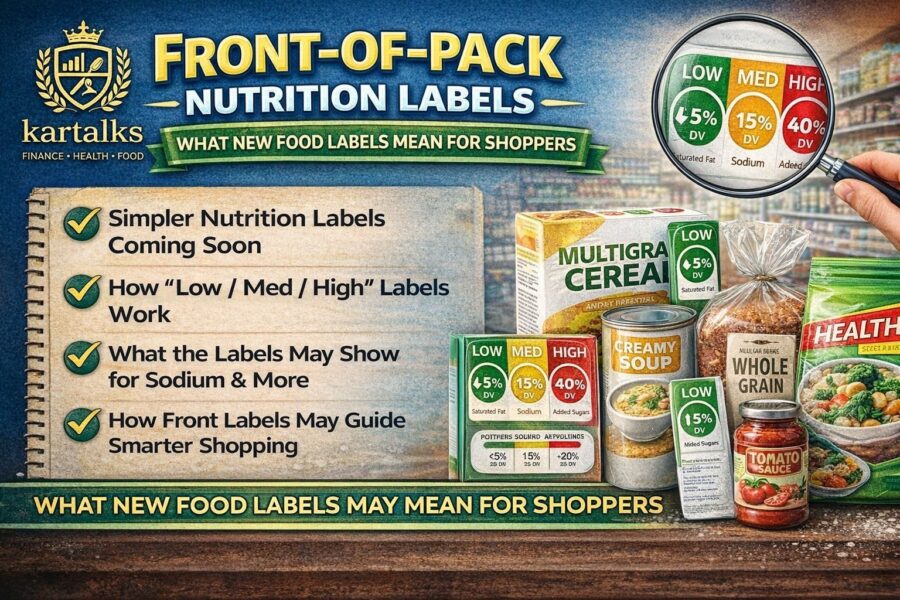
Front-of-Pack Nutrition Labels: Walk into any supermarket today and you face the same problem: too many claims, too little time. “High protein,” “multigrain,” “light,” “baked,” “low fat,” and “natural” can all sound healthy at a glance, yet the nutrition story is often more complicated. That is exactly why front-of-pack nutrition labels have become such an important topic in 2026. The FDA has proposed a new front-of-package label, called the Nutrition Info box, to give shoppers quick, easy-to-see information on saturated fat, sodium, and added sugars using simple Low / Med / High descriptions on the front of most packaged foods.
Front-of-Pack Nutrition Labels: Why This Topic Matters Right Now
This is not just a packaging update. It is part of a bigger public-health push. In its announcement, the FDA said the proposal is tied to efforts to address diet-related chronic disease, noting that 60% of Americans have at least one chronic disease and that chronic diseases are the leading driver of $4.5 trillion in annual U.S. healthcare costs. The agency also said excess intake of saturated fat, sodium, and added sugars is a major contributor to that problem.
As of the latest official FDA materials available now, this front-of-pack nutrition labels system is still a proposed rule, not a finalized requirement. FDA’s own 2026 Human Foods Program priorities still describe this as creating a front-of-package nutrition labels program, which means shoppers and brands should treat it as a major policy direction, but not yet as a label that must already appear on shelves.
Front-of-Pack Nutrition Labels: What Exactly Is the FDA Proposing?
The FDA proposal would require a compact Nutrition Info box on the front of most packaged foods that already carry a Nutrition Facts label. The box would show the relative amount of three nutrients people are advised to limit: saturated fat, sodium, and added sugars. Instead of forcing shoppers to decode the full back label first, the front panel would show those nutrients in a more interpretive format so shoppers can scan, compare, and decide faster.
The proposed box would not replace the familiar Nutrition Facts label on the back or side of the pack. It would complement it. The FDA also says calories would not be included in Front-of-Pack Nutrition Labels Info box, though manufacturers could still voluntarily put calories on the front under existing rules. That is an important detail because the purpose here is not to compress the whole label into one square; it is to spotlight the nutrients that are most often over consumed.
Front-of-Pack Nutrition Labels: Why These Three Nutrients?
The proposal focuses on saturated fat, sodium, and added sugars because current federal dietary recommendations advise consumers to limit them. The FDA’s Nutrition Facts label guidance also treats these as nutrients consumers should generally keep lower, while nutrients like fiber, calcium, iron, potassium, and vitamin D are ones consumers are encouraged to get enough of.
That makes the proposal practical. Many shoppers do not have time to study every gram and milligram while standing in an aisle. A front label centered on these three nutrients gives people a more direct signal about whether a packaged food may be heavy in the very things public-health guidance says to watch closely.
Front-of-Pack Nutrition Labels:
What Will “Low,” “Med,” and “High” Actually Mean?
This is where the proposal becomes especially shopper-friendly. The FDA proposes that the front-of-pack descriptions be tied to Percent Daily Value (%DV):
- Low = 5% DV or less
- Med = 6% to 19% DV
- High = 20% DV or more
That system follows the FDA’s long-standing consumer guidance for reading the Nutrition Facts label, where 5% DV or less is considered low and 20% DV or more is considered high. The difference is that under the proposal, shoppers would no longer need to remember that rule or hunt for it on the back. The front of the package would interpret it for them.
What This Means for Shoppers in Real Life
For everyday shoppers, the biggest benefit is speed. If you are comparing two cereals, two yogurts, two sauces, or two snack bars, a front label could help you spot the better option faster, especially when one product looks “healthy” because of branding but is actually high in added sugar or sodium. The FDA explicitly says the Nutrition Info box is meant to help consumers quickly and easily identify how foods can fit into a healthy diet and compare similar foods more easily.
This matters because many people already look at labels, but not always at the part that helps most with quick comparison. In the FDA’s proposal, the agency cites research showing 87% of U.S. adults look at the Nutrition Facts label, and at least 76% use it when buying a food for the first time. But only 49% report looking at %DV, and data suggest that up to 40% of Americans age 16 and older do not understand %DV. In simple words, people try to use labels, but the labels are not always easy enough to interpret on the spot.
That gap is exactly what Front-of-Pack Nutrition Labels tries to fix. Instead of asking shoppers to translate numbers into meaning, it gives the meaning first. For busy parents, older shoppers, teenagers choosing snacks, or anyone shopping in a hurry, that could be genuinely useful. The FDA also says the proposed label is intended to help consumers, including those with lower nutrition knowledge, make more informed dietary choices.
Front-of-Pack Nutrition Labels: Why the FDA Thinks This Format Works
The FDA did not choose this format randomly. In its January 2025 announcement, the agency said it had reviewed scientific literature, run focus groups, and conducted a 2023 experimental study of nearly 10,000 U.S. adults to test different front-of-pack designs. According to the FDA, the black-and-white Nutrition Info scheme with percent Daily Value performed best in helping participants identify healthier options.
The Federal Register proposal adds more useful detail. It says that in FDA research, the vast majority of participants could correctly identify the healthiest and least healthy nutrient profiles using the proposed Nutrition Info box format, with figures of 95% and 92%, respectively. That is a strong sign that interpretive labels may work better than just showing raw numbers or isolated warning language.
Front-of-Pack Nutrition Labels: What Shoppers Should Still Be Careful About
Even if the rule becomes final, the front label will not do all the thinking for you. It will help, but it will not replace smart reading.
A few things will still matter:
- Serving size still matters because the front label reflects the nutrient level per serving.
- A product that is Low in one nutrient may still be High in another.
- Foods with appealing marketing words like “fit,” “lite,” “protein,” or “whole grain” may still deserve a second look at the full label. This is an inference based on how the proposal is designed to help consumers compare products more accurately, not a separate FDA rule about those words.
The smartest way to use a front-of-pack label is this: use the front for your first filter, then use the full Nutrition Facts label for your final decision.
What This Could Mean for Food Brands
The proposal is aimed at information, but it may also change the food supply over time. The FDA says reformulation is not required, yet it also acknowledges that some manufacturers may choose to reformulate products to avoid unfavorable front-of-pack profiles or to preserve nutrient claims like “low sodium.” The proposal also includes compliance timelines of 3 years after the final rule’s effective date for businesses with $10 million or more in annual food sales and 4 years for smaller businesses.
That means shoppers should not expect overnight change even if the rule is finalized. But over time, the presence of easier-to-read front labels could push some brands to reduce added sugars, sodium, or saturated fat simply because comparisons will become more obvious on shelf. That is not guaranteed, but the FDA explicitly recognizes it as a possible effect of the rule.
Front-of-Pack Nutrition Labels: Why This Matters Beyond the U.S.
Even though this specific proposal is from the FDA, the broader idea matters everywhere: simpler front labels can make nutrition information more usable in real life. That is especially relevant in a food environment crowded with convenience products, ultra-processed snacks, flavored drinks, sauces, and packaged meals. The deeper lesson for shoppers is not just about one rule. It is about learning to value clearer nutrition signals over flashy packaging claims. This is an inference drawn from the FDA’s rationale for making nutrition information more accessible and easier to compare.
Front-of-Pack Nutrition Labels: Final Take
Front-of-pack nutrition labels could become one of the most shopper-friendly food-label changes in years. The idea is simple: take three nutrients people are repeatedly told to limit, place them on the front of the pack, and explain them in plain language that busy people can use. If the rule is finalized, it may not make every shopping decision perfect, but it could make many decisions faster, clearer, and less dependent on marketing spin. For shoppers, that is real value.
❓ 5 FAQs (Front-of-Pack Nutrition Labels)
1. Is the new front-of-pack nutrition labels already mandatory?
No. Based on the latest official FDA materials available now, it is still a proposed rule, not a finalized nationwide requirement.
2. Which nutrients would the proposed front label show?
The proposed Nutrition Info box would show saturated fat, sodium, and added sugars.
3. Would calories appear on the front label too?
Not as part of the proposed Nutrition Info box. The FDA says calories would not be included in that box, although manufacturers could voluntarily put calorie information on the front under existing rules.
4. What do Low, Med, and High mean on the proposed label?
The FDA proposal ties them to %DV: Low = 5% DV or less, Med = 6% to 19% DV, High = 20% DV or more.
5. Would the front label replace the Nutrition Facts label?
No. It is designed to complement, not replace, the current Nutrition Facts label.
Further reading
Low-Sodium Eating in 2026: Hidden Salt in Everyday Foods and Smarter Ways to Cut It
Sustainable and Local Food Movement: Why Climate and Health Are Finally Sharing the Same Plate
Bio-Engineered and Future Functional Foods: How Science Is Reshaping What We Eat
Clean Label And Natural Food Movement
Plant-Based Diet 2.0: The New Era of Eating
7 No-Cook Breakfasts Recipes for Healthy and Budget Indian Mornings.
GLP-1 Influence on Diet and Health (2026): What It Means for Weight, Metabolism, and Everyday Eating
Disclaimer
This article is for general educational purposes only and should not be treated as medical, legal, or regulatory advice. Food-label rules can change, and shoppers should rely on official FDA updates and the actual product label when making decisions.