
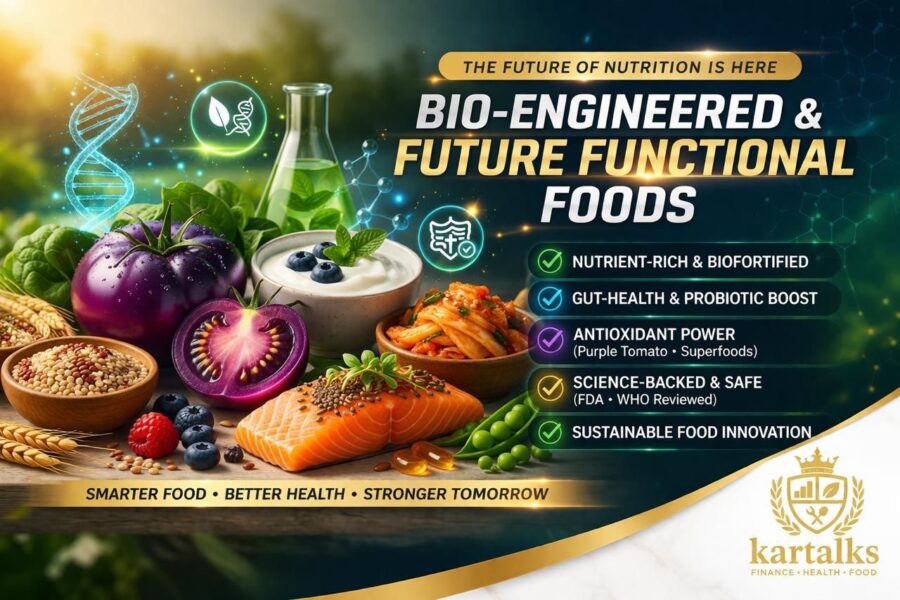
🧬 Bio-Engineered and Future Functional Foods: How Science Is Reshaping What We Eat
Bio-Engineered and Future Functional Foods: Food is no longer being judged only by taste, price, or calories. More readers now want to know a bigger story: Does this food support gut health? Is it richer in nutrients? Was it designed to solve a real deficiency problem? Is it safe, transparent, and actually useful in daily life?
That is why bio-engineered and future functional foods are becoming one of the most important nutrition conversations of this decade. The urgency is real. The latest UN food-security reporting says that 2.60 billion people were still unable to afford a healthy diet in 2024, even as food systems, prices, and climate pressures continued to reshape what reaches our plates. At the same time, WHO says the foundation of a healthy diet still remains a wide variety of minimally processed foods, with moderation, balance, adequacy, and diversity at the core.
🍅 What Bio-Engineered and Future Functional Foods Really Mean
Bio-Engineered and Future Functional Foods explained in simple terms, bio-engineered foods are foods produced from organisms whose genetic material has been modified using specific lab-based techniques. In the United States, USDA’s National Bioengineered Food Disclosure Standard uses the term “bioengineered” for foods that contain detectable modified genetic material that could not be created through conventional breeding or found in nature. USDA also requires disclosure for foods that fall under the standard.
Future functional foods are a broader category. These are foods developed, selected, or improved to deliver benefits beyond basic nourishment. That can include better fiber content, stronger probiotic activity, improved fatty-acid profiles, added micronutrients, stronger antioxidant content, or traits designed to support public-health needs such as vitamin and mineral intake. Some come from modern biotechnology, some from conventional breeding, and some from improved food processing or fermentation.
This distinction matters because many people still mix together very different ideas: fortified cereals, probiotic yogurt, biofortified crops, and genetically engineered produce are not the same thing. They sit on different points of the innovation spectrum, and they should be judged by their evidence, safety review, labeling, and real nutritional value—not by hype alone.
🔬 Why This Topic Matters Right Now
The old food model is under pressure from every side. Consumers want health benefits. Farmers need crops that can perform under stress. Governments are trying to reduce micronutrient deficiencies. Families are searching for affordable nutrition, not just premium wellness branding. That is exactly where science-enhanced foods enter the picture.
WHO describes biofortification as improving the nutritional quality of crops during plant growth through agronomic practices, conventional breeding, or modern biotechnology. That is different from classic fortification, which adds nutrients during food processing. This makes biofortification especially relevant in populations that rely heavily on staple foods and may not have regular access to diverse diets or supplements.
That makes future functional foods more than a premium supermarket trend. In the right context, they can become a public-health tool.
🥕 Real Examples Readers Should Know
1) Biofortified staple crops
One of the most practical examples is biofortified staple food. These are crops bred or developed to contain more iron, zinc, vitamin A, or other nutrients. WHO recognizes biofortification as a nutrition-sensitive agriculture intervention that can help reduce vitamin and mineral deficiencies.
This matters because a nutrient upgrade in a staple crop can reach people without requiring them to dramatically change their eating habits. If a family already depends on maize, beans, rice, sweet potato, cassava, or wheat, improving the nutrient density of those foods can be far more realistic than expecting perfect supplement adherence or expensive diet change. That is one reason biofortification keeps gaining attention in food-policy and nutrition circles.
2) The high-anthocyanin purple tomato
A more visible and conversation-starting example is the purple tomato. FDA’s consultation record for Norfolk’s Del/Ros1-N purple tomato notes that anthocyanins were undetectable in the control tomatoes but were present in the modified tomatoes at measured levels. In Canada, Health Canada said in 2025 that it had “no objection” to the food use of Purple Tomato after a safety assessment under its novel-food guidelines.
Why does this matter? Because it shows where future functional foods are going: not just longer shelf life or pest resistance, but foods designed with a more direct nutrition story. In this case, the focus is antioxidant-rich pigmentation tied to anthocyanins. That does not mean one tomato suddenly becomes a miracle cure. It means the product is part of a new generation of foods trying to combine consumer appeal, nutritional differentiation, and regulatory review.
3) Probiotic and gut-health foods
Not every future functional food is genetically engineered. Some of the most familiar examples are probiotic or microbiome-focused foods. NIH’s NCCIH says probiotics are live microorganisms intended to have health benefits when consumed. They are found in yogurt and other fermented foods, as well as in supplements. But NCCIH also makes an important caution clear: while some probiotic formulations show promise, strong evidence does not support many of the broad claims often made in marketing. It also notes important safety concerns in certain vulnerable groups, including premature infants.
For readers, that is a valuable lesson. Functional foods should be evaluated by strain, dose, outcome, and evidence—not just by a trendy label on the front of the pack.
🛡️ Are Bio-Engineered and Future Functional Foods Safe?
This is the question most readers care about first, and it deserves a straight answer.
FDA says foods from genetically engineered plants marketed in the United States must meet the same safety requirements as foods from traditionally bred plants. FDA also states that foods from genetically engineered plants that have gone through its consultation process do not go to market until FDA’s questions about safety are resolved. FDA’s consumer materials also say GMO foods are as healthful and safe to eat as their non-GMO counterparts.
That does not mean every future food claim is automatically strong, or that all products are nutritionally superior just because they are science-backed. Safety and usefulness are different questions. A product can pass safety review and still offer only a modest real-world benefit. That is why readers should look for two layers: first, regulatory safety; second, meaningful nutritional value.
📈 Where the Real Benefits Could Be
The strongest case for bio-engineered and future functional foods is not flashy branding. It is targeted usefulness.
One benefit is nutrient density. If breeding or biotechnology can raise the level of needed micronutrients in widely eaten foods, that can help address hidden hunger more efficiently than relying on expensive specialty products alone. WHO’s biofortification guidance is important precisely because it frames this as a population-level nutrition strategy, not just a boutique innovation.
Another benefit is better alignment with modern health needs. Future functional foods may support healthier fat profiles, improved fiber intake, gut-health support, or antioxidant-rich options that fit more easily into everyday diets. But WHO is still clear that the healthiest dietary base is variety, moderation, and minimally processed foods. So the best future foods will be the ones that strengthen a healthy diet—not distract from it.
A third benefit is food-system resilience. Science-led crop improvement can potentially support better stress tolerance, better yield stability, or better nutrient retention in the face of climate and supply-chain pressure. That does not solve the whole food crisis, but it can become part of a more resilient nutrition strategy.
⚠️ What Readers Should Not Ignore
Future functional foods also come with real caution points.
The first is the health halo problem. A food can contain a trendy ingredient and still be too sugary, too salty, too expensive, or too processed to deserve a “healthy” reputation. WHO’s healthy-diet guidance remains useful here because it brings the conversation back to overall dietary pattern, not just one ingredient story.
The second is marketing overreach. The evidence for some probiotic uses is promising, but not universal. The same rule applies to antioxidant claims, microbiome claims, and personalized nutrition products. The more dramatic the promise sounds, the more carefully readers should look for human evidence rather than advertising language.
The third is affordability. A food innovation that never reaches ordinary households will remain a niche conversation. The global healthy-diet affordability gap is exactly why future nutrition must focus on access, not only novelty.
🌍 Why the Future of Functional Foods Must Also Be Sustainable
This is where your screenshot connects beautifully to the next trend: sustainable and local food systems.
FAO and WHO describe sustainable healthy diets as diets that have low environmental impacts and are nutritionally adequate, safe, affordable, accessible, and culturally acceptable. That means future foods cannot be judged only by lab innovation. They also have to fit real communities, real budgets, and real environmental limits.
Local food systems also matter, but with nuance. USDA says there is no single consensus definition of “local,” though some programs use broad distance rules such as within the state or within 400 miles. USDA and NIFA also point to benefits such as support for local economies, food access, freshness, resilience, and reduced food insecurity.
At the same time, the climate story is more complicated than “local is always greener.” The IPCC notes that emissions savings from local food can vary by region and season, and that transport emissions depend strongly on the mode of transport. In other words, sustainability is about the whole system—production method, storage, waste, transport, and diet pattern—not just distance traveled.
✅ A Practical Reader’s Checklist
Before buying into any bio-engineered and future functional foods, readers should ask:
- What problem is this food actually trying to solve?
- Is the benefit nutritional, medical, environmental, or just marketing language?
- Has the product gone through a credible safety review?
- Is the claimed benefit supported in humans, or only suggested in theory?
- Does this food improve my overall diet, or just make me feel better about a weak food choice?
🧾Bio-Engineered and Future Functional Foods:
Final Take
Bio-engineered and future functional foods are not science fiction anymore. They are already entering farms, labs, markets, and regulatory systems. Some, like biofortified staples, may help address real micronutrient gaps. Some, like purple tomatoes, show how biotechnology is moving from commodity traits into nutrition-centered consumer foods. Others, like probiotic foods, remind us that not every promising category has equally strong evidence behind every claim.
The most useful way to think about this space is neither fear nor blind excitement. It is informed curiosity. The future of food should be safer, more nutritious, more transparent, more affordable, and more sustainable. The products that truly matter will be the ones that deliver those outcomes in everyday life—not just on a label.
FAQs
Q1. Are bio-engineered foods safe to eat?
Regulators such as the FDA say foods from genetically engineered plants must meet the same safety requirements as foods from traditionally bred plants.
Q2. What are future functional foods?
Future functional foods are foods designed or improved to offer benefits beyond basic nutrition, such as better gut health support, added nutrients, or stronger antioxidant content. This idea fits within broader healthy-diet and nutrition-improvement frameworks recognized by WHO.
Q3. Are probiotic foods always beneficial?
Not always. NCCIH says some probiotics show promise for certain uses, but strong scientific evidence is lacking for many broader health claims.
Q4. What is the difference between biofortified and bio-engineered foods?
Biofortified foods are improved to raise nutrient content, often through breeding or agronomic methods, while bio-engineered foods specifically involve detectable modified genetic material under USDA’s disclosure standard.
Q5. Why are functional foods becoming popular?
They are gaining attention because consumers want food that does more than fill hunger—such as supporting nutrition quality, gut health, and better long-term dietary habits. WHO also continues to stress that the healthiest pattern remains a varied, balanced diet
Further reading
7 No-Cook Breakfasts Recipes for Healthy and Budget Indian Mornings.
GLP-1 Influence on Diet and Health (2026): What It Means for Weight, Metabolism, and Everyday Eating
Plant-Based Diet 2.0: The New Era of Eating
Personalized Nutrition & AI Diet Planning
Clean Label And Natural Food Movement
Metabolic Fitness: The Health Shift Everyone’s Quietly Making in 2025
Sustainable Fitness: A Beginner’s Playbook
Disclaimer:
This article is for educational and informational purposes only. It is not medical, dietary, or professional advice. Readers should verify food, nutrition, and health-related information from trusted experts before making personal decisions.