
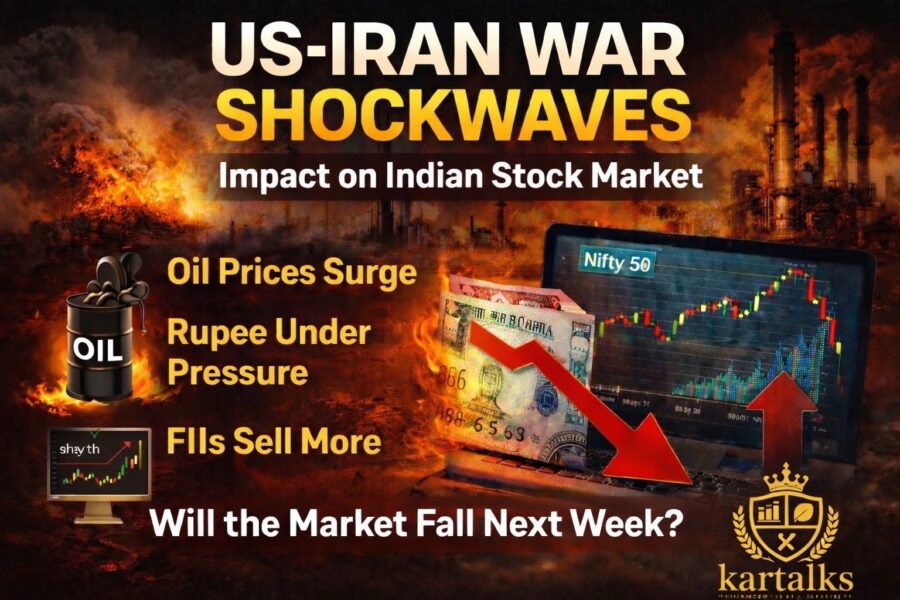
US-Iran War Shockwaves: Will Oil, the Rupee and Global Fear Drag the Indian Stock Market Lower Next Week?
US-Iran war latest escalations: When war headlines start hitting oil terminals, shipping routes and military bases, Dalal Street does not stay insulated for long. That is exactly where the market stands right now. The latest escalation in the US-Iran conflict is no longer just a geopolitical story. It has become an inflation story, a currency story, a trade story and, most importantly for investors, a stock market story.
What has escalated in the US-Iran conflict lately?
As of March 20–21, 2026, the conflict has moved into a more dangerous phase. Reuters reported that President Donald Trump said the United States was “very close” to meeting its objectives, even while Washington continued weighing how the Strait of Hormuz should be secured. On the same day, the UK approved the use of British bases for US strikes on Iranian missile sites targeting ships, showing that the conflict is drawing in more military infrastructure and more allied involvement.
At the same time, the energy angle has become even more serious. Reuters reported that shipping through the Strait of Hormuz has been badly disrupted, and war-risk insurance had to be expanded to help vessels even consider using the route. That matters because roughly one-fifth of the world’s oil passes through Hormuz. AP also reported fresh Iranian attacks on Gulf energy assets and a broader widening of war rhetoric, which kept global markets on edge into March 21.
Washington has also tried to cool the oil panic through market intervention. Reuters reported that the US moved to lend 45.2 million barrels from its Strategic Petroleum Reserve as part of a wider effort with IEA partners to stabilize prices after the conflict pushed crude to four-year highs. That tells you the oil shock is not a side issue anymore; it is central to how governments and markets are responding. Reuters
US-Iran war latest escalations: Why this matters so much for India
US-Iran war latest escalations: India may be geographically distant from the battlefield, but financially it is much closer. Reuters noted that India imports more than 80% of its crude oil needs, while the Indian government said on March 11 that the country consumes about 55 lakh barrels per day.
US-Iran war latest escalations: The government also said supplies remain secure for now because India imports crude from around 40 countries and about 70% of current crude imports are now coming from routes outside the Strait of Hormuz, up from about 55% earlier. That is a strong buffer, but not a complete shield against high global prices.
This is the key difference investors must understand: India may avoid an immediate physical shortage, but it still cannot escape expensive oil, a weaker rupee, higher shipping costs and inflation pressure if the conflict drags on. Reuters said the Hormuz disruption has already affected LNG, rice and fertilizer shipments and raised uncertainty for India’s roughly $100 billion annual trade with the Middle East.
US-Iran war latest escalations: What the Indian stock market has already done
US-Iran war latest escalations: The market’s reaction has been sharp but not one-directional. Reuters reported that on March 20, the Nifty 50 rose 0.49% to 23,114.50 and the Sensex gained 0.44% to 74,532.96, helped by value buying after a steep selloff. But both indexes still ended the week lower overall after Thursday’s deep fall, which was their worst session since June 2024. In other words, Friday’s rebound was relief, not clear confidence.
US-Iran war latest escalations: The currency market gave the bigger warning. Reuters reported that the rupee crashed past 93 per dollar for the first time, closing at 93.71 after touching 93.7350 intraday. It also said foreign investors have pulled more than $8 billion from Indian equities this month, the worst outflow since January 2025. That combination of a weaker rupee, rising crude and foreign selling is exactly the kind of cocktail that makes Indian equities fragile.
US-Iran war latest escalations: Oil tells the same story. Reuters reported Brent crude had spiked as high as $119.13 earlier in the week before easing to around $111 per barrel on Friday. That small cooling helped Indian stocks recover a bit, but the bigger message is that crude remains far above the comfort zone for an oil-importing economy like India.
How different sectors in India are likely to feel the heat
The first pressure point is obvious: any sector directly exposed to fuel, freight or imported input costs stays vulnerable. Airlines, paints, chemicals, logistics and oil marketing companies typically struggle when crude rises too fast and the rupee weakens. That is not because their business suddenly breaks, but because margins become harder to protect. This is my market reading based on the oil shock, rupee weakness and trade disruption now visible in the data.
US-Iran war latest escalations: Banks and rate-sensitive sectors also enter a tricky zone when geopolitical inflation rises. Reuters reported that Indian bond markets have already reacted, with asset managers dumping government bonds at a record pace in March because the oil shock is reviving inflation fears. If yields stay high, valuation comfort for financials, real estate and other interest-sensitive plays becomes harder to justify.
Some pockets may still show resilience. Reuters noted that IT and auto rebounded 2.2% each on Friday, while the broader market tried to recover from panic. That suggests investors are still willing to buy quality when oil cools even slightly. In a volatile tape, defensives, export-linked technology names and selective domestic leaders may attract dip buying faster than highly leveraged, oil-sensitive sectors. The last point is an inference, but it fits the market action seen this week.
US-Iran war latest escalations and Indian stock market forecast: what comes next?
My base view is simple: the Indian market is now trading less on earnings optimism and more on geopolitical risk pricing. If oil stays elevated, the rupee remains under pressure and foreign selling continues, upside on the Nifty could remain capped despite occasional bounce-backs. If headlines improve, the market can rally sharply because sentiment is already bruised.But if the conflict widens further, the downside can reopen quickly. This is an inference drawn from current moves in crude, the rupee, trade and equity flows.
Bullish scenario
If the conflict cools over the next few sessions, shipping through Hormuz starts normalizing and crude keeps slipping from the recent $119 peak toward lower levels, Indian equities can stage a relief rally. In that case, the market may reward quality large caps first, especially in IT, private financials after stabilization, and domestic cyclicals that were hit more by fear than fundamentals. This scenario is supported by the way stocks bounced when crude eased on March 20.
Neutral scenario
If the war does not dramatically worsen but also does not truly de-escalate, expect a highly headline-driven market. Nifty may remain choppy, with every oil downtick bringing buying and every missile or shipping headline bringing fresh selling.
US-Iran war latest escalations This kind of market usually favors traders over impatient investors. Stock-specific action can continue, but index-level confidence stays weak. That reading is consistent with Friday’s rebound inside a still-negative week.
Bearish scenario
If Hormuz disruption deepens, energy infrastructure takes more hits, or crude climbs back toward recent highs while the rupee slides closer to the 95-per-dollar risk flagged by Reuters, the Indian market could face another meaningful correction. In that case, inflation worries, FII outflows and margin pressure would likely overpower bargain hunting. That is the scenario long-term investors should respect, not ignore.
What investors should watch now
Watch Brent crude first, because oil is the fastest transmission line from war to Dalal Street. Watch the rupee second, because a currency under stress amplifies imported inflation. Watch fresh updates around the Strait of Hormuz third, because shipping normalization or further paralysis can change sentiment overnight. And finally, watch foreign flows closely. When global funds keep selling into geopolitical uncertainty, Indian markets struggle to hold rallies for long.
US-Iran war latest escalations: Final take
The latest US-Iran war escalation is not just another distant conflict for Indian investors. It is a live macro risk that is already moving oil, the rupee, bond yields, trade expectations and market sentiment. India’s government says fuel supply remains secure, which is reassuring. But secure supply does not automatically mean stable prices or calm markets. For now, the Indian stock market looks resilient enough to bounce, but not yet strong enough to ignore war-driven volatility. That makes the near-term forecast cautiously volatile rather than confidently bullish.
5 FAQs (US-Iran war latest escalations)
1. Is the US-Iran war already affecting Indian stocks?
Yes. Oil, the rupee and foreign outflows have already made Indian markets more volatile.
2. Why is crude oil so important for India?
Because India imports more than 80% of its crude oil needs, so higher oil quickly affects inflation and sentiment.
3. US-Iran war latest escalations: Is India facing an immediate fuel shortage?
The government says crude supplies remain secure and procurement is diversified. pib.go.in
4. Which market indicator should investors track first?
Brent crude, because it is currently the fastest signal for broader market risk.
5. Is this a buy-on-dips market or a wait-and-watch market?
Right now it looks more like a selective, cautious buy-on-dips market rather than an aggressive broad-market buying phase. This is an inference based on current volatility.
Further reading
US-Iran War Risk and the Indian Stock Market
U.S-Iran War Risk: How It Could Impact the Indian Economy and Stock Market
Stock Market 101 – Lesson 21 Annual Report Basics: What to Read (and What to Skip)
Disclaimer:
This article is for educational and informational purposes only and should not be treated as investment advice, trading advice or a recommendation to buy or sell any security. Stock market investments are subject to market risks, especially during periods of geopolitical uncertainty. Please consult a registered financial advisor before making investment decisions.