
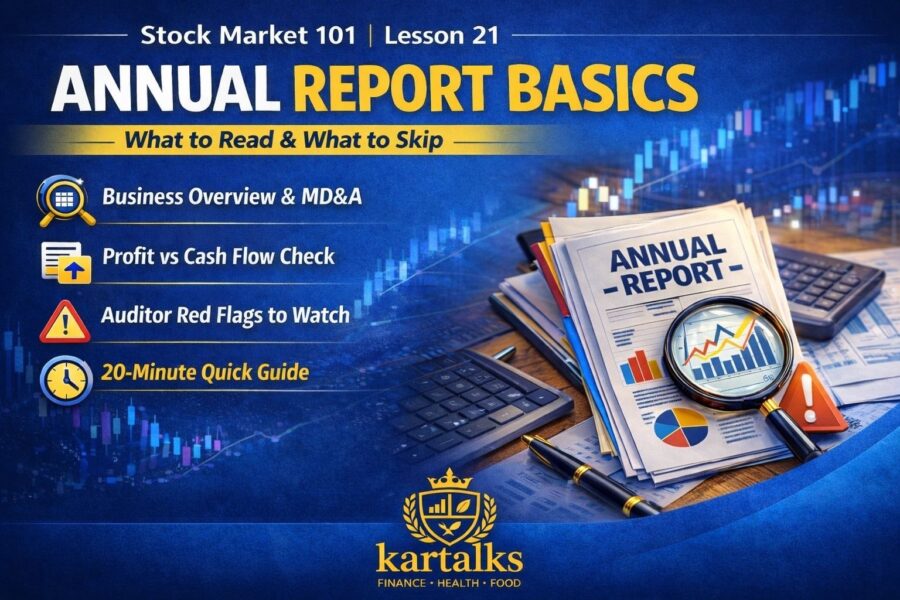
Stock Market 101 – Lesson 21
Annual Report Basics: What to Read (and What to Skip)
Hook: The annual report is the truth… if you know where to look
Most beginners look at a company’s share price, a few news headlines, and feel they’ve “done research.”
But serious investors do something different.
They open the annual report.
Not because it’s fun (it isn’t).
Not because they want to read 200 pages (they don’t).
They read it because this is where the company officially explains—what it did, how it performed, what risks it faces, and what it plans next.
The best part? You don’t need to read everything.
In this lesson, you’ll learn a simple beginner method to read an annual report:
what sections matter most
what to skim quickly
what red flags to watch
and a repeatable 15–20 minute routine for any company
What is an Annual Report (in simple words)?
An annual report is the company’s yearly “full story” shared with shareholders. It typically includes:
business summary
management commentary
financial statements
risks and legal details
auditor report
corporate governance
Think of it like this:
Charts show what people feel.
Annual reports show what the company really is.
Why annual reports matter for beginners
Many beginners buy stocks based on:
tips
social media hype
one good quarter result
trending themes
But annual reports help you answer practical questions:
Is the business growing consistently or only sometimes?
Does profit actually convert into cash?
Is debt increasing too fast?
Are promoters confident and realistic?
Are risks clearly disclosed?
This reduces guesswork and improves decision quality.
The biggest mistake beginners make
Trying to read the annual report from page 1 to page 250.
You get tired, confused, and quit.
Instead, follow a smart order.
The “20-Minute Annual Report Method” (Beginner Friendly)
Step 1: Business Overview (5 minutes)
This section explains:
what the company does
how it earns money
key products/services
key markets and customers
competitive advantage
What to check
Ask:
Can I explain this business in 2 lines?
Does it depend heavily on one product or one customer?
Red flag: If the business is too hard to understand, beginners should be cautious.
Step 2: Chairman/MD Message (3–5 minutes)
This letter tells you:
what management highlights
what they avoid
how they talk about challenges
What to look for
Clear numbers and clarity = good
Only big promises and vague positivity = caution
Step 3: Management Discussion & Analysis (MD&A) (5–7 minutes)
This section explains:
what worked and what didn’t
industry situation
plans ahead
risks
Green flag: Honest discussion of pressure and challenges.
Red flag: Everything sounds “perfect” every year.
Step 4: Financial Highlights (Quick scan)
Many reports show 5–10 year numbers:
revenue
profit
EPS
debt
cash flow (sometimes)
What you want
sales trend rising
profit reasonably consistent
debt under control
Red flag: Sales growing but profits not improving for years.
The 3 Financial Statements to Read (Quick and Smart)
1) Profit & Loss
Check:
revenue growth
margin stability
profit consistency
Beginner tip: One “best year” doesn’t matter if the next two years fall.
2) Balance Sheet
Check:
debt trend
receivables trend (collections)
cash position
Red flag: Profit increasing but debt also increasing year after year.
3) Cash Flow Statement
This is where the truth often hides.
Check:
operating cash flow positive most years?
cash flow broadly matches profits?
Red flag: Profits rising but cash flow weak for many years.
Notes to Accounts: The Hidden Story
You don’t need to read every line. Focus on:
one-time income/expenses
related party transactions
contingent liabilities
segment reporting
changes in accounting policies
Red flag: Too many “one-time” profits.
Auditor Report: A simple check
Look for:
qualifications
emphasis of matter
serious concerns
If the auditor flags something, don’t ignore it.
Corporate Governance (Quick scan)
Check:
promoter holding trend
pledging (if any)
related-party dealings
Red flag: High promoter pledge + rising debt.
What to skip or skim (to save time)
Skim:
long CSR stories
awards and marketing pages
repeated images
long legal content (unless something stands out)
Goal is investment clarity, not full reading.
Annual Report Checklist (Save This)
✅ Do I understand the business simply?
✅ Revenue growth over 3–5 years?
✅ Profits consistent?
✅ Debt under control?
✅ Operating cash flow positive most years?
✅ Any red flags in notes/auditor report?
✅ Management communication clear and realistic?
If many answers are “No,” slow down and avoid rushing.
Final Takeaway
You don’t need to read annual reports like a CA.
You need a repeatable routine.
Once you know where to look, you stop investing based on noise—and start investing with clarity.
5 FAQs (Lesson 21)
Q1) Do I need to read the full annual report?
No. Use the 20-minute method and focus on key sections.
Q2) Which section is most important?
Business overview + MD&A + cash flow statement.
Q3) Biggest red flag for beginners?
Profits rising but operating cash flow weak, or debt rising too fast.
Q4) Should I trust management message?
Read it, but verify everything with numbers.
Q5) Where can I download annual reports?
Company investor relations page + NSE/BSE filings.
👉Further reading
Stock Market 101 – Lesson 20 Your 12-Month Wealth Plan & Rebalancing
Stock Market 101 – Lesson 19 Futures & Options Primer
Stock Market 101 – Lesson 18: Risk Management (Position Sizing & Stop-Losses)
Stock Market 101: Learn Stocks from Zero
Where to find company filings (India)
Financial Ratios Checklist for Investors in 2026
• Compare valuation ratios with industry averages.
• Review Return on Equity (ROE) for business efficiency.
• Monitor Debt-to-Equity ratio to assess financial risk.
• Check profit margins and earnings growth trends.
• Use multiple ratios together instead of relying on a single metric.
In 2026, financial ratios remain one of the simplest ways to evaluate a company’s performance and valuation. Investors should combine profitability, valuation, and debt metrics to make more informed long-term investment decisions.
Last reviewed and updated: June 2026
Disclaimer:
This content is for educational purposes only and does not constitute investment advice. Please do your own research before investing.