
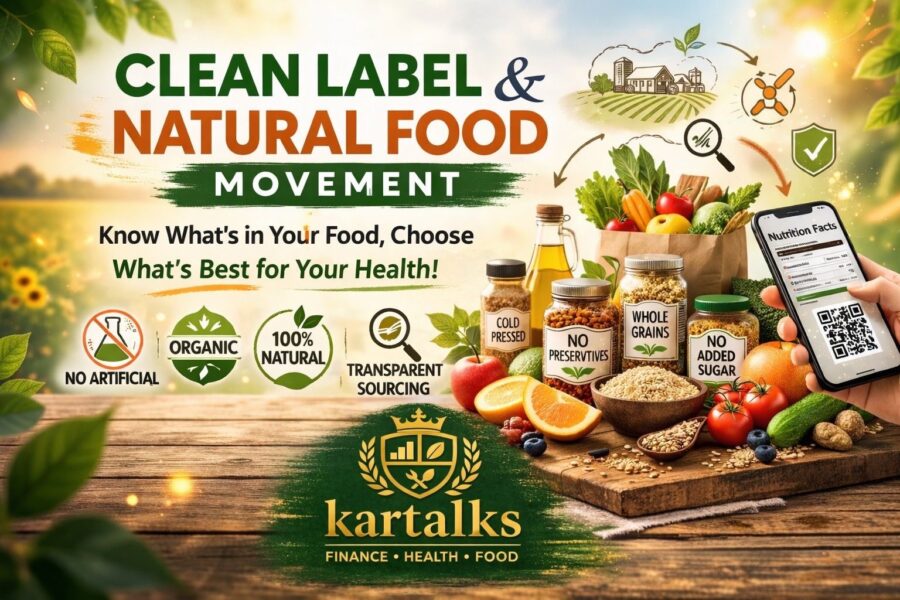
🍯 Clean Label And Natural Food Movement
The clean label and natural food movement is no longer a niche trend for health stores and premium shoppers. It has become a mainstream buying habit shaped by one simple question: “What exactly is in my food?” Around the world, more consumers are reading ingredient lists, questioning artificial additives, and looking for products that feel easier to understand and easier to trust. In 2025, Innova Market Insights said nearly 1 in 2 consumers globally are opting for clean label food and beverages as they prioritize transparency, health, and sustainability.
That shift matters because modern food labels are often crowded with claims—natural, healthy, organic, no artificial colors, minimally processed, non-GMO, preservative-free. Some of those claims are tightly regulated, while others are not. So the real value of this movement is not just “eating cleaner.” It is learning how to make smarter, calmer, evidence-based choices instead of being misled by front-of-pack marketing.
🥗 Clean Label And Natural Food Movement: What “Clean Label” Really Means
“Clean label” is a consumer-friendly idea, not a single legal standard. In practice, it usually refers to foods with:
shorter ingredient lists
recognizable ingredients
fewer artificial colors, flavors, and preservatives
less heavy processing
more transparency about sourcing and formulation
But there is an important catch: clean label does not automatically mean healthy. A product can be “cleaner” in wording and still be high in sugar, sodium, or saturated fat. That is why the best way to use the clean label movement is as a starting point, not a final decision-maker. The Dietary Guidelines for Americans still emphasize limiting foods high in added sugars, saturated fat, and sodium, regardless of how natural the packaging sounds.
🔍 Why Consumers Are Moving Toward Natural and Transparent Food
The rise of clean label eating is closely tied to trust. Shoppers increasingly want food that feels less industrial and more understandable.
The 2025 IFIC Food & Health Survey found that Americans increasingly define healthy food using practical markers like “minimal or no processing” (28%), “limited or no artificial ingredients or preservatives” (25%), and “natural” (24%). That is a strong signal that ingredient simplicity now shapes how people judge quality.👉IFIC
Newer retail-side data shows the same pattern. Acosta Group reported in early 2026 that 50% of U.S. shoppers are worried about artificial ingredients, and 58% say they now regularly read food labels. While that is a brand-affiliated survey, it still lines up with the broader market direction seen across IFIC and Innova reports: transparency has become part of everyday shopping behavior.
🍃 The Biggest Habits Driving This Movement
🌿 1. Avoiding Artificial Additives
Many consumers now scan for synthetic colors, flavors, and preservatives first. That is why “no artificial ingredients” and similar claims have become much more visible in packaged foods.
At the same time, labels can evolve faster than public understanding. In February 2026, the FDA said it would exercise enforcement discretion so foods using naturally derived color sources may still claim “no artificial colors.” That may encourage reformulation away from petroleum-based synthetic dyes, but it also makes it even more important for shoppers to read the full ingredient list rather than rely only on the front label.
🧾 2. Reading Ingredient Lists More Carefully
One of the most useful consumer protections is already built into the label: ingredients are generally listed in descending order by weight, meaning the first few ingredients usually tell you the most about what you are actually eating. If sugar, refined starches, syrups, or flavor blends show up near the top, that matters more than a large “natural” claim on the front.
🥬 3. Choosing Less Processed Foods
A major driver of the clean label movement is discomfort with ultra-processed foods. PwC’s 2025 global consumer survey found that many consumers are concerned about health risks linked to ultra-processed foods, yet only 35% say they greatly try to avoid them. That gap tells us something useful: people care, but convenience, habit, and price still shape actual choices.
So the practical goal is not perfection. It is reducing dependence on heavily processed foods where possible and building more meals around:
fruits and vegetables
whole grains
legumes
nuts and seeds
plain dairy or simpler alternatives
minimally processed proteins 👉pwc
✅ “Natural” vs “Organic” vs “Healthy”
This is where many shoppers get confused.
🌾 “Natural”
In the U.S., the FDA says it has not established a formal definition of the term “natural,” though it has a longstanding policy that the term means nothing artificial or synthetic has been added that would not normally be expected in the food. It also notes that this policy was not designed to address production methods like pesticides, genetic engineering, or processing techniques. In simple terms: “natural” sounds strong, but it is not a complete guarantee. 👉fda.gov
🏷️ “Organic”
“Organic” is different. The USDA Organic seal is an official mark protected by federal regulation and overseen by the National Organic Program. That makes it a much more concrete claim than “natural.” If a product carries the USDA organic seal, it has to meet defined standards.
And consumers are clearly rewarding that trust. The Organic Trade Association reported that U.S. organic sales reached $71.6 billion in 2024, up 5.2% from the previous year—more than double the growth rate of the overall marketplace.
❤️ “Healthy”
The FDA also updated the “healthy” claim in late 2024 to better align with current nutrition science. That means “healthy” is becoming a more structured claim than many shoppers realize. Still, even regulated claims work best when you look at the product as a whole, not a single word on the package.
🛒 How to Shop Smart in the Clean Label Era
The best clean label approach is practical, not obsessive.
🧠 1. Start with the first 3–5 ingredients
These usually reveal whether the product is based on real food or mainly refined fillers and sweeteners.
🧂 2. Check nutrition, not just branding
A product can be “all natural” and still be high in sodium or sugar. Use the Nutrition Facts panel and ingredient list together. The Dietary Guidelines still recommend keeping added sugars below 10% of daily calories for people age 2 and older.
🏭 3. Prefer fewer, clearer ingredients when possible
If two similar products are nutritionally comparable, the one with simpler, more recognizable ingredients is often the better long-term habit.
💸 4. Don’t assume expensive means better
Some clean label foods are genuinely better formulated. Others are mainly premium-packaged versions of ordinary products. Read beyond the marketing.
🍽️ 5. Focus on your overall eating pattern
The healthiest version of clean label eating is not chasing trendy claims. It is eating more whole foods more consistently.
🌍 Clean Label And Natural Food Movement: Where This Trend Is Heading Next
The clean label and natural food movement is moving beyond “free from” claims into a broader idea of food trust—cleaner ingredients, clearer sourcing, simpler labels, and more visible reformulation.
Innova’s 2025 reporting suggests clean label demand is being driven not only by health, but also by sustainability and transparency. That means future winning brands are likely to be those that explain ingredients better, reduce synthetic additives where possible, and make label reading easier for ordinary shoppers.
At the same time, regulation and labeling language will keep changing. That is why consumers should become label-literate, not just trend-aware. A trusted food choice is rarely built on one buzzword. It is built on the full picture: ingredient quality, nutrition profile, processing level, and how often you actually eat it.
❓ FAQs
Q1. Is clean label food always healthier?
No. Clean label can mean fewer artificial ingredients, but a product may still be high in sugar, salt, or saturated fat. Always check the nutrition panel too.
Q2. Does “natural” mean the same as “organic”?
No. “Organic” follows regulated standards. “Natural” does not have a formal FDA definition through rulemaking and is much less precise.
Q3. Are short ingredient lists always better?
Often, but not always. A shorter list can be a good sign, yet the actual ingredients and nutrition still matter more than list length alone.
Q4. What is the easiest way to judge a packaged food quickly?
Look at the first few ingredients, then check added sugar, sodium, and saturated fat. That gives a more reliable picture than the front label alone.
Q5. Is organic food part of the clean label movement?
Yes, for many shoppers it overlaps. Organic is often seen as a trusted choice because it follows regulated standards and has strong consumer demand.
👉Further reading
GLP-1 Influence on Diet and Health (2026): What It Means for Weight, Metabolism, and Everyday Eating
Metabolic Fitness: The Health Shift Everyone’s Quietly Making in 2025
Hydration & Electrolyte Wellness Drinks: Why Everyone Is Talking About It
Plant-Based Diet 2.0: The New Era of Eating
Food as Medicine: Why This Movement Is Exploding
Miso Soup for Digestive Wellness: Why This Fermented Classic Is Trending Daily
High-Protein Eating Gains Traction
⚠️Disclaimer:
This article is for educational and informational purposes only. It is not medical advice, diagnosis, or a substitute for guidance from a qualified doctor or registered dietitian.