
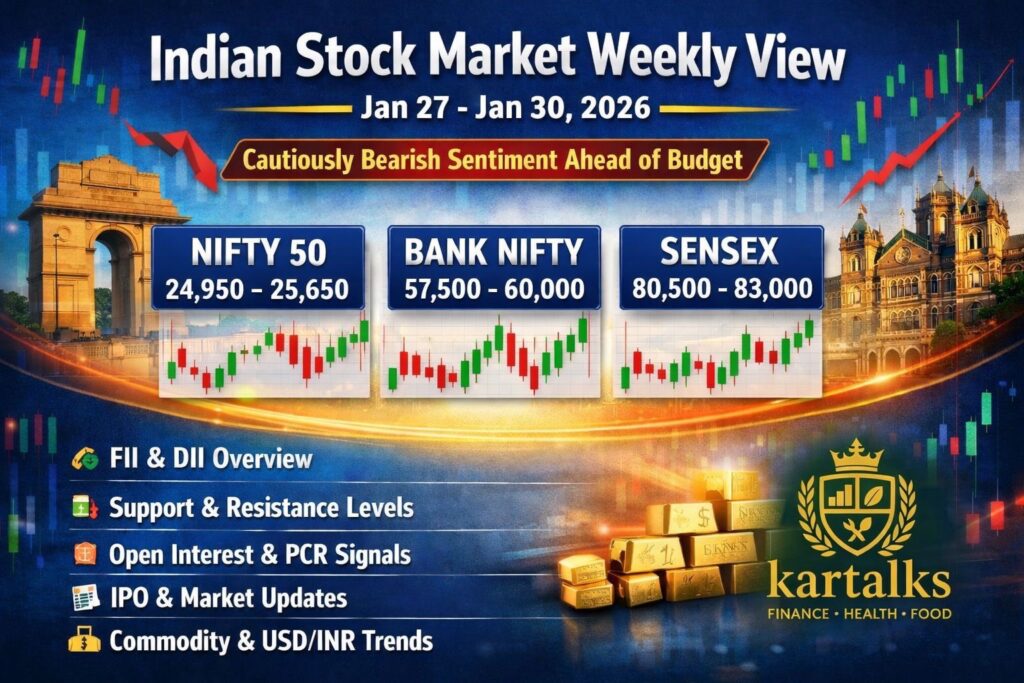
Indian stock market weekly view (Jan 27 – Jan 30, 2026) —Nifty 50,Bank Nifty,Sensex weekly levels and outlook.
📌 Market Snapshot: Where we are starting this week
Indian Stock Market Weekly View: Indian Markets Last week ended with a clear “risk-off” tone.
Nifty 50: 25,048.65 (weekly fall ~-2.51%), with a wide weekly swing between 25,653 and 24,919.
Bank Nifty: around 58,473 (weakness continued in financials).
Sensex: around 81,538 (sharp decline on Friday close).
India VIX: elevated around 13–14 range, signaling higher volatility expectations.
Weekly mood in one line: Volatility is up, foreign selling has been heavy, and traders may stay defensive until Budget clarity improves.
🧭 Indian Stock Market Weekly View (Jan 27–Jan 30): What may drive the market?
Key drivers this week
FII flow + risk appetite
January has seen meaningful FPI/FII equity outflows (reported ~₹33,598 crore outflow as of Jan 23).
When FIIs sell into weakness, rallies often become “sell-on-rise” unless strong domestic buying absorbs supply.
Pre-Budget positioning
With the Union Budget close, the market often sees:
quick sector rotations,
higher intraday swings,
sharp reactions to headlines.
Volatility regime
With VIX elevated, it’s safer to expect bigger candles (both up and down), and avoid oversized positions.
Base case (practical view): Expect a choppy, headline-driven week with a slightly negative bias unless Nifty reclaims key resistances convincingly.
🎯 Current Key Levels: Nifty 50, Bank Nifty, Sensex
📍 Nifty 50 key levels
Immediate Support Zone: 24,950 – 24,900 (last week’s swing low area).
Major Support: 24,700 – 24,600 (if volatility spikes)
Immediate Resistance: 25,250 – 25,350
Major Resistance: 25,650 (last week’s high zone).👉EconomicTimes
🏦 Bank Nifty key levels
Immediate Support: 58,300 – 58,000
Major Support: 57,500
Immediate Resistance: 59,200 – 59,500
Major Resistance: 60,000+
🏛️ Sensex key levels
Immediate Support: 81,300 – 81,000
Major Support: 80,500
Immediate Resistance: 82,300 – 82,600
Major Resistance: 83,000+
🏦 FII & DII Overview — Who Supported the Market?
Foreign selling stayed heavy while domestic institutions absorbed supply.
Last week (recent sessions’ clear pattern)
Jan 21: FII net -₹1,787.66 cr, DII net +₹4,520.47 cr
Jan 22: FII net -₹2,549.80 cr, DII net +₹4,222.98 cr
Jan 23: FII net -₹4,113.38 cr, DII net +₹4,102.56 cr
What it means for this week:
As long as this “FII sell / DII buy” continues, the market can avoid a free-fall, but upside rallies may face supply near resistances.
🧾 Derivatives (OI + PCR) — What Options Are Hinting
📊 Put-Call Ratio (PCR) snapshot (market sentiment gauge)
Nifty PCR: 0.5874
Bank Nifty PCR: 0.5912
A PCR below 1 generally suggests call-side dominance / cautious sentiment. It does not “predict” direction alone, but combined with VIX and price structure, it supports the view that traders are still defensive.
🎯 Max Pain (Options magnet zone)
Nifty Max Pain: around 25,048.65
Weekly interpretation: If the index stays near max pain, expect more range + mean reversion moves unless a strong trigger breaks the equilibrium.
🏛️ SEBI Updates: new rules and market impact
1) Closing Auction Session (CAS) & Pre-open modifications
SEBI issued a circular introducing a Closing Auction Session (CAS) in equity cash segment and modifications in the pre-open auction session. This can impact how closing prices are discovered and may influence volatility around the close.
2) “Significant Indices” framework proposal
SEBI proposed a governance framework for “Significant Indices” (based on AUM thresholds), aimed at tighter oversight of index providers. Over time, this supports transparency and trust in benchmarks used by passive funds/derivatives.
Investor takeaway: These changes are largely structural positives, but in the near term they can create process-driven volatility around auction windows and closing prints.
🧾 IPO Updates: what’s in the primary market this week?
Reports indicate no major mainboard IPO opening next week, while SME IPO activity remains active, with new issues and listings scheduled.
Simple approach for retail investors
In volatile weeks, consider applying only if:
valuation looks reasonable,
grey-market hype isn’t the only reason,
you can hold through listing volatility.
🛢️ Commodities Check — Macro Cues Traders Watch
Crude Oil
Brent around mid-$66.20/bbl area recently.
WTI around low-$61.28/bbl area.
Gold (India reference)
24K gold: ₹155,963 per 10g (Jan 23)
Silver (India reference)
- Silver ~ ₹3,34,600/kg has turned extremely volatile, with MCX silver discussed near record levels.
💱 Currency Update: USD/INR
RBI reference rate shows USD/INR around 91.94 on Jan 23, 2026 (very elevated).
Market meaning
A weaker rupee can pressure importers and raise inflation expectations.
Exporters may benefit, but overall it can add volatility to equity sentiment.
🔮 Weekly Range Forecast (practical trading range view)
Given last week’s wide range and higher VIX, a reasonable “working range” traders may watch:
Nifty 50: 24,700 – 25,650 (broad), with a tighter near-term focus on 24,900 – 25,350.
Bank Nifty: 57,500 – 60,000
Sensex: 80,500 – 83,000
(These are scenario ranges to plan risk, not guaranteed outcomes.)
✅ Two stocks and sectors that showed better relative performance last week
Even in a weak tape, some pockets showed relative strength:
📌 Stocks (relative strength cues)
Dr Reddy’s Laboratories featured among gainers on the weak close day (defensive pharma bid).
ONGC also showed resilience among gainers (energy support + crude sensitivity).
📌 Sectors (relative strength cues)
Metals saw outperformance on a key session, supported by commodity strength.
Defensives (FMCG/Healthcare) were described as showing comparatively steadier bids versus broader weakness.
🧠 How to position: short-term vs long-term (risk-managed)
Short-term (1–4 weeks)
Prefer lighter position size (because VIX is high).
Trade only with clear levels:
buy near support with strict stop,
book partial profits into resistance.
Avoid “revenge trading” if the market whipsaws around Budget headlines.
Long-term (6–24 months)
Use volatility as a staggered accumulation opportunity:
SIP/step-up SIP in diversified funds,
add quality leaders on deep dips,
avoid leveraged bets.
Keep some cash for post-Budget clarity if you are unsure.
A simple long-term checklist
strong balance sheet,
consistent cashflows,
reasonable valuation,
sector tailwinds,
management credibility.
👉Further reading
Indian Markets Post Market Report-Jan 23,2026
India’s New Labor Codes: Why Companies Are Taking “Thousand-Crore”
SIP vs Lump Sum: Which Is Better for Mutual Fund Investors?
How Much Should You Invest Every Month? A Simple Guide for Salaried People
Q3 FY26 Results Update: TCS, Infosys, HCLTech
Pre-Budget Market Outlook (Union Budget 2026-27) — What the Market Is Pricing In
FIIs Are Selling, Markets Aren’t Falling — Who Controls Indian Stocks in 2025?
🧾Disclaimer:
This report is for educational and informational purposes only and does not constitute investment advice, a recommendation, or an offer to buy/sell any securities. Markets are subject to risk, and past performance is not indicative of future results. Please consult a SEBI-registered financial advisor before making investment decisions.