
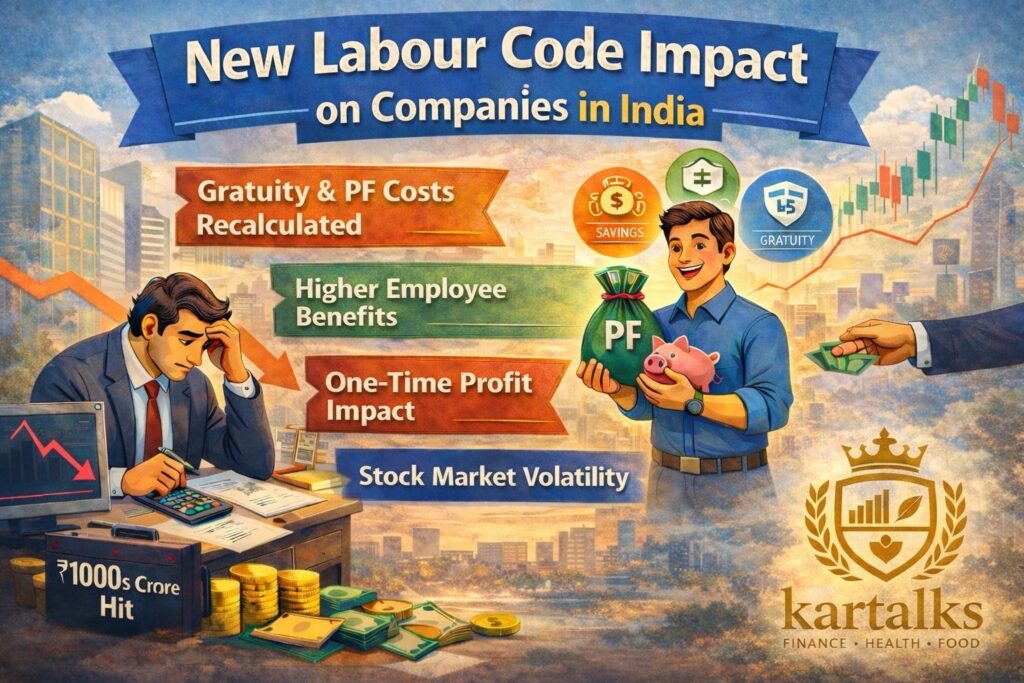
India’s New Labour Codes: Why Companies Are Taking “Thousand-Crore
” Hits — and What It Means for Employees & Stocks (2026)
New Labour Code impact on companies: Over the last few quarters, many large Indian companies—especially in IT services—have been reporting one-time / exceptional charges linked to the new labour codes. Headlines talk about a “dent of thousands of crores” because some firms have had to recalculate employee benefit liabilities (like gratuity and leave encashment) using the new definition of “wages,” and then recognise the impact in their financial statements.
This article explains what changed, why the accounting hit is so large, how employees benefit, and how stock markets typically react.
1) What are the “new labour codes” and what changed?
India has consolidated a large number of older labour laws into four Labour Codes:
Code on Wages
Code on Social Security
Industrial Relations Code
Occupational Safety, Health and Working Conditions (OSHW) Code
The big trigger behind the “profit dent” is the standardised definition of “wages” under the new framework. When the wage definition changes, it changes how multiple benefits are computed—especially:
Provident Fund (PF)
Gratuity
Leave encashment
Bonus / overtime-related calculations
The “50% rule” (in simple words)
A key idea being discussed widely is that wages (often linked to basic + DA, depending on structure) must be at least 50% of total remuneration—meaning allowance-heavy salary structures may need reshaping, which increases benefit calculations tied to wages.
2) Why did this create a “one-time” dent of thousands of crores?
A) Companies had to remeasure long-term liabilities (not just next month’s salary)
Benefits like gratuity and leave encashment are long-term employee benefits. When the wage definition changes, companies must:
Recompute benefit obligations using updated wage components, and
Recognise the difference as an immediate impact (often shown as an “exceptional item”) in the quarter when the rules become applicable or when the provision is concluded.
This is why the number looks huge: it’s not “this quarter’s” benefit cost alone—it’s a catch-up / remeasurement for the accumulated employee base.
B) IT firms are labour-heavy, so small rule changes scale into massive numbers
In IT and engineering services, employee count is large and tenure is meaningful. Even a change in the wage base for gratuity/leave can move the liability by hundreds or thousands of crores.
Examples reported in the current results season:
TCS disclosed a labour-code-related expense of ₹2,128 crore (widely reported as largely gratuity + leave-related).
Infosys reportedly took a one-time charge (around ₹1,289 crore) linked to labour code provisions.
HCLTech reported a labour-code-related charge of ₹956 crore.
Tata Elxsi posted a large drop in profit largely due to a one-time labour code charge (~₹956.9 million).👉Reuters
Put together, just a few large players can add up to ~₹4,000–₹4,400 crore+ of exceptional impact in a single quarter, which is why the “thousand crores” narrative caught fire.
C) “One-time” in accounting does not always mean “one-time” in business
Some analysts have cautioned that while the big catch-up provision may look one-off, the ongoing cost base (PF/gratuity accruals) could be structurally higher going forward, depending on how salary structures are redesigned and how consistently rules are implemented across states.
3) New Labour Code Impact On Companies – Is the labour code implemented already, or still coming?
This is where confusion happens in the market because implementation has been discussed in phases (central rules, state rules, rollout alignment with financial year, etc.).
Recent reporting indicates the government has been eyeing April 1 rollout alignment with the financial year, while other coverage notes an earlier effective date/notification and then rules being finalised over subsequent months. In practice, companies are provisioning based on how the rules are expected to apply and based on professional/legal interpretations.
Investor takeaway: even before every operational detail is settled everywhere, companies may still recognise provisions if the obligation is considered present and measurable.
4) How does this help employees?
From an employee standpoint, the logic of the reforms is to move toward:
Clearer wage definitions
Higher long-term social security and retirement-linked benefits
Improved coverage (including gig/platform/unorganised workers under social security nets)
Key employee benefits (practical impact)
Higher PF contributions (and higher retirement corpus):
If “wages” used for PF becomes a larger share of CTC, PF contributions can rise.Higher gratuity payout potential:
Gratuity is wage-linked. A higher wage base generally increases long-service benefit amounts.Better formalisation & coverage:
The broader push includes social security expansion and clearer compliance frameworks (including for certain non-traditional worker categories).
But will take-home salary reduce?
In some salary structures, take-home pay can temporarily feel lower because a higher share goes into PF/benefits. However, that reduction is often a trade-off for greater long-term savings/benefits rather than a “loss” in total compensation.
5) What is the impact on company profits and margins?
Immediate impact (P&L optics)
Profit takes a hit because the expense is recognised immediately.
Many companies report it as exceptional / one-time so that analysts can compare “core operating performance” separately.
Cash impact (often slower than P&L impact)
These provisions are frequently non-cash at the time of booking—the accounting expense reflects future obligations. Cash outflow happens over time as employees become eligible, leave, retire, or encash benefits. (The exact cash timing varies by benefit.)
Ongoing impact (structural)
If wage structures shift materially, companies could face:
Higher recurring benefit accruals (PF/gratuity/leave)
Increased compliance and administration effort
A stronger push toward efficiency (automation, utilisation discipline, pyramid optimisation) in labour-heavy sectors
6) Stock market impact: does it really move prices?
A) Short-term: earnings surprise drives volatility
When a large provision shows up unexpectedly, it can cause:
Stock dips in the immediate reaction (because reported profits fall)
Sector-wide sentiment pressure if multiple companies report similar charges
But markets also try to judge whether it is:
a genuine deterioration in business demand, or
an accounting remeasurement that doesn’t change long-term competitiveness.
B) Often, markets “look through” exceptional items
A useful example: Reuters noted Tata Elxsi’s profit fell sharply due to the labour-code charge, yet the stock had moved up before the results (reflecting how markets sometimes separate one-time items from operating trends).
C) Medium-term: what matters is margin trajectory + guidance
Investors will focus on:
Whether companies absorb the cost or pass it through pricing
How margins settle after wage structure changes
Management commentary on “normalised” profitability and competitiveness
7) Who is most affected (sector-wise)?
IT Services & ER&D – huge employee bases, large gratuity/leave books.
BFSI back-office / large service operations – many employees with long tenure. 👉KPMG
Manufacturing with large organised workforce – depending on wage structures and benefit policies.
Platform / gig ecosystem – potentially meaningful long-term benefits expansion (rules and implementation will be key).
8) What should employees and investors watch next?
For employees
New salary structure (basic vs allowances)
PF contribution change
Gratuity policy clarifications
Leave encashment rules and eligibility updates
For investors
One-time provisioning: whether more “catch-up” charges are pending
“Normalised” margins after the reset
Company commentary on wage redesign timelines
Clarity on central + state rules and implementation schedule
Conclusion
The “thousand-crore dent” isn’t a sudden collapse in business demand. In most cases, it is a financial statement reset driven by the new wage definition impacting gratuity and leave liabilities, especially for labour-heavy companies. The near-term impact is painful for profits, but the long-term intent is to improve employee social security, formalisation, and fairness in wage-linked benefits—with the market gradually shifting focus from the one-time hit to the new steady-state margin picture.
FAQs:
Q1. Why did companies take huge losses due to the new labour code?
Companies recorded one-time accounting charges after recalculating gratuity and leave liabilities under the new wage definition introduced by the labour code.
Q2. Is the labour code impact a permanent loss for companies?
Most of the impact is a one-time accounting adjustment, though ongoing employee benefit costs may increase slightly in future years.
Q3. How does the new labour code benefit employees?
The labour code improves retirement benefits, gratuity payouts, PF contributions, and strengthens long-term social security for employees.
Q4. Did the new labour code affect the stock market?
Yes, the stock market saw short-term volatility as companies reported lower profits, but investors largely treated it as a non-recurring expense.
Q5. Which sectors are most affected by the labour code?
Labour-intensive sectors like IT services, engineering, and large manufacturing firms are most impacted due to higher employee benefit liabilities.
Further reading
How Much Should You Invest Every Month? A Simple Guide for Salaried People
SIP vs Lump Sum: Which Is Better for Mutual Fund Investors?
Q3 FY26 Results Update: TCS, Infosys, HCLTech
Stock Market 101 – Lesson 13 ETFs & Index Funds: Fees, Tracking, and How to Choose
Disclaimer:
This article is for educational and informational purposes only and does not constitute investment advice or a recommendation to buy/sell any security. Please consult a qualified financial advisor before making investment decisions.