
Investment: Why It Matters, How It Works, and What Normal People Should Really Do
HOOK
Why Investment Matters: Detailed explanation in this article, most of us work hard, save what we can, and hope things will somehow work out in the future. For a while, that feels enough. But slowly, doubts begin to appear. Expenses rise, responsibilities grow, and savings don’t seem to move the same way life does. That’s when a quiet question shows up — am I doing the right thing with my money? Investment often feels confusing or risky, so many people delay it. This article is meant for those moments of doubt, when you’re not looking for shortcuts, just clarity.
Let’s be honest for a moment.
Most of us don’t grow up learning about investment. We grow up learning how to earn money, not how to grow it. School teaches math, history, science — but never teaches what to do with your first salary.
So what do people do?
They save.
They keep money in the bank.
They feel safe.
And for some time, that feels okay.
Until one day you realise — life is moving faster than your money.
That’s where investment quietly becomes important.
First, what is investment? Not the textbook version.
Investment is simply this:
You take money you don’t need immediately and place it somewhere so that future you gets more value from it.
That’s it.
No fancy definition.
No complicated words.
You are delaying comfort today so that life becomes easier later.
Why investment is actually important (in real life)
Because money loses value quietly
Why Investment Matters in real life, this is something people don’t notice until it’s too late. Ten years ago, certain things were cheap.
Today, they are expensive.
Ten years later, they’ll be even more expensive.
That’s inflation.
It doesn’t announce itself.
It just slowly eats purchasing power.
If your money stays still, you’re not safe — you’re falling behind.
Because income alone cannot handle future pressure
Right now, salary may feel sufficient.
But think about:
children’s education
medical costs
home ownership
retirement
These are not monthly problems.
They are big-ticket problems.
Investment prepares you for these silently, month by month.
Because emergencies don’t ask permission
No one plans to fall sick.
No one plans job loss.
But when it happens, investments become support — not panic.
Why Investment Matters -Types of investments (explained like we talk normally)
There is no single best investment. Anyone telling you otherwise is selling something.
Different investments exist because people are different.
Low-risk investments – for peace of mind people
Some people value peace more than profit. That’s okay.
They don’t want surprises.
They prefer:
fixed deposits
government-backed schemes
debt instruments
Returns are not exciting.
But capital safety is high.
These are suitable when:
you cannot afford loss
you need money soon
you are retired or close to it
Equity investments – uncomfortable but rewarding
Equity is where people make mistakes emotionally.
Markets go up.
Markets go down.
People panic when prices fall — even though nothing has changed fundamentally.
Equity rewards:
patience
discipline
long thinking
It punishes:
fear
greed
impatience
Over long periods, equity has beaten almost every other asset.
But only for those who stay invested.
Mutual funds – for people who don’t want daily stress
Mutual funds are practical.
You don’t need to track markets daily.
You don’t need to understand balance sheets.
You invest regularly, and professionals handle the rest.
This works well for:
working professionals
beginners
people who value simplicity
Real estate – slow, heavy, but solid
Property is not flexible.
You need:
money
patience
legal clarity
Returns are slow, but tangible.
Some people feel secure seeing something physical. That’s a psychological advantage.
Gold – emotional, cultural, defensive
Gold is not about fast growth.
It’s about:
stability
protection
diversification
Gold shines during uncertainty, not during economic booms.
Which investment gives “good returns”?
This question itself causes trouble.
Good returns depend on:
time
discipline
emotional control
Equity has historically given the best returns — but not in straight lines.
Short-term thinking destroys long-term results.
Who should choose what?
This is where honesty matters.
Young people
You have time.
Time is power.
Mistakes heal. Markets recover.
You can take risk.
Middle-aged people
Responsibilities increase.
Balance becomes important.
You can’t gamble, but you can’t stay ultra-safe either.
Older people
Protection matters more than growth.
Regular income beats excitement.
Risk – let’s talk honestly
Risk is not loss.
Risk is temporary discomfort.
Loss happens when people panic and exit.
Even not investing has risk — inflation risk.
So risk is unavoidable.
The goal is manageable risk.
How long does it take to see real results?
This is where expectations break.
Investment is slow.
Boring.
Quiet.
Real compounding shows up after:
7 years
10 years
15 years
Before that, it feels ordinary.
After that, it feels magical.
How to actually choose investments (not theory)
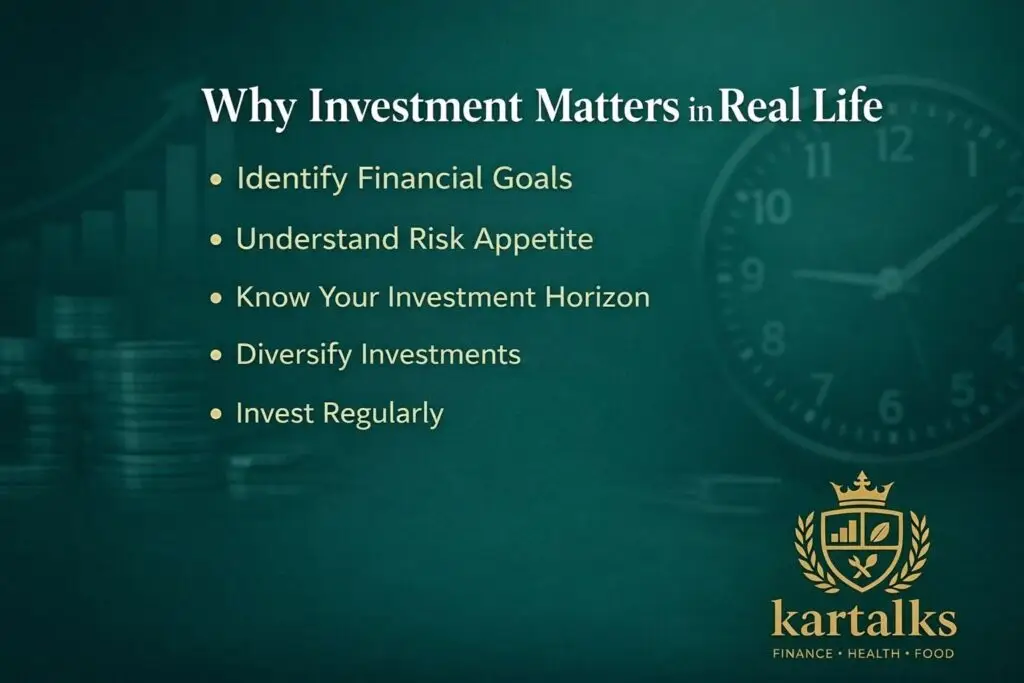
Ask yourself why you’re investing
Decide when you’ll need the money
Accept that markets fluctuate
Spread money across assets
Don’t chase tips
Stay consistent
Simple — but not easy.
Mistakes people repeat again and again
Investing because someone else did
Expecting fast profits
Panicking during market falls
Not reviewing at all
Overconfidence after small success
Markets don’t punish ignorance.
They punish arrogance.
Final words (no motivation talk)
Investment is not about becoming rich.
It is about not becoming helpless later.
You don’t need perfect knowledge.
You need a calm approach.
Start small.
Stay patient.
Let time do the heavy lifting.
That’s it.
👉Further reading
Stock Market 101 – Chart Patterns Explained
Why FIIs &FPIs Are Selling Indian Stocks
Stock Market 101: Learn Stocks from Zero
SEBI – Investor Education SEBI
Disclaimer
This article talks about investment in a calm, practical way. It explains why investment matters, what options exist, how much risk is involved, and how long it usually takes to see results. No complicated terms. No promises. Just a clear explanation for normal people.